
Features
India’s likely name change; death-dealing Ministries


 Interesting reading on the Internet about the likely name change of India to Bharat. Curious how before any change was officially made, PM Modi sat at the head of the discussion table of G20 delegates behind the country name-board ‘Bharat’. Curiouser it was that the government decided to send out invitations to G20 delegates for Saturday September 9 dinner as from the President of Bharat
Will the name change happen? Officially, the Indian government has taken no decision and issued no statement. One senior leader dismissed the speculation of a name change as ‘just rumours’. But Foreign Minister Subrahmanyam Jaishankar seemed to advocate the increased use of Bharat, particularly at the G20 Summit. Officials of Modi’s right-wing Bharatiya Janata Party (BJP) favour the name change. Their argument is that the name India was introduced by British colonials and is a symbol of slavery for about 200 years until the country gained independence from the British Raj in 1947.
The subcontinent of more than 1.4 million people is officially known by the names India and Bharat, and Hindustan is another name often used in literature. Bharat is an ancient Sanskrit name that was found in early Hindu texts, and is commonly used as India’s name when Hindi is spoken.
Priyanka Shankar (freelance journalist based in Brussels) published Rahul Gandhi’s opinion on the name change. He was on a five-day visit to Europe and had told Al Jazeera in Belgium that Modi’s plan to change the country’s name was absurd. He added it was a diversionary tactic. “It’s interesting that every time we raise the issue of Mr (Gautum) Advani and chronic capitalism, the Prime Minster comes out with some dramatic new diversion tactic.” The Congress party leader has accused Modi of favouring big industrialists and sought an investigation against billionaire Advani, who controls the Adani Group, for alleged financial violations.”
Recent name changes in our country
In 1972, when Ceylon under Premier Sirimavo Bandaranaike assumed republican status and ceased to acknowledge Queen Elizabeth II as Head of State, the hitherto used name Ceylon was substituted by the patriotic name of Sri Lanka. Ceylon was the anglicised name given us by the British.
In 1992, then President Ranasinghe Premadasa changed the country name to Shri Lanka with no consideration of fallouts of a sudden name change. Admittedly, it was a substitution of the first syllable of the name with another, but carrying an entirely different sound in pronunciation. The reason for the change was an astrologer’s advice, perhaps his own astrologer; the Prez leaning more on astrology as his fears and insecurity increased. Sri was supposed to be unlucky and with the sound change the country’s fortunes would improve.
That last is what Cass read; however, she believes the change was wrought to make the President’s tenure securer and life safer. As a librarian, Cassandra shuddered considering repercussions in alphabetization of country names in a world list, to mention but one consequence. Mercifully, in 1993 our country name quietly reverted to Sri Lanka with Premadasa’s assassination.
When he was alive no cabinet minister or top bureaucrat dared even squeak a protest. Same always, even now. To save his skin no politician who had a say would go against the man in power, even if his limited intelligence or sensibility prompted it to be a bad move for the country and its people in general.
Interest led Cass to investigate the origins of the name Sri Lanka. Lanka was the name given to the island in the Hindu epic Ramayana with Ravana named ‘demon king of Lanka’. Sri means resplendent, which our island really is. Lanka also means island so with Sri added the nomenclature is complete: resplendent island.
Trouble trouble, boil ‘n bubble; finally kill
Yes, this is what’s happening in this island gone rotten; made rotten by its own people. All ministries are such but the worst are those of Health, Education and Transport.
The short-sighted Education Ministry does not kill in one fell stroke; rather does it asphyxiate and cause slow demise. Children wither away due to loss of hope, frustration and drugs peddled to them almost within school premises. English teaching was throttled by SWRD and other ‘National Leaders’ and next to nothing done to remedy this situation. Cass knows a teacher of English in a school not so remote who cannot string 5 simple English words in a proper sentence.
Protests of students in mainstream universities and academics throttled fee levying higher education which would have saved money of those Sri Lankans going overseas to universities and was certainly a way of earning forex from students from other countries coming over here.
And the railway has actually caused death for all to see and hear on September12. Hearing this awful news of a young student’s death due to a fall from an overcrowded train. Because of a strike by railway workers, this young man died. Of course, he should have been more cautious but sometimes one is called upon to risk one’s life to meet a deadline (no pun meant).
Minister Bandula Gunawaradena told the media he would request the President to declare the railway service as an essential service. Invariably wake up to crises after damage is done. Strikes were on-going inconveniencing hundreds of commuters anxious to get to work in time and more so to get home after a long day at office.
Whom to blame for all these recent deaths? The Cabinet Ministers of course. Then others in the Cabinet who close their eyes to all misdemeanours of colleagues. Top bureaucrats come next. And us the voting public who get idiotic scum of the earth to rule us.
Ours seems not to question why; not to make reply; not to reason why; but merely to do and die as we flounder in this valley of death – our land sunk to the depths by those who were in power, mostly through enriching themselves and encouraging their suckers to loot and steal.
We are in the pits: with mismanagement to the left of us; corruption to the right of us; thuggery behind us; subdued by nincompoops, submerged in corruption, dregs and drugs, while those in power volley and thunder and pontificate: all done for the good of the people, they affirm.
Post script: please read Dr Upatissa Pethiyagoda’s Health Sector in Crisis: causes and possible remedies in The Island of Wednesday September 13. He deals with more than the health sector and is spot on in his analysis. I feel compelled to quote but one paragraph. “Sadly, in our society, politics takes precedence over everything else. That it emits an overpowering stench on all that it touches is clear. It is a largely parasitic creature, whose roots have sunk into a totally subservient heart …”












Sri Lanka stands at a geopolitical crossroads where geography is both its greatest asset and its most vulnerable liability. Sitting astride the Indian Ocean’s critical east-west highway, the waters, south of Dondra Head, channel nearly 30% of the world’s maritime trade. This route is the arterial vein connecting Asia, Europe, and the Middle East. Yet, as tensions flare in the Middle East and great power competition intensifies, Sri Lanka finds itself guarding a highway it does not own, with an economy too fragile to absorb the shocks of collateral damage.
Recent analyses, including insights from the Financial Times on the fragility of global ocean governance, offer a stark warning: international treaties alone cannot guarantee security. The newly enacted UN Biodiversity Beyond National Jurisdiction (BBNJ) treaty may be a diplomatic triumph, but as major powers, like the US, sidestep commitments, while China seeks strategic influence, the high seas are becoming increasingly lawless. For Sri Lanka, relying on international law to protect its 600,000 km² Exclusive Economic Zone (EEZ), is a strategy destined to fail. The moment demands a shift from passive reliance to active resilience.
The Naval Imperative: Sovereignty requires strength
The first pillar of survival is a robust Navy. The FT report highlights that without enforcement mechanisms, marine protected areas become “paper parks.” Similarly, an EEZ without patrol capacity is merely a line on a map. With Sri Lanka’s Navy having just rescued 32 Iranian sailors from the sunken frigate IRIS Dena, following a US submarine strike in nearby international waters, and additional Iranian vessels now seeking assistance, or operating in the region, amid major powers vying for influence, the risk of direct incidents at sea remains very real.
Sri Lanka must accelerate investment in blue-water naval capacity and EEZ surveillance. Strengthening patrols, south of Dondra Head, is not just about conservation, it is about sovereignty. The ability to manage rescue operations, grant diplomatic clearances, and monitor traffic, without external coercion, is the definition of independence. “Might is right” remains the operating principle for some superpowers. Sri Lanka cannot afford to be a bystander in its own waters. A strong Navy acts as a deterrent, ensuring that the 30% of global shipping passing nearby does not become a theatre for proxy conflicts.
Statecraft: Balancing economics and sovereignty
The second pillar is nuanced statecraft. Sri Lanka imports nearly 100% of its fuel, making it hypersensitive to disruptions in the Strait of Hormuz. Prolonged conflict in the Middle East will spike oil prices, reigniting inflation and threatening the hard-won economic stability following recent crises. However, economic desperation must not drive diplomatic misalignment.
The smartest priority is strict neutrality. Sri Lanka cannot afford to alienate any major partner – the US, India, China, Iran, or the Gulf states. Coordinating quietly with India for maritime domain awareness is prudent given proximity, but joining any military bloc is perilous. Recent discussions highlight how the US aggressively prioritises resource extraction in international waters, often at the expense of broader environmental protections. Sri Lanka must navigate these competing agendas without becoming a pawn. Publicly urging de-escalation, through forums like the Indian Ocean Rim Association (IORA), allows Colombo to advocate for safe passage without picking sides.
Securing the economy and energy future
The third pillar is economic shielding. The immediate threat is fuel security. The government must build emergency fuel stocks and negotiate alternative suppliers to buffer against Hormuz disruptions. The Central Bank must be prepared to manage rupee pressure as import bills swell. Furthermore, monitoring secondary effects is crucial; higher shipping costs will hit exports like tea and garments, while tourism warnings could dampen arrival numbers.
Long-term resilience demands energy diversification, prioritising solar power. Sri Lanka’s abundant sunshine offers huge potential to cut reliance on Middle Eastern oil and shield the economy from geopolitical shocks. Accelerate rooftop/utility-scale solar with incentives: duty exemptions on equipment, enhanced net-metering, subsidies/loans for households and businesses, and fast-tracked approvals plus battery storage support. This attracts investment, creates jobs, and boosts energy security. Secure financier confidence for sustainable blue economy initiatives without compromising sovereignty.
The bottom line
The message for Sri Lanka is clear: This is a “pay attention or pay the price” moment. The country is geographically positioned on the critical Indian Ocean highway but remains economically fragile. The smartest priorities are to protect people first, secure the seas second, and shield the economy third, all while staying strictly neutral.
Any misstep, whether getting drawn into naval incidents or visibly picking sides in a great power struggle, would be far costlier than the fuel price hike itself. The global oceans treaty may offer a framework for cooperation, but as experts warn, we need “systems of co-operation that go beyond the mere words on the page.” For Sri Lanka, those systems must be built on national capacity, diplomatic agility, and an unwavering commitment to neutrality. The ocean is rising with tension; Sri Lanka must ensure it does not drown in the wake.
Reference:
“The geopolitics of the global oceans treaty”https://www.ft.com/content/563bef02-f4a7-42c3-9cfa-7c3fe51be1eb
By Professor Chanaka Jayawardhena
Professor of Marketing
University of Surrey
Chanaka.j@gmail.com

Asanga Abeyagoonasekera’s latest book is a comprehensive account of international relations in the regions it covers, with particular reference to current rivalries between India and China and the United States. It deals with shifting alliances, or rather alliances that grow stronger or weaker through particular developments: there are no actual breaks in a context in which the three contestants for power in the region are wooing or threatening smaller countries, moving seamlessly from one mode to the other though generally in diplomatic terms.
The area is now widely referred to as the Indo-Pacific. Though that term was coined over a hundred years ago by a German keen to challenge the Anglo-American hegemony that triumphed after the First World War, it gained currency more recently, following a speech by the hawkish Japanese Prime Minister Shinzo Abe, who was instrumental in developing the Quad Alliance between Japan, India, the United States and Australia.
This marked a radical change in Indian Foreign Policy, for India had prided itself previously on being Non-Aligned, while the West saw it as close to the Soviet Union and then to Russa. But as Abeyagoonasekera constantly reiterates, India’s approach is governed now by nervousness about China, which in the last couple of decades has made deep inroads into the Indian Ocean. Now many states around this Ocean, relatively far from China, are being closely connected, economically but also otherwise, with China.
Instrumental in this development is the Belt and Road Initiative, which China has used to develop infrastructure in the region, designed to facilitate its own trade, but also the trade of the countries that it has assisted. Abeyagoonasekera is clear throughout the book that the initiative has been of great assistance to the recipient countries, and contests vigorously the Western claim that it was designed as a debt trap to control those countries.
I fully endorse this view. To supplement his perspective with a couple of anecdotes, I recall a British friend in Cambodia telling me how the country had benefited from Chinese support, which developed infrastructure – whereas the West in those days concentrated on what it called capacity building, which meant supporting those who shared its views through endless seminars in expensive hotels, a practice with which we are familiar in this country too.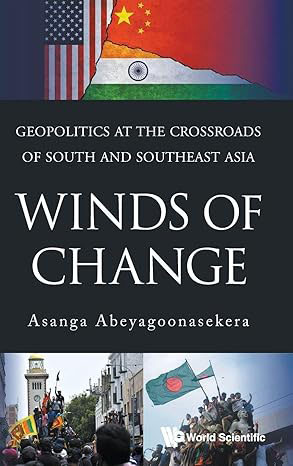
Soon afterwards I met a very articulate taxi driver in Ethiopia, who had come home from England, where he had worked for many years, who described the expansion of its road network. This had been neglected for years, until the Chinese turned up. I remembered then a Dutchman at a conference talking about the sinister nature of a plane full of Chinese businessmen, to which an African responded in irritation that the West had applauded the plunder of the continent by their own businessmen, and that the Africans now knew better and could ensure some benefit to themselves as the owners of the commodities the West had long thought their own birthright.
Abeyagoonasekera contrasts with the Chinese approach the frugality of the Indians, a frugality born of relative poverty, and appends the general suspicions with which Indian interventions are treated, given previous efforts at domination. And while he is himself markedly diplomatic in his accounts of the different approaches of the three players in this game, time and time again he notes the effortless ease with which the Chinese have begun to dominate the field.
His research has been thorough, and the statistics he cites about trade make clear that the Chinese are streets ahead of the other two, both in terms of balances as well as in absolute terms. And he notes too that, whereas the Western discourse is of Chinese restrictions on freedom, in Sri Lanka at any rate it is the others who are wary of transparency.
Though he notes that there is no clarity about the agreements the current government has entered into with the Indians, and that contrary to what might have been expected from former Marxists it has not resumed the tilt towards China of earlier left wing regimes, he shows that there has been no break with China. He seems to believe that the groundwork China laid still gives hope of more economic development than what the other two countries have to offer.
We cannot after all forget that the Rajapaksa government first asked India to develop the Hambantota port, and I still recall the Indian High Commissioner at the time, Ashok Kantha, wondering whether India had erred in not taking up the offer. In a marked example of how individuals affect bilateral relations, I have no doubt his predecessor, the effusive Alok Prasad, would have taken up the offer.
It was Rajapaksa hubris that made the cost of the port escalate, for when the rock inside the breakwaters was discovered, before the harbour was filled, and Mahinda Rajapaksa was told it would not cost much to get rid of it, he preferred to have the opening on his birthday as scheduled, which meant the waters then had to be drained away for the rock to be dynamited. And unfortunately, planning being left to the younger brother, we had grandiose buildings in the town, instead of the infrastructure that would have ensured greater economic activity.
This error was repeated in spades with regard to Mattala. Though not in the right place, which was not the case with the Hambantota development, nothing was done to take advantage of the location such as it was and institute swift connections with the hill country, the East Coast, and the wildlife so abundant in the area.
The last section of the book, after its thorough examination of the activities of the three major players in the region as a whole, deals with Sri Lanka’s Domestic Political Challenges, and records, politely but incisively, the endless blunders that have brought us lower and lower. But while highlighting the callousness of politicians, he also notes how efforts to appease the West weakened what he describes as core protections.
Though there has been much speculation about what exactly brought down Gotabaya Rajapaksa – not his government, for that in essence continued, with a different leader – perhaps the most far-reaching revelation in Abeyagoonasekera’s book is of Gotabaya’s conviction that it was the CIA that destroyed him. As so often when the hidden hand of the West is identified, the local contributions are ignored, as Gotabaya’s absurd energy policy, and the ridiculous tax concessions with which his rule began. But that does not mean there were no other players in the game.
Ironically, Gotabaya’s accusations against the United States occur after a startling passage in which Abeyagoonasekera declares of that country that ‘The fatigue gripping the nation is deeper than weariness; it is a spiritual exhaustion, a slow erosion of belief. Rising prices, policy paralysis, and a fractured foreign policy have left America adrift. Inflation haunts them like a spectre, while the immigrant crisis stirs frustrations in communities already stretched to their limits’.
This he claims explains the re-emergence of Donald Trump. Now, in the midst of the horrors Trump has perpetrated, this passage suggests that he is desperate to assert himself in denial of the fatigue that has overcome a nation initially built on idealism, now in the throes of ruthless cynicism. What will follow I do not know. But the manner in which India’s slavishness to the bullying of Netanyahu and Trump has destroyed the moral stature it once had suggests that Abeyagoonasekera’s nuanced but definite adulation of Chinese policy will be a hallmark of the new world order.
By Rajiva Wijesinha
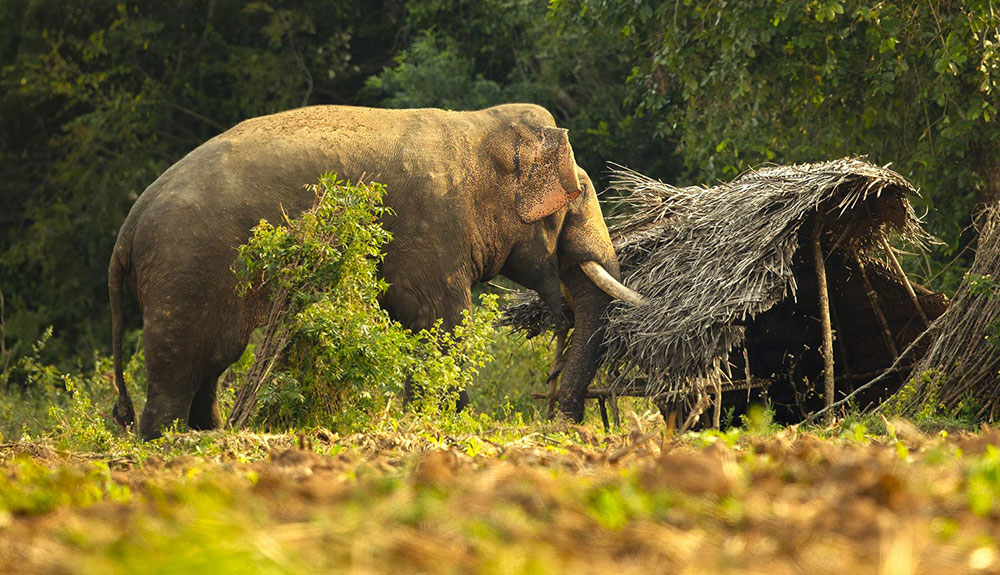
Human–elephant conflict (HEC) in Sri Lanka results in significant loss of human life, elephant deaths, and extensive damage to crops and property. Despite numerous interventions over the decades, the situation continues to deteriorate. The reasons for the breakdown of what was once a relatively tolerant coexistence—albeit one dominated by humans—into an increasingly confrontational relationship must be clearly understood by both the public and policymakers. Immediate measures are required to minimise losses, alongside long-term solutions grounded in sound ecological and governance principles. It must also be recognised that this is a complex problem; effective mitigation and sustainable solutions require a multidisciplinary approach integrated into the country’s overall development planning. This article examines several cost-effective methods that have been successfully implemented in other countries and may apply to the Sri Lankan context.
Key Challenge: Lack of Reliable Data
The primary reason for the escalation of human–elephant conflict (HEC) is the shrinking of wildlife habitats in the country due to poorly planned development and uncontrolled, unwise land encroachment. A major barrier to effective intervention is the lack of accurate and comprehensive data in two key areas: (a) land and land utilisation, and (b) the elephant population and their range.
It became evident after the Ditwah cyclone disaster that the lack of readily accessible, reliable data on land and its use, is a major obstacle to a wide range of project planning and implementation efforts. Regardless of how HEC is mitigated, the government must take immediate action to establish a digital land-use database, as this is a key component of long-term planning for any development initiative. Using modern aerial mapping technologies, it should be possible to catalogue the geography and utilisation of every square metre of the island’s landmass.
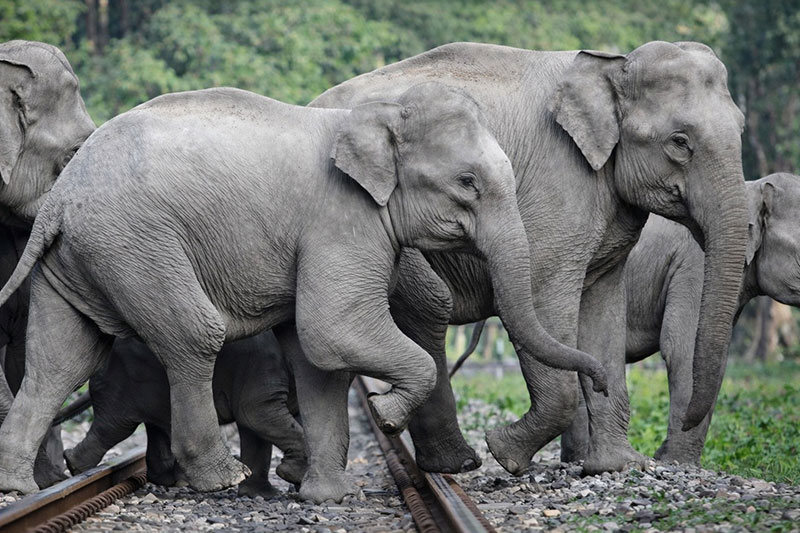
Crossing a railroad in the North Central Province (File photo)

Wild elephant near an electric fence (File photo

Chilli-grease fence
Similarly, accurate data on the number of elephants, their age and gender distribution, and the extent of their habitat range, are essential for data-driven decision-making. Here, too, modern technology offers practical solutions. Land-based digital cameras have been successfully used to count elephants, identify individual animals, and monitor their range. Research has shown that the pigmentation patterns of Asian elephants—particularly those on their ears—can serve as a “fingerprint” for identifying individuals. The same technique can also be used to study elephant movement patterns and habitat range. Computer programmes already exist for such cataloguing purposes; however, developing a similar programme, locally, could be both economical and educational, for example, as part of a university IT programme. Since data-driven decision-making is key to the success of any long-term strategy, data collection must begin immediately while short-term mitigation measures are implemented.
Root cause
There must be a general understanding of how this problem has worsened. Sri Lanka is considered an anomaly in island biogeography for supporting a high density of megafauna—including Asian elephants, leopards, and sloth bears—on a relatively small landmass of about 65,000 square kilometres. This is further complicated by the country’s high human population density, estimated at about 356–372 people per square kilometre, ranking among the highest in the world. The human population has increased more than fivefold between 1900 and 2024, from about 4.5 million to nearly 22 million.
The corresponding expansion of land use for human settlement, agriculture, and infrastructure development has placed enormous pressure on wildlife habitats. Habitat loss, together with imbalances in predator populations, has resulted not only in escalating human–elephant conflict (HEC) but also in increasing crop damage caused by peacocks, monkeys, giant squirrels, and feral pigs. The Sri Lankan elephant has no natural predators; its only significant threat arises from human activities. Restoring balance within this complex ecological system is no easy task, yet it must remain the long-term objective if the country is to safeguard its unique biodiversity.
Short-term Measures
Since the current situation has developed over an extended period, practical and humane solutions will also take time to implement. In the short term, several interventions can reduce direct interactions between humans and elephants while ensuring the safety of both:
* Strict prohibition of roadside feeding and improved waste management.
* Public education on safe deterrence methods and the promotion of ethical and sustainable practices in forests, national parks, and sanctuaries.
* The use of proven, non-lethal deterrent methods implemented in a coordinated and systematic manner.
* Anti-depredation squads (ADS): well-trained response teams tasked with implementing and monitoring these measures.
* The use of AI-based technologies to prevent train–elephant collisions.
Several countries have successfully used chilli as a deterrent to keep elephants away from farms and settlements. While cultivating chilli as a crop may contribute to this effort, it alone is not an effective deterrent; the pungent compounds in chilli, which act as an irritant to elephants, must be delivered effectively. One widely used and economical method is chilli-grease fencing, an alternative to electric fencing. In this method, rags soaked in a mixture of ground chilli and used motor oil are hung from ropes in strategic locations to create a deterrent barrier.
More advanced deterrence techniques have also been tested. For example, compressed-air launchers that fire chilli-filled projectiles have demonstrated effectiveness in safely redirecting elephants from a distance without causing harm. In some countries, locally made projectiles containing chilli powder, sand, and firecrackers enclosed in flexible sheaths, such as rubber balloons, are ignited and launched ahead of approaching animals. When combined with strobe lights, air horns, or other noise-making devices, these methods have been found to be even more effective. Over time, elephants may learn to associate irritation with light and sound, allowing these signals alone to act as deterrents. The main limitation of this approach is the need for well-trained personnel available throughout the day. Therefore, the involvement of existing national services—such as the armed forces—in developing and implementing such systems should be considered.
Technology can also play an important role in reducing train–elephant collisions. Night-vision cameras mounted on trains, combined with artificial intelligence, could be used not only to detect elephants but also to identify patterns in elephant movements near railway tracks. Once such high-risk locations are mapped, additional cameras could be installed along the tracks to transmit warning signals to approaching trains when elephants are detected nearby. As a further step, this system could be integrated with the Driver’s Safety Device (DSD)—the “dead man’s” handle or pedal—so that trains can be automatically stopped when elephants are detected on or near the tracks, thereby reducing reliance solely on driver response.
Sustainable Long-Term Solutions
A lasting resolution depends on strategic land-use planning and coexistence-based management. This must form part of a broader national discussion on the sustainable use of the country’s limited land resources.
* Protection and restoration of elephant migration corridors.
* Data-driven placement and maintenance of fencing, rather than attempting to confine elephants within fixed areas.
* Strengthened management of wildlife reserves, including the prevention of human encroachment and uncontrolled cattle grazing.
* Habitat improvement within forests to reduce the attraction of elephants to agricultural lands.
* Introduction of drought-resistant grass varieties such as Cenchrus purpureus (commonly known as elephant grass or Napier grass) and Pennisetum purpureum in wildlife refuges and national parks to alleviate food shortages during the dry season.
* Population control measures, including vaccine-based methods, supported by reliable population data.
Public education on the importance of maintaining ecological balance—especially amid environmental change and expanding economic development—must also be a key priority. Basic principles of environmental management should be incorporated into higher education across all disciplines. At the same time, difficult but necessary questions must be asked about the long-term sustainability and economic return of certain land-use patterns, particularly those shaped during the colonial period for plantation crops. Inefficient agricultural practices, such as chena cultivation, should be phased out, and the clearing of wilderness—especially in ecologically sensitive highland areas for tourism development—must be strictly regulated.
Elephants typically travel between 15 and 50 kilometres a day. Therefore, restoring uninterrupted elephant corridors, linking existing wildlife reserves, must be a central component of long-term planning. In some cases, this may require carefully considering the relocation of human settlements that have developed within former elephant corridors.
Unfortunately, rural communities often bear a disproportionate share of the burden created by these conservation measures. It is, therefore, essential that policies ensure they receive a fair share of the economic benefits generated by wildlife-based industries, particularly tourism. Such policies should aim to help these communities transition from subsistence livelihoods toward improved standards of living. In this context, a critical evaluation of existing agricultural systems must form part of a broader national land-management strategy. Put plainly, the long-term viability of plantation industries, such as tea and rubber, should be assessed in terms of their return on investment—particularly the investment of scarce land resources.
Finally, all ecosystems have a carrying capacity, meaning there is a limit to the number of people and animals that a given area of land can sustain. This issue extends beyond Sri Lanka; many scientists argue that, given current levels of malnutrition and resource depletion, the planet may already have exceeded its sustainable carrying capacity. Others suggest that technological advances and lifestyle changes may increase that capacity. In either case, significant changes in human consumption patterns and lifestyles are likely to become inevitable.
For elephants, however, the absence of natural predators means that humane human intervention may be required to manage population growth sustainably. If elephant populations were allowed to increase unchecked, food scarcity could lead to malnutrition and starvation among the animals themselves. At the same time, a nation, already struggling with child malnutrition, must carefully balance its limited resources between human welfare and wildlife conservation.
One promising approach is immunological sterilisation using the Porcine Zona Pellucida (PZP) vaccine, a reversible and humane form of immunocontraception used in wildlife population management. By stimulating antibodies that prevent sperm from fertilising eggs, this dart-delivered vaccine controls reproduction without significantly altering the animals’ natural behaviour. Once accurate data are obtained on the age and gender distribution of the Sri Lankan elephant population, the systematic application of such methods could become feasible.
Moreover, the development of local capacity to produce such vaccines should be encouraged. Similar technologies could also be applied to manage populations of other animals—such as monkeys and stray dogs—whose numbers can become problematic if left unchecked. Local vaccine production would not only address domestic needs but could potentially create opportunities for export and scientific collaboration.
Conclusion
Human–elephant conflict (HEC) in Sri Lanka is intensifying due to habitat fragmentation, unplanned development, and weak governance. Elephants require large, connected landscapes to survive, and when traditional migration corridors are blocked, conflict becomes inevitable.
Current ineffective practices—such as the mass translocation of elephants, fragmented fencing that obstructs migration routes, and policies that overlook the livelihoods of rural communities—must be reconsidered and replaced with more effective strategies. Mechanisms must also be established to ensure that the economic benefits of environmental protection, particularly those generated by wildlife tourism, are fairly shared with rural populations who bear the greatest burden of living alongside wildlife.
A shift toward data-driven planning, protection of ecological corridors, community partnerships, and stronger institutional accountability is essential. The human–elephant conflict is not solely a wildlife issue; it is fundamentally a land-use and governance challenge. Sri Lanka would benefit from establishing a dedicated Human–Elephant Coexistence Organisation, or from strengthening an existing Wildlife Commission with the authority and capacity to implement long-term, science-based management strategies.
With informed policies and genuine support for affected communities, peaceful coexistence between humans and elephants is both achievable and sustainable. Ultimately, educating future generations and equipping them to face emerging environmental challenges with knowledge and responsibility is the most effective long-term strategy.
BY Geewananda Gunawardana and Chula Goonasekera
on behalf of LEADS forum
Email admin@srilankaleads.com

Iran names Khamenei’s son as new supreme leader after father’s killing

Oil prices jump above $100 for first time in four years

Dry weather will prevail over the island

FSP warns of possible coal shortage

Repatriation of Iranian naval personnel Sri Lanka’s call: Washington

Indian Ocean must remain peace zone: Sajith

‘Dates have the highest sugar content to fight Coronavirus’

Sunday Island 27 December – Headlines

#SundayIsland 17th December – Headlines

Sunday Island – 28th March

Sunday Island Headlines – 21 March

Sunday Island – 21st February – Headlines
-

 News3 days ago
University of Wolverhampton confirms Ranil was officially invited
-

 News4 days ago
Legal experts decry move to demolish STC dining hall
-

 News3 days ago
Female lawyer given 12 years RI for preparing forged deeds for Borella land
-

 News2 days ago
Peradeniya Uni issues alert over leopards in its premises
-

 Business5 days ago
Cabinet nod for the removal of Cess tax imposed on imported good
-

 News3 days ago
Library crisis hits Pera university
-

 News2 days ago
Wife raises alarm over Sallay’s detention under PTA
-

 Business5 days ago
War in Middle East sends shockwaves through Sri Lanka’s export sector