
Business
How to pay more than Rs. 1,000 per day to tea estate workers


by Remy Jayasekere, Chartered Engineer
In the recent past there have been several articles written opposing the government decision to increase the wages of tea estate workers. On November 21, the Island newspaper published an article titled “Tea industry experts willing to learn the magic formula …” written by a spokesman for the Planters’ Association. Its theme was that under the present conditions it is not possible to increase wages.
There is a 1,000 acre tea plantation called Nerada in far north Queensland in Australia (neradatea.com.au). It produces 6.6 million kg of leaf and 1.6 million kg of made tea annually. Total labour force is less than 50 and the factory is manned by four people in a shift. The minimum hourly wage in Australia is about AUD 20 or around SLR 2,500 which works out to SLR 20,000 for an eight-hour day. Nerada pays above minimum wages so that they can retain talent.
Leaf plucking is done by one machine for the whole plantation – therefore there is only one tea plucker at any time and plucking is a 24-hour operation. The plantation is family-owned and they have developed all the technology themselves – no Tea Research Institutes or Tea Boards.
If Nerada can pay SLR 20,000 per person per day why can’t Sri Lanka pay SLR 1,000 per day? The answer is simple – at Nerada 50 people produce 1.6 million kg of made tea annually which works out to 32,000 kg per person annually. This is worth about AUD 150,000. Pay the worker AUD 50,000 per year and the company has AUD 100,000 per person per year for other things.
This has been achieved through innovation which has resulted in mechanisation and automation of processes. SL has not innovated, continuing to do things the way they have been done for ages. This could be the net result of many decisions taken in the past such as nationalisation of the plantations, regional plantation companies (RPC) not owning the plantations, therefore milking them rather than developing them and general backwardness of the country in developing and employing modern technology.
RPCs have managed the plantations for more than 25 years and if they are interested in developing the plantations, they had ample time to do so. However, they have chosen to remain in the dark ages without any innovative thinking and actions and now are arguing against wage increases. SLR 1,000 is around USD six per day which is not much higher than the extreme poverty level defined by the UN. The actions of the government, the plantation companies and the planters have made sure the workers remained in poverty during the past and now want to ensure that continues into the future.
In the 1980s Singapore had the problem of being turned into a large garment manufacturing centre which they did not want. The government increased the wages of garment factory workers – the message was innovate and produce more per worker or close down. History shows they all closed down and engaged in other pursuits. The Sri Lankan government should be congratulated for taking this bold step of increasing wages – the message is clear, innovate or we will change the agreements. How can you let the RPCs hold a large proportion of the population as well as the economy of the country hostage.
What is stopping us from using a company such as Nerada as the benchmark and trying to achieve what they have achieved. Let me list a few steps.
1. Green leaf – Nerada produces 6600 kg per acre per year. Considering it is one plantation, as a country can we aim for at least half of that. I am sure everyone knows what to do – the list is long. Definition of innovation – 5% is knowing what to do and 95% is doing it.
2. Plucking – This possibly is the highest cost item in the production of tea in Sri Lanka. Two excuses are given for not mechanising plucking – the terrain does not allow for mechanised plucking and mechanised plucking reduces the yield. New replanting areas should have the terrain modified to enable mechanised plucking. The myth of reduced yield does not stand against evidence from Nerada
3. Factory – There are more than 700 tea factories in Sri Lanka employing large numbers of people. Factories in some areas cannot find enough people to man them. Most of these people are used for transporting material from one process or machine to another and in some cases to watch and operate machines. At Nerada all these operations are automated and only four people are required in a shift. Why not scrap the existing factories and build new ones – the payback will be very quick. One of the big problems in the past was trying to modify existing factories which limits possibilities. Do not think outside the box. Think there is no box.
4. Then there are other minor things that go beyond what Nerada has done – using solar energy for the driers and using dehumidified air for withering. Nerada has no need for producing dehumidified air as the humidity in that area is very low.
5. The workers cannot do anything about these. The government, RPCs and management have to take the initiative to improve our plantations. There are no bad soldiers – only bad officers
I believe I have made a case for increasing wages of plantation workers and hope the RPCs will look at this in a positive manner.








National Development Bank PLC (hereinafter ‘the Bank’) announced its results for the financial year ended December 31, 2025 to the Colombo Stock Exchange recently. Full year results tabled by the Bank showcase a strong growth across all business lines with Net Banking Revenue increasing by a 45.2% on a comparable basis.
Like most other peers, the Bank’s 2024 financial performance was positively impacted following the successful conclusion of the ISB debt restructure with a one-off impact on interest income, fee income and net impairments amounting to LKR 1.4 billion, LKR 0.7 billion and LKR 9.4 billion, respectively for the said year.
Fund based income
Net interest income (NII), which accounts for close to 75.0% of Bank’s total operating income, grew by 6.5% on a normalised basis. Despite pressure on interest-earning assets arising from the lower interest rate environment, the Bank’s disciplined margin management helped stabilise Net Interest Margin (NIM) at 4.0% for the year. On a comparable basis, excluding one-off exceptional items, NIM stood at 4.2%, compared to 4.3% for both scenarios in 2024. By the end of the year, the Bank had close to LKR 29.3 billion in Loans and Deposits under a special arrangement with its customer(s) with a netting-off feature (end 2024: LKR 19.6 billion).
Non-fund based income
Net fee and commission income reached LKR 8.1 billion for the year – representing a growth of 14.3% from LKR 7.1 billion in 2024 excluding ISB restructuring related fees. Key growth drivers for the current year were trade finance, credit and lending, digital banking and credit and debit cards.
Credit and operating costs
Credit costs for the year amounted to LKR 5.7 billion, reflecting a substantial reduction of 57.1% compared to LKR 13.2 billion in 2024, a testament to the Bank’s strong credit underwriting practices and focused efforts on collections and recoveries. The Bank’s success on account of the latter is best reflected in notably improved stage 2 and 3 loan stock which stood at 7.9% and 10.8% respectively at end 2025 as compared with 16.6% and 14.0% at end 2024. Stage 3 provision coverage also saw further improvement to 59.1% from 54.5% during 2024 showcasing the Bank’s prudent management of credit risk.
Operating expenses closed at LKR 19.0 billion for the year, marking a 13.1% YoY increase. This increase was primarily driven by routine staff-related increments and necessary market realignments, along with higher investments in IT infrastructure and business development undertaken during the year.(NDB)

PMF Finance PLC has announced the appointment of Ms. Nishani Perera as a Non-Executive Independent Director, further strengthening the Company’s strategic oversight, governance framework, and board-level expertise as it continues to advance its transformation and long-term growth agenda.
Ms. Perera is a Fellow Member of the Institute of Chartered Accountants of Sri Lanka and brings over 19 years of experience across audit, assurance, advisory, risk management, and corporate governance. She currently serves as Partner – Audit & Assurance at Moore Aiyar and as Director of Moore Consulting (Pvt) Ltd.
Over the course of her career, Ms. Perera has gained substantial exposure to listed companies, banks, finance companies, and other regulated entities. Her areas of expertise include financial reporting under SLFRS/LKAS, audit and risk oversight, regulatory compliance, and the implementation of quality management standards. She has worked closely with Boards of Directors and Audit Committees on matters relating to financial reporting integrity, internal control frameworks, enterprise risk governance, and adherence to evolving regulatory requirements.
Ms. Perera holds a Master of Laws (LL.M.) from Cardiff Metropolitan University in the United Kingdom and a Bachelor of Science in Business Administration (Special) from the University of Sri Jayewardenepura. She is also an Associate Member of ACCA and CMA Sri Lanka, and a Fellow Member of AAT Sri Lanka.
Business
Capital Alliance deepens capital market presence with third Closed-End Fund Listing at the CSE
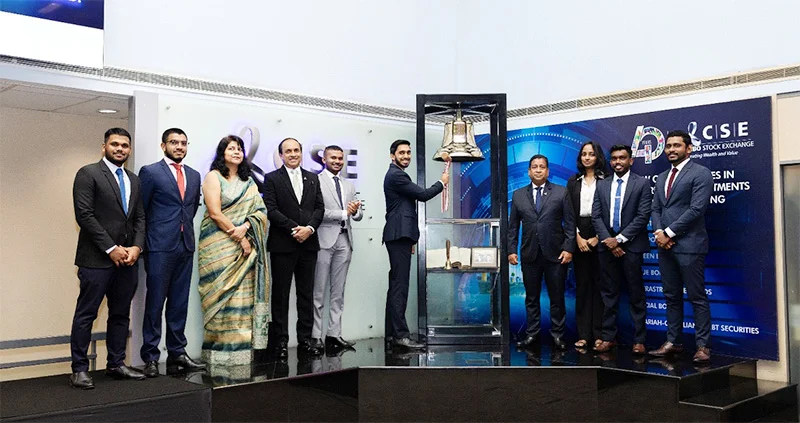
The units of the “CAL Three Year Closed End Fund” were officially listed on the Colombo Stock Exchange (CSE) recently. Accordingly, a total of 841,263,375 units of the ‘CAL Three Year Closed End Fund’ were listed by Capital Alliance Investments Ltd (CALI), a member of the Capital Alliance Ltd Group (CAL Group). The listing was commemorated by way of a special bell ringing ceremony on the CSE trading floor.
CSE CEO Rajeeva Bandaranaike speaking at the occasion remarked upon the rising demand for Unit Trusts: “When you look at funds, particularly unit trusts in today’s active capital market, we see a lot of domestic interest in the market with more investors entering. Funds, not only fixed income funds but also growth and balanced funds, can be the ideal vehicle through which new investors can enter the market. We see this interest reflected in the success of CAL’s Three Year Closed End Fund. More people are seeking to invest their money through professional fund managers.”

US and Iran hold talks seen as crucial to prevent conflict

Zimbabwe opt to bowl, include Maposa; Samson, Axar back for India

Markram, bowlers lead South Africa’s rout of West Indies

Samra, Airee headline Associates’ team of the tournament

Maharoof expects ‘some hard decisions’ after Sri Lanka’s T20 World Cup exit

Matthews’ century leads West Indies to six-wicket victory

‘Dates have the highest sugar content to fight Coronavirus’

Sunday Island 27 December – Headlines

#SundayIsland 17th December – Headlines

Sunday Island – 28th March

Sunday Island Headlines – 21 March

Sunday Island – 21st February – Headlines
-

 Features5 days ago
Why does the state threaten Its people with yet another anti-terror law?
-

 Features5 days ago
Reconciliation, Mood of the Nation and the NPP Government
-

 Features5 days ago
Victor Melder turns 90: Railwayman and bibliophile extraordinary
-

 Features4 days ago
LOVEABLE BUT LETHAL: When four-legged stars remind us of a silent killer
-

 Features5 days ago
Victor, the Friend of the Foreign Press
-

 Latest News6 days ago
New Zealand meet familiar opponents Pakistan at spin-friendly Premadasa
-

 Latest News6 days ago
ECB push back at Pakistan ‘shadow-ban’ reports ahead of Hundred auction
-

 Latest News6 days ago
Tariffs ruling is major blow to Trump’s second-term agenda