
News
Geneva controversy: Ambika hits back hard at Foreign Ministry


Human Rights Advocate Ambika Satkunanathan has alleged that the culture of impunity is well documented, not only by civil society organisations, human rights defenders and the UN, but most importantly the Supreme Court and the Human Rights Commission of Sri Lanka. Since 2020 several incidents of violence by state officials have been publicly recorded. Yet, to date, the number of persons held accountable is negligible.
The former member of the Human Rights Commission said so in a statement issued in response to a statement titled ‘Human Rights: FM challenges Neelan Tiruchelvam Trust over its representations to Geneva ‘ in Feb 5, 2022 edition of The Island. The following is the text of her statement issued in response to the Foreign Ministry statement that dealt with Satkunanathan’s representations before the European Parliament Sub-Committee on Human Rights:”The FM
statement contains numerous misrepresentations and insinuations, and appears to be aimed at silencing critique of government policies and actions.
In my statement to the Sub-Committee, I spoke of a number of issues, many of which I have previously written about with supporting evidence. This is available in the public domain. These are issues that other civil society organisations and activists have raised and documented over the years. In this context, the government labelling my statement “misleading”, appears to be an effort to downplay the issues raised and deceive the public.
It is disturbing the government has taken umbrage at my appeal to the European Union (EU) to advocate with the government to fulfil its international human rights obligations using GSP Plus trade privileges as a conduit. The GSP Plus privileges are dependent on the recipient fulfilling human rights obligations. The said human rights obligations are obligations the government has a duty to fulfill as a member of the United Nations and signatory to several UN conventions. These are obligations that provide protections to the citizens of Sri Lanka.
It is regrettable the government refuses to acknowledge that any adverse outcome of the GSP Plus review process would only be due to its failure to fulfill the GSP Plus scheme’s requirements. Hence, it is the government that has to take responsibility for any adverse outcomes. Instead, the government implies that those who advocate for the protection of the marginalised, such as Free Trade Zone workers, are responsible for a possible adverse outcome because they highlight the government’s failures. This is an attempt to deflect blame. To ensure there is no adverse impact on vulnerable communities, the government needs to acknowledge that the crisis is the result of its poor policy decisions, taken without bearing the best interests of citizens in mind.
Efforts to bring lasting peace to Sri Lanka are undermined by denials of the root causes of the armed conflict, i.e. discrimination. Instead, the MFA statement labels discussion of the root causes as LTTE propaganda. This is ominous given the decades long strategy of weaponising the PTA against Tamils. Implying such discussion is a danger to communal harmony, as the Ministry does in its statement, can be used to weaponise the International Covenant on Civil and Political Rights Act to stifle dissent. The government’s use of these phrases will create fear amongst civic activists, especially in the North and East, and shrink civic space further. The very space the government denies is shrinking.
In this regard, the insinuations made in the Ministry’s statement are dangerous. My attention has been drawn to articles peddling false information about my supposed links to the LTTE being circulated on social media in the wake of the statement. The statement therefore could cause persons with racist ideologies to harass and perpetrate violence, including cyber violence against me.
The culture of impunity is well documented, not only by civil society organisations, human rights defenders and the UN, but most importantly the Supreme Court and the Human Rights Commission of Sri Lanka. Since 2020 several incidents of violence by state officials have been publicly recorded. Yet, to date, the number of persons held accountable is negligible.
The “war on drugs” (erroneously referred to as war and drugs in the statement) is being used to justify arbitrary arrests and detention as well suspected extra-judicial killings by police in Sri Lanka. The Bar Association of Sri Lanka too has raised concerns about this. It is important to curb the supply of drugs and international drug trafficking. However, such policies need to adhere to human rights standards.
Although the MFA claims Sri Lanka is a secular country, several statements have been made by the President in which he mentions inter alia, that ‘’protection of Sinhala Buddhists is his foremost responsibility’’ and that “all others who would love to live in unity have to be assimilated into this main socio-cultural basis of this country, based on rich Buddhist values”. This is illustrative of the Sinhala Buddhist nationalism to which I referred in my statement. Another example is the Presidential Task Force on Archeological Heritage Management in the Eastern Province, which has the membership of Buddhist clergy and is headed by a Buddhist monk. The ‘One Country One Law’ Task Force is chaired by Gnanasara Thera, who has publicly made inflammatory and discriminatory statements and incited violence against Muslim community. Such an appointment begs the question whether the government is concerned about the preservation of social harmony.
The Ministry has conflated the process of militarisation, with the military occupation of land. The former includes the military undertaking tasks that were and should be within the purview of civilian entities. The phenomenon of militarization has been meticulously recorded by civil society, including myself, and is publicly available for reference.
Despite the Ministry’s claim the government views civil society as partners and not adversaries, regrettably, its statement singling out my statement to the EU, is the perfect example of the government’s intolerance of dissent. Furthermore, several civil society organisations and activists, particularly from the North and East, have been questioned by the Terrorism Investigation Division (TID) during the last year. That they are being subject to these “routine security checks” when there is no prima facie evidence of wrongdoing, casts doubt on the government’s assertion of partnership with civil society.
As a Sri Lankan citizen, it is my right and civic duty to question the actions of elected representatives of this country when such actions lead to the suffering and marginalisation of vulnerable communities, and demand accountability. Only a country that respects this right can be considered truly independent and democratic.
Finally, the Ministry has referred to my position as Chairperson of the Neelan Tiruchelvam Trust in the statement. However, I did not make the statement to the Sub Committee as Chairperson nor represent the Trust at the hearing. I delivered the statement in my capacity as a human rights advocate, and it in no way has any relationship to the Trust.”

Approval has been granted at the Cabinet meeting held on 22.07.2024 to publish the draft bill of State Assets Management Act in the government gazette notification and thereby present it to the Parliament for its concurrence.
However, the draft bill couldn’t be passed in Parliament as a result of the Parliament being dissolved in the month of October 2024.
Thereafter, the draft bill was subject to further inspection by a
committee appointed which comprised of officials and authorities on the subject.
The said Committee has recognized the amendments to be made and a fundamental draft has been prepared including the proposed amendments.
Accordingly, the Cabinet of Ministers approved the resolution furnished by the President in his capacity as the Minister of Finance, Planning and Economic Development to suspend further activities regarding the draft bill of State Assets Management Act published in the extraordinary gazette of 02.08.2024, and to direct the Legal Draftsman to prepare a draft bill based on the fundamental draft prepared by the subject specialists’ committee.
Considering the compliance of the Cooperative Societies’ operations with the concurrent socio – economic circumstances as well as the changes in the common law, the requirement of amending the Cooperative Employees Commission Act No. 12 of 1972 has been recognized.
A fundamental draft including proposed amendments based on the experience gained by that Commission as well as the opinions and proposals of Cooperative societies, their director board members, cooperative employees and other interested parties has been prepared.
Accordingly, the Cabinet of Ministers granted approval to the resolution furnished by the Minister of Trade, Commerce, Food Security and Cooperative development to provide instructions to the Legal draftsman to prepare a draft bill to amend the Cooperative Employees Commission Act No. 12 0f 1972, based on the said fundamental draft.
Latest News
Dilki Wathsala Marambage appointed as Director General of the Department of Technical Education and Training

The Cabinet of Ministers granted approval to the proposal forwarded by the Prime Minister in her capacity as the Minister of Education, Higher Education and Vocational Education to appoint Mrs. Dilki Wathsala Marambage to the post of Director General of the Department of Technical Education and Training.

Cabinet approves redrafting of State Assets Management Act
Cooperative Employees Commission Act No. 12 of 1972 to be amended
Dilki Wathsala Marambage appointed as Director General of the Department of Technical Education and Training
Declaration of Naakolagane Sanctuary under the Fauna and Flora Protection Ordinance
Cabinet approves transfer and maintenance of selected roads presently under PC’s and Local Authorities to the RDA
Obtaining financial facilities for the Water Supply and Sanitation Improvement Program (Sub-program 2) from the ADB

‘Dates have the highest sugar content to fight Coronavirus’

Sunday Island 27 December – Headlines

#SundayIsland 17th December – Headlines

Sunday Island – 28th March

Sunday Island Headlines – 21 March

Sunday Island – 21st February – Headlines
-

 Features6 days ago
The Sri Lankan who made Scottish history
-

 Sports6 days ago
Nissanka absence opens door for Sri Lanka’s young guns
-

 News5 days ago
NDB fraud Rs 60mn more than reported
-

 News7 days ago
Gnansara Thera to be assigned to prison printing section: Officials
-

 News5 days ago
Removing monk’s robes matter for Sangha to decide: Mahanayake Theras
-
 News7 days ago
OIC of FCID summoned before Maligakanda Magistrate
-

 Features6 days ago
Future of Sri Lanka’s state university system: Should it be shut down and reopened?
-
 News6 days ago
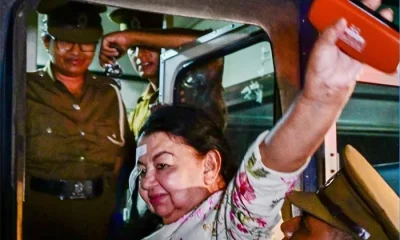
Shiranthi R remanded until 13 Oct.