
Opinion
Generation cost grossly underestimated and objectives not achievable

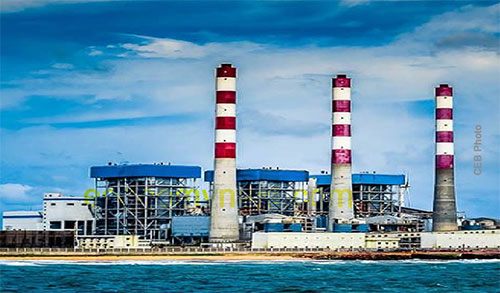
Proposed new coal power plant at Norochcholai:
The Chairman of the Ceylon Electricity Board (CEB), at a press briefing held at the CEB recently, has announced that a fourth unit of 300 MW would be added to the Norochcholai Coal Power Plant. This plant is estimated to cost around USD 300 million and it will produce 1.8 billion units (1,800 GWh) of electricity annually at a cost around Rs. 8.50 plus per unit of kWh (The Island of 31.07.2020).
Regrettably, the Chairman is giving a grossly underestimated value for the generation cost leaving out more important costs. The specific capital cost being USD/kW 1,000, one may assume that the plant is a subcritical type with low efficiency and high emissions. These types of plants are no longer installed in developed countries as they have efficiency below 35% meaning the plant consumes higher amount of coal than a high-efficient plant to generate the same amount of electricity.
A low efficient plant will also emit higher amount of pollutants such as oxides of nitrogen, oxides of sulphur and particulate matter as well as generate higher amount of ash than a higher efficient plant. These emissions cause serious damage to health of people as well as damage to vegetation and crops and also fisheries within the exposed area. The disposal of ash collected at the rate of about 100,000 tonnes annually from a 300 MW plant has not been properly addressed even with the existing plants. The addition of a fourth unit will aggravate the ash problem and its impact on the environment.
A study undertaken by the Sri Lanka Energy Managers’ Association recently, the monetized value of such damage referred to as external costs of thermal power plants have been worked out. The cost of externalities in respect of a coal power is found to be about LKR 10 per kWh, according to this study. Though the CEB may not be accountable for such damages, the government will have to meet the cost of healthcare for affected people as well as cost to the economy due to loss of agricultural and fisheries productivity. Hence, it is important to include cost of these externalities when assessing different types of generation plants. With this cost included, the cost of generation of a coal power plant will be around LKR/kWh 18.50, rather than the LKR/kWh 10 as quoted by the Chairman.
The Chairman’s statement also says that an environment impact assessment (EIA) study is underway. Actually, in Sri Lanka, an EIA study has no meaning and is carried out merely to get over a legal requirement. There is no system to monitor regularly the performance of the plant once it is commissioned after receiving approval for its EIA. For example, in a coal power plant special pollution control equipment are installed to reduce the emissions such as Sulphur dioxide and particulates to a level making it eligible for EIA approval. If the control equipment starts malfunctioning due to some reason or other, pollutants are emitted in large quantities that violate the relevant emission standards but the plant will continue to operate causing heavy pollution.
When the control equipment is new, they reduce the emissions as expected, but there is the possibility that they will start malfunctioning soon, especially when operating in coastal environment. This was evident in the existing coal plant and there is the possibility it will happen with the new plant as well. The EIA only says that with the control equipment installed, emissions will be reduced to permissible levels. Though such an assurance is given at the beginning, there is no assurance that the plant will perform as expected throughout its lifetime. Hence, what should be selected is a power plant that will intrinsically not generate pollution such as a gas power plant or one operating with renewables.
Another issue is how the capital cost is met. The cost of the plant is expected to be USD 300 million or LKR 60 billion. How will the CEB raise this amount of capital? Is it on a loan raised from a Chinese source or from a commercial bank or from a multilateral financial agency like ADB or World Bank, but it is unlikely these institutions will fund coal power projects? Hence, the choice is limited to a Chinese Institution or commercial bank/s. There were also media reports that CEB may enter into a joint venture with China with 50:50 share and the CEB may obtain a loan from a local bank to meet its obligation. In any case, financing the project will include additional costs.
According to a report released by the Public Utilities Commission of Sri Lanka, the cost of generation of existing coal power plant is LKR 18.60 based on Bulk Supply Tariff submission by the CEB for the period Oct-Dec 2017, including finance cost, and excluding cost of externalities and transmission. In November 2019, Cabinet approval was granted for the CEB to hire Chinese technicians for maintaining the existing coal power plants. It is very likely that the CEB will have to depend on Chinese technicians to manage the new plant as well, in which case its maintenance costs will escalate.
The Chairman, therefore without misleading the Cabinet and the people saying that coal power is the cheapest with the exception of hydro power, should divulge the entire costs incurred in operating the new coal power plant. These costs should include the amortized annual capital cost, fuel cost, operation and maintenance cost, externality costs as well as cost of financing.
Though the building of the fourth unit of 300 MW was approved at a Cabinet meeting held on 03.06.2020 with the objective of meeting the power deficit anticipated in 2021, it is obvious that this objective cannot be achieved by the proposed coal power plant simply because it will take a minimum of five years to complete.
The Chairman, being a professional, owes an explanation to the Cabinet as well as to the public why he recommended building a coal power plant knowing very well that the expected objective of meeting the 2021 deficit claimed in the Cabinet decision cannot be achieved with the proposed plant.
With the high costs associated with a coal power plant and its inability to meet the 2021 deficit as announced, the government should seriously consider building a plant operating with an alternative source such as gas or a renewable source which is cleaner, costing much less and taking shorter time to build than a coal power plant.
Dr. Janaka Ratnasiri
Nawala

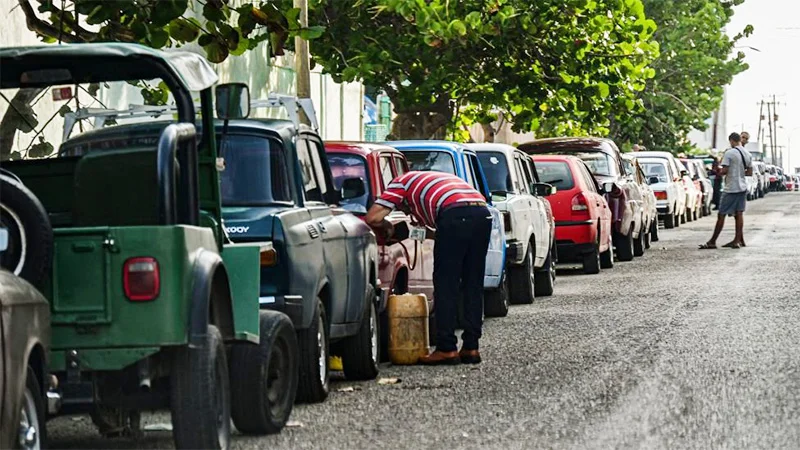
Cuba, a firm friend in need for Sri Lanka and the world, is undergoing an unprecedented crisis, not of natural causes, but one imposed by human design. It’s being starved of energy, which is almost as essential as water and air for human survival today. A complete and total embargo of oil in today’s world can only spell fatal, existential disaster, coming on top of the US economic blockade of decades.
The UN Secretary General’s spokesman has expressed the Secretary General’s concern at the “humanitarian situation in Cuba” and warned that it could “worsen, if not collapse, if its oil needs go unmet”.
Cubans are experiencing long hours without electricity, including in its hospitals and laboratories which provided much needed medicines and vaccines for the world when they were most needed. Cuba which relies heavily on tourism has had to warn airlines that they have run out of jet-fuel and will not be able to provide refueling.
Cuba is being denied oil, because it is being ridiculously designated as a “sponsor of terrorism” posing a threat to the United States, the richest, most powerful country with the most sophisticated military in the history of the world.
On the 29th of January 2026, the President of the United States issued an executive order declaring that the policies, practices and actions of the Cuban Government pose an “unusual and extraordinary threat… to the national security and foreign policy of the United States” and that there is “national emergency with respect to that threat”, and formally imposed what the Russian Foreign Ministry called an “energy blockade” on Cuba.
Responding within days to the US President’s executive order seeking to prevent the provision of oil to Cuba from any country, the Independent Experts of the United Nations Human Rights Council (UNHRC) strongly condemned the act stating that “the fuel blockade on Cuba is a serious violation of international law and a grave threat to a democratic and equitable international order,” and that it is “an extreme form of unilateral economic coercion with extraterritorial effects, through which the United States seeks to exert coercion on the sovereign state of Cuba and compel other sovereign third States to alter their lawful commercial relations, under threat of punitive trade measures”.
They warn that the resulting shortages “may amount to the collective punishment of civilians, raising serious concerns under international human rights law”. They advocate against the “normalization of unilateral economic coercion” which undermines the international legal order and the multilateral institutions.
https://www.ohchr.org/en/press-releases/2026/02/un-experts-condemn-us-executive-order-imposing-fuel-blockade-cuba
Global Concern – Will Colombo add its voice?
The Group of G77 and China which has 134 countries issued a special communique in New York stating that “these measures are contrary to the purposes and principles of the Charter of the United Nations and international law, and undermine multilateralism, international economic cooperation and the rules-based, non-discriminatory, open, fair and equitable multilateral trading system with the World Trade Organization at its core.”
The Non-Aligned Movement also issued a communique expressing its “deep concern” at the “new extreme measures aimed at further tightening the economic, commercial and financial embargo imposed against the Republic of Cuba, including actions intended to obstruct the supply of oil to the country and to sanction third States that maintain legitimate commercial relations with Cuba.”
Sri Lanka is a member of both these groups. These two statements also speak for the Sri Lankan state, as well as all other members of these groups.
However, there has been no statement so far from Colombo expressing concern. One hopes that there will be one soon. One also hopes that this administration’s rightward turn in economics doesn’t also extend to abandoning all sense of decency towards those friends who stood by Sri Lanka when it needed them. This would not bode well for us, when we need help from our friends again.
The Sri Lankan parliament has a Cuba-Sri Lanka Friendship Association. Its President is Minister Sunil Kumara Gamage who was elected to this position for the Tenth Parliament. I hope the parliamentary friendship extends to at least expressing concern and solidarity with the Cuban people and an appeal for the immediate end to this extreme measure which has had such distressing impact on Cuba and its people.
Countries like Vietnam, Russia, China, Namibia and South Africa have already issued statements.
South Africa’s ruling African National Congress (ANC) has issued its own statement, strongly condemning this measure, calling it a “direct assault on the Cuban people” and a “deliberate economic sabotage and strangulation”. They call for “the immediate lifting of the fuel blockade and the trade embargo” calling on “the progressive forces and countries of the world, committed to progressive internationalism, peace, and prosperity, to join the ANC in solidarity against imperialist and colonialist aggression and to take further concrete actions in solidarity with Cuba.”
Before the JVP revealed itself in power to have metamorphosed into something other than its self-description before it was elected to government, with ubiquitous Che Guevara images and quotes at its rallies and party conventions, one would have expected something at least half-way as supportive from it. However, with new glimpses and insights into its trajectory in its current incarnation, one doesn’t really know the contours of its foreign policy aspirations, preferences and fears, which have caused an about-turn in all their previous pronouncements and predilections.
On a recent TV interview, a former Foreign Secretary and Ambassador/PR of Sri Lanka to the UN in New York praised the current President’s foreign policy speech, citing its lack of ideology, non-commitment to concepts such as “non-alignment” or “neutrality” and its rejection of ‘balancing’ as beneficial to Sri Lanka’s “national interest” which he went on to define open-endedly and vaguely as “what the Sri Lankan people expect”.
While this statement captures the unprecedented opacity and indeterminate nature of the President’s foreign policy stance, it is difficult to predict what this administration stands for, supports and thinks is best for our country, the world and our region.
Despite this extreme flexibility the administration has given itself, one still hopes that a statement of concern and an appeal for a reversal of the harsh measures imposed on a friendly country and long term ally at the receiving end of a foreign executive order that violates international law, could surely be accommodated within the new, indeterminate, non-template.
FSP, Socialist Alliance stay true
Issuing a statement on February 1st, the Frontline Socialist Party (FSP), the JVP breakaway, was the first to condemn and denounce the new escalation. It said in its statement that this “decision which seeks to criminalize and punish sovereign states for engaging in lawful trade with Cuba -particularly in relation to fuel supplies- represents an act of economic warfare and blatant imperialist coercion.” The FSP urged all progressive movements to “raise their voices against this criminal blockade and reject the normalization of economic aggression and collective punishment.”
The Executive Committee of the Socialist Alliance of Sri Lanka comprising the Communist Party of Sri Lanka, Lanka Sama Samaja Party, Democratic Left Front and Sri Lanka Mahajana Party, wasted no time in condemning what it called the “escalation of the decades-long criminal blockade” against Cuba by the United States. It said that the energy embargo has transformed “an inhuman blockade into a total siege” which it says seeks to “provoke economic collapse and forcible regime change”.
https://island.lk/socialist-alliance-calls-on-govt-to-take-immediate-and-principled-action-in-defence-of-cuba
In its strongly worded message issued by its General Secretary, Dr. G. Weerasinghe, the alliance calls on the government to demonstrate “principled courage” and to publicly condemn the “economic siege” at all international forums including the UN. It also asks the government to co-sponsor the UNGA resolution demanding an end to the US blockade, which seems unlikely at this stage of the administration’s rightward evolution.
The Socialist Alliance concludes by saying that “Silence in the face of such blatant coercion is complicity” and that this “imperialist strategy” threatens the sovereignty of all independent nations. However prescient these words may be, the government has yet to prove that terms such as “sovereignty” and “independence” are a relevant part of its present-day lexicon.
Cuba Flotilla
The plight of the people of Cuba under the energy blockade has moved those inspired by the Global Sumud Flotilla which sailed to Palestine with aid, to initiate a similar humanitarian project for Cuba. An alliance of progressive groups has announced their intention to sail to Cuba next month carrying aid for Cubans. It is called the “Nuestra América Flotilla” (https://nuestraamericaflotilla.org/).
While Mexico and China have already sent aid, the organisers recognise the need for more. David Adler, who helped organise the Sumud Flotilla is also helping the Cuba flotilla. This effort has been endorsed by the Brazilian activist who came into prominence and gained global popularity during the Sumud flotilla, Thiago Avila.
The organizers hope that this month’s successful Mexican and Chinese aid deliveries to Cuba may indicate that unlike in the case of the Sumud Flotilla to Occupied Palestine, the aid flotilla to Cuba will reach the people of Cuba without interception.
Shape of the emerging world order
At the on-going Munich Security Conference, the German Chancellor announced that the Rules-Based-Order has ended. With Europe dealing with the real threat of the forcible annexation of Greenland by the United State, their longtime ally, it is no wonder that he declared the end of the old order.
At the same venue, Alexandria Ocasio-Cortez (AOC), Congresswoman representing New York, questioned whether the Rules-Based-Order ever existed, when the rules seem to apply only to some. Characteristically clear-sighted and forthright, the progressive US Democrat said exceptions to the rules were carved out in the world to suit the US and when that happens too often, those exceptions become the rule. She asked if we have actually been living in a “pre-Rules Based Order”, rather than one that had already been established.
Regarding the January oil blockade of Cuba, AOC issued a statement saying that the world is entering an “era of depravity”.
The UN has long advocated against Unilateral Coercive Action, which threatens countries with trade sanctions, financial restrictions, asset freezes and blockades without authorization by the United Nations system. These have also been referred to as “private justice”, which brings home the chilling nature of these measures.
Are these ruptures with even the bare minimum of predictable behaviour in international relations, the birth-pangs of a new era emerging in a world almost incomprehensible in its behaviour towards states and peoples, starting with the genocide in Occupied Palestine? The nightmares have not yet reached their peak, only signaled their downward spiral. With enormous US aircraft carriers circling Iran, what would the fate of that country and the region and perhaps the world be, in a few weeks?
Cuba is under siege right at this moment of danger. An exemplary country which helped the world when it faced grave danger such as the time of Covid 19, Cuba and the selfless Cuban people are now in dire need.
Cuba has never hesitated to help Sri Lanka, and could be relied on unconditionally for support and solidarity at multilateral forums. Sri Lankan medical students have had the benefit of training in Cuba and Cuban medicines and vaccines have served the world, as have their doctors. And now, as Cuban Ambassador Maria del Carmen Herrera Caseiro, who as a skillful young diplomat in Geneva in 2007-2009 was helpful to Sri Lanka’s successful fightback at the UNHRC, said at the UNESCO this month, the new blockade will “directly impact Cuban education, science and the communication sectors”.
Sri Lanka has consistently voted against the decades-long economic blockade of Cuba by the United States, whichever administration was in power. This recent escalation to a full embargo of fuel supplies to this small island struggling against an already severe economic blockade, requires a response from all those who have benefited from its generosity including Colombo, and every effort to prevent a humanitarian crisis on that island.
[Sanja de Silva Jayatilleka is author of ‘Mission Impossible Geneva: Sri Lanka’s Counter-Hegemonic Asymmetric Diplomacy at the UN Human Rights Council’, Vijitha Yapa, Colombo 2017.]
Sanja de Silva Jayatilleka
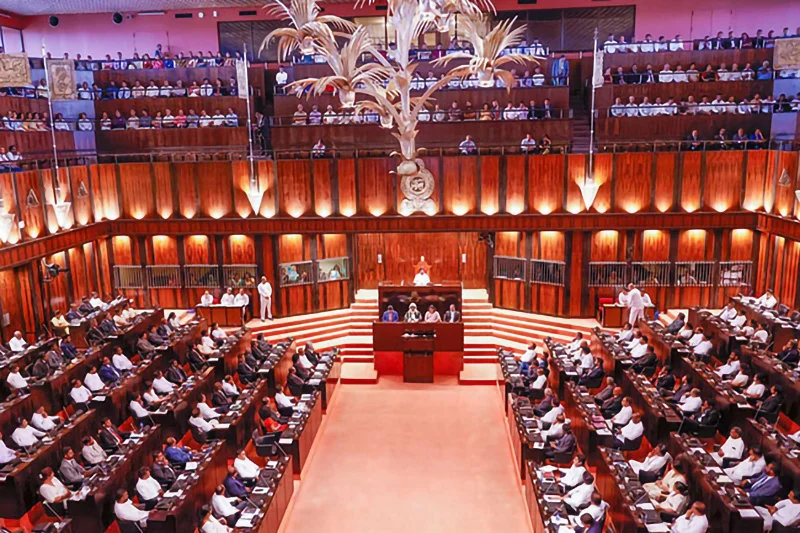
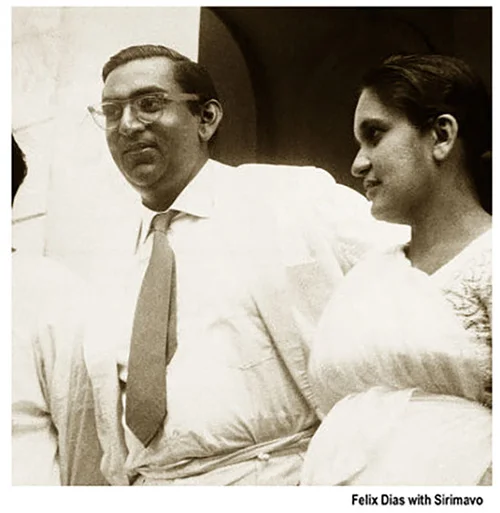
In 1976, the late Felix R. Dias Bandaranaike initiated the legislation that would provide a person who had retired after serving in the national Legislature for a minimum period of five years with a pension during his or her lifetime. The Parliamentary Pensions Act No.1 of 1977 is applicable to any Sri Lankan citizen who had served in the Legislature since July 7, 1931. A person who has served for the minimum period in the aggregate is entitled to a monthly payment of a pension amounting to one-third of the substantive monthly allowance currently payable to a Member of Parliament, and a maximum of two-thirds of such substantive monthly allowance if he has served for a period of fifteen years as such Member. The rationale for this legislation was to ensure that participation in the Legislature will not be the prerogative of the affluent.
The government now proposes to repeal this Act with retrospective effect. The Supreme Court has ruled that the Bill may be passed with a simple majority.
Unfortunately, the original 1977 Act was thereafter amended by successive governments in 1982 and 1990 to enable the payment of a pension, not only to a retired legislator, but also to a widowed spouse, and thereafter to any surviving children as well. Those amending Acts negated the purpose for which the original Act was enacted in 1977, and perhaps even contributed to the government’s decision to abolish the right to a pension altogether.
During the past fifty years, every person who was elected to the national legislature had a legitimate expectation that when he or she ceased to serve in that capacity, having done so for at least five years, that retiree will receive a monthly sum from the parliamentary non-contributory pension scheme. That is a statutory entitlement which retired legislators now enjoy in common with thousands of others who had similarly served the State in public or judicial capacities. In public law, a well-established concept is that of legitimate expectation. In their dealings with the public agencies, private persons are entitled to rely upon statements or decisions notified to them. That is the legitimate expectation of any citizen.
 It may be reasonable to deny a pension to a legislator who has subsequently been elected to the office of President and thereby become entitled to a presidential pension in terms of Article 36 of the Constitution. It may also be reasonable to deny (or perhaps suspend for a specified period) the payment of a pension to a legislator who has subsequently been disqualified from being elected to the legislature under Article 89 of the Constitution by reason of a conviction under the Bribery Act or for a corrupt practice under the law relating to elections, or upon being imposed a sentence of imprisonment for a period in excess of two years following a conviction for a criminal offence.
The government, of course, has the right to decide to terminate the entitlement of a legislator to a pension. Parliament has the right to give effect to that decision. However, sound public policy requires that a law should be prospective, and not retrospective. The Parliament ought, therefore, to retain the Parliamentary Pensions Act No. 1 of 1977 (but not the 1982 and 1990 amendments) and provide that it shall not apply to any legislator who is elected to such office on or after the date on which the amending Act comes into force. It is significant that Article 36 of the Constitution, which declares the entitlement of the President to a pension, states quite explicitly that any amendment or repeal of that Article shall not have retrospective operation. Why, then, should legislators be subjected to a different standard?
by Dr Nihal Jayawickrama


There seems to be a striking similarity between ancient Greece and modern Britain. Both countries remain paradoxes of history. Greece was a small city state constantly at war with neighbouring countries. It did not have a big army, but it had considerable sea power. However, Greece was a leading state over the whole of the Mediterranean. In fact, Greece was once a super power in the Western world.
Britain was very powerful in the 19th century. British justice was administered in Africa, India and Ceylon. British factories flourished in many countries and schoolchildren started reading R.L. Stevenson’s ‘Treasure Island’ and the works of Rudyard Kipling. What Ralph Waldo Emerson said in the 1850s is still valid today. He said, “If there’s one test of national genius universally accepted, it is success; and if there be one successful country in the universe for the last millennium, that country is England. It is the best of actual nations.”
In World War I, Britain faced a crushing defeat. Eventually, the British Empire was reduced to a Commonwealth. World War II shattered the image of Britain further. Although Britain lost much of its power, it continued to be an influential country. Even after achieving independence, India retained English as an official language. The British parliament system is well established in many Commonwealth countries. Some people still wonder how England still exercises its influence over the minds of men and women.
Staying power
There are many powerful countries in the world today such as the United States, Russia and China. Although England is not a super power, she has staying power. According to Oliver Wendell Holmes, a good part of greatness is simply being there. For that matter, England has been there for many centuries. So far no other country has been able to defeat her. As a result, sometimes we wonder whether we can have a world without England.
England has had an unwritten Constitution for a very long time. Other countries have emulated her political institutions. The British people have an established church with complete religious freedom. Although there are social classes in Britain, there has been no major clash among them. Unlike in many other countries, there are only two leading political parties in England. When the Labour Party is in power, the government is not subservient to labour. Similarly, when the Conservative Party is in power, the government is not conservative.
Most British colonies in the East including India and Ceylon did not sever the cultural and emotional links with Britain and retain them even after achieving independence. India became independent in 1947, but she decided to retain English as an official language. By doing so, India produced a number of English writers such as R.K Narayan. However, Ceylon did not give English any official status and treated it as a link language. As a result, students paid less attention to learning English. They were made to understand that everything can be done by learning Sinhala and Tamil. We have failed to produce English writers in the calibre of J. Vijayatunga who wrote ‘Grass for my feet.’
Politically shrinking
The United Kingdom is politically shrinking. However, its influence vibrates throughout the world. English has brought many nations together. There is a common understanding among countries that share the English language and literature. William Shakespeare’s dramas are staged in countries such as China where English is not an official language. People have come to the conclusion that English has become a broker of ideas and institutions.
England is not an aggressive country. However, if provoked, it can deliver a mortal blow to its enemy. British Prime Minister Margaret Thatcher showed her mettle as the iron lady. Britain held the fort against the might of Napoleon Bonaparte who ruled France. The country can still boast of a heavy moral credit. The British stick to their international agreements. The power of England draws mainly from its language. British people say ‘It’s right’ when it is right’. When it is not right, they say, ‘It’s not right.’ Meanwhile English occupies a pre-eminent place in world languages. All the research work in many parts of the world is available in English. You can learn any subject easily through English.
Apart from the language, people respect British standards which are technical specifications and quality benchmarks developed by the British Standards Institution. The United Kingdom’s independent national standards body was established in 1901. It maintains over 37,000 standards covering industries such as construction, manufacturing and technology ensuring safety and reliability.
British English
Standard British English is the variety of English that has undergone codification to the point of being socially perceived as the standard language associated with formal schooling, language assessment and official print publications. For historical reasons dating back to the rise of London in the ninth century, the form of language spoken in London and the East Midlands became the Standard English used in schools, universities, literature and law.
British English functions as one of the two major foundational and standard varieties of the English language alongside American English. It serves as a primary reference point for spelling and grammar. It acts as a global standard, and international institutions are often defined by specific pronunciation.
Most Sri Lankan doctors primarily move to England for postgraduate training, higher specialisation and better career prospects. They are driven by superior training infrastructure, world-class facilities and globally recognised qualifications.
To sum up, when you think of learning an international language, there is no alternative to English. If you wish to read literature, you cannot ignore eminent English dramatists and poets such as William Shakespeare and John Milton. Many leading Sri Lankans like S.W.R.D. Bandaranaike were Oxford University products. Therefore, English deserves to be made an official language in Sri Lanka.
By R.S. Karunaratne

India look to go into Super Eight stage with all-win record

Cabinet approves construction of new 300 bed Base Hospital in Deniyaya

Heavy showers about 100 mm are likely at some places in the Eastern, Uva and North-central provinces and in Matale and Nuwara-Eliya districts

Cabinet nod to legally empower methodology for implementing the ‘Praja Shakthi’ poverty alleviation national movement

NPP not under Indian pressure to hold PC polls – JVP

Battery storage drive to power Sri Lanka’s renewable leap

‘Dates have the highest sugar content to fight Coronavirus’

Sunday Island 27 December – Headlines

#SundayIsland 17th December – Headlines

Sunday Island – 28th March

Sunday Island Headlines – 21 March

Sunday Island – 21st February – Headlines
-
 Life style3 days ago
Marriot new GM Suranga
-

 Business2 days ago
Ministry of Brands to launch Sri Lanka’s first off-price retail destination
-
 Features3 days ago
Monks’ march, in America and Sri Lanka
-
 Opinion6 days ago
Will computers ever be intelligent?
-
 Features3 days ago
The Rise of Takaichi
-
 Features3 days ago
Wetlands of Sri Lanka:
-
 News3 days ago
Thailand to recruit 10,000 Lankans under new labour pact
-
 News3 days ago
Massive Sangha confab to address alleged injustices against monks