
Features
From Villain to Unsung Hero


One winter morning in 1998, as a part of the SIA crew while planning a departure from Kimpo (Gimpo) International Airport Seoul South Korea, in our Airbus A 340 aircraft, we realised that it had snowed all night and the runway surface was ‘contaminated’ with melting snow (Slush). We had been told time and time again by the performance experts that a depth of snow, slush or standing water more than 3mm (1/8th of an inch), the proverbial SriLankan Baas’s ‘Noola’, on more than 25% of the Runway, it is considered to be contaminated. The Kimpo Airport Authorities hadn’t cleaned the runway surface like in most other airports.
A contaminated runway poses a whole host of problems for pilots attempting to take-off. Because of the natural resistance of the water, snow or both on the runway in varying degrees and depths, the acceleration to the take-off speed becomes slow as the wheels have to displace the contaminants using up a greater amount of runway length than on an uncontaminated (dry) runway. This leaves less runway length available for the aircraft to stop, if for some unforeseen reason the pilots need to abandon the take-off. Then stopping becomes a problem as the tyres may skid or aquaplane, making the wheel brakes ineffective with a good chance of over running the runway length available.
 In this day and age, to reduce the thermal and mechanical stresses to the jet aircraft engines it was recommended by the manufacturer that pilots use a reduced thrust setting on uncontaminated (dry) runways, for take-off. Therefore, it was mandated that on a contaminated runway, full thrust is used to enable the aircraft to accelerate quicker to the speed (V1) at which the Captain will have to decide whether he will stop or go. Every type of aircraft is tested in snow, slush or standing water, the spray patterns studied and a set of lower V1 speeds for slush operations are available for different take-off weights in graphs or in tabulated form for quick reference. At V1 speed, if the Captain decides to continue the take-off it becomes a ‘non-event’. However, if he decides to stop for any reason, it becomes regimented and exiting as he has got to announce to the First Officer that he is discontinuing the take-off, apply brakes, close the engine Throttles, keep the aircraft straight on the centre line (that may not be visible), deploy spoilers and Reverse Thrust bringing the aircraft to a stop and cancelling Reverse and spoilers at the appropriate time. The non-flying pilot notes the air speed at which the Captain rejected and announces to the Control Tower that they have abandoned the take-off and then monitors the deceleration, providing a back up to the Captain’s actions. These are standard Operating Procedures (SOP’S) evolve through the years. Noting the speed at which they rejected the take-off is necessary when it comes to brake cooling time after rejecting a take-off. The brakes in the old days became white hot with its use at high speed. With the use of Carbon brakes and integral cooling fans the problem is resolved to a large extent.
In the present day in all the modern airliners braking is done automatically using ‘Auto Brakes’ with anti- skid devices operating and this exercise (Rejected Take off) is practiced in the Simulator every six months as a team exercise under the supervision of a Flight Instructor. As a further consideration, the manufacturer Boeing’s analysis of all the past rejected take-off accidents have also shown that if the Captain was two seconds too slow in rejecting the take-off at the decision speed of V1, the aircraft will exit the runway at the other end at 60kt! So, their recommendation was to be ‘go minded’ at V1 and not attempt to stop. The reader will agree that a lot of things happening and judgemental considerations going through the Captain’s mind simultaneously while on the take-off run.(what if)
Usually on take-off on an uncontaminated runway it was a legal requirement to be at a height of 35 feet over the end of the runway. On a contaminated runway the aircraft is allowed to clear the end at 15 feet to accommodate the loss of performance. In addition to all this, in jet aircraft, it is recommended to have the continuous ignition ‘on’ to ensure that the engines do not flameout (fail) due to slush ingestion by the engine intakes. Fortunately, it wasn’t snowing that day in Kimpo and therefore did not pose a problem with ice on the wings which would have created another problem for us as the wings are meant to be clean on take-off. These Standard Operating Procedures (SOPs) are all contained in the Flight Manual of any particular type of aircraft and expected to be read and understood by its Crew.
 That morning the take-off at Kimpo went off like clockwork. As everything appeared to be normal there was no need to abandon the take-off and after getting airborne, we had to concentrate on other important things like a sharp turn left before reaching the DMZ (De Militarised Zone) and avoiding overflying the South Korean President’s Palace which was a known prohibited area. They would fire two tracer shells. If no action was taken to change course and avoid, they will attempt to shoot you out of the skies, passengers or no passengers!
All in all, tackling a contaminated runway in modern times became a ‘piece of cake’ if one knew what to do. These procedures were not promulgated overnight. They were the result of ‘blood sweat and tears’ through the years. The story below is a good example.
In 1949 there was an accidental overrun of the runway of a Trans Canada Airlines (TCA) aircraft in Vancouver, Canada. The Investigators declared that the probable cause was the presence of slush (melting snow) on the runway preventing acceleration to the required speed for take-off. This observation was intimated to many airlines including British European Airlines (BEA) authorities who had not taken any cognizance and duly filed the letter without advising their operating crews of such possibilities.
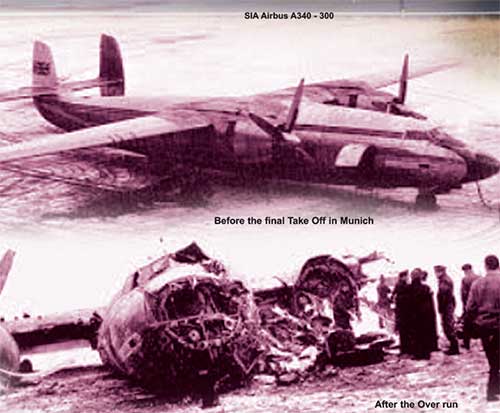
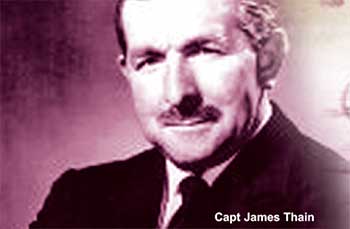
Nine years later, on 6th Feb 1958, Capt James Thain and Capt Kenneth Rayment were operating a BEA charter flight from Belgrade Yugoslavia to London with the Manchester United Football Team and some well-known sports writers as their passengers. Both pilots were good friends and had served in the RAF together during WWII. Usually there would have been a regular First officer but since both captains had common interests like poultry farming, they had requested to operate together. The young Manchester United team known as ‘Busby Babes’ were well on their way to be European Cup Champions. Since the Airspeed Ambassador ‘Elizabethan’ aircraft did not have sufficient range to fly direct to London, they needed to do a Technical (refuelling) stop in Munich, Germany. The flight was uneventful till they reached Munich.
The Runway was contaminated with melting snow in Munich. Light snow was falling on the wings. Due to the fact that anti-ice heaters were used on the descent into Munich Airport, Capt. Thain decided not to get the wings cleaned. It was a judgment call.
After refuelling the crew attempted to take-off twice, but had to discontinue due to an engine malfunction. Then they taxied back to the ramp for a consultation with the Ground Engineer, after which the two captains decided to open power slowly to fix the engine problem which was known to occur in Munich which was over 1700 feet above mean sea level. On the third attempt the power was opened slowly and that involved a longer take off run which took the aircraft to a more contaminated unused part of the runway which actually made the aircraft lose speed from 117 knots to 105 knots and never accelerated to flying speed. Capt Thain was looking inside the cockpit and carefully ‘nursing’ the engines and monitoring the speed while Captain Rayment was handling the controls. When he looked outside the runway end was closing in quickly and it was too late. He opened throttles to the maximum. The wheels never left the ground because it didn’t have flying speed. The aircraft over ran and crashed through a fence, hit a tree and a house and burst into flames. The crash killed 23 out of the 44 passengers and crew on board, critically injuring Capt Kenneth Rayment, He passed away a few days later, leaving Capt Thain to carry the blame alone. With that, destroying the chances of Manchester United being European champions.
The German Accident investigator Capt. Hans J Reichel and his team arrived from Brunswick, West Germany, ill-equipped, about six hours later. By this time the weather had worsened and it was night time. He had to borrow lighting equipment from the BBC photo crew present at the site, He had been a pilot both in the Luftwaffe and Lufthansa the German Airline. The first thing he did was to check for wing ice and found a six-hour build-up of snow and declared that there was ice on the wings before take-off. No proper measurements of the depth of the slush were done on the runway at Munich. A parallel UK investigation was also launched. The formal accident inquiry commenced on 29th Apri’58 and was protracted and didn’t consider the effect of slush at all. The ‘Brits’ virtually fell in line with their German counterparts. The Final Accident Report came out on 9th March 1959, (More than a year after the crash), blaming the ice build-up on the wings and Capt Thain’s failure to de-ice.
It saidL:
 “Apart from the ice, we couldn’t find any other reason which could have contributed to the air crash “
Capt Thain’s licence was suspended and he reverted to full time poultry farming while relentlessly working with the British Air Line Pilots Association (BALPA) to obtain more research data on the effects of slush on Take-off performance.
In 1961 Capt. Thain was fired from his job of BEA for allowing Capt Rayment to sit in the Left hand seat while he as designated Captain on the roster sat on the Right hand seat. The Captain on the roster should have sat on the Left hand seat and thus it was purported that he had violated the existing BEA Flight Crew Standing Orders which in itself a relatively minor matter. Looking back, it probably was just an excuse to shed him as this WWII veteran and BEA Captain ended up being an embarrassment to the Airline. There was no doubt about his ‘unquestionable ability’ up to that time of the accident. In the eyes of the general public and Football fans he was considered a villain.
If the German Accident Investigators blamed the Slush on the Runway for the overrun then the Munich Airport Authorities would have to take the rap for not cleaning the runway surface. It was rather obvious that like in most accidents it is convenient and emotionally satisfying to blame an individual and not the system that gave rise to the unsafe situation. Capt. Thain did not give up trying to clear his name. He was determined to find out the real cause of the accident. He appealed.
Seven months after the crash in September 1958 the FAA started conducting practical tests on the impact of slush on aircraft acceleration for take-off. Although there was new scientific evidence available, the Germans were not keen on reopening the case and Capt. Thain was languishing in guilt. Capt. Thain kept the pressure on. Eventually in 1967 Prime Minister Harold Wilson mentioned publicly, that Capt. Thain was a “victim of injustices.” Soon after (1968) the British were also conducting experiments with slush on the runway at Royal Aircraft Establishment (RAE) in Bedford in shallow ponds of standing water, using Canberra, Viscount and Ambassador Aircraft. The significant adverse effects of slush on the Runway were confirmed.
Finally, Capt. Thain’s persistence paid off and his plight was mentioned in Parliament and the British Authorities agreed to review the investigation and found that the German investigation was incomplete. The Investigators had not interviewed many witnesses including the Air Traffic Controllers and those who reached the wreck first and could have given evidence to say that there was no ice on the wings immediately before the crash. It seemed that witnesses had been selectively interviewed to fit the ‘probable cause’.
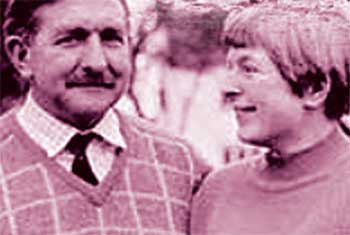 Eleven long years after the crash in March 1969 Capt. James Thain was finally exonerated, but died soon afterwards of a heart attack at a relatively young age of 54, due to trauma and stress. This prompted one of the ‘wags’ in the BALPA to declare that “If the crash doesn’t kill you, the inquiry will”
Capt. James Thain with his determination to find the real culprit of the Munich accident made taking off in slush safer for airline pilots, by triggering off research on both sides of the Atlantic that evolved into SOP’s which allowed us to take off safely from Kimpo that wintry morning.
In his own words, to his daughter, “The difference between the possible and impossible is merely a measure of man’s determination”
To me, Capt. James Thain was an unsung hero whose great determination to prove his innocence made flying safer for the future air travellers.




Features
Beyond Degrees: Lessons from a Self-Made Entrepreneur, Dudley Sirisena to the Youth of Gampaha

by Athula Ranasinghe
Productivity Specialist
(The writer can be contacted via rathula49@gmail.com )
Beyond Degrees: Lessons from a Self-Made Entrepreneur, Dudley Sirisena to the Youth of Gampaha.
I am delighted to have attended the Pathfinder Career Guidance Fair – 2026 organized by the Lions District 306 D4 at the Sumedha International College, Gampaha on the September 20 when I had the privilege of listening to the eminent speakers addressing the school children in a well-attended audience.
To say the least, it was very meticulously arranged and provided an excellent opportunity to the senior students of the schools of the Gampaha district to be exposed to various career paths, professional qualifications for building a career and the wider opportunities available to the students immediately after leaving school. The children had the opportunity to collect career related materials from the leading sponsors.
Lions Club deserves the gratitude of the people in Gampaha because it added a subject of considerable national importance that has yet to receive the attention it deserves—the need to make meaningful career guidance accessible to Sri Lanka’s young people, particularly those living in peripheral villages and disadvantaged communities. This is precisely why I believe career guidance should be popularized as a national social service rather than being regarded merely as an occasional educational activity. In an economy undergoing technological, industrial and occupational transformation, possessing educational qualifications alone cannot guarantee productive employment. Young people need to understand their own abilities, identify emerging opportunities, acquire appropriate skills and make informed decisions about their future.
Presentations by Professionals
I would be failing in my duty if I did not convey my gratitude to the Lions Club 306 for organizing this much-needed career guidance fair for school children in this vulnerable segment. I was particularly fascinated by the manner in which the erudite speakers conveyed their messages through PowerPoint presentations, highlighting the challenges children face in building a professional career. Although the slides were prepared in English, the speakers made it a point to explain the opportunities in lucid Sinhala, greatly benefiting the children. Almost all the speakers took great pains and effort to disseminate their core messages in simple terms, emphasizing the qualitative traits students should cultivate before entering the world of work.”
The resource persons, who were senior professionals from the industry and professional institutions, shared first-hand illustrations of the essential qualifications and skills students must cultivate, leaving a profound impact on their young minds.
Chief Guest Dudley Sirisena’s Address
Among all the speeches, the Chief Guest’s speech was the most engaging and inspiring. The speaker was the famous entrepreneur Dudley Sirisena (DS), owner of the Araliya Group, Polonnaruwa. Even without a PowerPoint presentation, his punchy 30-minute speech fascinated the audience. He opened by mentioning that he is not a scholar and lacks a university degree, but the business experience he gathered over 40 years gave him the ability to deliver a speech to the students.
DS began under very modest circumstances as stated in his own biography. He came from a rural agrarian family, worked in a garage and a petrol station and began his agricultural venture with only 25 sacks of rice before developing it into a substantial enterprise. His biography also records the creation of thousands of jobs and diversification of his business empire both vertically and horizontally from agriculture, tourism, engineering, construction, automotive, property sales and infrastructure. As a matter of fact, he is a role model similar to Adani in India.
He was very candid to say that he lost a valuable opportunity of gaining higher education owing to a family dispute and he worked in a petrol shed and a garage during his youth. However, today he has built a well-diversified network of business ranging from paddy production, leisure sector and investment projects employing more than 10,000. He must be congratulated for the manner in which he had built his business empire with dint of honest hard work, perseverance and determination. Today his business provides a jobs to 10,000 means which means perhaps 50,000 lives in those families are supported in addition to other participants in the supply and marketing chains.
Observing of Management Principles
What is particularly important is that he himself had applied so called management principles in building up his empire without having any formal, academic or professional education. His meteoric rise in business despite all odds is worthy of emulation. He appeared to have learned basic management principles he has had applied without knowing the academic and professional terminologies they involve. His references indicated that he had extensively used Henry Fayol’s Principal of Division of Work and Specialization, Maslow’s Hierarchy of Needs, Visionary Leadership styles with vision and clarity and a unity of direction. Hence, please allow me to illustrate some of the key points he touched in this presentation encompassing the modern-day management techniques.
His simple address to the large student audience at the commencement of his speech, was that students should love their work and labor with dedication once they enter the professional world. This brings to mind the famous message by Steve Jobs, Co-Founder of Apple Inc., who said: “Your work is going to fill a large part of your life, and the only way to be truly satisfied is to do what you believe is great work, regardless of the position or capacity you hold. And the only way to do great work is to love what you do.” I believe DS has never heard of this famous saying, nor has he ever heard the name Steve Jobs!
Simplicity
“Despite being a multi-billionaire, one would have expected DS to lead a luxurious life. However, his simplicity was manifestly exposed when he disclosed that he had a simple breakfast of red rice, pol sambol, lotus root, long beans etc before leaving Polonnaruwa for the event. Another instance of his simplicity was that he did not hesitate to greet the audience by waving his hands pleasantly at the students listening to his speech.
Acquiring of Three Skills
In his short but punchy speech, he did not hesitate to motivate the young minds, emphasizing the basic qualitative traits that students should gain if they want to succeed in their professional careers. Touching upon the subject of qualifications, he urged the children to gain academic qualifications, professional qualifications, and specialized training. This is a highly commendable message to them. He emphasized that in today’s competitive world, it is essential to obtain these three qualifications.
His reference to the skills one should acquire is particularly important in that it emphasizes the necessity of acquiring technical skills, soft skills and emotional intelligence in present management parlance. Although he did not use these exact management terminologies, his message clearly covered these three skills. I wonder how this business leader without any formal education realized the importance of these skills. Probably, his familiarity and experience with a massive business empire would have given him this knowledge.
Personal Attributes
Then, he went on to discuss another important subject: personal attributes. He highlighted key values such as work ethics, adaptability, integrity, initiative, and resilience. Specifically, he emphasized the necessity of completing assigned tasks within stipulated deadlines, while placing a strong focus on punctuality and regular attendance. His core message was to avoid absenting oneself from work without prior notice. DS mentioned that the mere absence of a single worker on a production line can adversely affect the entire production target, causing massive financial losses to the institution.
DS maintained that he allows his staff to take initiatives that benefit the company. A unique feature he has practiced is encouraging unfettered initiative, free of rigid administrative and financial controls. Furthermore, he stressed the importance of interpersonal relationships at the workplace. Once an employee joins the company, they should maintain a high standard of understanding and rapport with their superiors and subordinates, he said.
Cross-Functional Activities
Although he did not use the exact management jargon, his reminder to the students was to gather all-around experience and understand the effectiveness of cross-functional activities. DS emphasized that gaining comprehensive knowledge of various functional activities offers a distinctive advantage, securing internal promotions and higher remuneration packages during performance evaluations
Five Key Pillars
He delivered a powerful address to the students, identifying five key pillars that influence career choice. His presentation was highly engaging and resonated strongly with the audience. The clarity and depth of his insights mirrored concepts typically taught in elite MBA programs such as those at Harvard Business School or the National University of Singapore (NUS). Drawing from his own professional journey, he advised the students to pursue a long-term career rather than a short-term job if they wish to achieve meaningful professional growth.
“Dear Students, one of the most critical decisions you will ever make is choosing your career path. This choice will directly impact your income, happiness, relationships, lifestyle, health, and personal satisfaction “he asserted.
Furthermore, he cautioned the students against selecting a career, based on parental pressure, social prestige, peer influence or a lack of alternative options. The audience was highly receptive; the students listened with rapt attention, and many actively took notes throughout the address.
“Due to time constraints, he did not dwell at length on all five pillars—Passion, Strength, Values, Lifestyle, and Demand. Instead, he focused on Passion and Demand, delivering a clear and impactful message to the students. Regarding Passion, his simple advice was to cultivate an inner enthusiasm that brings happiness independent of external rewards. He explained in plain language that passion is the work that energizes you.
When you are passionate about your chosen career, you look forward to each day, willingly acquire new skills, persevere despite setbacks, and become creative and innovative—making excellence a natural outcome. I personally believe that he built his own business empire by aligning it with the very passion he so strenuously practiced.
Labour Market Demand
Ultimately, he emphasized that passion is what starts your career journey off. He stressed that even if the students had passion, strengths, values, and the desired lifestyle, they should inevitably consider labour market demand in choosing a career. Essentially, the career you choose solves a problem not only you but for the society at large, he said.
This message would have probably resonated his own satisfaction at providing stable income base for 10,000 employees and their dependents numbering over 50,000. He cautioned the students that today’s world is changing rapidly and they should be conscious about the following facts. Is the occupation you select growing, what skills will employers need in five or 10 years? Will technology replace the career you choose; can your skills be transferred to different industries and finally what additional skills should you develop in line with the changing technology? Finally, he emphatically requested the students to upgrade KSA – Knowledge, Skills and Attitudes so that the students will always remain employable.
Build Your Own Brand (BYOB)
Before winding up his speech, DS’s advice to the students was to build up their own brand (image) by marketing themselves to the opinion makers and stakeholders saying that BYOB is a powerful tool that must be rigorously observed for career progression. At a time, when another slogan BYOB (Bring your own booze) is visibly seen in every nook and corner, his obvious reference would have been to desist from consuming liquor and narcotics. Building a brand within the workplace is an uphill task yet one should relentlessly stamp his brand for his employability even after the retirement, DS emphatically stressed.
What particularly impressed me was the lucid, practical and authoritative manner in which Mr. Sirisena communicated his experience to young people. His presentation was not a theoretical lecture on career development. It was a message derived from lived experience, delivered in a manner that could be understood and appreciated by young people from different educational and social backgrounds.
A degree is merely the key that unlocks the door; it is your character, competence, and commitment that determine how far you will walk through it. “Embrace adaptability, never stop learning, and let your journey define your greatness.” This was the gist of the core message finally conveyed to the students by this business leader Dudley Sirisena.

Sri Lanka needs a fairer and more transparent approach to renewable energy
by K R Pushparanjan
Sri Lanka has spent several decades encouraging private investment in renewable energy. Small hydropower was among the earliest successes of this policy while rooftop solar has more recently enabled thousands of ordinary households and businesses to become electricity producers. These developments have reduced the country’s dependence on imported fuel, mobilised private capital for electricity generation and contributed towards a cleaner and more diversified energy system.
It is therefore difficult to reconcile these objectives with reports that renewable generators are increasingly being required to curtail production during periods of low electricity demand, particularly on Sundays, Poya days and other holidays. The question is especially relevant to run-of-river mini-hydropower, where naturally available water may simply pass downstream when generation is stopped, and to rooftop solar, where abundant midday sunshine cannot be postponed until the evening peak.
There are, of course, legitimate technical reasons why the Ceylon Electricity Board (CEB), as system operator, may occasionally have to curtail renewable generation. An electricity system must maintain a continuous balance between generation and consumption. On Sundays and holidays, industrial and commercial demand can fall considerably while solar, hydro and wind generation remain available. Certain conventional generating units may sometimes have to remain connected to provide frequency control, voltage support, operating reserves and other services essential for grid stability. Transmission constraints can also make it impossible to substitute generation in one part of the country directly for generation elsewhere.
No responsible renewable-energy producer would suggest that grid security should be compromised merely to accept every available unit of renewable electricity. However, legitimate engineering considerations should not become a blanket explanation that places curtailment decisions beyond public scrutiny.
The CEB itself describes the economic principle underlying electricity dispatch as merit-order dispatch, under which lower-cost generation is normally utilised before progressively more expensive generation. Consequently, whenever inexpensive renewable electricity is deliberately curtailed while substantially more expensive oil-fired generation continues, electricity consumers and renewable producers are entitled to ask why. If a particular thermal generating unit must remain online for frequency stability, voltage support, network security or some other technical requirement, that can be explained. If transmission congestion requires renewable generation in a particular area to be reduced, that too can be demonstrated. Transparency should strengthen technically sound decisions, not threaten them.
Mini-hydro and an unequal contractual relationship
Run-of-river mini-hydropower deserves particular consideration. Unlike reservoir hydro, most such plants have limited ability to store water. When sufficient water is available, but the plant is instructed not to generate, that water may simply bypass the turbines and continue downstream. The opportunity to produce that electricity is then lost. No imported diesel, furnace oil or coal is required to allow that water to turn a turbine, and there is no corresponding fuel-related foreign-exchange expenditure.
Sri Lanka’s mini-hydropower industry was developed largely through private investment. The CEB currently records 219 commissioned mini-hydro projects with an aggregate capacity of approximately 430 MW and acknowledges the role of government policy in encouraging private-sector development of this indigenous renewable resource.
Yet, there has always been a fundamental imbalance in the commercial relationship between the small power producer and the national purchaser. Mini-hydro projects have historically sold their electricity through the Standardised Power Purchase Agreement (SPPA). The very nature of a standardised agreement substantially limits the individual developer’s negotiating position. Published material concerning Sri Lanka’s small-power-producer framework has described the SPPA as standardized and non-negotiable.
This is hardly a negotiation between parties of equal bargaining strength. A mini-hydro developer cannot realistically reject an unfavorable provision and offer the electricity to another national grid. For much of the industry’s history there has effectively been one purchaser, leaving the developer with little practical alternative but to accept the terms offered.
The weakness of that position becomes particularly evident when curtailment occurs. A PUCSL-commissioned study has recorded that under the original SPPA there was no penalty on the CEB for not purchasing energy. The developer may have invested the capital, borrowed the money, undertaken the construction and hydrological risks, maintained the machinery and had both water and generating equipment available, yet still carry the financial loss when electricity cannot be accepted for reasons originating within the national system.
If curtailment is genuinely necessary for grid security, the plant operator may have to accept the technical instruction. It does not logically follow, however, that the entire financial consequence should automatically be imposed upon the weaker contracting party.
Germany curtails renewables too – but differently
Germany provides a useful comparison precisely because it demonstrates that renewable curtailment is sometimes unavoidable even in an advanced electricity system. With very large quantities of wind and solar generation, Germany regularly experiences transmission congestion and occasions when all available renewable electricity cannot immediately be transported to consumers.
The important difference lies in how the problem is managed. Germany operates a regulated redispatch system. European electricity-market rules require redispatch to be undertaken according to objective, transparent and non-discriminatory criteria. Conventional generation, renewable generation and storage can all form part of the process, with interventions determined by what is required to relieve network constraints safely and economically.
Equally important is the recognition that curtailment has financial consequences. Germany’s Federal Network Agency explains that affected generators and storage operators have statutory entitlements to appropriate financial compensation within the redispatch framework. Depending upon the circumstances, relevant arrangements can take account of generation expenditure, lost revenue opportunities, readiness costs, maintenance implications and costs avoided because generation was reduced. The German framework also provides balancing mechanisms intended to address the commercial position of installations affected by redispatch, including renewable generators.
The principle is worth considering in Sri Lanka. When a privately financed generator is required to sacrifice otherwise available production for the security and benefit of the national electricity system, why should that cost automatically and entirely be borne by the generator?
Germany offers another lesson that may be even more important: transparency. Through the Federal Network Agency and its SMARD electricity-market information platform, information on congestion management, renewable curtailment and conventional redispatch is publicly available. Official German figures show that renewable curtailment amounted to approximately 3.5 percent of renewable generation in 2025, meaning that more than 96 percent of renewable electricity generated reached the system and consumers.
Sri Lanka cannot simply copy Germany. The two electricity systems differ enormously in size, resources, interconnections and market structure. What can be adopted, however, are the principles of transparency, non-discrimination, accountability and fair treatment of generators affected by decisions taken for the benefit of the wider system.
What generation remained online?
Whenever significant renewable curtailment occurs in Sri Lanka, sufficient information should therefore be made publicly available to answer some straightforward questions. How many megawatts were curtailed, for how many hours, and how many megawatt-hours of renewable electricity were consequently lost? Which thermal generating units remained operational during those hours? What fuel were they using and what was their approximate generation cost? Why was each of those units technically required to remain online? Was the curtailment caused by system-wide oversupply, a local transmission constraint, frequency considerations or some other identifiable requirement? These are not unreasonable questions. If the decisions are technically and economically sound, the answers should vindicate the system operator.
The issue assumes particular importance because Sri Lanka has historically spent enormous sums purchasing thermal electricity. An Auditor General’s special audit concerning ACE Power Embilipitiya reported expenditure of approximately Rs. 59.454 billion on electricity purchased from that plant between 2016 and 2021. The audit also drew attention to transmission-system problems and the consequences of permanent solutions not being implemented in a timely manner.
This does not establish that thermal generation is unnecessary or that private thermal producers have acted improperly. Nor should allegations of corruption be made against particular parties without evidence. Nevertheless, Sri Lanka’s long history of public concern regarding procurement, governance and major public expenditure makes transparency particularly important. Large thermal power contracts, fuel purchases and capacity arrangements involve substantial sums of money. The best protection against suspicion is not secrecy but disclosure.
If expensive thermal generation genuinely has to remain online while inexpensive renewable generation is curtailed, publish the technical reason. Publish the quantities. Publish the relevant costs. Allow engineers, economists, regulators, investors and electricity consumers to examine the decision for themselves.
Rooftop solar must not become the next casualty
The same argument now applies to rooftop solar. Sri Lanka successfully encouraged households and businesses to invest their own money in solar installations. Net Metering, Net Accounting and related arrangements helped transform consumers into small-scale electricity producers and contributed substantially to the growth of distributed renewable energy. PUCSL continues to recognise Net Metering, Net Accounting and Net Plus within Sri Lanka’s rooftop-solar framework.
The rapid expansion of rooftop solar undoubtedly creates genuine technical difficulties. Solar production is concentrated around daytime hours, while Sri Lanka’s major electricity demand peak occurs later. On a sunny Sunday or holiday, solar production can therefore be substantial precisely when commercial and industrial demand is low. Distribution networks designed for one-way electricity flows may also encounter voltage and hosting-capacity limitations as increasing quantities of electricity flow back from consumers towards the grid.
But it would be fundamentally unfair to encourage citizens to invest their savings in solar energy and subsequently treat their electricity as a problem simply because the national grid has not developed quickly enough to accommodate it.
Battery energy storage offers an important part of the eventual solution. A household battery can capture surplus solar energy around midday and release it during the evening, when both the household and the national system need electricity most. PUCSL has already recognized the value of combining rooftop solar with battery storage in its evolving regulatory arrangements.
However, domestic battery storage still represents a considerable additional investment for an ordinary household. Public policy should therefore be careful not to make battery ownership an economic prerequisite for participating in rooftop solar before such systems become reasonably affordable.
Until domestic battery storage becomes economically accessible to the average household, Net Metering and Net Accounting should be preserved, strengthened and made genuinely accessible. They provide a practical bridge between today’s rapidly growing distributed solar generation and tomorrow’s electricity system in which affordable batteries, utility-scale storage, pumped hydro and sophisticated demand management can shift much more renewable energy from periods of surplus to periods of high demand.
The national grid should, during this transition, continue to perform an important balancing function. Meanwhile, policy should encourage rather than compel household batteries through appropriate time-of-use tariffs and incentives. As battery prices decline, consumers will increasingly adopt them voluntarily because the economics make sense.
The grid must evolve with renewable energy
The longer-term answer is therefore not to choose between renewable energy and grid stability. Sri Lanka needs both.
Investment is required in battery storage, pumped-storage hydro, stronger transmission and distribution networks, better renewable forecasting, modern inverter technology, sophisticated system-control facilities and demand-response programmes. Electricity tariffs can also be designed to encourage industries, commercial establishments, water pumping, electric-vehicle charging and other flexible loads to consume more electricity during periods of abundant solar production.
The electricity system must gradually become capable of moving energy not merely geographically but also across time—storing electricity when nature provides more than consumers require and releasing it when demand rises.
This is also essential for maintaining investor confidence. Private investors make renewable-energy decisions according to expected annual generation, financing costs and anticipated revenue. If a developer can spend substantial capital constructing a renewable project only to face unpredictable curtailment outside his control and without adequate compensation or contractual recourse, the investment risk increases. Eventually that risk translates into higher financing costs, higher required returns and fewer projects.
A country cannot credibly invite private investors to finance renewable energy infrastructure while retaining an overwhelmingly one-sided contractual ability to discard their output and transfer the resulting financial loss back to them.
Transparency should not frighten the CEB
Nobody should expect the CEB to compromise national grid security merely to accommodate a mini-hydro plant or rooftop-solar producer. Where curtailment is technically unavoidable, it should occur.
But “system stability” should never become a phrase that ends the discussion.
Where synchronous generation must remain operating, explain why. Where transmission congestion requires renewable curtailment, identify the constraint. Where renewable producers sacrifice available generation for the benefit of the national system, develop a fair compensation mechanism. Where expensive thermal generation remains operational while naturally available water bypasses turbines, disclose why that was the technically necessary and economically preferable decision.
Germany demonstrates that renewable curtailment and renewable-energy development are not contradictory. Even sophisticated electricity systems sometimes have to discard renewable electricity. The difference is that a mature system attempts to minimize curtailment, operates under transparent rules, publishes relevant information and recognizes the financial consequences imposed upon generators.
Sri Lanka should aspire to the same principles.
We should not encourage private investors to build mini-hydropower plants and then place them against the wall through contracts over which they have little negotiating power. We should not encourage households to spend their savings installing solar panels and later make them bear the cost of deficiencies in the electricity network. And we should certainly not discard economically usable indigenous renewable energy without a convincing explanation while scarce foreign exchange is being spent importing fuel.
Sri Lanka should not spill usable water, reject available sunlight and then burn imported fuel to produce electricity that nature was prepared to provide without a fuel bill.
The issue is not whether every unit of renewable electricity can always be accepted. Clearly it cannot. The real test is whether every unit curtailed was genuinely necessary, whether the least-cost and least-wasteful solution was chosen, whether affected producers were treated fairly, and whether the public is permitted to see the evidence.
That is not an unreasonable demand from renewable-energy producers. It is the standard of transparency, accountability and economic discipline that Sri Lanka’s electricity consumers should expect from a modern national power system.

Tales of Mystery and Suspense 22
by Prof. Rajiva Wijesinha
I return now to J K Rowling of Harry Potter fame, writing under the pseudonym Robert Galbraith about Cormoran Strike. There are several books in this series of off-beat detective stories, featuring a private investigator who lost a leg while serving in the army, and his assistant Robin Ellacott, who had been raped when a student, with lasting psychological effects. Strike himself was the child of a rock band groupie, who had lived a sordid life, her last attachment being to a failed rock star of relatively aristocratic provenance and brutal habits.
Career of Evil is the third in the Strike series, and markedly different from the two books I read previously, the first and the fifth. Those were relatively speaking classic whodunnits, with a range of possible murderers, the solution in the end being quite unexpected but also convincing. The murderers in both cases are unhinged, but this does not become obvious until Strike has put two and two together and revealed a history of aberrant behaviour.
This novel has just a few suspects, all of them bizarre, as is made clear from the moment they are introduced. The case begins with Robin being sent a severed leg from a dead body, or rather it begins with the thoughts of the murderer who seeks revenge from Strike, which it seems he intends to achieve by first terrifying and then killing the woman he calls Strike’s Secretary. He also evinces a horrid desire to mutilate women after abusing them.
The first person Strike thinks of as a possible suspect is a member of a crime syndicate known to have sent body parts through the post, but Strike soon decides that he cannot be the perpetrator, in part because he is not likely to have known that Strike was responsible for his conviction earlier. Rather Strike is convinced it is one of three people who hate him, two of them individuals he helped to prosecute when he was in the investigating unit of the army, the third his step-father whom he suspected had killed his mother.
Unfortunately, Wardle, the policeman assigned to the case, who gets on well with Strike, is convinced it is the first person Strike had suggested, and does not seem interested in the rest, so Strike sets about trying to find out what they are up to.
They are not easy to trace, but Strike eventually tracks them down. He finds Laing’s mother in Scotland, although she is no longer able to provide any useful information. He then tracks down the mother of Laing’s first wife, Rona, whom Strike had found tied up and tortured. It was this incident that led to Laing’s conviction and imprisonment, and ultimately fuelled his hatred of Strike.
He finds the sister of the second suspect, Noel Brockbank, and learns that she and her brother were both abused as children by their stepfather. Brockbank later went on to abuse young girls himself. When Strike went to arrest him over the abuse of his stepdaughter, Brockbank attacked him with a broken bottle, and Strike knocked him out. Brockbank subsequently suffered seizures and was found to have a serious brain injury. Although Strike was initially blamed for the injury, it was later established that Brockbank had fractured his skull in a rugby match before the confrontation. Brockbank was therefore never convicted of the abuse allegations, while Strike was cleared of responsibility for his brain injury.
Strike’s third suspect is his former stepfather, Jeff Whittaker, whom he describes as unutterably filthy and abusive, yet strangely attractive to women. When Strike tracks him down, he finds Whittaker living with Stephanie, a woman who supports him with what she earns as a sex worker. Despite being abused by Whittaker, she remains devoted to him.
In his musings, the killer refers to the woman he lives with as “It”, suggesting that he could be Whittaker, who lives off Stephanie’s earnings. But when Robin is attacked by a man dressed differently from Whittaker, whom she had seen shortly before, it becomes clear that Whittaker is not the killer. Laing, the first of Strike’s three suspects, is also apparently ruled out when Robin sees him on crutches and learns that he is claiming disability benefits. Strike and Robin therefore concentrate on the third suspect, Noel Brockbank, whom they eventually trace to a home he shares with his girlfriend, Alyssa, and her two young daughters. Robin has seen the younger girl and becomes increasingly worried about what Brockbank might do to her. Although Strike has ordered her to leave Brockbank alone, Robin continues investigating because of her concern for the child. She eventually discovers that Brockbank has been sexually abusing the older of the two girls.
Meanwhile, Strike and Robin manage to identify the girl whose leg was sent to the agency. Among the bizarre letters Strike had received in the past was one from a young woman who fantasizes about having her healthy leg amputated and believed that Strike had deliberately had his own leg removed. Robin realises that the girl was suffering from a condition known as body integrity identity disorder, or BIID, in which a person has a persistent desire to have a healthy limb or other body part removed. Strike simply ignored the letter, unaware that the girl was suffering from a recognised condition and that her request was serious. The girl, Kelsey Platt, is subsequently found to have been murdered, and the police discover forged letters apparently written by Strike in response to her.
Wardle has his suspicions of the man married to the girl’s sister, with whom she had lived. Strike thinks this absurd, and it turns out that the man has an alibi for the time of the murder, but Strike does go along when the sister asks to see him and is overwhelmed by the sense of grief she and her husband evince.
The girl is evidently a godsend to the murderer, whose desire to remove body parts could not be controlled. He chops fingers off a girl he almost kills, and then removes the nose and ears of a girl he kills soon afterwards. And previously he had sent Robin the toe of the girl whose leg had been sent earlier.
All this horror can seem over the top, and one may wonder how Rowling could bring herself to wallow in such grim material. But perhaps she felt very strongly about the abuse women were subject to, and though her depiction of the way women played into the hands of abusive men seems excessive, she feels that awareness of that increases the need for support groups and other mechanisms to provide safety nets.
But there is also another side to the novel, namely the relationship between Strike and his partner Robin, which verges on the romantic though neither wishes to move on the matter. Strike feels diffident about taking advantage of his position as her employer, while Robin is engaged to a young man she has known for years, and whom she was virtually engaged to while at university. He has stood by her after the rape, when she could barely face society, and she finally decides to accept him and they are planning their wedding at the beginning of this book. But she finds that he is jealous of Strike, and hence his resentment of her commitment to her work, she breaks off the relationship when they are staying with her parents to finalize arrangements for the wedding.
But they still share a flat, and given the threat looming over her she cannot really move to live by herself. And gradually his misery wears her determination down, and she agrees again to marry him. The novel ends with their wedding, which Strike just manages to get to, causing her to beam, though she ‘had not once smiled in the entire service’.
But they still share a flat, and with the threat hanging over her, Robin cannot really move out and live by herself. Gradually, Matthew’s misery wears down her determination, and she agrees to marry him after all. The novel ends with their wedding. Strike arrives just in time, battered and bloodied after his confrontation with the killer. Robin has not smiled once during the ceremony, but when she sees Strike, she suddenly beams.
Before that, in the kerfuffle caused by Robin’s attempt to rescue the children of the woman Brockbank was living with, Strike sacks her. This turns out to be useful to him, because he subsequently enlists the children’s mother, Alyssa, to help trap the killer, whom he has by then identified as Donald Laing. With Shanker’s help, Strike arranges for Alyssa to pose as his new secretary and lure Laing into the open while he gains access to the flat Laing has been using as a hideout. There he discovers the evidence of the murders, including the severed body parts kept in a refrigerator.
This leads to a dramatic climax in which the murderer turns up. Strike has difficulty subduing him, partly because of his missing leg, but he is helped by Shanker, a man whom his mother, Leda, had taken in as a neglected and badly beaten boy and who has remained deeply grateful to the family. With the murderer captured and the case effectively wrapped up, Strike asks Shanker to drive him to Yorkshire, where Robin’s wedding is taking place. They arrive while the ceremony is still in progress, and Strike manages to get into the church just as Robin is making her vows. When she sees him, she beams and says “I do” while looking at him rather than at Matthew.
Clearly, this suggests that the relationship between Strike and Robin is far from settled. Indeed, as I discovered when I read the fifth book in the series, the story certainly does run and run.

Beyond Degrees: Lessons from a Self-Made Entrepreneur, Dudley Sirisena to the Youth of Gampaha

Proposals considered to amend Prevention of Domestic Violence Act

IIHS expands global nursing pathways

Sampath Bank launches Sri Lanka’s first community-powered book discovery platform at Colombo International Book Fair

CEAT expands premium retail network with Kurunegala outlet

STC General launches three new products

‘Dates have the highest sugar content to fight Coronavirus’

Sunday Island 27 December – Headlines

#SundayIsland 17th December – Headlines

Sunday Island – 28th March

Sunday Island Headlines – 21 March

Sunday Island – 21st February – Headlines
-

 News6 days ago
Police remove Thileepan statue in Jaffna
-

 Features6 days ago
The 22nd Amendment, constitutional recovery and illiberal slippage
-

 Features6 days ago
Of foreigners as CEOs of Lankan ventures
-

 Latest News4 days ago
Gold winner Tharanga gets brand-new Honda Vezel from SLAAJ
-

 News6 days ago
Sajith rejects Jt. Opp. protest sabotage claim; SJB TU chief demands remedial action
-

 Features4 days ago
Why Sri Lanka needs an Inclusive Civic Nationalism – urgently
-

 Features5 days ago
Thailand’s biggest new global star …
-

 News3 days ago
US-assisted ‘Ice’ detection: NPC to examine IGP’s move to transfer drug-busting team