
Foreign News
Anguished families left to identify Venezuela quake victims at makeshift morgue

Warning: This story contains distressing details
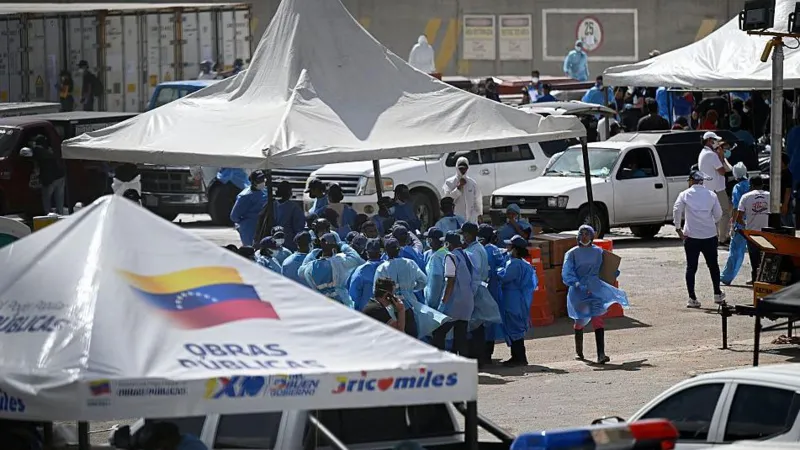
At a port storage facility transformed into a makeshift morgue in La Guaira, the same scene repeats itself again and again.
Families – many of whom have already spent days searching hospitals, shelters and rubble – wait hours to try and confirm the deaths of their loved ones.
As the death toll of Venezuela’s twin earthquakes surpasses 2,600, officials face the challenge of not only recovering victims, but identifying them.
The scale of the disaster has overwhelmed local services, forcing institutions to improvise.
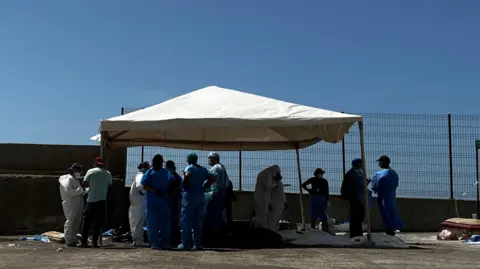
With little infrastructure left standing nine days after the tremors, bodies have been put outside or in temporary tents.
Under the blazing sun, dozens of families wait with a mixture of anguish and dread.
Rows of chairs have been placed inside and outside Los Silos, where sadness is contagious. No one speaks. Some stare blankly into space, others check their phones, reading the news or answering messages.
Just a few metres away, armed personnel from the Bolivarian Armed Forces control access to the site.
“I’m afraid of what I’m going to see in there, but it’s the only way to end this agony,” a woman says before passing through the gate. She has been searching for her nephew for nearly a week. “I’ve looked for him everywhere: in the building, in the hospitals, I’ve spoken to everyone… and no one knows anything.”
Inside, the smell of decomposition is the first thing that greets you. Some family members cover their mouths with their hands. Most wear cloth masks, which offer little relief. Within minutes, many stop reacting. They seem to grow used to it.
Nearby, hundreds of bodies lie in rows, wrapped in plastic bags and exposed to the sun. In the sweltering heat, decomposition is rapid.
The bodies are arranged according to when they were recovered.
At one end of the site, a tent offers free cremation services. At the other, forensic specialists use dental records to help identify victims whose bodies have become difficult to recognise.
Families face two options. Those who think they can identify a loved one by their clothing are taken to one area.
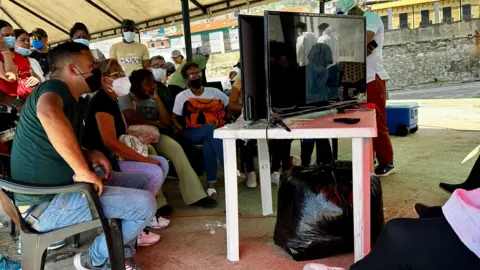
Most relatives, however, are directed to two television screens. There, a different ordeal begins.
More than 1,000 images of bodies flash across the screens in a sequence that feels endless. Many are swollen, have darkened skin or bear the marks of injuries, making identification difficult.
Families search for any trace that might help identify their loved ones – a tattoo, a bracelet, a piece of clothing, or an item from their home.
Sometimes there is a pause, a moment of hope. The two workers scrolling through the photos on an iPad zoom in on teeth, tattoos, or scars.
In front of one of the screens, a woman bursts into tears as she recognises her son thanks to a dusty blanket. Another woman, a stranger, embraces her.
A phone rings and breaks the silence. A young man whispers into the phone that he is trying to identify his mother. But he says the state of the bodies is making it difficult.
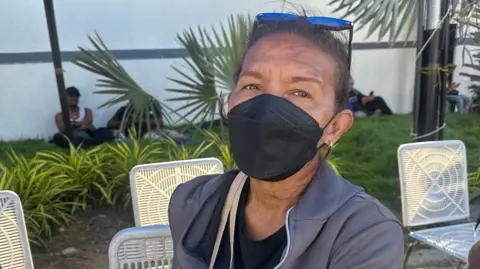
“This is like a horror movie,” Liliana González, a 60-year-old resident of Catia La Mar, says as she leaves. She had come to look for her aunt, but in the end identified her 37-year-old nephew by his tattoo. “He wasn’t on the list,” she says. “I had to look at the images.”
“I saw my mum when she died, but this… this isn’t the same.”
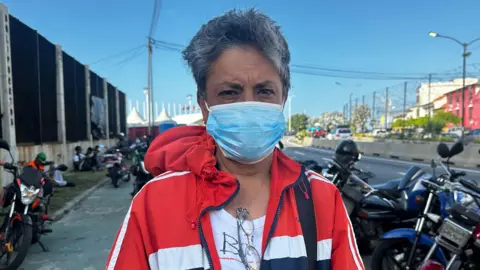
Modesta Alemán, 56, travelled from Carayaca, in western La Guaira, to look for her older sister Matilde. Her sister lived in Playa Grande – one of the hardest-hit areas.
“They told us there were no survivors,” she says. Volunteers later said they could hear voices calling from the building, “but no one could get them out”.
Modesta does not enter the makeshift morgue and waits outside while other relatives handle the identification process. Perhaps, she says, it is better this way.
The process can take hours. Once a body is identified, the arrangements to remove the remains begin. After identification, fingerprints are taken, if possible.
Then, the bodies are placed in coffins. Later, the paperwork for the death certificate begins – an essential document so funeral homes can collect the remains.
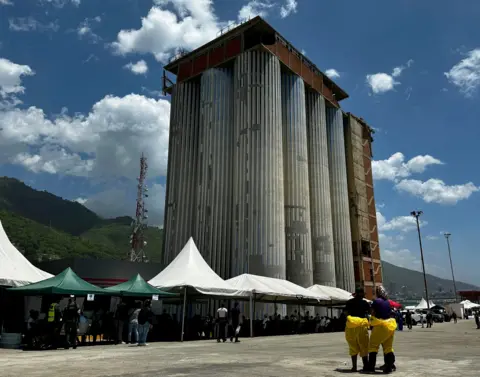
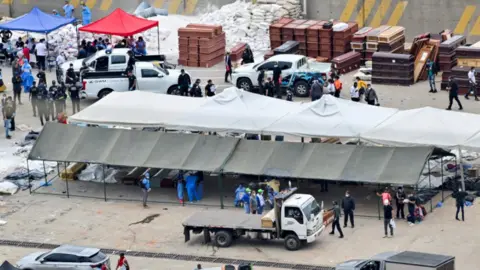
Jéssica Soto, 42, sits in a chair at the entrance to Los Silos.
For two days, she has been waiting for the remains of her 15-year-old daughter and three-year-old granddaughter, who got trapped in their apartment after the earthquakes. Their bodies were recovered on Tuesday, nearly a week later.
“They keep you waiting and waiting for the paperwork, the trucks, and who knows what else,” she tells BBC Mundo.
“They have had them there in a coffin, sitting out in the sun since yesterday. I have no choice but to wait and trust in God.”
Liliana says she panicked when she was told she would have to identify her nephew by herself. “But then, seeing me like that, two workers accompanied me to the body. They helped me find him so I wouldn’t suffer as much,” she recounts. “Thank God, because in a moment like that, it’s good to feel someone’s hand.”
Her aunt remains buried in the rubble. She fears having to return to the morgue in the coming days to repeat the process all over again.
[BBC]

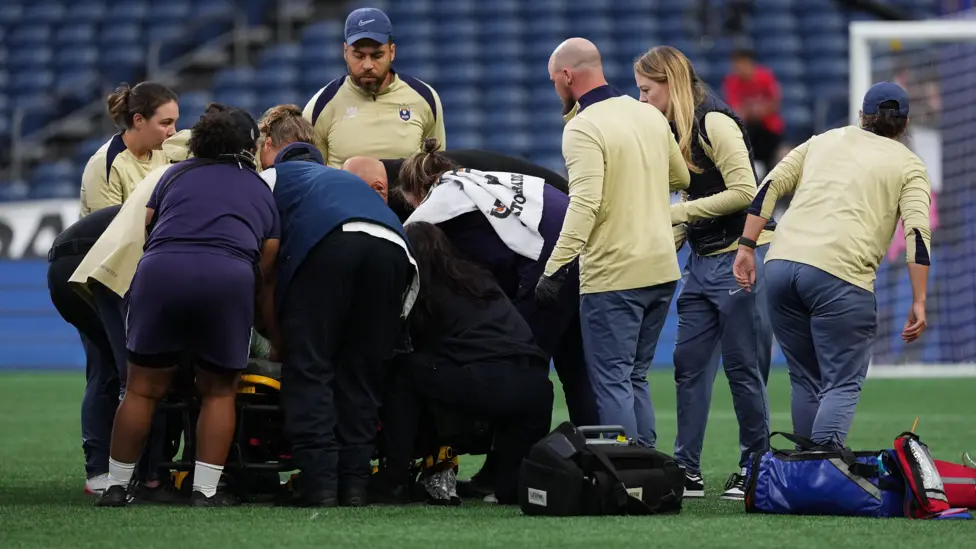
United States women’s national team player Savannah DeMelo is suing a hospital and two doctors after she suffered a cardiac arrest on the pitch last year.
Midfielder DeMelo, who has seven senior caps for the USA, has filed a lawsuit against University of Louisville Health (UofL Health) for negligence.
The 28-year-old, who plays for Racing Louisville, collapsed in the first half of a National Women’s Soccer League (NWSL) match on 14 September 2025.
According to documents seen by BBC Sport, the case was filed on Tuesday morning with Jefferson Circuit Court in Kentucky, where her club is based – a year and a day after her on-field collapse.
DeMelo’s filing claims UofL Health and two doctors, Dr Sarabjeet Suri and Dr Jennifer Daily, “failed to act as a reasonably prudent and competent medical practice, and such negligence was a substantial factor in causing DeMelo to suffer severe physical injuries, including, but not limited to, her cardiac arrest”.
Dr Daily, according to her online UofL biography, is Racing Louisville’s chief medical officer. The lawsuit states DeMelo was under the care of Dr Daily from January 2024 to July 2026.
It states that in March 2025, Dr Daily referred DeMelo to Dr Suri for “evaluation and treatment” after she had been complaining of chest pain, dizziness and shortness of air; Dr Suri obtained a history, performed a physical examination and ordered diagnostic tests.
Nearly six months later, DeMelo suffered the cardiac arrest.
“She was subsequently diagnosed and treated for ventricular tachycardia [an abnormal heart rhythm],” the suit states.
DeMelo, who has spent her entire professional career with Racing Louisville, has not played since her collapse.
In a post to her instagram page on Tuesday, De Melo – who was picked in the USA squad for the 2023 Women’s World Cup and started their first two games – marked the anniversary of the incident.
“A year ago today, while playing soccer, I collapsed due to an undiagnosed cardiac arrhythmia, that caused me to go into cardiac arrest,” she wrote.
“I respect and appreciate the privacy everyone has met me with while going through everything I have this year. I’ll never be able to fully put into words how emotionally hard this year has been. There has been a lot of uncertainty and emotions intertwined with it all.”
[BBC]

The Philippine Coast Guard says it has recovered 41 bodies from the wreckage of a ferry that caught fire this week, bringing the total death toll to 76.
More than 130 people were on board the MV June Aster when the blaze erupted on Wednesday as it neared its destination at the tourist hotspot of Coron, after departing from Manila.
The coast guard said on Saturday the number of survivors remained 43, with many receiving treatment in hospital, but 13 people remain unaccounted for.
Recovery of bodies had been hampered due to toxic fumes and lingering heat, which meant authorities were unable to board until Friday.
Geronimo Tuvilla, an official for the Philippine Coast Guard, said the priority was identifying victims and determining the cause of the blaze.
Kristine Ablana, a tourism official in Coron, said relatives were being asked to help identify family members through personal items and DNA testing.
“Once someone is able to verify that this photo or these belongings are indeed those of their relative, they will be asked to provide a DNA sample,” she said.
Coast Guard spokesperson Commodore Noemie Cayabyab said the fire began in a cargo hold before spreading.
She said survivors had described hearing a loud explosion, “the appearance of smoke and then fire. It spread very quickly”. She added that those who had made it off the ship did not have time to put on lifejackets.
A survivor who was hauled to safety on a rescue boat told the BBC he had heard frantic cries onboard when the fire erupted, and was trampled by panicked people as he tried to escape.
The ferry, built in 2002, held valid safety certificates and passed an enforcement inspection in March, but investigators are looking into potential manifest discrepancies, cargo loading integrity, and crew emergency response protocols, the Palawan Daily reported.
The vessel was carrying 117 passengers and 17 crew members.
Atienza Interisland Ferries, the vessel’s operator, has pledged full co-operation with the inquiry.
[BBC]
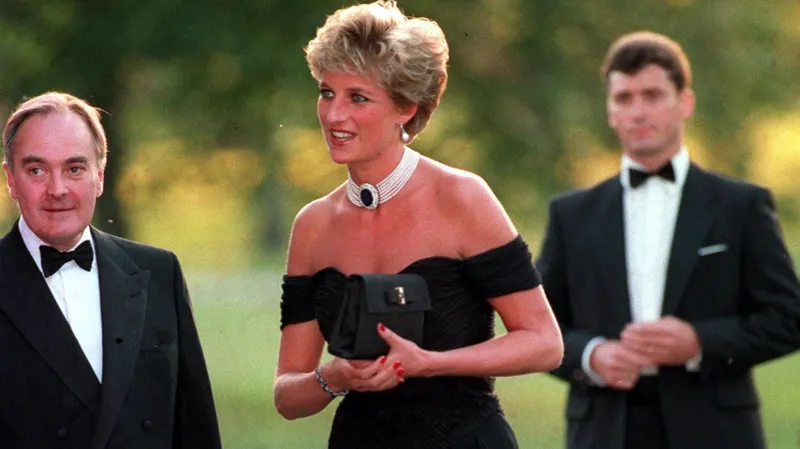
A dress worn by Princess Diana to a party in London hours after a documentary was televised in which the then-Prince Charles admitted to committing adultery during their marriage is going up for auction.
Her dramatic arrival at the Serpentine Gallery in 1994 in a custom-made black silk evening dress by designer Christina Stambolian became an iconic pop-culture moment.
The media dubbed her outfit the “revenge dress”.
Auction house Sotheby’s expects the dress to sell for up to £220,000 ($300,000) when it goes under the hammer on 9 December.
A press release from Sotheby’s said it is the first time the dress has been offered at auction since 1997, when the late princess sold 79 of her dresses to raise money for charities.
Morgane Halimi, Sotheby’s Global Head of Handbags and Fashion, said in a statement that Princess Diana “understood instinctively” that fashion can be a language in its own right.
“On her own terms, Princess Diana turned the dress into one of the most powerful messages she ever made, during one of the most scrutinised and emotionally charged episodes of her life,” Halimi said.
“She walked into a moment in which so much of her story was being told for her and, through what she chose to wear, reclaimed the narrative for herself.”

According to Sotheby’s, Anna Harvey, her stylist at the time, said Diana “wanted to look a million dollars”.
The princess made a last-minute wardrobe change for the fundraising dinner and chose the strapless evening dress by the Greek designer Christina Stambolian – which she accessorised with a royal jewel, a black clutch and black heels.
The vintage Jaguar XJ40 car that Diana arrived in at the event was sold at auction earlier this year for £66,250.
The revenge dress is expected to fetch a considerably higher price.
If it does, it will not be the first time an item from the princess’s wardrobe has sold for a significant sum.
Princess Diana’s sweater featuring a black sheep among rows of white ones was sold for £920,000 at an auction by Sotheby’s in New York in 2023.
[BBC]

Zimbabwean Tavengwa Mukuhlani appointed Deputy Chair of the ICC until November 2027.

DIMO KNIGHTS 2026 Reinforces a Culture of Recognition and Growth

Isle of Man teenage all-rounder Lucy Barnett ICC Women’s Player of the Month for August 2026

Sonal Dinusha named the ICC Men’s Player of the Month for August 2026.

USA midfielder sues doctors after on-pitch cardiac arrest

River home to 500 crocodiles chosen as Olympic rowing venue

‘Dates have the highest sugar content to fight Coronavirus’

Sunday Island 27 December – Headlines

#SundayIsland 17th December – Headlines

Sunday Island – 28th March

Sunday Island Headlines – 21 March

Sunday Island – 21st February – Headlines
-

 Sports7 days ago
DDS set to lose Test captaincy
-

 News7 days ago
Sri Lanka faces new grid challenge as rooftop solar surges: former CEB GM
-

 Latest News7 days ago
Shafali, Deepti power India into sixth T20 Asia Cup final
-

 News5 days ago
Gnanasara Thero absconding after SC ruling
-

 Latest News6 days ago
Sri Lanka thwart Fatima Sana challenge to secure Asia Cup final spot
-

 News6 days ago
Ammunition cache found in old Kandy bungalow
-

 Editorial7 days ago
A flight of fancy
-

 News6 days ago
Green Climate Fund (GCF) Regional Dialogue for East and South Asia will be held from 14 to 17 September 2026 at Cinnamon Life at City of Dreams Hotel, Colombo