
News
FBI identified Naufer Moulavi as Easter carnage mastermind – Public Security Minister


Hakeem points finger at Israeli Intelligence
By Saman Indrajith
Public Security Minister Rear Admiral (Retd.) Sarath Weerasekara told Parliament yesterday that the US Federal Bureau of Investigation (FBI) had identified Naufer Moulavi as the mastermind behind the Easter Sunday terror attacks.
Making a special statement to the House in response to a statement by Attorney General Dappula de Livera, Minister Weerasekera said that according to the investigations carried out by the Sri Lanka Police and US detectives, it was clear that Moulavi had masterminded the terror attacks on 21 April, 2019, killing 270 persons and wounding another 500.
“Naufer is the person who brought the IS ideology to Sri Lanka and roped in Mohamed Zahran in 2016,’ the Minister said, adding that it had been confirmed by the statements given by Zahran’s wife.
Minister Weerasekera said that it was Naufer who carried out IS training programmes in Sri Lanka and evidence from his documents and laptop support that conclusion. It was Moulavi who prepared the curriculum and course content of those IS training programmes. In addition, he supervised the training camps in Nuwara Eliya and Hambantota.
“Moulavi gave his sister-in-law in marriage to Zahran,” said the Minister adding that the FBI investigation also proved Moulavi was the main player in the attacks.
The Minister said it had come to light that several foreigners were involved in the Easter Sunday terrorist attacks and that an Australian national of Sri Lankan origin, Luqman Talib, had already been arrested in Qatar. Lankan intelligence agencies had uncovered links between Thalib and Al-Qaeda and IS. “Thalib has two sons and one son is already under house arrest in Australia. Sri Lankan forces have also traced four Maldivian suspects who financed the National Organiser of the Jamaat-e-Islami organization, Sadik Abdullah, and provided weapons manufacturing equipment. There is no need to have any doubt over the investigations on the Easter Sunday terror attacks.”
Nine cases had been filed against 32 suspects so far and necessary steps would be taken to file cases against the other suspects as well, the Minister said.
SJB Gampaha District MP Dr Kavinda Jayawardana said Mohamed Naufer, Mohamed Anwar Mohamed Riskan and Ahamed Milhan Hayathu Mohamed had been charged last month in a federal court in Los Angeles. But there were cases against them here yet. “In addition, the Attorney General has mentioned that there is a conspiracy behind these investigations. We as Catholic MPs have a serious problem when people question these statements and developments. We hope that either the Minister of Public Security or the Minister of Justice will explain to this House the actual situation with regard to the investigations.”
SLMC Leader Rauff Hakeem said that there were reports that Israeli intelligence services had a hand behind the Easter Sunday attacks and its mastermind. Facts related to this and that Israeli intelligence connection were mentioned in the report of the Presidential Commission of Inquiry into the Easter Sunday attacks, he added. “Please check these facts and study those reports. There is an innocent poet called Altaf Nazim. He is being held for publishing a poetry book, which contains nothing related to terrorism. Please, get the book translated and see its content. Many international organisations including Amnesty International have written to the government in this regard. Public trust in investigations is eroded when you prosecute innocent people. I also want to say that the case against Hejaaz Hizbullah is totally fabricated. He is held on statements forcibly obtained from children. He is a lawyer and past student of S. Thomas’ College. When you go after the innocent you cannot capture the real culprits.”
Minister Weerasekera: All those who are spaking now were the MPs or Ministers of the Yahapalana government which should be held responsible for the crime of weakening our intelligence and letting this tragic incident happen in spite of warnings. When the SIS recommended the arrest of Zahran in 2018, the then government authorities neglected that. Had Zahran been arrested then nothing of this sort would have happened. Therefore, all those in that government should be held responsible for the crime. There had been 10 incidents prior to the April 21 attacks, but no arrests had been made.
SJB MP Ranjith Madduma Bandara: It is wrong. It was during our government an open warrant for the arrest of Zahran was obtained. The conspirators are in the government.
Minister Weerasekera: MP Hakeem mentioned Hejaaz Hizbullah. The latter was the one who operated the Save the Pearl organisation under which he gave lectures to indoctrinate Muslim youth to the terror outfit. We have evidence of his lectures brainwashing them to make them terrorists. Zahran and Naufer Moulavi too had conducted lectures on suicide attacks to children. Those lectures were organised by Save the Pearl.






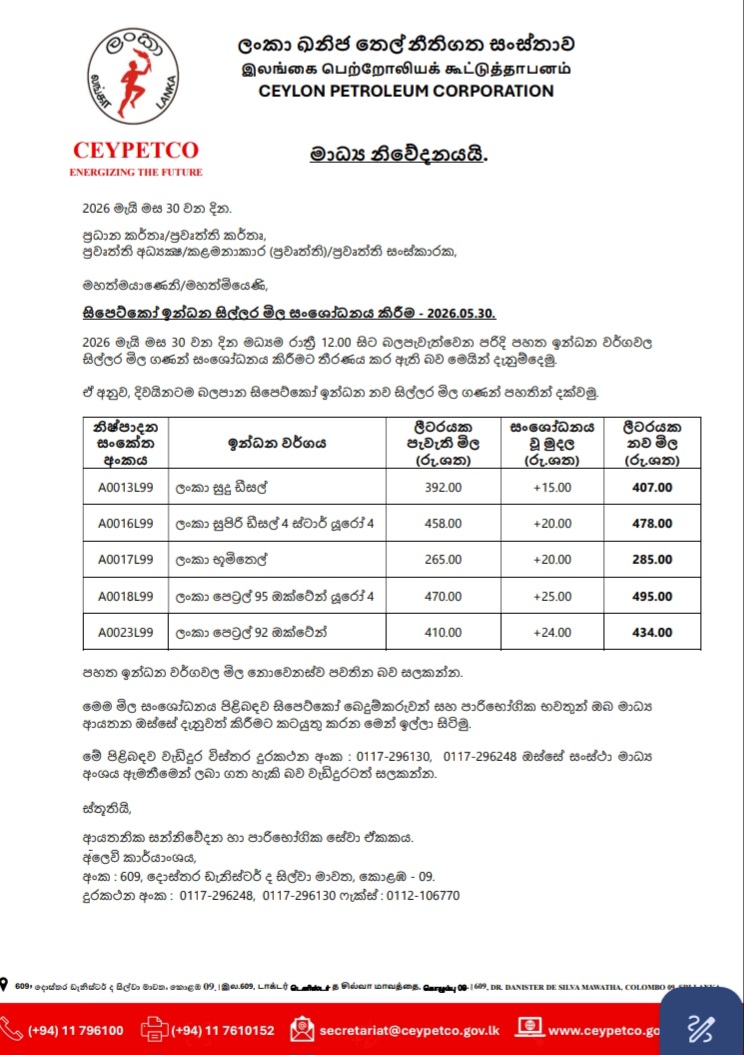
The Ceylon Petroleum Corporation (CEYPETCO) has announced a revision of fuel prices, effective from midnight on Saturday (May 30).
Accordingly,
the price of Auto Diesel has been increased by Rs. 15 to Rs.407 per liter,
the price of Super Diesel has been increased by Rs. 20 to Rs. 478 per liter.
the price of Petrol 92 Octane has been increased by Rs. 24 to Rs. 434 per liter
the price of Petrol 95 Octane up by Rs. 25 to Rs. 495 per liter
the price of kerosene by Rs. 20 to Rs. 285 per liter.

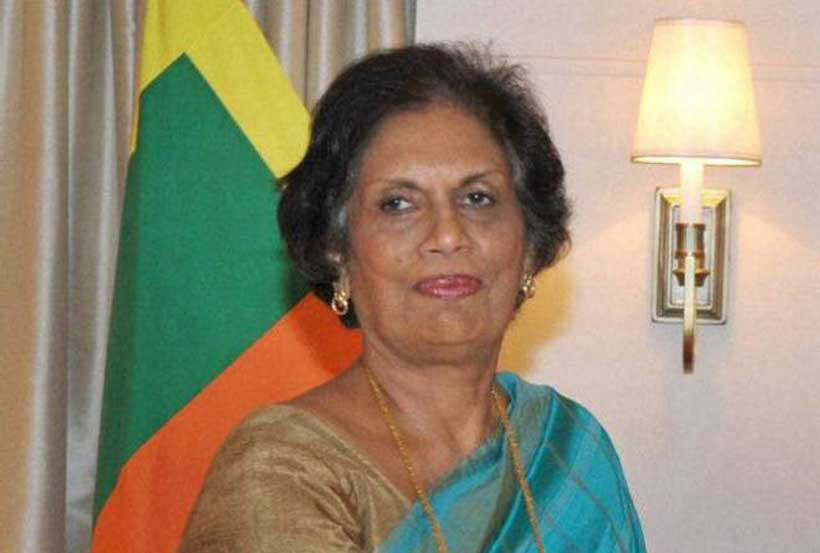
Former President Chandrika Bandaranaike Kumaratunga has called for a comprehensive reform programme within Sri Lanka’s Buddhist clergy, warning that repeated efforts to strengthen the Sasana have in the past been derailed by opposition from within sections of the Sangha itself.
In a statement addressed to the Mahanayake Theras of the three Buddhist chapters, Kumaratunga stressed that the long-term preservation of Buddhism depends on safeguarding both the Dhamma and Vinaya, or disciplinary code, and urged urgent internal reform to address what she described as deep-rooted structural weaknesses.
She noted that Buddhist history has consistently demonstrated that periods of institutional crisis were addressed through reform processes, citing precedents from the First Buddhist Council to reforms during the Kandyan era under Welivita Sri Saranankara Thera.
Referring to post-independence efforts, Kumaratunga said initiatives taken during the 1956 Bandaranaike administration to strengthen Buddhism were left incomplete following the assassination of former Prime Minister S.W.R.D. Bandaranaike.
She further stated that during her own presidency, plans to convene a Buddhist Council under the guidance of the late Madihe Pannasiha Mahanayake Thera had received government backing but were ultimately abandoned due to resistance from certain sections within the clergy.
The former President alleged that, on both occasions, vested interests benefiting from existing weaknesses within the Buddhist establishment had worked to obstruct meaningful reform efforts.
Warning that Buddhism in Sri Lanka is currently facing serious challenges, she called for a broad internal dialogue within the Sangha to identify root causes and implement both short- and long-term corrective measures.
Kumaratunga urged the Mahanayake Theras to take the lead in convening a Dharma Sanghayana, or Buddhist Council, and said she was prepared to work with senior lay Buddhist leaders to support such an initiative.
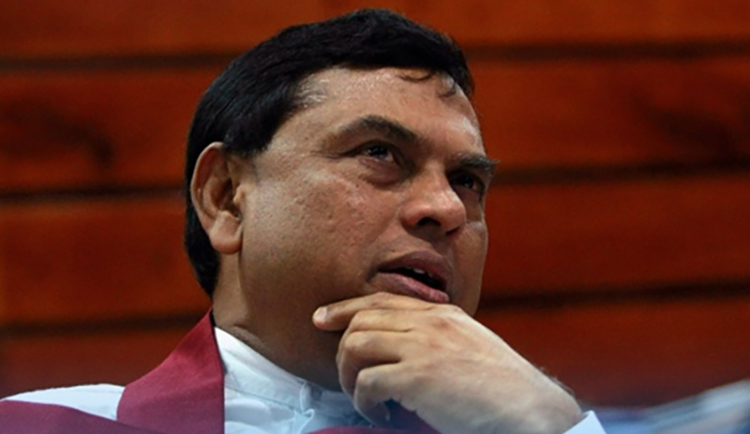
The Colombo Fort Magistrate’s Court on Friday ordered the arrest of former Minister Basil Rajapaksa, Tourism Promotion Bureau Chairman Bhashwara Gunaratne, Managing Director Rumi Jauffer and several others over the alleged misuse of Rs. 7.8 million belonging to the Tourism Promotion Authority during the 2014 Uva Provincial Council election campaign.
Magistrate Pasan Amarasena directed the Criminal Investigation Department (CID) to arrest and produce the suspects before court, after it was informed that they would be named under the Public Property Act on the advice of the Attorney General.
The CID told court that attempts to take the suspects into custody from their residences had been unsuccessful as they were not present.
The Magistrate also imposed an overseas travel ban on the suspects and ordered that the Controller of Immigration and Emigration be notified.
Investigations have reportedly revealed that the funds were used to print 12,000 T-shirts bearing an image of former President Mahinda Rajapaksa on one side and the name of a political party on the other.
According to the CID, the T-shirts were later distributed at a political event held in the Monaragala District.

‘Disappointing’ – Sangakkara on Sam Curran turning out for Surrey with IPL still on

Truck carrying Afghan returnees from Pakistan flips on highway, killing 18

PSG beat Arsenal to win back-to-back Champions League titles after shootout

What Hegseth’s comments at Shangri-La Dialogue say about US foreign policy

Home comfort vs championship pedigree as Gujarat Titans and Royal Challengers Bengaluru collide in IPL 2026 final

Minhas’ record-breaking debut sets up handsome Pakistan victory

‘Dates have the highest sugar content to fight Coronavirus’

Sunday Island 27 December – Headlines

#SundayIsland 17th December – Headlines

Sunday Island – 28th March

Sunday Island Headlines – 21 March

Sunday Island – 21st February – Headlines
-
 News6 days ago
Police probe underway to ascertain links between criminals deported from UAE and local politicians
-
 News5 days ago
Easter Sunday carnage: Court told Maulana’s statement cannot be accepted without cross-examination
-
 News1 day ago
IMF urges Lanka not to meddle with exchange rate
-
 News5 days ago
UK passport holder hiding here wants to have deportation order rescinded to leave without blemish
-
 Opinion5 days ago
Undermining the democratic political framework
-
 Features2 days ago
The Division Bell Mystery
-
 News6 days ago
Dickoya double murder suspect arrested
-
 Midweek Review4 days ago
Israeli-US aggression won’t go unanswered -Iranian Ambassador