
News
Estate workers sought a wage increase for their survival, not to lead a luxurious life –Sathasivam


by Douglas Nanayakkara in Nuwara Eliya
The purchasing power of plantation workers should be pushed up if they are to be healthy to work hard by eating a balanced diet at least once a day. This is the reason they are demanding a daily wage of Rs.1,000 so that they could fulfill their basic need to be healthy to work hard, said S. Sathasivam, president/general secretary of Ceylon Workers’ Alliance
He commended the Prime Minister cum Finance Minister for proposing a salary hike of Rs. 1,000 for estate workers in the budget for the first time in the history of Sri Lanka.
When tea estates were managed especially by the British, the workers had the privilege of enjoying a string of welfare measures such as the infrastructure, dry rations and so many other benefits that enabled the then estate owners to enhance
production and promote Ceylon tea to the entire world and earn substantial foreign exchange, he told a media conference at Cooperative Holiday Home in Nuwara Eliya last week.
“It is the tea industry that has been contributing to the GDP during and after the departure of the British. It should not be forgotten that our country was first popular for its finest tea the world over before it became famous for anything else”, he stressed.
After the government take-over of the tea estates soon after independence, they were handed over to the Sri Lanka State Plantation Corporation (SLSPC), Janatha Estate Development Board (JEDB) and USAWASAMA for management and administration. Even during the management of the estates by the government, securing wage hikes and welfare benefits were possible through trade union activities such as ‘work to rule’ or strikes, the former provincial councilor noted.
The Srima Shasthri Pact was in force during the 1960s. There was a decline in all aspects of the plantation industry. Everything came to a standstill as there was a scarcity of male workers as most of them left Ceylon for good. Some men were sent/transferred to other estates where there was an acute scarcity. This situation disrupted the unity that existed among the plantation community, Sathasivam asserted.
In 1992, the estates were handed over to private companies on lease while the government retained ownership. The estates were leased out with the intention of promoting the tea industry in the country as the management and maintenance of the estates were costly. The expectation was that the companies will look into the welfare and the other necessities and wages of the workers while earning profits, he explained.
The earlier practice to increase the wages was based on the cost of living index, as this was no other effective method. The companies urged the trade unions to enter into a Collective Agreement, and as a result, it was decided to increase the salaries/wages of the workers every two years, he further said.
Subsequently, the estates were not properly managed; there was no weeding, proper manuring, pruning, road maintenance and development carried out by these private companies. Consequently, the wonderful tea estates that brought immense foreign exchange turned into jungles and forests. Some of the estates were abandoned resulting in an increase in the breeding of leopards, wasps, snakes and bees , Sathasivam continued.
“We hear about deaths of leopard and snakes and wasp attacks. It is evident that the workers are faced with untold hardships but despite their suffering, the estate management continue to insist on 18kg of tea leaf for a day’s pay/wage”, he said.
Based on the cost of living index and commodity prices five years ago, the workers demanded a salary of Rs. 1,000 per day based on the then prices of coconut, sugar and flour. There were no luxury items included. Considering the skyrocketing prices of these commodities the government has decided to increase the salaries of estate workers through the budget by asking the private management companies to pay Rs. 1,000 per day, he added.
“We cannot compare the estate sector to any other labour related industrial sector as this requires very hard labour and lot of energy working under climatically adverse conditions whereas others don’t suffer as much. The estate management demanding higher performance without considering the adversities faced by the plantations workers is inhuman”, he noted.
Welfare activities beneficial to estate workers are not implemented by the companies. Recruitment is always done on a hire and fire policy. Most infrastructure and welfare facilities are provided by the government now and the money saved could be utilized to maintain estate fields that will give a good yield and minimize mortality by wild animal attacks, he suggested.
“Unattended tea estates can also be converted into profitable cash crop plantations”, he said.
“We insist that the companies should focus more on productive estates and fields that are managed properly for a good yield while protecting the workers by looking into their needs and welfare as they asked for a wage increase only for survival and not to lead a life of luxury”, Sathasivam added.

Latest News
Flood warning issued to the Divisional Secretariat Divisions of Ganga Ihala Korale, Udapalatha, Doluwa, Udunuwara, Yatinuwara, Gangawata Korale, Harispattuwa, and Pathadumbara


Due to heavy rainfall received in the upper catchment areas of the Mahaweli River over the past few hours, there is a risk of minor flooding in the low-lying areas surrounding the Mahaweli River within the Divisional Secretariat Divisions of Ganga Ihala Korale, Udapalatha, Doluwa, Udunuwara, Yatinuwara, Gangawata Korale, Harispattuwa, and Pathadumbara.Residents living in the above mentioned areas and motorists using roads passing through these areas are urged to exercise extreme caution and remain highly vigilant regarding the prevailing situation.
Furthermore, residents living in close proximity to the Mahaweli River in these areas are advised to remain highly alert to the situation and take all necessary precautions to protect themselves from any potential flooding.The relevant disaster management authorities are requested to take all necessary measures in response to this situation.

The National Building Research Organisation [NBRO] has issued landslide Red Alerts to the districts of Kandy, Kegalle and Nuwara Eliya effective from 14:00 hrs on 20.09.2026 To 14:00 hrs on 21.09.2026
Accordingly,
LEVEL III [RED] Land Slide early warnings have been issued to the Divisional Secretaries Divisions and surrounding areas of Pasbage Korale in the Kandy district, Dehiowita, Aranayake, Deraniyagala, Mawanella and Yatiyanthota in the Kegalle district and Kothmale West, Kotmale East, Ambagamuwa and Norwood in the Nuwara Eliya district
LEVEL II [AMBER] Land Slide early warnings have been issued to the Divisional Secretaries Divisions and surrounding areas of Padukka in the Colombo district, Nagoda, Thawalama and Neluwa in the Galle district, Bulathsinhala, Palindanuwara, Walallawita and Agalawatta in the Kalutara district, Ganga Ihala Korale in the Kandy district, Bulathkohupitiya and Kegalle in the Kegalle district, Akuressa and Pitabeddara in the Matara district, Thalawakele in the Nuwara Eliya district and Pelmadulla, Ratnapura, Ayagama, Kuruwita and Ratnapura in the Ratnapura district.
LEVEL I [YELLOW] Land Slide early warnings have been issued to the Divisional Secretaries Divisions and surrounding areas of Seethawaka in the Colombo district, Niyagama and Baddegama in the Galle district, Mirigama in the Gampaha district, Ingiriya in the Kalutara district, Udapalatha and Yatinuwara in the Kandy district, Galigamuwa, Warakapola and Ruwanwella in the Kegalle district, Kotapola, Pasgoda and Athuraliya in the Matara district, and Eheliyagoda, Kalawana and Elapatha in the Ratnapura district.
News
Development projects can deliver results to the people more quickly when the political authority and the public service work together towards a common goal – PM
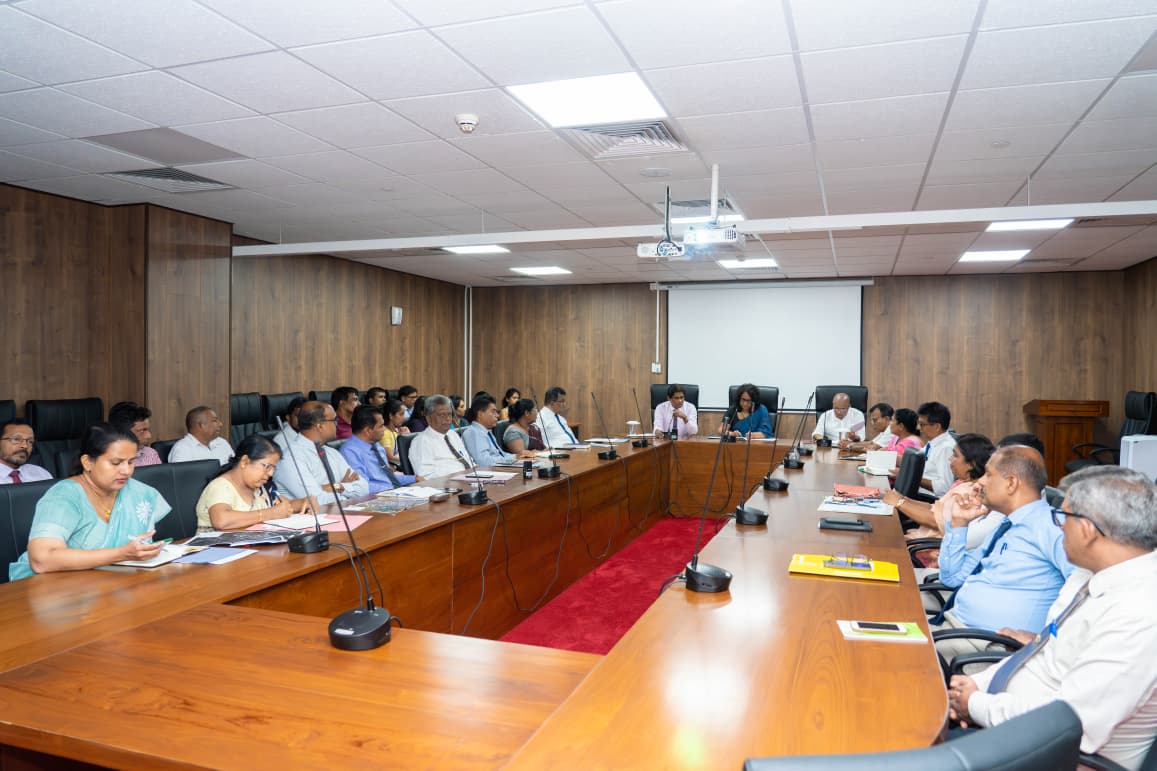
Prime Minister Dr. Harini Amarasuriya stated that development projects can deliver results to the people more quickly when the political authority and the public service work together towards a common, people-oriented objective.
The Prime Minister made these remarks while participating in a discussion held on Friday [September 18] at the Western Province Council Auditorium to review the progress of the development project to rehabilitate Rathmalana Kandawala Road and the drainage system on either side of the road, within the Dehiwala–Mount Lavinia Municipal Council limits in the Colombo District.
The project, which commenced on September 10, 2026, is scheduled to be completed before June 30, 2027. Implemented by the Provincial Road Development Authority (PRDA), the project includes the construction of a bridge at a cost of Rs. 64 million, the rehabilitation of the drainage system at a cost of Rs. 930 million, and the rehabilitation of the road at a cost of Rs. 115 million.
The Prime Minister also paid special attention to the progress of the responsibilities assigned to the Western Province Council, the Irrigation Department and the Ratmalana Divisional Secretariat in accordance with decisions taken at the previous committee meeting. Attention was also given to the current status of the plans being carried out by the Sri Lanka Land Development Corporation (SLLRDC), as well as the construction and maintenance activities being undertaken by the Provincial Road Development Authority (PRDA).
Commending the expedite and commendable progress of the project, the Prime Minister particularly appreciated the commitment demonstrated by officials of the relevant government institutions to work in close coordination with one another and in collaboration with the political authority.
The Prime Minister also emphasised the importance of taking measures well in advance to control flooding and minimise its impact on Colombo and several other districts in view of the rainy weather that may affect the Western Province during the latter part of this year.
The meeting was attended by the Chairman of the Colombo District Coordinating Committee and Member of Parliament Lakshman Nipuna Arachchi, Chairperson of the Ratmalana Divisional Coordinating Committee and Member of Parliament Samanmalee Gunasinghe, Chairman of the Roads Sub-Committee of the Colombo District Coordinating Committee Dewananda Suraweera, Mayor of the Dehiwala–Mount Lavinia Municipal Council Parakum Shantha, Chief Secretary of the Western Province K.G. Pradeep Pushpakumara, along with a number of government officials.
[Prime Minister’s Media Division]

Flood warning issued to the Divisional Secretariat Divisions of Ganga Ihala Korale, Udapalatha, Doluwa, Udunuwara, Yatinuwara, Gangawata Korale, Harispattuwa, and Pathadumbara

Landslide Red Alerts issued to the districts of Kandy, Kegalle and Nuwara Eliya

Shafali dazzles with 49-ball unbeaten 100 and India march into Asian Games final

Development projects can deliver results to the people more quickly when the political authority and the public service work together towards a common goal – PM

Landslide Early Warnings issued to the Districts of Colombo, Galle, Kalutara, Kandy, Kegalle, Matara, Nuwara Eliya and Ratnapura

Chamari Athapaththu’s unbeaten 83 leads Sri Lanka into final

‘Dates have the highest sugar content to fight Coronavirus’

Sunday Island 27 December – Headlines

#SundayIsland 17th December – Headlines

Sunday Island – 28th March

Sunday Island Headlines – 21 March

Sunday Island – 21st February – Headlines
-

 Opinion7 days ago
From Galkissa (Mount Lavinia) to Tambuttegama
-

 News4 days ago
US embassy won’t comment on IGP’s probe into joint drug raid
-

 Features6 days ago
The emptying university: why are academics leaving?
-

 Features7 days ago
Sri Lanka’s university crisis: Brain drain and union action demand urgent reform
-

 News3 days ago
Bid for Basil’s extradition nears final stage: Police
-

 Opinion7 days ago
Ashraff: From the SLMC towards the National Unity Alliance
-

 Business4 days ago
All-new Bolero MaXX unveiled in Sri Lanka
-

 Editorial7 days ago
Muscle flexing, astroturfing and dog-and-pony shows