
News
Estate workers sought a wage increase for their survival, not to lead a luxurious life –Sathasivam


by Douglas Nanayakkara in Nuwara Eliya
The purchasing power of plantation workers should be pushed up if they are to be healthy to work hard by eating a balanced diet at least once a day. This is the reason they are demanding a daily wage of Rs.1,000 so that they could fulfill their basic need to be healthy to work hard, said S. Sathasivam, president/general secretary of Ceylon Workers’ Alliance
He commended the Prime Minister cum Finance Minister for proposing a salary hike of Rs. 1,000 for estate workers in the budget for the first time in the history of Sri Lanka.
When tea estates were managed especially by the British, the workers had the privilege of enjoying a string of welfare measures such as the infrastructure, dry rations and so many other benefits that enabled the then estate owners to enhance
production and promote Ceylon tea to the entire world and earn substantial foreign exchange, he told a media conference at Cooperative Holiday Home in Nuwara Eliya last week.
“It is the tea industry that has been contributing to the GDP during and after the departure of the British. It should not be forgotten that our country was first popular for its finest tea the world over before it became famous for anything else”, he stressed.
After the government take-over of the tea estates soon after independence, they were handed over to the Sri Lanka State Plantation Corporation (SLSPC), Janatha Estate Development Board (JEDB) and USAWASAMA for management and administration. Even during the management of the estates by the government, securing wage hikes and welfare benefits were possible through trade union activities such as ‘work to rule’ or strikes, the former provincial councilor noted.
The Srima Shasthri Pact was in force during the 1960s. There was a decline in all aspects of the plantation industry. Everything came to a standstill as there was a scarcity of male workers as most of them left Ceylon for good. Some men were sent/transferred to other estates where there was an acute scarcity. This situation disrupted the unity that existed among the plantation community, Sathasivam asserted.
In 1992, the estates were handed over to private companies on lease while the government retained ownership. The estates were leased out with the intention of promoting the tea industry in the country as the management and maintenance of the estates were costly. The expectation was that the companies will look into the welfare and the other necessities and wages of the workers while earning profits, he explained.
The earlier practice to increase the wages was based on the cost of living index, as this was no other effective method. The companies urged the trade unions to enter into a Collective Agreement, and as a result, it was decided to increase the salaries/wages of the workers every two years, he further said.
Subsequently, the estates were not properly managed; there was no weeding, proper manuring, pruning, road maintenance and development carried out by these private companies. Consequently, the wonderful tea estates that brought immense foreign exchange turned into jungles and forests. Some of the estates were abandoned resulting in an increase in the breeding of leopards, wasps, snakes and bees , Sathasivam continued.
“We hear about deaths of leopard and snakes and wasp attacks. It is evident that the workers are faced with untold hardships but despite their suffering, the estate management continue to insist on 18kg of tea leaf for a day’s pay/wage”, he said.
Based on the cost of living index and commodity prices five years ago, the workers demanded a salary of Rs. 1,000 per day based on the then prices of coconut, sugar and flour. There were no luxury items included. Considering the skyrocketing prices of these commodities the government has decided to increase the salaries of estate workers through the budget by asking the private management companies to pay Rs. 1,000 per day, he added.
“We cannot compare the estate sector to any other labour related industrial sector as this requires very hard labour and lot of energy working under climatically adverse conditions whereas others don’t suffer as much. The estate management demanding higher performance without considering the adversities faced by the plantations workers is inhuman”, he noted.
Welfare activities beneficial to estate workers are not implemented by the companies. Recruitment is always done on a hire and fire policy. Most infrastructure and welfare facilities are provided by the government now and the money saved could be utilized to maintain estate fields that will give a good yield and minimize mortality by wild animal attacks, he suggested.
“Unattended tea estates can also be converted into profitable cash crop plantations”, he said.
“We insist that the companies should focus more on productive estates and fields that are managed properly for a good yield while protecting the workers by looking into their needs and welfare as they asked for a wage increase only for survival and not to lead a life of luxury”, Sathasivam added.

News
Karu argues against scrapping MPs’ pension as many less fortunate members entered Parliament after ’56


Former Speaker of Parliament Karu Jayasuriya has written to President Anura Kumara Dissanayake expressing concerns over the proposed abolition of MPs’ pensions.The letter was sent in his capacity as Patron of the Former Parliamentarians’ Caucus.
In his letter, Jayasuriya noted that at the time of Sri Lanka’s independence, political participation was largely limited to an educated, affluent land-owning elite. However, he said a significant social transformation took place after 1956, enabling ordinary citizens to enter politics.
He warned that under current conditions, removing parliamentary pensions would effectively confine politics to the wealthy, business interests, individuals engaged in illicit income-generating activities, and well-funded political parties. Such a move, he said, would discourage honest social workers and individuals of modest means from entering public life.
Jayasuriya also pointed out that while a small number of former MPs, including himself, use their pensions for social and charitable purposes, the majority rely on the pension as a primary source of income.
He urged the President to give due consideration to the matter and take appropriate action, particularly as the government prepares to draft a new constitution.The Bill seeking to abolish pensions for Members of Parliament was presented to Parliament on 07 January by Minister of Justice and National Integration Dr. Harshana Nanayakkara.

Five suspects, including former Minister Johnston Fernando and his two sons, who were arrested by the Financial Crimes Investigation Division (FCID), were further remanded until 30 January by the Wattala Magistrate’s Court yesterday.
The former Minister’s , sons Johan Fernando and Jerome Kenneth Fernando, and two others, were arrested in connection with the alleged misuse of a Sathosa vehicle during Fernando’s tenure as Minister.
Investigations are currently underway into the alleged misuse of state property, including a lorry belonging to Lanka Sathosa, which reportedly caused a significant financial loss to the state.
In connection with the same incident, Indika Ratnamalala, who served as the Transport Manager of Sathosa during
Fernando’s tenure as Minister of Co-operatives and Internal Trade, was arrested on 04 January.
After being produced before the Wattala Magistrate’s Court, he was ordered to be remanded in custody until 09 January.The former Sathosa Transport Manager was remanded on charges of falsifying documents.
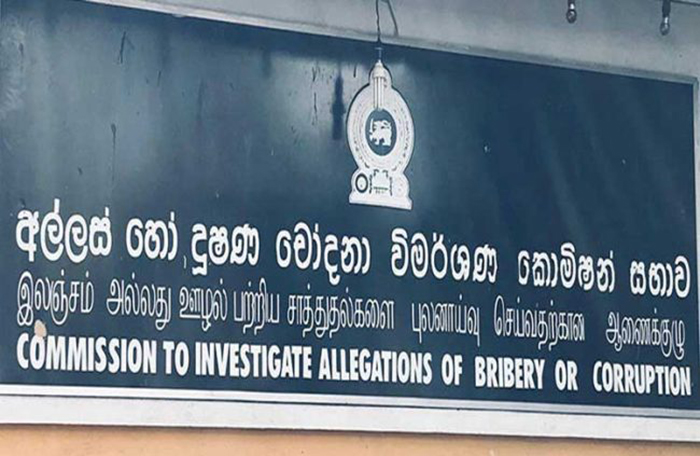
The Commission to Investigate Allegations of Bribery or Corruption (CIABOC) yesterday informed the Colombo Magistrate’s Court that indictments had been filed in the Colombo High Court against former Minister and NDF Badulla District MP Chamara Sampath Dassanayake over a corruption allegation.
The Bribery Commission notified the court when the case, in this regard, was taken up yesterday before Colombo Chief Magistrate Asanga S. Bodaragama.
At the hearing, the CIABOC notified the court that indictments had been presented before the Colombo High Court against the accused.
Accordingly, concluding the proceedings before the Magistrate’s Court, the Magistrate ordered MP Dassanayake to appear before the High Court once a notice was issued.

Alleged drug kingpin and ex-Olympian Ryan Wedding arrested after years on the run

Showers above 50 mm are likely at some places in the Northern, North-central, and North-western provinces and in Trincomalee district

Karu argues against scrapping MPs’ pension as many less fortunate members entered Parliament after ’56

Johnston, two sons and two others further remanded over alleged misuse of vehicle

CIABOC indicts MP Chamara Sampath in HC on bribery allegation

High-level discussion held to enhance Sri Lanka Agricultural Productivity with Chinese assistance

‘Dates have the highest sugar content to fight Coronavirus’

Sunday Island 27 December – Headlines

#SundayIsland 17th December – Headlines

Sunday Island – 28th March

Sunday Island Headlines – 21 March

Sunday Island – 21st February – Headlines
-

 Editorial6 days ago
Illusory rule of law
-

 Features6 days ago
Daydreams on a winter’s day
-
 Features6 days ago
Surprise move of both the Minister and myself from Agriculture to Education
-

 Features5 days ago
Extended mind thesis:A Buddhist perspective
-

 Features6 days ago
The Story of Furniture in Sri Lanka
-

 Opinion4 days ago
American rulers’ hatred for Venezuela and its leaders
-
 Features6 days ago
Writing a Sunday Column for the Island in the Sun
-
 Business2 days ago
CORALL Conservation Trust Fund – a historic first for SL