
News
EPF asked to pay 30% tax unless it participates in domestic debt restructuring process

Banks, which pay taxes over 50%, least affected
By Sanath Nanayakkare
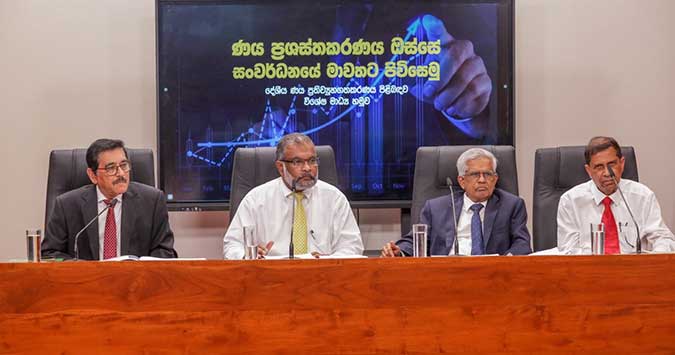
If the Employees’ Provident Fund (EPF) and other pension funds did not wish to participate in the proposed domestic debt restructuring process, there will be an application of higher annual income tax of 30%, Central Bank Governor Dr. Nandalal Weerasinghe said yesterday. The EPF is currently taxed at the rate of 14%.
Dr. Weerasinghe said so, addressing the media in Colombo.Finance Ministry Secretary Dr. R. Samaratunga, Treasury Secretary Mahinda Siriwardena were also present. Dr. Weerasinghe said, “Banking sector has already borne a significant burden of the fiscal adjustment and the economic crisis in several ways. The banking sector has been paying higher tax rates than other corporations.
The total tax burden on the banking sector, which is serving 57 million customer deposits, is more than 50%. Through high tax payment, the banking sector is helping the government’s fiscal consolidation efforts. Further, banks gave moratoriums and faced the brunt of non-performing loans during the Covid-19 pandemic. So, any disturbance to financial system stability could be costly. And disruptions to the banking system will adversely impact the effective transmission of monetary policy. So, the main effort is preserving the 57 million customer deposits in the banks and letting no room for a bank run.
“In contrast, superannuation funds are subject to a tax of 14%. It has been proposed for superannuation bonds to be exchanged for longer term maturity T-Bonds at a coupon rate of 12% until 2025m which will be 9% minimum beyond 2025. So, there is at least 9% return on EPF funds ensured on a long-term basis while there will be no reduction on the current balance of any individual’s EPF. In the event it has to be lowered below 9%, the Treasury has agreed to fill the balance.
“If superannuation funds don’t want to take part in this process, they will be liable to be taxed at 30% instead of the current 14%.”
The minimum participation requirement for EPF is set at 50% for outstanding bonds maturing in 2023 and 100% of bonds maturing between 2024 and 2032, according to CBSL.
Speaking further the CBSL Governor said:
“What we expect from this is to bring the government debt stock to a sustainable level within 10 years as per the agreement with the IMF. The number one benchmark in this context is reducing the public debt to GDP to 95 % from 128%. Secondly, the Gross Financing Needs (GFN) of the government needs to be reduced to below 13% of GDP from 34.6 % of GDP between now and 2032. Thirdly, Foreign Debt Servicing needs to be reduced to below 4.5 % of GDP from the current 9.4 % of GDP within the same period. If these targets are achieved, it should help close external financing gaps of USD 16.9 billion. For this, we need to restructure loans obtained from official bilateral creditors such as Japan and China.
Then there is the need for restructuring international sovereign bonds (ISBs) and negotiations are underway for these two elements. Our foreign exchange debt service target is set at 4.5% max. of GDP in 2027-2032. Thirdly, it is important to restructure domestic debt in some form and that is why we are presenting a plan to execute it. One available option in optimizing government debt is to increase taxes and improve the Primary Account Balance. These measures have already been taken. So, the remaining option is restructuring government debt stock through optimization of Treasury Bills and Treasury Bonds. At present Treasury Bill stock is worth LKR 4.1 trillion. 62.4 % of it is owned by the Central Bank of Sri Lanka (CBSL). CBSL has already agreed that its holdings of Treasury Bills would be converted to Treasury Bonds because this will help reduce gross financing needs of the government. And there are
Treasury Bonds worth of Rs. 8.7 trillion of which 20.5% is from superannuation funds including the Employee Provident fund (EPF); 36% from the banks and the balance from insurance funds and other private funds. So, we are looking at the best solution which can protect the banks, depositors and the EPF. That’s why CBSL has agreed to take part in these domestic debt optimization negotiations,” Dr. Weerasinghe said.











News
Cabinet nod to increase the number of new automated passenger clearance gates at the Bandaranayake International Airport to 12


Approval of the Cabinet of Ministers was granted at their meeting held on 19.05.2025 to purchase four (04) automated passenger clearance gates for Bandaranayake International Airport.
In addition, it is expected to extend the automated passenger clearance gates facility so far given only to the Sri Lankans
parallel to the e – passport issuance system to be introduced in the year 2027 also to the foreigners who travel to and from this country.
Furthermore, considering also the number of air passengers rapidly increasing with the fast – forwarding business and tourism field, the appropriateness to increase the total automated passenger clearance gates up to twelve (12) in number has been recognized.
Accordingly, the Cabinet of Ministers, approved the resolution furnished by the Minister of Public Security and Parliamentary Affairs to initiate the procurement and installation of 12
automated passenger clearance gates altogether with the already approved four (04) and another eight (08) automated passenger clearance gates adhering to the formal procurement procedure
Based on the observations submitted by the Task Force on Prevention of Money Laundering and Financing for Terrorism, approval of the Cabinet of Ministers was granted at their meeting held on 18.12.2024 to amend the Trust Ordinance No. 9 of 1917 including amendments proposed by the Financial
Intelligence Unit of the Central Bank of Sri Lanka.
Accordingly, clearance of the Attorney General has been granted for the Trust (Amendment) Draft Bill formulated by the Legal Draftsman.
Therefore, the Cabinet of Ministers approved the resolution furnished by the Minister of Justice and National Integration
to publish the said draft bill in the government gazette notification and thereby, submit the same to the Parliament for its concurrence.
Action was taken to provide a fuel relief for the fuel consumers during the months of April, May and June of 2026 to redress by minimizing the impact caused to the day today life of the citizens of this country as well as the entire economy due to the price hike of petroleum fuel in the global market resulting from the war situation in the Middle East.
Government mediation is essential for minimizing the impact on the day to today life of citizens in this country due to that war situation not being ended further. Therefore, it has been planned to redress on the sale price for Auto Diesel and Industrial Diesel for a period of 03 months by the Government to provide relief to the public as well as to maintain the prices at a bearable level to the consumers without escalating the fuel prices in this country compared to the escalation of fuel prices
in the international market.
Therefore, the Cabinet of Ministers granted approval for the resolution furnished by the President in his capacity as the Minister of Finance, Planning and Economic Development to
allocate provisions subject to the monthly limitations respectively as rupees 15 billion for the month of October, rupees 13.5 billion for the month of November and rupees 12.15 billion for the month of December to provide the said relief

Cabinet nod to increase the number of new automated passenger clearance gates at the Bandaranayake International Airport to 12
Draft Bill for amending the Trust Ordinance
Implementing further relief programme to Public sffected by the Middle East conflict situation
Establishment of a Spectrum Management and Monitoring System and a Quality of Service and Quality of Experience System for the Telecommunications Regulatory Commission of Sri Lanka
Appointment of a Committee for the Restitution of Sri Lankan Cultural Heritage Held Abroad
Ten-Year National Action Plan on the Social Protection Sector (2026–2035)

‘Dates have the highest sugar content to fight Coronavirus’

Sunday Island 27 December – Headlines

#SundayIsland 17th December – Headlines

Sunday Island – 28th March

Sunday Island Headlines – 21 March

Sunday Island – 21st February – Headlines
-

 News7 days ago
Mastermind Naufer Moulavi among 15 found guilty
-

 Midweek Review7 days ago
Thileepan’s fast unto death: An authentic narrative that many missed
-

 Latest News6 days ago
Showers above 100 mm are likely at some places in the Western, Sabaragamuwa, Central and North-western provinces and in Galle and Matara Districts
-

 Editorial7 days ago
Big Bad Bills
-
Editorial6 days ago
Crimes punished and unpunished
-

 Features5 days ago
Beyond traditional jobs: Why Sri Lanka needs to facilitate the gig economy
-

 News7 days ago
No referendum needed for passage of 22 A: SC
-

 News7 days ago
One clause in Anti-Corruption (Amendment) Bill requires referendu: SC