
Business
Education equity in Sri Lanka: A pathway out of poverty

By Wimal Nanayakkara
Although Sri Lanka has provided universal free education since 1939, around one-fifth of poor children drop out of school after the age of 14 years and another-two thirds after the age of 16 years. Comparison of estimates based on the Household Income and Expenditure Survey (HIES)-2012/13 and HIES-2016, conducted by the Department of Census and Statistics (DCS), show only a marginal improvement.
With the closure of schools following the COVID-19 outbreak and the sudden shift to online learning, poor children with no access to e-learning opportunities risk falling even further behind. In this context, some proposals made in budget 2021 to improve the education system and reduce poverty will benefit poor children who have been disproportionately affected by the pandemic. This blog highlights some of the education-related difficulties faced by poor children in Sri Lanka based on HIES data and the recent budget proposals which could help them to overcome these difficulties.
Poor children out of school
 A large proportion of poor children are dropping out of school after 14 years, and the percentage of poor children (15-16 years) not attending school has declined only by 4.2, between the two survey periods. Among poor children aged between 17-18 years, this figure has remained almost unchanged at nearly 65%. The corresponding percentages for non-poor children are much lower (Table 1).
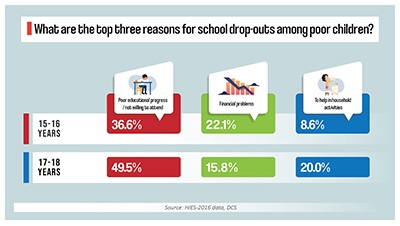
Out of the poor children (15-16 years) who leave the education system, more than 66% left mainly due to “poor educational progress/not willing to attend” (36.6%), “financial problems” (22.1%), or to “help in housekeeping /other activities of the household” (8.6%). The corresponding percentages of poor children (17-18 years) were 49.5, 15.8 and 20.0 respectively. One of the reasons for poor education progress could be inadequate nutritional intake. The HIES-2016 shows that the per capita energy consumption of poor households with children (5-18 years) is less than 75% [or 1513 kilo calories per capita a day (kcpcad)] of the recommended energy requirement (2030 kcpcad). The corresponding consumption of non-poor households is 2081 kcpcad, above the recommended requirement.
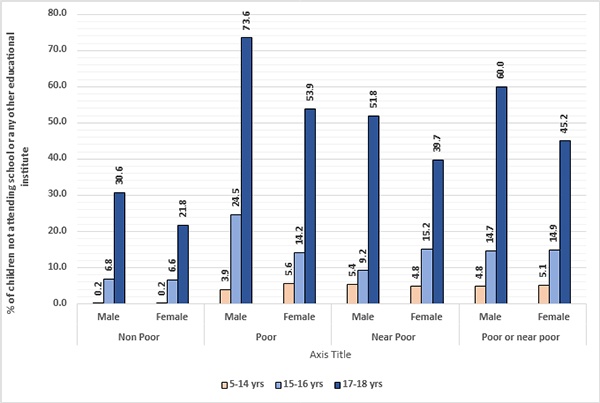
As there is a possibility for some of the near-poor children to slip into poverty, due to the effects of COVID-19, it is important to consider both poor and near-poor. Figure (1) shows the proportions of early school leavers are very high for poor and near-poor children compared to non-poor. There is also a significant gender gap, especially among the poor and near-poor.
For example, 73.6% of poor boys aged 17-18 years are out of school compared to 53.9% of poor girls in this age group. The corresponding percentages for the 15-16 age group are 24.5 and 14.2 respectively. A similar pattern is observed for near-poor children and even non-poor children, although the proportions are significantly low for non-poor.
Inadequacy of facilities for online learning
Inequality in education can be further widened as not all children have the necessary facilities for online learning during prolonged curfews, lockdowns or when schools are kept closed indefinitely. According to the Computer Literacy Survey –2019 (DCS), only 22.2% of the households in Sri Lanka own a desktop/laptop computer (Urban: 38.3%; Rural: 19.9% and Estate: 3.8%). According to the Telecommunications Regulatory Commission (TRC) of Sri Lanka, there were a total of 1.53 million fixed internet subscribers and 5.73 million mobile subscribers in 2018. However, the use of smartphones would be limited, especially in remote rural areas, where broadband internet facilities are weak and there is no information on the extent of smartphone users among the poor.
‘E-Thaksalawa’ the national e-learning portal of the Ministry of Education (MoE), is facilitating e-learning for students (Grade 1 to Advanced Level). But some children, cannot access them at present due to the lack of facilities or means. Broadband internet facilities, a computer/laptop or a smartphone and sufficient data are essential to download available study material.
 As highlighted in a previous IPS blog, the best option therefore would be to use television (TV) as 86% (HIES-2016) of households in the country own TVs (Urban: 88.9%; Rural: 86.1% and Estate: 81.2%). The ‘Guru Gedara’ distance learning programme of the MoE broadcast by Channel Eye/Nethra TV, ART TV and Ada Derana, for students from Grade 3 to GCE (A/L) are both in Sinhala and Tamil. The SLBC is also broadcasting these lessons for the benefit of children who do not have access even to a TV.
This is an excellent and innovative way for poor children to continue their studies in a stream of their choice, who may be leaving education prematurely due to lack of facilities, especially teachers, to teach science/ technology subjects, mathematics, languages, etc., in rural/estate schools and non-national schools.
Budget proposals
Budget 2021 has some proposals which, if implemented, could solve most of the issues highlighted above. They will benefit the poor and vulnerable children, who are facing difficulties in continuing their education, explained above. The proposals are also aimed at developing the entire education system with special emphasis on skills development, to meet the ever-increasing demand for high skills and also to provide necessary facilities.
A summary of some of the most important proposals are:
• ‘Gamata Sannivedanaya’ to provide 4G/Fiber broadband facilities to cover all Grama Niladhari divisions; internet facilities to all schools.
• ‘E-Thaksalawa’ learning portal to be strengthened further to minimise the difficulties faced by students in rural / estate and non-national schools.
• ‘Guru Gedara’ programme to be made available to all students, by providing TV sets to schools in difficult areas.
• Improving and expanding the opportunities for vocational/technical education, which will be extremely useful in developing the necessary skills in a rapidly changing environment.
The early implementation of these proposals could pave the way to breaking the vicious poverty trap through equitable education and ensuring that no child is left behind.
Link to original ‘Talking Economics’ blog: https://www.ips.lk/talkingeconomics/2020/12/28/education-equity-in-sri-lanka-a-pathway-out-of-poverty/
Wimal Nanayakkara is a Senior Visiting Fellow at the Institute of Policy Studies of Sri Lanka (IPS) with research interests in poverty, and is a specialist in sampling. He was previously engaged at the Department of Census and Statistics, where he functioned as the Director General for 12 years. He received his BSc in Mathematics and Physics from the University of Peradeniya and holds a Postgraduate Diploma in Applied Statistics from the University of Reading, UK. (Talk to Wimal – wimal@ips.lk)


By Hiran H. Senewiratne
Sri Lanka’s financial literacy rate is approximately 58 percent. Such literacy is absolutely necessary for the inclusion of people in the country’s financial system which in turn is central to overall economic development, Central Bank Governor Dr. Nandalal Weerasinghe said.
‘One needs to have knowledge and skills of a financial nature to figure in financial inclusiveness. While 86 percent of Sri Lanka’s population has access to the country’s financial system, 82 percent of the public has at least a savings account in the country’s banking system, Dr Weerasinghe said.
The Governor made these comments recently at the inauguration of Financial Literacy Month 2026 at the Central Bank’s Centre for Banking Studies, Rajagiriya.
Dr. Weerasinghe added: ‘Suitable, affordable and quality financial instruments are needed to enhance financial literacy in the country.
‘Financial information has to be accurate, risk-free and accountable, thus creating confidentiality in the financial system, which would enable the sector to reach greater heights’.
Meanwhile CBSL sources said: ‘The Literacy Month opened with the two-day ‘FinLit Expo Colombo’. The expo gives the public the opportunity to engage with institutions, better understand financial services, gain practical insights into managing their finances and learn how to protect themselves from financial fraud and scams.
‘The CBSL is leading the program in collaboration with stakeholder institutions. It forms part of the Financial Literacy Roadmap for Sri Lanka, which is implemented under the National Financial Inclusion Strategy (NFIS), the national framework for widening access to and use of formal financial services.
‘The Colombo event will be followed by six regional ‘FinLit Expos’ aimed at direct engagement with local communities. Partner institutions will also run awareness activities. Together, the events are intended to provide financial education to communities and encourage people to apply financial knowledge in everyday life.
‘A public awareness campaign on television, radio, newspapers and social media will extend the program’s reach. The program also includes digital financial literacy activities and the promotion of QR codes and other online payment methods.
‘The public and stakeholder institutions are encouraged to take part in the month’s activities under the theme, “Towards a Financially Literate Sri Lanka”.
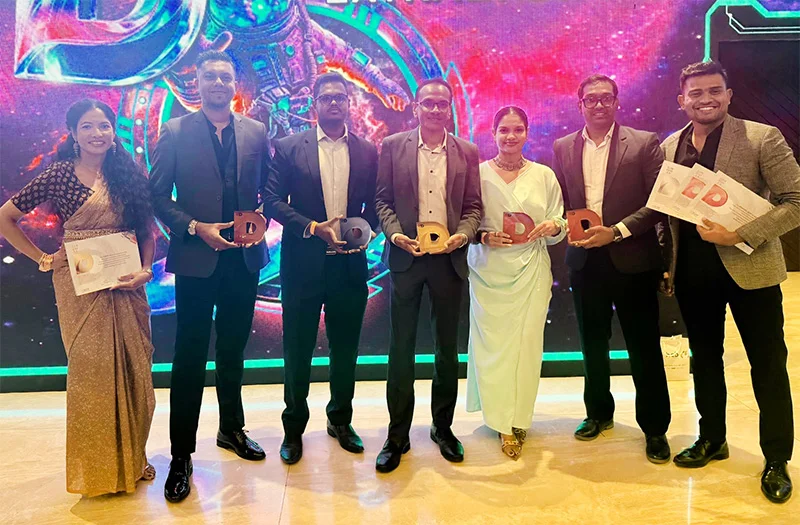
HUTCH Sri Lanka strengthened its position as a leader in digital engagement by securing five accolades at SLIM Digis 2.6, emerging as one of the most recognized brands at this year’s digital excellence awards. The achievement was further highlighted by HUTCH being the only telecom operator to be recognized at the event.
Organized by the Sri Lanka Institute of Marketing (SLIM), SLIM Digis is Sri Lanka’s premier platform celebrating excellence, innovation, and outstanding achievements in the digital marketing industry. The recognition highlights HUTCH’s growing strength in digital-first, agile, and creative marketing, and its ability to respond to everyday moments, engage audiences, and deliver impactful digital campaigns.
The Gold Award for Best Use of Agile and Moment Marketing, a Silver for Best Use of Digital in a Marketing Campaign, and a Bronze for Best Performance Marketing were all awarded for “Keeping Sri Lanka Connected Through Ditwah,” HUTCH’s response to the cyclone that struck Sri Lanka in November 2025, recognised for the speed and relevance with which HUTCH kept customers better connected and informed.
HUTCH Roaming also earned two further Bronze awards for Best Use of Digital in a Marketing Campaign and Best Use of Creative Content. Bringing together AI-led storytelling, the campaign was designed around distinct customer clusters, each characterized by unique travel behaviours, needs, and perceptions, delivering relevant content for different audiences within a single overarching campaign.
“These wins are a strong reflection of how HUTCH approaches marketing today, staying close to the moments that matter to our customers and responding with speed, relevance, and creativity. Being the only telco recognised at SLIM DIGIS 2.6, and across five categories, is proof that agility and thoughtful storytelling can go hand in hand. This recognition reflects the collective efforts with our strategic partners, whose collaboration, expertise, and shared commitment brought great campaigns to life,” said Hamdhy Hassen, Chief Marketing Officer, HUTCH Sri Lanka.
Sri Lanka’s Smart Luxury Business Hotel to Host Delegates and Contestants from Over 40 Countries as the Island Nation Hosts Its First-Ever Global Pageant of This Scale
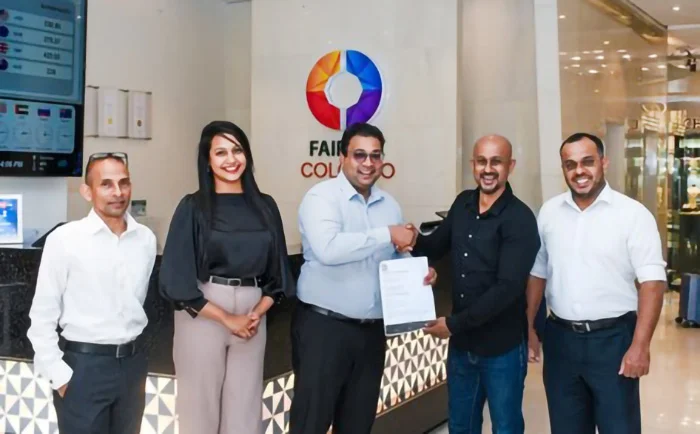
Fairway Colombo, a subsidiary of Fairway Holdings (Pvt) Ltd, has been appointed as the Official Accommodation Partner for Manhunt International 2026, one of the world’s most prestigious male pageants, scheduled to take place in Sri Lanka.
The event marks a historic milestone for Sri Lanka, as the country prepares to host a global pageant of this scale for the very first time. More than 40 contestants representing countries from across the world will arrive in Colombo, bringing together diverse cultures, international media attention, and a global audience — further strengthening Sri Lanka’s position as a premier destination for tourism, culture, and hospitality.
As the official accommodation partner, Fairway Colombo will welcome and host international delegates and contestants throughout their stay in Colombo, delivering the exceptional hospitality experience and personalized service that the hotel is recognized for.
A Landmark Partnership for Sri Lankan Tourism
“We are truly honored to be selected as the Official Accommodation Partner for Manhunt International 2026. This partnership is a proud moment not only for Fairway Colombo but also for Sri Lanka as a whole. Hosting an event of this global stature provides us with an opportunity to showcase our commitment to smart luxury, innovation, and authentic Sri Lankan hospitality to an international audience. We look forward to creating a memorable and seamless experience for all delegates and guests,” said Avinga Wanigasekara, General Manager of Fairway Colombo.
Strategically located in the heart of Colombo’s historic Fort district, Fairway Colombo is recognized as a Smart Luxury Business Hotel, combining modern comfort, advanced technology, and exceptional service. As part of Fairway Holdings (Pvt) Ltd, the property represents the group’s vision of delivering innovative, world-class experiences across the hospitality and leisure sectors.

Cabinet approves redrafting of State Assets Management Act
Cooperative Employees Commission Act No. 12 of 1972 to be amended
Dilki Wathsala Marambage appointed as Director General of the Department of Technical Education and Training
Declaration of Naakolagane Sanctuary under the Fauna and Flora Protection Ordinance
Cabinet approves transfer and maintenance of selected roads presently under PC’s and Local Authorities to the RDA
Obtaining financial facilities for the Water Supply and Sanitation Improvement Program (Sub-program 2) from the ADB

‘Dates have the highest sugar content to fight Coronavirus’

Sunday Island 27 December – Headlines

#SundayIsland 17th December – Headlines

Sunday Island – 28th March

Sunday Island Headlines – 21 March

Sunday Island – 21st February – Headlines
-

 Features6 days ago
The Sri Lankan who made Scottish history
-

 Sports6 days ago
Nissanka absence opens door for Sri Lanka’s young guns
-

 News5 days ago
NDB fraud Rs 60mn more than reported
-

 News7 days ago
Gnansara Thera to be assigned to prison printing section: Officials
-

 News5 days ago
Removing monk’s robes matter for Sangha to decide: Mahanayake Theras
-
 News7 days ago
OIC of FCID summoned before Maligakanda Magistrate
-

 Features6 days ago
Future of Sri Lanka’s state university system: Should it be shut down and reopened?
-
 News6 days ago
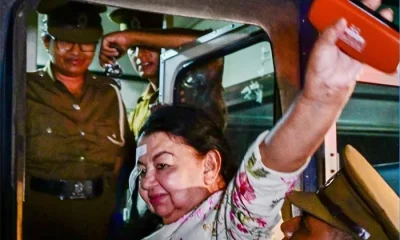
Shiranthi R remanded until 13 Oct.