
Latest News
Deepti Sharma’s 5/7 headlines spin-dominant day

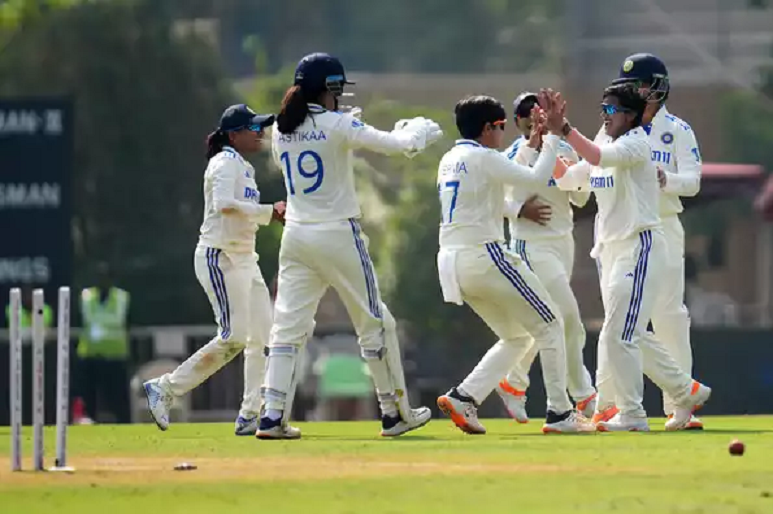
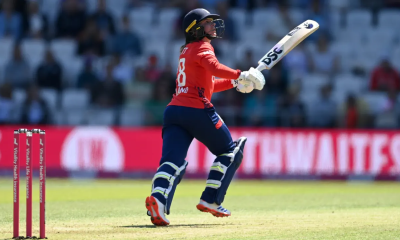
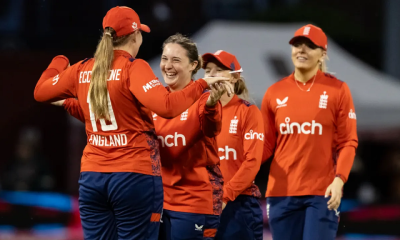
On a day when 19 wickets fell in total, India managed to get into the driver’s seat on the back of Deepti Sharma’s incredible spell that yielded 5/7, and earned them a 292-run first innings lead.
With spin dominating the day’s play completely, the tone was set early in the day when Sophie Ecclestone accounted for two of the last three wickets India had. Overnight on 60, Sharma herself became Lauren Bell’s third victim being caught at slip.
Having dismissed India for 428, England harboured hopes of continuing the fight with the bat as well but to little avail. India judged early in he innings that spin was going to play a big part and introduced it early.
But before that, they had the brilliance of Renuka Singh beating Sophia Dunkley’s defence to give them an early breakthrough while Pooja Vastrakar chipped in with the ball and on the field to account for Heather Knight and Tammy Beaumont. England’s fight came through Nat Sciver-Brunt who launched a bit of a counterattack, being free-flowing in her strokeplay.
Briefly, she had Danielle Wyatt employing a similar ploy for company and the duo threatened to launch a fightback in the middle. However, India kept making bowling changes in a bid to keep the batters guessing. The move worked with the introduction of Deepti Sharma, just as it had with Vastrakar, with the spinner striking in her first over.
Wyatt was caught at short-leg – a position that remained busy right through the day – as the offspinners found enough purchase and triggered a dramatic collapse. Amy Jones was then caught off a deflection from short leg while the sharp turn, and sometimes lack of bounce, accounted for others who could not counter the lines and lengths. Alongside Sneh Rana, Sharma ripped through the lower order picking up eye-popping figures of 5/7 as England lost their last seven wickets for just 28 runs.
India decided not to enforce the follow-on despite the big lead and instead came out with an attacking intent with the bat. Smriti Mandhana lofted Ecclestone for a six off the bowler’s first ball in the second innings signaling the dominant frame of mind the hosts were in. Along with Shafali, who opened up after a watchful start, Mandhana put on a 61-run opening stand before England’s spinners found their feet.
Mandhana was out fending to short leg off Ecclestone as some extra bounce came into play, Shafali holed out to long on attempting a big hit, Yastika Bhatia was forced to fend to short leg as was Jemimah Rodrigues. Offspinner Charlie Dean accounted for Deepti Sharma who missed a sweep and Sneh Rana bowled first ball to end the day with a four-wicket haul.
In the absence of Shubha Satheesh, who was nursing a hairline fracture on her finger, India’s batting was held up by Harmanpreet Kaur’s unbeaten 44 and a 53-run stand with Vastrakar that stretched India’s overall lead to a massive 478 by Stumps on day two.
Brief scores:
India 428 (Shubha Satheesh 69, Jemima Rodrigues 68, Yastika Bhatia 66, Deepti Sharma 67; Lauren Bell 3-67, Sophie Eccleston 3-91) & 186/6 (Harmanpreet Kaur 44*; Charlie Dean 4-68) lead England 136 all out (Nat Sciver-Brunt 59, Deepti Sharma 5-7) by 478 runs







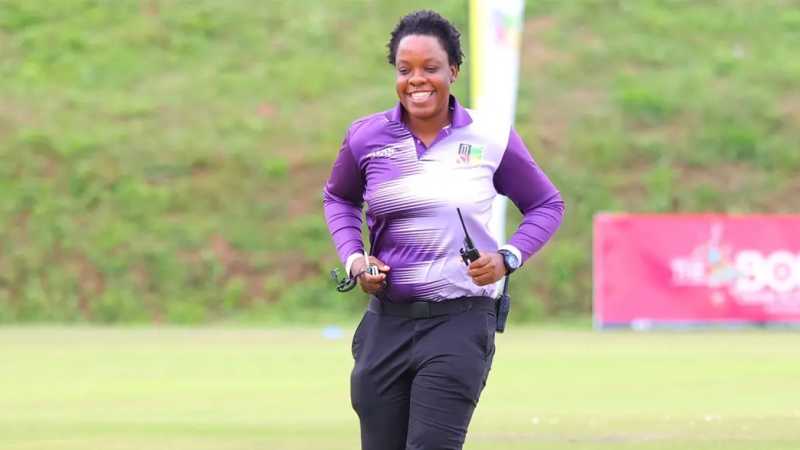
Former Zimbabwe fast bowler and umpire Sarah Dambanevana passed away in Harare on Monday. She was 36.
A Zimbabwe Cricket release said Dambanevana was in hospital receiving care since undergoing a medical procedure in March.
Her senior international umpiring career began on 2 September 2023, and she went on to officiate at the Women’s T20 World Cup 2024 in the UAE and the Women’s ODI World Cup 2025 in India and Sri Lanka, where she was part of the tournament’s historic all-female panel of match officials.
Prior to that, Dambanevana officiated in the final between India and England at the 2023 Under-19 Women’s T20 World Cup in South Africa, becoming the first Zimbabwean woman to umpire a World Cup final.
Overall, she officiated in 63 senior internationals, comprising 42 women’s T20Is, 11 women’s ODIs and 10 men’s T20Is, alongside her assignments in domestic cricket and global youth tournaments.
Dambanevana also represented Zimbabwe as a player between 2009 and 2014, including at the World Cup Qualifier in 2011. She joined the ICC development panel of umpires in 2022.
“Sarah served Zimbabwe with distinction, first as a player and then as an umpire whose ability earned her a place on the world stage,” ZC chairman Tavengwa Mukuhlani said. “Watching her stand in a World Cup final was a moment of immense pride for our cricket community and our country. She showed young Zimbabwean women that they belong at the highest levels of the game, including in roles where opportunities had long been limited.
“Through her achievements, she opened doors and gave others the confidence to pursue their own ambitions. We will remember her dedication, her professionalism and her willingness to help others grow. Her passing leaves a painful void in our cricket family, but the example she set will continue to inspire those who follow in her footsteps.”
(Cricinfo)
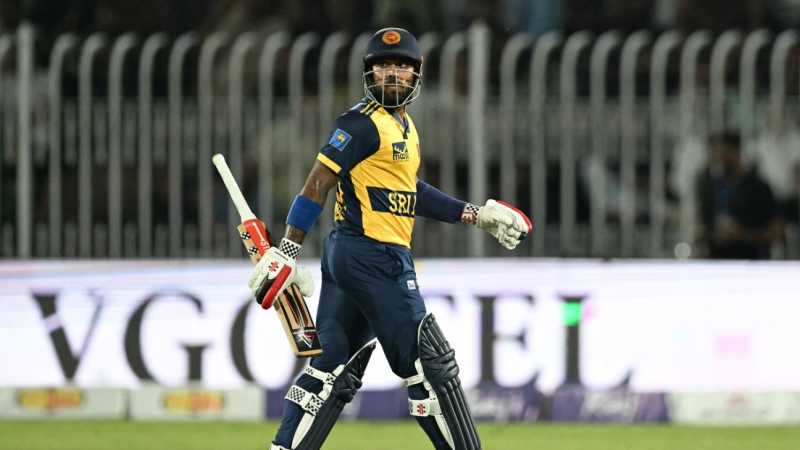
Even counting the win against Bangladesh at the Asian Games Sri Lanka have lost 12 T20Is to the two they have won since their win against Australia in the 2026 T20 World Cup. There have been significant personnel changes in that period. Captains have changed. There is a new head coach. Various batting orders have been trialled. But on Sunday’s evidence, they are deeply outmatched by even this Pakistan side, who themselves are hardly world-beaters at the moment, having not made the World Cup semi-finals this year.
With as highly-rated a coach in Gary Kirsten and a new captain in Kusal Mendis still searching desperately for a stronger combination, expect Sri Lanka to be in flux for this match as well. In game two, spinner Maheesh Theekshana was taken apart, while the seamers struggled to threaten Pakistan’s batters on a flat Rawalpindi deck. The decks don’t look like they are going to be any better for bowling. Sri Lanka’s attack will have to find new gears.
Pakistan are in the rare position of being utterly dominant in a white-ball series against an opponent who even in their previous low ebbs have challenged them. Having sewn up the trophy 2-0, Pakistan are in a position to rest key players. But it is so rare that their batters get to dine out across a whole series, management will be mighty tempted to keep this tuneful band together.
Even if Sri Lanka’s bowlers get through the Pakistan top order this time, the middle order could do with a decent workout.
So far in this series, Maaz Sadaqat has thumped 50 off 29 balls, and 96 off 51, showcasing not only power against spin, but touch against pace when the ball has demanded it. Sri Lanka are going seam-heavy in this series, but Sadaqat has found ways to take down even the little spin he has come up against, particularly in the second T20I. Sri Lanka are likely to switch up their attack a little for the last match, so he may have new problems to solve on Tuesday.
A long-term performer in Sri Lanka’s domestic cricket, Lahiru Udara has finally made a mark in white-ball internationals, hitting 91 off 55 balls in the first match of this series. A good bouncer from Salman Mirza prevented him from making a similar impact in the second match. But at age 32, Udara will know he doesn’t have many chances to convert an excellent domestic record into a long run in the national side. Anotherood score in match three will shore up his place.
Rawalpindi surfaces have tended to be batting friendly, and the track for the third T20I will likely have plenty of runs in it. The weather on Tuesday evening is expected to be fine, with temperatures in the low 20s celsius.
As legspinner Abrar Ahmed has had a couple of modest outings in this series, Pakistan may bring in left-arm wristspinner Sufyan Moqim, whose T20I stats so far in a 21-match career are encouraging.
Pakistan XI (probable): Sahibzada Farhan (capt), Fakhar Zaman, Maaz Sadaqat, Hasan Nawaz, Saim Ayub, Khawaja Nafay (wk), Shadab Khan, Mohammad Imran, Naseem Shah, Salman Mirza, Sufyan Moqim
Sri Lanka’s misfiring top order could do with a tweak or two, but there are not many spare batters on this tour. They could potentially bring back Kamil Mishara in place of an allrounder, however. With Maheesh Theekshana having been taken down on Sunday, Sri Lanka will also be tempted to try out legspinner V Viyaskanth. Dushmantha Chameera could also come back if he is fit.
Sri Lanka XI (probable): Lahiru Udara, Sineth Jayawardena, Kusal Mendis (capt, wk), Kamindu Mendis, Sahan Arachchige, Dasun Shanaka, Chamindu Wickramasinghe, Maheesh Theekshana/V Viyaskanth, Eshan Malinga, Dushmantha Chameera/Binura Fernando, Nuwan Thushara
Latest News
Heavy showers about (100-150) mm are likely at some places in the Central, Sabaragamuwa, Uva and Southern provinces

WEATHER FORECAST FOR 13 October 2026
Issued at 2.00 p.m. on 12 October 2026 by the Department of Meteorology
A low-pressure area may form over the southeastern Bay of Bengal by 13 October.
Under the influence of this system, an increase in rainfall is expected over the island and the deep and shallow sea areas around the island during the next few days from tomorrow (13).
The general public, as well as the naval and fishing communities, are requested to be attentive to the future forecasts and bulletins issued by the Department of Meteorology in this regard.
Heavy showers about (100-150) mm are likely at some places in the Central, Sabaragamuwa, Uva and Southern provinces.
Fairly heavy showers above 75 mm are likely at some places in the other areas of the island. Showers or thundershowers will occur in most parts of the island.
The general public is kindly requested to take adequate precautions to minimize damage caused by temporary localized strong winds and lightning during thundershowers.
Misty conditions can be expected at some places in the Sabaragamuwa, Central and Uva provinces during the early hours of the morning.

Former Zimbabwe player and umpire Sarah Dambanevana dies aged 36

Deflated Sri Lanka look to prevent whitewash against dominant Pakistan

Heavy showers (100-150) mm likely at some places in the Western, Sabaragamuwa, Central, Uva and Southern provinces showerss above 75 mm are likely in the other areas of the island.

Presidential pardons: Govt. studying Justice Thurairaja’s recommendations – Minister

Mahinda and Shiranthi hospitalised

Monks must be allowed to wear robes when produced in court: Mahanayake Theras

‘Dates have the highest sugar content to fight Coronavirus’

Sunday Island 27 December – Headlines

#SundayIsland 17th December – Headlines

Sunday Island – 28th March

Sunday Island Headlines – 21 March

Sunday Island – 21st February – Headlines
-

 Features5 days ago
The Sri Lankan who made Scottish history
-

 Sports5 days ago
Nissanka absence opens door for Sri Lanka’s young guns
-

 News6 days ago
Gnansara Thera to be assigned to prison printing section: Officials
-

 News4 days ago
NDB fraud Rs 60mn more than reported
-

 News4 days ago
Removing monk’s robes matter for Sangha to decide: Mahanayake Theras
-

 Features5 days ago
Future of Sri Lanka’s state university system: Should it be shut down and reopened?
-
 News6 days ago
OIC of FCID summoned before Maligakanda Magistrate
-
 News5 days ago
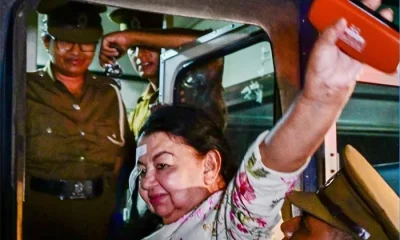
Shiranthi R remanded until 13 Oct.