
Sports
Mandhana century, Asha four-for give India a winning start

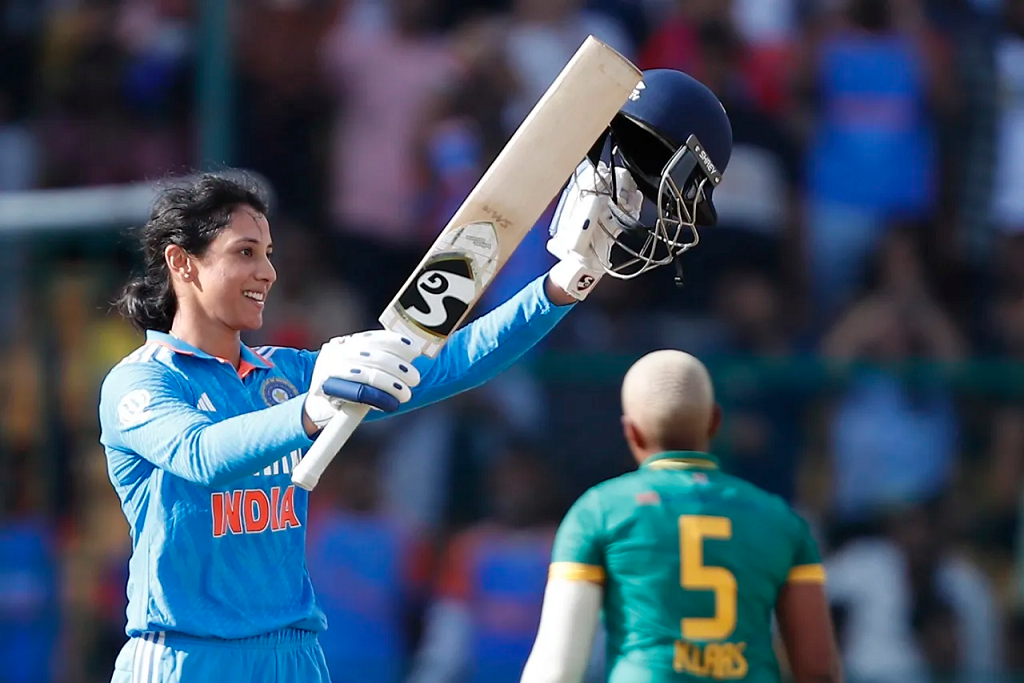
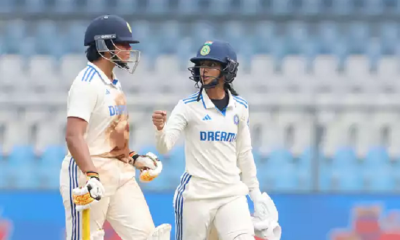
Smriti Mandhana’s outstanding century and a clinical bowling performance led by Asha Sobhana headlined India’s massive win as they went 1-0 up against South Africa in the first of the three ODIs in Bengaluru, on Sunday.
Mandhana’s 117, her first century at home and sixth in ODIs, rescued the hosts after they opted to bat first but suffered an early collapse. India added 166 runs after the fall of the fifth wicket, the most they have done in a women’s ODI, to push their total from 99 for 5 to 265 for 8, which proved too much for South Africa, who had an underwhelming outing with the bat on a surface that offered variable bounce and turn.
The chase got off to a shaky start as South Africa lost Laura Wolvaardt, the returning Tazmin Brits and Anneke Bosch for 33 runs. Marizanne Kapp and Sune Luus chipped in briefly but none of the batters could negate the spin threat under lights at the M Chinnaswamy Stadium. Asha, showing no nerves on her debut, starred with four wickets to skittle the visitors for 122, handing India a 143-run victory.
A month after making her International debut at 33 in the T20Is against Bangladesh, Asha was handed the ODI cap, becoming India’s oldest debutant in this format as well. She was slotted in ahead of the offspinner Shreyanka Patil. That Asha has the knack of picking up big wickets in pressure situations was well-known after the WPL. On Sunday too, she showcased that control and maturity to tilt the momentum in India’s favour.
After India’s pacers and Deepti Sharma strangled South Africa’s top order, South Africa slowly found a way to get back into the contest, thanks to Kapp and Luus’ partnership. The duo had batted for more than ten overs after the fall of the third wicket and India knew a well-set Kapp could be a game-changer.
Having bowled two overs for eight runs, Asha came back for her second spell, in the 19th over. The legspinner started by conceding just two runs, getting enough drift and turn to slow down the scoring. After largely sticking to length deliveries in her first few overs, she floated one outside off this time, slow through the air, to deceive Kapp and force her to hit in the air towards cover where Harmanpreet was stationed. An easy catch for one of India’s best fielders gave Asha joy, and her maiden ODI wicket.
In her next over, Jemimah Rodrigues dropped Annerie Dercksen at point but a mix-up between her and Luus ended Dercksen’s innings as she was run out at the striker’s end.
At 75 for 5, South Africa were all but out of the game.
D Hemalatha and Rodrigues were back in the XI. Rodrigues was returning from a back niggle after missing out on the Bangladesh T20I series while Hemalatha, on the back of good performances against Bangladesh, made her way to the ODI setup.
In India’s last ODI series against Australia in December, head coach Amol Muzumdar had mentioned that Richa Ghosh would be suited for No. 3, with Harmanpreet and Rodrigues coming in after her. This was a deviation from her previous role where she was used as a finisher.
However, on Sunday, with Shafali Verma departing early for 7, Hemalatha slotted in at No. 3. She perished after a 16-ball 12. Rodrigues and Harmanpreet were India’s Nos. 4 and 5 and Ghosh back to the lower-middle order at No. 6. She survived four balls but was then caught behind for 3.
Ninety-two for three became 99 for 5 in the 22nd over and India were desperate for a big partnership. An ODI after a gap of six months, players are bound to be rusty. But not Mandhana. She put on a brisk 81-run stand for the sixth wicket with Deepti Sharma to lift the team past 250. Switching to the long format, the India vice-captain curbed her aggressive instinct to play along the ground to play long.
South Africa denied easy runs for India’s batters, with the likes of Dercksen and Ayobhanga Khaka targeting a stump-to-stump line. But Mandhana countered well, using the crease whenever the opportunity arose to play her pull and cut shots to manufacture runs. Though she and Deepti kept the scorecard ticking, there were also chances to convert the ones to twos.
Mandhana hit 12 fours – seven of them on the leg side – and a six. She was all clarity and calmness. After 32 overs, she batted cramps on her way to hundred. But it also forced her to find a few quick boundaries and forgo the singles.
Once Deepti departed for 37, Pooja Vastrakar joined Mandhana and this pair stitched a 58-run stand off 54 deliveries to give India the late push they wanted. South Africa let their guard down in the last ten overs, conceding 74 runs, with the humidity also playing a major factor in their sloppy fielding.
Mandhana played for 193 minutes and 42.3 overs overall to make 117. In the end, South Africa could post only five more than her score.
Brief scores:
India Women 265 for 8 in 50 overs (Smriti Mandhana 117, Deepti Sharma 37, Pooja Vasttrakar 31*, ; Ayabonga Khaka 3-47, Masabata Klass 2-51) beat South Africa Women 122 in 37.4 overs (Marizanne Kapp 24, Sunee Luus 33, Sinalo Jafta 27*; Deepti Sharma 2-10, Asha Sobhana 4-21) by 143 runs
[Cricinfo]








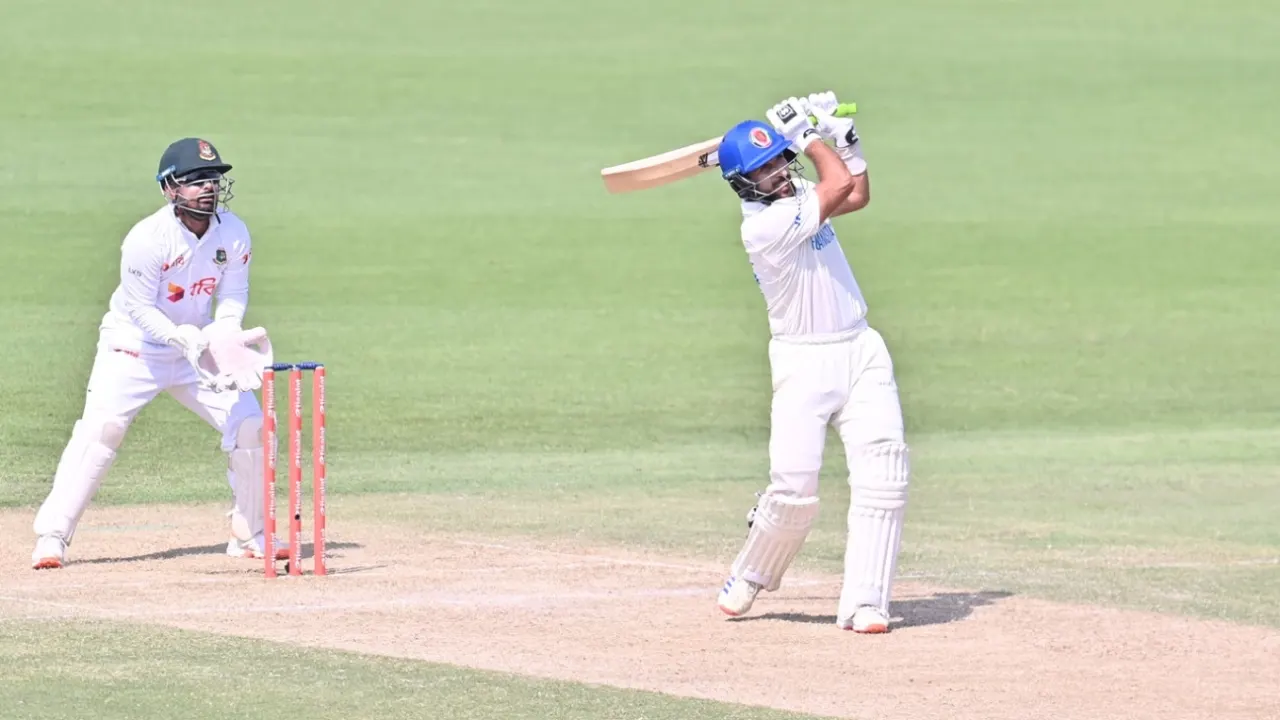
Captain Rahmat Shah played a crucial knock as he held Afghaniistan together on the second day in Abu Dhabi. He blunted Bangladesh’s threat by adding 72 runs for the unbroken fifth wicket with his deputy Ikram Alikhil.
Rahmat was unbeaten on 84 off 186 balls with eight fours and a six, while Alikhil’s 26 came off 91 balls. Ebadot Hossain was Bangladesh’s best bowler of the day.
Bangladesh wicketkeeper Litton Das got his side back into the contest shortly after the tea break. He first took a brilliant diving catch to his right, when the set Abdul Malik edged Ebadot five balls into the third session. Malik made 62 off 120 balls, with five boundaries including a six.
Next over, Litton completed a fine stumping when a Mehidy Hasan Miraz delivery turned and bounced sharply against Hashmatullah Shahidi. The former Afghanistan captain lasted just two balls as he fell for a duck.
Alikhil started with two well-timed boundaries before reining himself in for the next nine overs. Rahmat broke the boundary drought with two fours off Nayeem Hasan in the 60th over. He first pumped the offspinner through midwicket before finding the gap through mid-off for the second four.
Afghanistan then held off the Bangladesh bowling for the next 17 overs without a single boundary. Finally in the 77th over, Rahmat struck Mehidy for two fours in a row, both superb shots through extra cover, as he brought up Afghanistan’s 200.
The day began with the Afghanistan pace bowlers removing the two remaining Bangladesh wickets. It took them 8.3 overs, with Mohammad Saleem picking up his fourth wicket, having Taijul Islam caught behind and Yamin Ahmadzai removing Ebadot with a slower delivery.
Saleem finished with 4 for 82, having taken 6 for 140 against India in Afghanistan’s previous Test in June. Ahmadzai took three and Ismat Alam two wickets. This was the first time a fast bowling attack took nine wickets in a Test innings in Abu Dhabi.
After bowling out Bangladesh for 346, Afghanistan went to lunch on 34 for 1. Sediqullah Atal edged Hasan Mahmud to first slip. Atal struck three fours in his knock but also survived a caught-behind appeal in the third over. Replays showed that he had inside-edged it but Bangladesh did not use the review.
After lunch, Afghanistan batted positively. Shahidullah swept Mehidy while Mahmud conceded two fours early. Malik played the ball confidently, but Bangladesh kept things tight from both ends. It created a wicket when Shahidullah top-edged a hook against Ebadot in the 21st over. Mahmud took a good tumbling catch running in from fine-leg, as Shahidullah fell for 20 off 44 balls.
Rahmat though immediately stamped his authority with a crunchy cover drive in the same over. He hit Taijul for a straight six shortly afterwards, with Malik repeating the dose to the same bowler after a few more overs. Malik also cover-drove Nayeem before reaching his maiden Test half-century in the 34th over.
Scores:
Afghanistan 211 for 4 in 80.5 overs (Abdul Malik 62, Rahmat Shah 84*, Ikram Alkhi 32*; Ebadot Hossain 2-50) trail Bangladesh 346 in 92.3 overs (Shadman Islam 67, Tanzid Hasan 83, Litton Das 53; Mohammad Saleem 4-82, Yamim Ahmadzai 3-79, Ismat Alam 2-20) by 135 runs
[Cricinfo]


Risindi Hewawasam of Sri Lanka and Anthony Castigador of the Philippines won the girls’ and boys’ singles titles at the ATF 16 & Under Colombo 2026 – Week 1 tournament concluded at the Sri Lanka Tennis Association courts on Friday.
Castigador produced a dominant performance in the boys’ singles final, defeating India’s Gurshaan Chahal 6-2, 6-2 to secure the title. The Filipino maintained his advantage throughout the match, winning in straight sets to cap an impressive campaign.

Risindi Hewawasam (Pix by Kamal Wanniarachchi)
In the girls’ singles final, Risindi delivered an equally dominant display to beat compatriot Kiara Jayamanne 6-1, 6-1. (RF)
by Rex Clementine
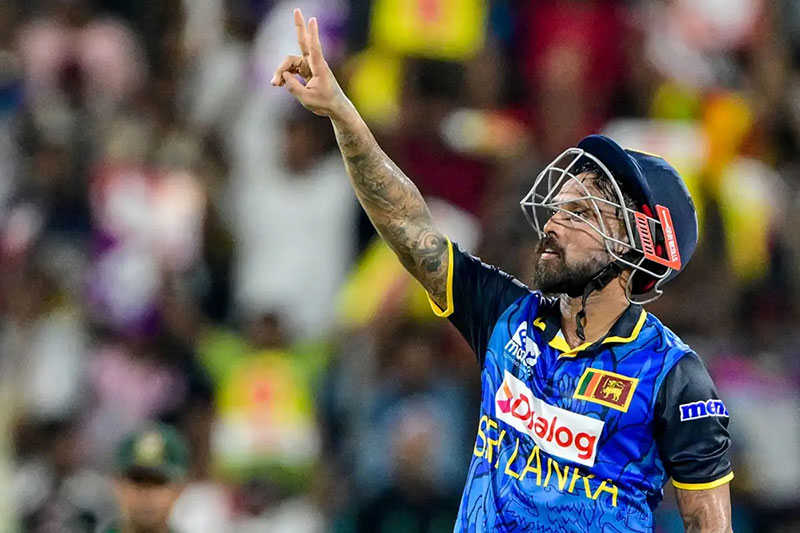
It is not often that a Test captain is replaced midway through a World Test Championship cycle. The fact that Dhananjaya de Silva has made way just days before the squad for the tour of Pakistan is announced is a clear indication that the cricket establishment was far from impressed with his leadership. He may now struggle to retain his place as a specialist batter, particularly if the selectors decide to relieve newly appointed Test captain Kusal Mendis of the wicketkeeping gloves.
Previous administrations of Sri Lanka Cricket would have taken the easy way out. They would have allowed the World Test Championship cycle to run its course before ringing in the changes. But when you have someone of Sidath Wettimuny’s calibre heading the Cricket Committee, tough calls are part of the package. Sidath has no favourites. He calls a spade a spade and has the best interests of the game at heart. It is no coincidence that Sri Lankan cricket flourished during his tenure as Chairman of Selectors from 1999 to 2001.
Kusal Mendis now suddenly finds himself captaining Sri Lanka across all three formats. Given his chequered past and bad boy image, there will inevitably be raised eyebrows over whether he deserves to wield so much influence over Sri Lankan cricket. But credit where it is due. Over the last five years, he has largely stayed out of trouble. More importantly, over the last three years, he has knuckled down, worked tirelessly on his game and earned the admiration of both the coaching staff and the cricket establishment.
The turning point came at Lord’s in 2024.
Every cricketer dreams of playing a Test match at the Home of Cricket. But the selectors pricked Kusal’s pride by dropping him for the showpiece occasion. The decision did not win them many admirers, with former captains Duleep Mendis and Aravinda de Silva among those who questioned the wisdom of the move.
But, as it turned out, the setback proved to be a blessing in disguise.
Kusal returned for the third Test at The Oval and produced an innings that was worth considerably more than the 39 runs against his name in the scorebook.
On a seaming surface, where England’s quicks were making life miserable for the Sri Lankan batters, Kusal showed admirable restraint without completely putting away his attacking instincts. His 39 came at less than a run a ball.
So what was so special about a knock that did not even reach fifty?
Plenty, as it turned out.
Kusal’s counterattack forced England to spread the field, taking the sting out of their bowling and allowing Pathum Nissanka to cash in. Pathum deservedly walked away with the plaudits for his magnificent hundred, but Kusal had done much of the groundwork.
It was not an innings that would find its way into cricket’s record books. But it was one that spoke volumes about Kusal’s changing attitude. Here was a player prepared to put the team’s cause ahead of personal milestones.
When Sri Lanka returned home for the Test series against New Zealand, the team management went a step further. They virtually created a position for Kusal, handing him the wicketkeeping gloves in Test cricket. He has remained a permanent fixture in the side ever since.
Since that Oval Test in 2024, Kusal has featured in nine Tests, scoring five half-centuries and a hundred. His work behind the stumps has been equally impressive, with hardly a blemish on his wicketkeeping record.
The maturity Kusal has displayed, both as white ball captain and as a senior member of the side, has impressed successive coaching teams. It is refreshing to see a cricketer learn from his mistakes, turn over a new leaf and allow his performances to do the talking.
Kusal has had his share of run ins with trouble over the years. Now comes the biggest challenge of his career. Leading Sri Lanka across all three formats is no small responsibility and the captaincy will test his temperament as much as his cricketing skills.
The selectors have placed their faith in a man who once struggled to keep himself out of the headlines for the wrong reasons. It is now up to Kusal to ensure that the headlines are about his leadership, his runs and, above all, Sri Lanka’s success.

Rahmat, Malik fifties lead Afghanistan’s strong reply

Showers above 75 mm are likely at some places in the Western, Sabaragamuwa, Central, Uva and North-Western provinces and in Galle, Matara, Anuradhapura and Mannar districts.

Iranian ships stranded, Lanka fears US sanctions

Sri Lanka CERT warns of overseas university admission scams

Navi Pillay’s Lankan affairs in focus as she wins 2026 Nobel Peace Prize

Lanka welcomes Indian SC remarks on Katchatheevu dispute

‘Dates have the highest sugar content to fight Coronavirus’

Sunday Island 27 December – Headlines

#SundayIsland 17th December – Headlines

Sunday Island – 28th March

Sunday Island Headlines – 21 March

Sunday Island – 21st February – Headlines
-

 News7 days ago
Geneva takes up Sallay’s case and govt. ignores opportunity to answer accusations
-

 Features6 days ago
Preventing grievances from becoming communal
-

 Features4 days ago
The Sri Lankan who made Scottish history
-

 Sports4 days ago
Nissanka absence opens door for Sri Lanka’s young guns
-

 News5 days ago
Gnansara Thera to be assigned to prison printing section: Officials
-

 News3 days ago
NDB fraud Rs 60mn more than reported
-

 Features7 days ago
Sri Lanka Cricket Bill: Governance reform is not yet a cricket strategy
-

 Features4 days ago
Future of Sri Lanka’s state university system: Should it be shut down and reopened?