
Business
CSE enables issue of Green Bonds by Sri Lankan companies


The Colombo Stock Exchange (CSE) is pleased to announce the introduction of listing and trading of Green Bonds for the first time in the Sri Lankan stock market, with effect from 25th April 2023.Under the Green Bonds concept, proceeds are invested exclusively in green projects that generate climate or other environmental benefits, for example in renewable energy, energy efficiency, sustainable waste management, sustainable land use (forestry and agriculture), biodiversity, clean transportation, and clean water.
The objective of enabling regulations for the issue of green bonds in the Sri Lankan stock market is to facilitate Sri Lankan corporates to raise capital that will be used for green projects and to foster greater transparency and accountability in the use of proceeds from the Green Bond, and to ensure reporting of the impact of the green projects for which the proceeds of the bond was used.
The use of proceeds from the Green Bond should be aligned with the Green Bond Principles, which are accepted by the CSE. The accepted Green Bond Principles of the CSE are the Green Bond Principles by the International Capital Markets Association (ICMA), the European Green Bond Standards (EUGBS), and the Climate Bonds Initiative Standards (CBI Standards).
Corporate Debentures and Green Bonds
The Green Bonds will have the same features of a Corporate Debenture and will be listed on the Debt Market segment of the CSE.The main difference between a Corporate Debenture and a Green Bond is the usage of the proceeds. In a Green Bond, the proceeds have to be exclusively used for financing or re-financing in part or in full, new or existing eligible green projects which are aligned with at least one international Green Bond standard set out above.
The Green Bonds will be traded on the Automated Trading System (ATS), similar to Corporate Debentures. The trading parameters currently applicable to Corporate Debentures will also apply to Green Bonds as well.The potential issuers of Green Bonds are any public company incorporated under the Companies Act and any statutory body established/incorporated under a statute.
Benefits of issuing and investing in Green Bonds
Green Bonds could be identified as a new investment asset class for potential issuers and investors. By issuing Green Bonds, an issuer could access a broader pool of capital, including access to a foreign investor base who has an interest in investing in green projects. It also can play a positive role, in raising awareness and building expertise among investors on issues relating to the environment, thus, fostering greater transparency in the use of proceeds from the Bond.
Green Bonds can also facilitate the establishment of public-private partnerships that might accelerate the pace of green investment and lead to the adoption of new technologies and also contribute to a sustainable economy.
Commenting on this new product, CSE CEO Rajeeva Bandaranaike said, “As of January 2023, Green Bonds have globally raised $2.5 trillion, to support green and sustainable projects. Sri Lanka can tap into these funds and capitalize on by attracting foreign investments into Green Bonds. This will contribute positively towards the Sri Lankan economy whilst issuers get an opportunity to attract a new pool of investor base; especially foreign funds which are exclusively aimed at green projects.”
“We are proud to be at the forefront of promoting sustainable investment mandates in the market, integrating environmental, social and good governance (ESG) criteria into the business or investment decisions, for the lasting benefit of both the capital market and the country at large.”
“Based on the demand for bonds like Green Bonds, the CSE proposes to introduce Blue Bonds and Social and Sustainability Bonds in the future”, added Bandaranaike.











Ceylinco Life’s Ambalantota branch agent AIP Manjula has been named one of three global finalists for the prestigious Insurance Agent of the Year award at the 11th Asia Trusted Life Agents & Advisers Awards (ATLAA) 2026.
The recognition places a Sri Lankan insurance professional among the finalists in a regional field spanning South Asia, Southeast Asia, East Asia and the wider Asia-Pacific region.
Ceylinco Life said the achievement reflected the calibre and customer-focused approach of its agency force, while recognising Manjula’s professionalism and commitment to policyholders.
The award evaluates insurance agents on criteria extending beyond sales performance, including ethical conduct, client service, policy persistency, digital adoption, innovative practices and contributions to the insurance industry and community.
The awards are organised by Asia Advisers Network and Asia Insurance Review, with LIMRA as co-organiser. An independent judging and balloting process is monitored by KPMG as the official scrutineer. The judging panel comprises senior insurance executives, association presidents and industry experts from across the Asia-Pacific region.
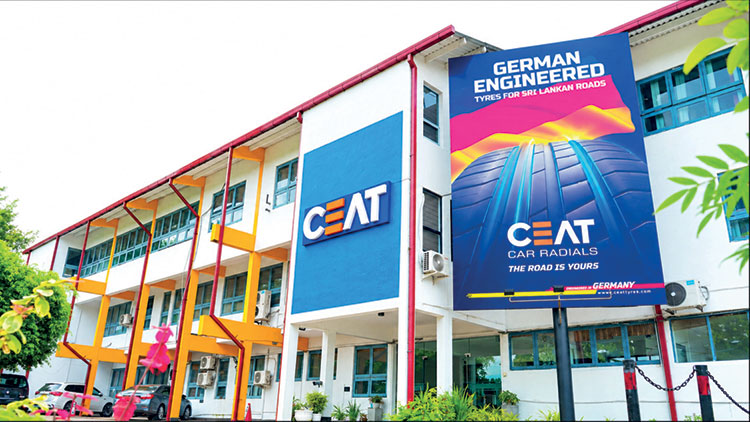
CEAT Kelani Holdings (CKH) has retained its National Long-Term Rating of ‘AA+(lka)’ with a Stable Outlook from Fitch Ratings for the sixth consecutive year, reflecting the company’s financial resilience and leading position in Sri Lanka’s pneumatic tyre market.
The ‘AA+(lka)’ rating, the second-highest on Fitch’s national scale, indicates a very strong capacity to meet financial commitments.
Fitch said CKH’s established market leadership and resilient financial profile remained key strengths, while noting its exposure to price-sensitive, cyclical and highly competitive markets.
The Stable Outlook reflects expectations that the company will maintain its market position despite rising input costs and increasing competition from imported tyres, while preserving adequate credit metrics during periods of weaker earnings and higher investment.
Fitch expects CKH’s established brand, extensive dealer network and adaptive pricing strategies to support its market position. Planned production facility upgrades are also expected to improve product quality, particularly in the radial tyre segment.
The rating agency expects near-term pressure on margins from higher raw material and energy costs but said the company’s low leverage and sound liquidity would provide a cushion.
CKH Chairman Chanaka De Silva said the rating reinforced the company’s focus on disciplined financial management, operational adaptability and long-term investment.

SLT-MOBITEL Enterprise, the enterprise services arm of Sri Lanka Telecom PLC, has launched its Premium Cloud service powered by Nutanix, aimed at helping Sri Lankan businesses modernise their IT infrastructure and accelerate digital transformation.
The service was unveiled at the Lanka Tech Summit 2026 held recently at ITC Ratnadipa, Colombo.
The Premium Cloud combines hybrid multi-cloud capabilities with enterprise-grade performance, enabling businesses to run mission-critical workloads, scale cloud deployments and strengthen business continuity through disaster recovery capabilities.
Hosted on SLT-MOBITEL’s Tier III data centre infrastructure, the platform is designed to provide enhanced security, reliability and flexibility while supporting the growing technology requirements of enterprises.
SLT-MOBITEL Enterprise said the platform would also support organisations seeking to adopt AI-ready capabilities and improve the management and performance of IT workloads.
A key feature of the launch was SLT-MOBITEL Enterprise joining the Nutanix Elevate Service Provider Program (NESPP), which the company said made it the first service provider in the region to join the programme.
Powered by Nutanix’s hybrid multicloud platform, the service enables application and data mobility across on-premises environments, public clouds and edge locations.
The company said the partnership combined Nutanix’s cloud technology with SLT-MOBITEL’s local expertise and support, strengthening its multi-cloud portfolio.

Buttler out of Oval decider as Lawrence earns ODI call-up

Showers will occur in the Western, Eastern, Uva and Sabaragamuwa provinces and in Galle, Matara, Kandy and Nuwara-Eliya districts.

Nor’easter brings flooding as New York and New Jersey declare emergency 2 hours ago

Trump rejects Iran deal to reopen Strait of Hormuz in seven days

Govt plans to hire 121,000 state workers, redistribute tax revenue

Parliament clears 22A amid protests

‘Dates have the highest sugar content to fight Coronavirus’

Sunday Island 27 December – Headlines

#SundayIsland 17th December – Headlines

Sunday Island – 28th March

Sunday Island Headlines – 21 March

Sunday Island – 21st February – Headlines
-

 News5 days ago
Mastermind Naufer Moulavi among 15 found guilty
-

 News7 days ago
Hatton youth protest against reported death sentence for Lankan in Saudi Arabia
-

 News7 days ago
Mahaweli rises as heavy rain triggers flood, landslide fears
-

 News6 days ago
Protest against setting up of cement factory in highly populated area near BIA
-

 Midweek Review5 days ago
Thileepan’s fast unto death: An authentic narrative that many missed
-
 Latest News4 days ago
Showers above 100 mm are likely at some places in the Western, Sabaragamuwa, Central and North-western provinces and in Galle and Matara Districts
-

 Editorial6 days ago
Trouble beginning in earnest
-
Editorial5 days ago
Big Bad Bills