
Opinion
Covid19-The second wave


BY RAJITHA RATWATTE
fromoutsidethepearl@gmail.com
Well it is here in Aotearoa, the dreaded 2nd wave of the virus. After over 100 days of no infections within the country, a worker in a frozen food import facility has been diagnosed. He has apparently had symptoms since the 31st of July but got tested only on the 6th of August. Now his whole family and a number of contacts have also tested positive. To compound matters this family has travelled on holiday to a number of resort towns in the North Island, and it gets worse, they have visited a relative in an age care facility! One of the Children goes to a school that has 3,000 students. The husband and the wife’s work places have transmissions of the virus, and the school and the age care facility we don’t know about.
These people live in what is considered the poorer areas in the south of Auckland. Judging by this and the type of work done by the husband and wife it is very possible that they belong to a minority race. However, they seem to be rather affluent as the holiday they have enjoyed does not seem to have suffered from financial constraints. The holiday has included visits to museums, art galleries, Thai restaurants, boat trips and of course fast food outlets! Unfortunately, this makes the possibility of a spread of the infection greater. Sometimes, people of the minor races prefer to live among their own people and in areas where the shops and restaurants cater to their tastes and needs. This is no reflection of their financial status.
The news broke to the general populace about 8.30 pm on Tuesday the 11th of August. Auckland which is the main area affected was put into level 3 lockdown. This means no restaurants and bars, only take away food and gathering only within your bubble and a maximum of 10 people. The rest of the country into level 2, which means gatherings of a maximum of 100 people only. All supermarkets and pharmacies are open and only essential workers can go to work. Everyone else works from home. Face masks are advised and social distancing of course, prevails.
 An interesting fact is that the genome of this new infection is apparently different to the one that prevailed earlier. The genome of this germ seems to be more closely related to the disease prevalent in the UK. From there we proceed to the question how did this infection start. The initial and logical theory was that the imported frozen food handled by the worker contained the germ. We have no details of this. Accepted facts broadcast regularly on BBC says, this infection can live on plastic and glass for 72 hours and extreme cold or heat cannot kill it.
Meanwhile, Winston Peters the outspoken deputy prime minister and leader of the Maori party has given an interview to Australian Television, saying that he has reliable information that this infection is due to a quarantine violation. We have no further evidence on this either.
The cabinet met again on Friday (15th) afternoon to review the situation and decide how to proceed. The opposition was waiting to pounce. There is general election due soon remember and the opposition looks like they are going to lose on similar lines to that which happened in the Pearl. They are desperate, and they represent the rich white people of NZ. If the lockdown level was increased to a higher level, they would have started screaming about the economic damage. It was a tricky decision, handled beautifully; the present level of lockdown is to remain for a total of two weeks. A review will be done on the 21st of August depending on, if the available data is better or worse than expected, the lockdown level will be increased or reduced.
A great decision I say because now the people know what to expect. If they wish to be foolish and abuse the freedoms available at level 3 and consequently the lockdown level has to be increased, well, it is their problem. The resulting economic damage cannot be blamed on the government. Meanwhile, the Finance Ministry is extending the benefits offered to meet wage payments for affected businesses. It seems they had plans in place and had not spent the full allocation of funds approved. I guess in retrospect and hindsight, it would have been only a miracle that would have stopped the second wave. There will also be increased paid leave available for those who are required to self-isolate.
There are loud requests for the postponement of elections from the opposition as certain immediate defeat is worse that possible later defeat! Governance in these turbulent times makes the possibility of mistakes higher and an opposition waiting on the sidelines to capitalise on mistakes can only benefit. I say postpone the elections and let the opposition live in hope. Because when they lose after all excuses have been removed, it makes the victory sweeter! This is the civilized decision to make and I hope it prevails.
Well, it has been done. The election has been postponed by 4 weeks. The reason given by the PM include the need to have a “safe, accessible and credible” election, an election that “delivers certainty for the future” and an election held in the “best interests of the voter in our democracy”. When delivering this decision, the PM mentioned 3 countries that had held elections without postponement, when “managing” Covid19. Sri Lanka was NOT mentioned!
The total of infections due to this second wave is no 56. All but one has been identified as coming from the one source. The doubtful one is also probably linked to this source, but the patient is in hospital and I guess final confirmation will come when that patient can be approached. The plan is to identify the perimeter of the full cluster in two weeks and if it looks like it can be contained, the level of lockdown will be eased. Testing continues at a furious pace, with a record number of 15 thousand tests being done on the 14th of August.
We are in the last weekend of the Super Rugby Aotearoa tournament. The cup has already been won by the South Island based Canterbury Crusaders with a match to spare. However, this weekend game was a complete sell out with over 40 thousand tickets sold for the game between the Crusaders and the Auckland Blues. The Auckland Blues have shown a resurgence of form after many decades, their fans were hoping for great things. Beating the Canterbury side which has now won 3 Super Rugby tournaments in a row was something all of us were looking forward to. This was to be played at Eden Park stadium in Auckland and is now cancelled. Level 3 lockdown does not allow such a large amount of people to gather in one place. In fact, it does not even allow the teams to gather, without spectators!
Most of us went to at least one match and enjoyed some fantastic quality rugby and the atmosphere that goes with a full stadium. Again, we have been luckier than most and should be grateful, here in Aotearoa.
It is “interesting times ahead” for us in Aotearoa and all we can do is stay within the rules and be kind to each other!


by Capt. (Ret) G.A.Fernando
‘Meritocracy’ is held to be an essential part of good governance in any organisation. The other two essential components are ‘pragmatism’ and ‘honesty as in Singapore’. Unfortunately, meritocracy is also subjective. Reportedly, in the early days of Air Ceylon, the first officer (co-pilot) would sometimes help to pack the operations manager’s bags before an impending trip, in order to gain ‘merit’ in the airline. Alternatively, the first officer considered for command may have been a ‘boozing buddy’ of the captain. In short, there was no system.
In Air Lanka all our managers, instructors and chief pilots were expatriates. Fairly or unfairly, a rumour had it that pilot promotions were decided at the whites-only Colombo Swimming Club. There were many instances when promotions were offered to someone of so-called ‘good standing’, or ‘a friend of the family’, in the eyes of airline management. Thus, some junior pilots were unfairly by-passed for no valid reason. Such was life in those days.
Consequently, in the mid-1980s the Pilots’ Guild declared that ‘enough was enough’, and after a quick survey of other airline practices, using data supplied by the International Federation of Air Line Pilots’ Associations (IFALPA), it was demanded of Air Lanka management that they too should establish a seniority list to ensure that no-one will be overlooked when it came to pilot promotions.
Essentially, a pilot would be given a ‘seniority number’ at the time of joining the airline. If the date of joining was the same for a batch of pilots, then the number of hours of experience at the time of joining in decreasing order would be the factor in determining individual pilots’ seniority within that batch. The lower the seniority number the greater the seniority of the pilot. That, and only that, would be the consideration. In other words, it was a pecking order of sorts. In case a pilot was bypassed due to some valid requirement, that pilot would be entitled to a good and acceptable reason, and then to a bypass allowance.
While accepting it on principle, no one in the Flight Operations department was willing to ‘bell the cat’ or buck the system.
Therefore, it fell upon the Pilots’ Guild, and specifically me as its secretary, to establish a draft copy of a seniority list, which was eventually accepted by the management of Air Lanka, for pilot promotions.
The pilot was to carry that number until his career with the airline ended. It also gave an opportunity for management to pick candidates out of sequence (for good reason), as the seniority will eventually be re-established. However, if the pilot left the airline for greener pastures and returned, he/she would have to join at the bottom of the list (as the most junior pilot).
Narcotics, firearms, capital flight and a daylight massacre, and the duty of the security state
By Mahil Dole
Senior Superintendent of Police (Retired) | Former Head of Counter-Terrorism, State Intelligence Service
The past fortnight has not been a collection of isolated crime stories. It has been a pattern: a large maritime narcotics seizure in the North, inland heroin and ICE hauls in the West and South, a cache of military-pattern firearms on the outskirts of Colombo, a multi-billion-rupee foreign-exchange fraud through shell companies, and, worst of all, a daylight shooting in Halpethota, Baddegama. Gunmen in a car intercepted a three-wheeler and fired at point-blank range, leaving a man and a woman dead. Another woman succumbed to her injuries.
These are not good signs for a peace-loving people. Criminals operating in tandem, brandishing firearms, and treating a public road as an execution ground advertise an insecure environment. When that coincides with Easter Sunday judgments and a presidential claim that politics has been turned from a business into public service, the temptation in Colombo is to treat security as background noise. That would be a serious error.
What the record of two weeks actually shows
On 27 September, personnel of the Northern Naval Command and SLNS Agbo intercepted a consignment at Kusumanthurai Beach, Madagal, Jaffna. One suspect was arrested and a small boat recovered. Examination with the Police Narcotics Bureau established approximately 45.5 kilograms of ICE and 35.7 kilograms of heroin, nearly 81 kilograms, with a street value exceeding Rs. 1.5 billion. It was described as the Navy’s largest ICE-and-heroin haul from northern waters.
That same morning, in Halpathota, Baddegama, the victims were said to have been returning after signing at the Galle Crimes Division. Motive can wait. The method cannot: pursuit, interception and execution in daylight, with a military-pattern weapon, in a populated southern town.
In the days immediately preceding these events, officers of the Western Province North Crime Division arrested suspects in Bokundara, Piliyandala, with more than 11 kilograms of heroin and more than 6 kilograms of ICE, valued in the region of Rs. 300 million. In Walgama, Matara, a man and a woman were arrested with nearly 22 kilograms of ICE, together with cash and vehicles suspected of being used in trafficking. In Kolonnawa, raids recovered a 9mm pistol, seven firearms capable of firing T-56 ammunition, and more than 600 rounds of 9mm ammunition. The Financial Crimes Investigation Division produced before court a suspect alleged to have aided remittances equivalent to some Rs. 24.8 billion through shell companies, against imports that never arrived. He has been remanded until 1 October. The file sits inside a wider inquiry into scores of companies and tens of thousands of telegraphic transfers.
Taken separately, each arrest is a success. Taken together they describe a market: drugs arriving by sea, broken and distributed inland, protected by firearms, and accompanied by money moving through corporate vehicles that look lawful until they are examined.
Non-traditional threats in a crowded political climate
National security in Sri Lanka is still too often imagined as the business of preventing another Easter Sunday or another armed insurgency. Those remain real responsibilities. The Colombo High Court Trial-at-Bar has just convicted 15 of 24 accused in the principal Easter Sunday case and imposed sentences running to two centuries of rigorous imprisonment. That judgment matters for victims, for the record, and for deterrence. It does not, by itself, close the file on intelligence failure, institutional negligence, or the wider architecture that allowed a conspiracy to mature. Into that same week has come another publication, and it requires a different kind of honesty.
A book titled Navayay Paha Vikurthiya– (9:5 Distortion), has been launched after Qur’an 9:5. There is a particular hypocrisy in that naming while refusing to read 9:1 to 9:7. The verse is not a licence. It is a wartime clause after a broken treaty, a four-month warning, and an order to honour pacts that were kept. The next line requires safe-conduct for an enemy who only wants to hear the Word of God. To lift “kill the polytheists” and sell it as the meaning of Islam is not scholarship. It is the method Surah Al-Imran 3:7 condemns: those in whose hearts is deviation chase isolated lines to create fitnah, while those firm in knowledge take the Book as a whole.
The vested interest is not hard to see. The same launch that branded a Qur’anic verse as “distortion” was used to seek another presidential pardon and the cover of the Maha Sangha. A cleric already convicted for insulting Islam now packages that faith as a public threat, then asks the State for mercy so that he may continue the same politics. That is not national security. It is the old trade: isolate a line, inflame a crowd, and convert communal fear into personal and political capital. Sri Lanka has paid for that trade before, in broken streets, in a community placed under blanket suspicion after Easter, and in an intelligence culture that watched identity instead of behaviour. Say so plainly, without matching abuse with abuse, and without letting a slogan stand in for the text.
Narcotics, underworld firearms, capital flight dressed as trade, and contract-style public shootings are not “ordinary crime” in a country that still lives with organised violence. They feed corruption and create the cash and firepower on which larger threats later ride. A state that treats them as a blotter problem, while its political class argues in Colombo, has misread its own risk register.
From politics as business to public service, a test, not a slogan
At a mass rally in Gampaha this Sunday, under the theme “People’s Rule – Two Years Strong. Progress for All,” the President said that politics which had become a business has been transformed into public service. The sentence is well aimed. For decades office was inventory: licences, contracts, land, appointments and silence. That marketplace ran into Customs sheds, bank counters, landing points and the underworld’s procurement of weapons. If politics is now public service, the claim must be tested in the court and on the road.
The courts, in recent weeks, have not been idle. Political figures, public servants and entrepreneurs have been produced on corruption charges: a sitting parliamentarian on an alleged aircraft-procurement bribery file; a former Krrish Group director over an alleged Rs. 70 million payment tied to a Fort property; the former chairman of Lanka Mineral Sands; the General Manager of Lanka Salt; a former National Transport Commission chairman over Expressway permits; a former minister’s secretary over an alleged Rs. 8.1 million bribe. Earlier this year CIABOC reported more than thirty public officials arrested in four months. These files are the visible edge of an effort to make “politics as business” expensive.
That effort is a condition of national security, not a side-issue to be parked with the bribery commission. A dinghy does not beach at Kusumanthurai without facilitators. A T-56 does not appear in Kolonnawa or Baddegama without a supply chain that has passed through a compromised official or a bank that asked too few questions. Phantom imports on the FCID’s scale are the financial twin of the narcotics trade. Clean politics starves those networks. Dirty politics feeds them. But a remand is not yet public service, and a rally sentence is not yet a secure street. If directors are in court while a three-wheeler is raked in Halpethota, and if ICE still moves by the kilo through northern waters, the citizen is entitled to ask which marketplace has actually been closed.
There is a further caution. Campaigns against corruption succeed only when they are even-handed and evidence-led. Selective zeal recreates the old business of politics under a new label. An intelligence service used to settle scores will not be trusted when it later asks the public about a landing or a weapons dump. The Gampaha formulation is useful if it becomes an operational standard: the law applies to the powerful and the obscure alike, and the State’s first business is the ordinary person on an ordinary road.
Agency responsibilities: who must do what.
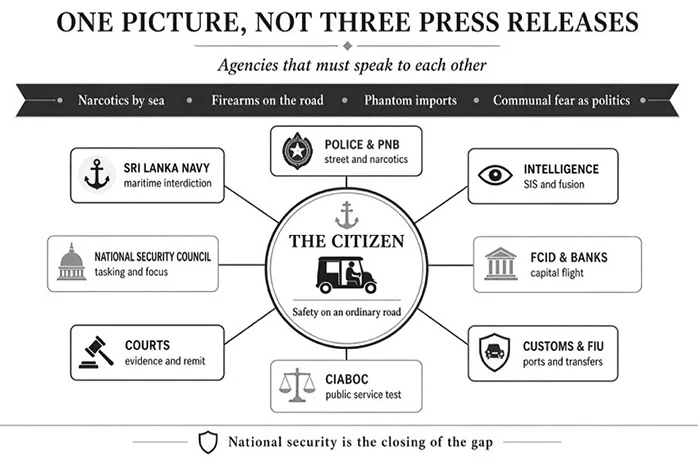
Figure: The citizen on an ordinary road is the test. The Navy, Police and Narcotics Bureau, intelligence desks, FCID and banks, Customs and the FIU, CIABOC, the courts and the National Security Council are not rival press offices. They are one picture — or they are three press releases.
The Navy’s duty on the northern and southern approaches is not ceremonial. The Palk Strait remains a preferred corridor: the crossing is short and fishing provides cover. Interdiction at Kusumanthurai is valuable only if it is followed by source-to-market mapping, packers, landing points, inland receivers, offshore facilitators. That work requires the Police Narcotics Bureau, Customs, the Financial Intelligence Unit, and a fusion cell that treats a dinghy, a bank transfer and a T-56 as one picture.
The Police duty is to prevent the next daylight murder, not merely to investigate the last. When a T-56 is used on a public road against people returning from a crimes division, the question is how the weapon moved, who sanctioned the hit, and why threat assessment failed. Inland ICE and heroin finds must be treated as distribution nodes, not trophies. A 22-kilogram haul in Matara and an 18-kilogram mixed find in Piliyandala, days apart from an 81-kilogram coastal seizure, should be one picture, not three press releases.
The FCID and the banks have a national-security function whether or not the statute uses that phrase. Phantom imports drain reserves, can wash criminal proceeds, and can pay for the consignments the Navy pulls off beaches. The Kotikawatte arrest should open a network case, not close a headline.
Intelligence agencies must resist waiting for a “terrorism” label before they sit up. Organised narcotics, contract killing and covert capital movement are intelligence problems. They require sources, financial intelligence, maritime awareness and the courage to share what is known before the next three-wheeler is stopped on a southern road.
Preventive measures that can be taken now
Prevention is a set of unglamorous tasks. First, a standing joint cell, Navy, Police Narcotics Bureau, Customs, FCID and the Financial Intelligence Unit, with one target list and one weekly assessment to the National Security Council. Measure networks dismantled, not only kilograms.
Second, treat firearms recovery as a campaign. The Kolonnawa cache is a logistics dump. Every recovery should be traced: origin, last custodian, end-user, cash trail. Unaccounted military-pattern weapons remain an unfinished post-conflict item.
Third, close the gap between court appearance and street vulnerability. People required to sign at a crimes division are known to the system. The system then owes a threat assessment. Public roads in Baddegama should not become killing grounds because two factions have a rifle.
Fourth, match telegraphic transfers against Customs and shipping data as routine, not as a special project after a complaint reaches Police Headquarters. The Rs. 24.8 billion file should rewrite that routine.
Fifth, political controversy must be ring-fenced from operational command, and the anti-corruption drive must speak to the anti-narcotics drive. A National Security Council on a fixed cycle, with a fused assessment and written tasking, keeps the permanent State at work while the temporary Government argues its constitutional case. CIABOC, the FCID, the Police Narcotics Bureau and Customs should not discover at a press conference that they have been chasing the same names.
The test that matters
Sri Lanka has spent a generation learning, at terrible cost, that security is not the same thing as the absence of a declared war. The peace-loving public does not ask the State to win arguments in Colombo, or to win applause at a Gampaha rally. It asks that a three-wheeler on a southern road can pass a car without being raked by a T-56; that a northern beach is watched before the dinghy beaches, not after; that a house in Kolonnawa is not a magazine; that billions of rupees cannot leave the country dressed as imports that never were; and that the man who once sold a licence and the man who now fires a rifle are both answerable to the same law.
The detections of the past two weeks prove that parts of the system still work. The Baddegama murders prove that other parts do not work in time. The court list proves that another part has at last been put to work. National security is the closing of that gap, by agencies that know their duty, by a centre that refuses to be distracted, and by a standard that treats public service as the protection of the ordinary citizen from the old business of politics and the new business of crime.
(This analysis is offered in the interest of national security, institutional reform, and public safety)
The writer is a Senior Superintendent of Police (Retired), former Head of the Counter-Terrorism Division of the State Intelligence Service, and a former Member of the Sri Lanka Wakfs Board. He writes on national security, intelligence and institutional reform. Email- mahildole54@gmail.com
Sources:
contemporaneous reports of the Sri Lanka Navy, Police spokesmen, CIABOC and court proceedings, News First, Newswire, Ada Derana, Daily Mirror and related parliamentary reporting, 21–27 September 2026; Qur’an 9:1–7 and 3:7; book launch of Navayay Paha Vikurthiya, 20 September 2026.
by Prof.G. L. Peiris
D. Phil. (Oxford), Ph. D. (Sri Lanka);
Former Minister of Justice, Constitutional Affairs and National Integration;
Quondam Visiting Fellow of the Universities of Oxford, Cambridge and London;
Former Vice-Chancellor and Emeritus Professor of Law of the University of Colombo.
There is widespread interest in the 22nd Amendment to the Constitution of Sri Lanka in this country as well as abroad. This is especially so, after the widely disseminated comments by Ms. Margaret Satterthwaite, the Special Rapporteur of the United Nations on the independence of the judiciary. The analysis contained in this article is being developed for publication in scholarly legal journals in the Commonwealth. The current version was written to cater to local interest.
I. Full Court
This was taken up as a threshold issue.
Given the importance of the matter, the majority of petitioners strenuously contended for the constitution of a Full Court consisting of all thirteen judges of the Supreme Court.
There is ample precedent for this in our country. In 1983, to adjudicate on an aspect of the Sixth Amendment, Neville Samarakoon CJ constituted a Bench which included the full strength of the Supreme Court, then consisting of nine judges. The same course of action was adopted by Sharvananda CJ in 1987 with regard to a challenge to the constitutionality of the Thirteenth Amendment and the Provincial Council Bills.
There are other situations in which Benches of seven judges have been constituted. Examples are provided by the orders by Nalin Perera CJ in 2018 in the premature dissolution of Parliament case and by Jayantha Jayasuriya CJ in the Easter Sunday bombing fundamental rights application in 2023.
The five judge Bench in the 22A case had no hesitation in rejecting the request for a Full Court.
This conclusion was founded on the premise that the hearing of the petitions “cannot be assigned a procedure outside the Constitution”. The governing provision is that “The Chief Justice may, if the question involved is in the opinion of the Chief Justice one of general or public importance, direct that such appeal, proceeding or matter be heard by a Bench comprising five or more judges of the Supreme Court”.
The substantial ground of rejection of the request for a Full Bench was that the Chief Justice had already exercised his discretion in appointing five judges, and that any variation of this would necessarily involve “an abdication by the Chief Justice of the constitutional role vested in him and usurpation of the discretion of the Chief Justice by the other judges of the Court”.
It was declared that, in the absence of provision conferring a right of appeal, revision or review, the application was misconceived. This, however, overlooks the reality that what was sought was not intervention by other judges to override an order of the Chief Justice, but a subsequent order by the Chief Justice himself to expand the composition of the Bench in light of cogent submissions by counsel representing the petitioners about the objective need for this initiative. This was not a situation in which, as a matter of strict procedure, the Chief Justice, having made an order, was finally and irrevocably functus and devoid of authority to take any further action in the matter at his own discretion. The invocation of a totally rigid constitutional fetter is fanciful and unrealistic, and defeats the ends of justice.
It was observed: “The Court cannot without any reasonable basis or justification give prominence to some selected cases and postpone other cases”. Nevertheless, the reasonable justification could readily be inferred from the circumstances, since the request by the petitioners was by no means self-centered or idiosyncratic but derived from the far-reaching implications of the matter at hand, evident even at a glance.
The Chief Justice nominated five judges to the adjudicating panel. Stephen Tiru, President of the Commonwealth Lawyers Association, who was an observer of the proceedings, as well as LawAsia, commented explicitly on the apparent absence of any explicable criterion governing the selection. Seniority on the Bench was clearly not the yardstick, since the judges selected occupied, from this perspective, slot numbers 6, 8, 11 and 13 out of a total complement of 13 judges of the Supreme Court.
Indisputably, the discretion is solely that of the Chief Justice. But, as my former teacher, Professor Sir William Wade of the University of Cambridge, never tired of pointing out, discretionary powers in the public domain, however amply conferred, must always be exercised so as to inspire public confidence. He insisted that nothing is more inimical to the values of public law than the concept of unfettered discretion. Indeed, the entire body of common law represents as strong a disincentive as possible against arbitrariness and caprice.
II. Consultation
The Court gave short shrift to the petitioners’ argument relating to the failure by the government to conduct a consultative process.
The singular absence of consultation was quite manifest. The Minister of Justice, in reply to explicit questions by the Opposition on the floor of Parliament, stated that no change relating to the retirement age of judges had been decided upon. Even two weeks before the Amendment was gazetted, the Secretary to the Ministry of Justice declared that she was unaware of any proposed change. The Bar Association, despite persevering efforts, was able to obtain an interview with the President only after a final decision by the Cabinet and subsequent to publication of the Bill in the Gazette. The Maha Sangha, the Catholic Bishops’ Conference, the Church of Ceylon, the Bar Association of Sri Lanka, 43 trade unions as well as a large number of academics and civil society organizations protested vehemently, but to no avail.
The Court, as the ground of dismissal, made the surprising statement that “the Parties failed to show any legal provision which has made it incumbent upon the government to ‘conduct a consultative process with the relevant stakeholders’ before it decides to gazette the Bill and place it in the Order Paper of Parliament”.
In 2022, when the United Kingdom embarked upon a comprehensive review of the retirement age of judges, and the government published proposals for public scrutiny and debate, there were no fewer than 1,200 responses from stakeholders during the span of over a year. And yet, there was no coercive statutory provision of any kind which made this consultative process compulsory. On the contrary, it was the cumulative thrust of comity, recognition of the value of consensus and the continuity of democratic tradition which impelled the deciding authority to regard the range and depth of public consultation as indispensable. Not even the most unrepentant Positivist would deny its necessity in the absence of statutory imperatives.
In any event, internationally acknowledged practice is unequivocal. The Venice Commission and Report on Constitutional Amendment has this to say: “Constitutional amendments should only be made after extensive, open and free public discussions involving the various political forces, non-governmental organizations, citizens’ associations, academia and the media, and with an adequate time frame for meaningful debate”.
In the specific context of judicial reforms, the Venice Commission has recently reaffirmed that “It is essential to continue to have proper public consultations before a Parliamentary vote”. Nothing could be more explicit.
III. Bias
One of the principal contentions on behalf of the petitioners was that, since the impugned measure has the effect of conferring on the decision makers an extension of judicial tenure, with accompanying advantages in terms of salary and all other perquisites of office, the public perception of probable lack of objectivity or bias would contravene the tenets of natural justice.
The Court adopted the approach that the disqualifying interest must necessarily take the form of “a direct pecuniary or personal interest in the specific outcome as between the litigants”. This limitation on the scope of bias as “a direct personal and case-specific interest”, excluding an “institutional stake”, is an unwarranted gloss on the law, clearly inconsistent with judicial authority of the highest standing.
In re Pinochet (No. 2), speaking in the House of Lords, Lord Browne-Wilkinson, commenting on the scope of the rule against bias, accepted its applicability in two distinct contexts: “first, where the judge has a financial or proprietary interest; and secondly where, although he has no such interest, his conduct or relationship may give rise to a suspicion that he is not impartial”.
In the 22A proceedings, the Court unhesitatingly opted for a subjective interpretation of the notion of bias, asking the question whether the decision-maker believed that he was receiving a benefit arising from a “legislative bribe”. This is reflected in the emphatic assertion: “We hold that there cannot be any such conflict in the mind of the judge”. It is respectfully submitted that this is the wrong question to ask. The issue is not whether the judge, in his own mind, considered himself the recipient of an advantage, but rather whether “a fair-minded and informed observer would conclude that there was a real possibility that the tribunal was biased” (Porter v Magill).
The operative criterion, then, is apparent or potential bias which extends beyond direct interest to the underlying purpose of sustaining public confidence in judicial impartiality.
An identifiable flaw in the Court’s reasoning derives from placing increase of salaries of judges and retrospective enhancement of the age of retirement of judges on the same level. The Court categorically asserted: “We have to apply one yardstick to both”. However, while salaries must obviously be increased over a period of thirty or so years during which a judge may hold office, the same considerations hardly apply to extension of duration of tenure, departing from constitutional postulates which determined the period of office at the time of commencement of the appointment.
This is vividly illustrated by the attitude of Chief Justice Geoffrey Ma, who held office in Hong Kong when, in 2019, the age of retirement of judges of the Supreme Court was extended from 60 to 65 years. Chief Justice Ma, in expressing the reasons for his decision, which continues to resonate as an inspiring precedent, said that although in terms of the law enacted midstream during his judicial tenure, he was entitled to serve for an additional five years, he would refrain from doing so and relinquish office at the previously designated age of retirement. He was doing so to give effect to his own settled expectation, and that of all others, that he would retire at the age which applied at the time he took office. He considered that this course of action was conducive to the health of the judicial system which he wished to transmit, in its full integrity, to his successors.
Another observation by the Sri Lankan Court gives rise to consternation. This relates to the Court’s attitude to a seminal statute, the Judicature Act,No.2 of 1978, which sets out, inter alia, the procedure to be followed in the event of a judge having an interest in the subject matter of a case before him. Their Lordships commented: “We regret to note a gradual increase in the number of vexatious petitions being filed in Courts. We think the time has come for Courts to give a purposive interpretation to section 49 of the Judicature Act rather than trying to blindly follow the said provision”.
The suggestion that a court may properly, at its own discretion, apply or disregard a binding provision of statute law is likely to occasion more than passing misgivings.
IV. Role of the Constitutional Council
The effect of Article 41C, read with Article 107(1) of the Constitution, is that concurrence by the Constitutional Council is a condition precedent for appointment of Superior Court judges by the President.
One of the objections to 22A was that the Constitutional Council had approved the appointment of these judges only up to the time indicated in Article 107(5) of the Constitution and that any extension of tenure beyond this period would be without the concurrence of the Constitutional Council, and therefore in violation of a mandatory constitutional requirement.
This contention was disposed of by the Court on two grounds. First, the Court declared: “The incumbent judges of the Superior Courts whose age of retirement would be increased if the Bill is passed into law, are judges whose appointments have been approved by the Constitutional Council after due process”. This overlooks the consideration that the approval was time-bound and cannot plausibly be construed as open-ended, covering any period which a subsequent legislature might choose to prescribe.
The second reason was stated as follows: “We have already adverted to the fact that they have been serving in the Judiciary well before the present government came to power”. It is difficult to understand the rationale spelt out in these terms. Whatever government was in power, the issue is whether approval granted by the Constitutional Council in respect of a particular appointment envisages only the period during which the appointment was thought to be operative at the time concurrence was given, or whether approval is infinitely elastic in terms of time frame. There is obviously no particular sanctity attaching to judicial appointments made prior to, or after, a specific point in time.
V. Selectivity and “Court Capture”
By way of refutation of this basic criticism of the constitutional innovation, the Court placed heavy reliance on the generality of application of the proposed reforms. Their Lordships declared: “It is important that we bear in mind two important distinctions that were referred to by the learned Solicitor-General, that being the extension is non-discriminatory in that it applies to all judges, and it is non-discretionary, in that the extension is not at the whim and fancy of the Executive”.
Empirical reality militates against the validity of this contention.
During the first half of this year, 2026, three judges of the Supreme Court retired. If the proposed extension of tenure had been effected at the beginning of the year, these judges would have been entitled to its benefit and would have continued in office for an additional two years.
In May 2026, just three months before the 22nd Amendment was presented to Parliament, the President of the Court of Appeal, after a distinguished career spanning 30 years, retired from service. He did so at a time when no fewer than four vacancies existed on the Bench of the Supreme Court. The President of the Bar Association, in his address at the ceremonial sitting to mark the retirement of the judge, publicly expressed regret that the country had been deprived of his service at the apex court, despite repeated interventions by the Bar to prevent this injustice. On 3 September 2026, just days before the vote in Parliament took place on 22A, another judge of the Court of Appeal retired, not having been promoted to fill one of the vacancies in the Supreme Court.
These circumstances, objectively viewed, detract substantially from the merit of the argument premised on the absence of discretion and discrimination.
VI. An Appeal to Patriotic Sentiment
In the face of attempts to convey to the Court, with a sense of urgency, the ill omens in other jurisdictions, Their Lordships were inclined to push back energetically by denigrating these apprehensions and regarding the circumstances of our country as special. The Court was strident in its assertion: “We can only reiterate that the judiciary of this country consists of men of courage and men of wisdom who have always and who will always maintain the independence of the judiciary under varying circumstances”. It was claimed: “This is clearly established by the fact that nobody, not even the Bar Association of Sri Lanka, has ever complained, nor has there been any allegation or an iota of suspicion that the judges of this country surrendered their much cherished independence”. The bedrock of this approach was an appeal to patriotism: “Disparaging our country to advance an argument at the expense of our national reputation is unfortunate and regrettable”.
Sadly, the state of the world we live in is far less sanguine. History is replete with examples which bear testimony to the truth that descent into autocracy does not generally happen by one fell swoop but takes place incrementally over time, for the most part by steps which are typically modest and even imperceptible. To persuade ourselves that we are insulated against the common experience of humankind and are, alone, invulnerable is fraught with the gravest danger. The dynamics of history do not admit of anomalous exceptions. This is why “the gritty resolve of this Court to uphold constitutional obligations” may not, by itself, provide entirely satisfying reassurance.
VII. Conclusion
The longevity of amendments to the Constitution of Sri Lanka during the last five decades has not been impressive. The future will decide the wisdom and viability of the 22nd Amendment.

Trump hints US could strike Iran, warns time coming

Showers or thundershowers will occur at most part of the island after 1.00 p.m.

US-assisted ‘Ice’ detection: NPC to examine IGP’s move to transfer drug-busting team

2027 Budget to be held from 12 Nov. to 14 Dec.

CB Governor confident over timely disbursement of next IMF tranche; hands post-2027 programme decisions to govt.

Cabinet spokesman explains why Thileepan statue was removed

‘Dates have the highest sugar content to fight Coronavirus’

Sunday Island 27 December – Headlines

#SundayIsland 17th December – Headlines

Sunday Island – 28th March

Sunday Island Headlines – 21 March

Sunday Island – 21st February – Headlines
-

 Editorial5 days ago
Birth of a bad law
-

 Features6 days ago
Beyond traditional jobs: Why Sri Lanka needs to facilitate the gig economy
-

 News3 days ago
Police remove Thileepan statue in Jaffna
-
 Latest News6 days ago
Kusal, Wellalage star as Sri Lanka defend 322 in Headingley thriller
-

 News5 days ago
TIN mandatory for key transactions from Nov. 1
-

 Features3 days ago
The 22nd Amendment, constitutional recovery and illiberal slippage
-

 Features3 days ago
Of foreigners as CEOs of Lankan ventures
-

 News3 days ago
Sajith rejects Jt. Opp. protest sabotage claim; SJB TU chief demands remedial action