
Business
‘Colombo Stock Exchange booms again’


by Dr. Darin Gunesekera
International news report the CSE as a top performing stock exchange in 2021. It is heart warming to Sri Lankans.
The headlines cover much. This exchange in its modern form is now 35 years old. Its related Acts and Regulations, 34 years. In these years there have been fairly minor changes as names, etc only. The substantial structure and Regulatory Act have been the same.
The reason is that these were formulated on the basis of economics after some long hands on study. I decided to do it based on economics only. I added the usual cover gloss of current law. The President at the time gave complete freedom. Actually when shortly afterwards I did the Kenyan system, President Moi gave freedom also. Even when I replaced totally what consultants had then just finalized; after all Harvard Consultancy could not complain that they were left behind by Kenya’s own Yale. And after over 30 years except for allowing trade electronically, there is no substantial change.
And, as in Colombo, great success.
This subject, regulating stock exchanges, was begun by William O’Douglas, a Yale Professor. As he himself said later, and his students carried on as tradition, he had no interest in the economics. He thought the US economy well based. He brought in what he later excelled in as a Supreme Court Justice, rights or human rights. That is the old style in Securities Law.
The modern era was actually pioneered by Dr Tan Cheng Theng, about ten years my senior. He was the best student at Harvard Law School and the editor of the Review. When Lee Kwan Yew went on his sabbatical tour of universities, he recruited Tan to do the “SEC” of Singapore. He did so with some brilliant leaps in where there had been darkness before.
I asked him what he considered important, now for him ten years later, as I wished to incorporate the best. He just expressed disgust of the stockbroking and investment banking business. He told me firmly that he was now a “born again” Christian. I understood the sentiment.
But my great uncle had impressed on me that mathematics was at the heart of the courts of law, which is where the People got their law. And mathematics I knew. I had been tasked to take Professor Smale’s ideas on Economics Maths in Law as a teacher briefly at the Yale Law School. So I knew this did not work easily. So I looked for help. My grandfather had been the leading police officer in the British era and anyway the police are the agents of the law. Tyrrel Gunatilleke was then the leading person in the police. I questioned him and he refused to answer but finally relented and told me how he caught criminals. I had the maths, the real maths. That tight construction was possible. And for all securities, including government, which is now the mainstay of the Kenya exchange.
When in Kenya, I was able to reposition the stock exchange so that it had a much greater social force through these constructions and I am very happy that the exchange has climbed to high regard with simultaneous issues in London and that the lead company on the exchange has over 15BUSD in market value.
Colombo, with no change in laws and regulations has the same capacity. But it must address India. Not long after I left CSE, I visited India where I had as an economist some relations with the civil servant in charge. I noticed that his still old fashioned markets had only one third more than Colombo in capital raising as of then. For all India.
This age is actually now coming to an end. It is often said in America that “Finance and Economics is not Rocket Science”. That is true. Elon Musk has discovered it too. Rocket science is still true to WW2 roots. Real Science and tech are far ahead. Any economics student today has to study Maths and stats beyond a rocket scientist.
Three years or so ago I gave a lecture and spent discussion time in NASA talking of my wealth and poverty field. Our field is there in the Beyond Rocket Science.
Not actually because of high speed trading. The youngster who did the largest trading platform, since sold to Chicago, said to me, “Doctor you don’t understand the economics”. But I learnt and now know. The electronics chases the agio, something Dr Tan as a Christian would have found apalling.
The subject is becoming different.
The moment we move to a transactions base rather than stocks, like the competitive agricultural market from Adam Smith demand and supply to rice or wheat in silos, a conceptual change occurs. It is no longer the market for apples. Actually demand and supply, which never existed except as a construct, now de-constructs. Ask yourself, have you ever seen demand or supply prices. No these change all the time. Where is the economist’s price ?Where is there more market volatility in Colombo today ? At the CSE broker’s office or at Keells Veggie counter ? Clearly at Keells. No CSE stockbroker sells tomatoes at 23 today, at 9 in two days time and then 17 in another two days !
Similarly a share which I used to have in my hand and may be photoed and sent to my mother is now some computer entry or slash hashtag, /***/***/*. Actually like a Dialog bill. You just have to go along. But do you want to?
By newspaper accounts, there were some proposals called MCC. The problem unattended to inside that is one long overdue in hitting developing country markets. The problem is that IT, or conversion to IT identification, will hit with anti-commons or gridlock through our systems from the top. Every computer program redefines the finance. And do we need or want it ?
I just cannot believe it. We want only what is good economics. Not consultant fit talk that hides loss of rights, loss of economic status and dumbing down of owners.
A simple example. The new sets of MIT graduates mainly who have the over all skills and others in Russia and UK and EU who are using SMART skill sets are doing work on the ground and becoming Associate Profs and quietening as the next wave comes.
One in East Africa work spoke with me., and also a young man yet of the old consultancy type. The latter was deeply concerned with water and sanitation. He had got aid agencies to build the sanitary seats but was having difficulty with usage. I suggested he look to the specialists in seat usage. He blinked. I just fumbled with my airline ticket. He got the message. He soon had frequent flyer…
The other was an anti-commons gridlock studies student who did a SMART project in the Congo. I had also talked with the Governor of the Congo Ituri Province virtually, this was in Covid time. And he went on at some length on Covid difficulties. I told him that at least he has no one saying his capital is the Ebola Capital anymore. He smacked his head. “I had clean forgotten”. That is the Congo for you. Well this student approached the municipal council of Kivu which bordered Ituri. Kivu is a typical Congo town. Kivu is in the Congo river basin. This council had problems of tables and chairs, no trash vehicles, etc. The tech kid ignored these trivialities, maths variables of the global set after all are what count. He just set up a SMART system. Suddenly Kivu found itself thick in development. The kid got them to be, without saying so, SMART security issuers and so moving at whatever level of money was around. No multi million dollar system.
Trucks in that area still hard link, that is rod link not chain link, to each other so that they can go through the potholes in those muddy roads. Different to Sri Lanka dirt roads but called the same. They fully immerse to over roof top level in the pot hole mud and just roar their engines and roll on.
Now their finance at least is up to the mark in mathematical construction.
It is a diverse world. So far, the old rod-linked economics has seen our stock exchange weather it all. I hope the Colombo Stock Exchange and its regulator all the best in the future.

By Ifham Nizam
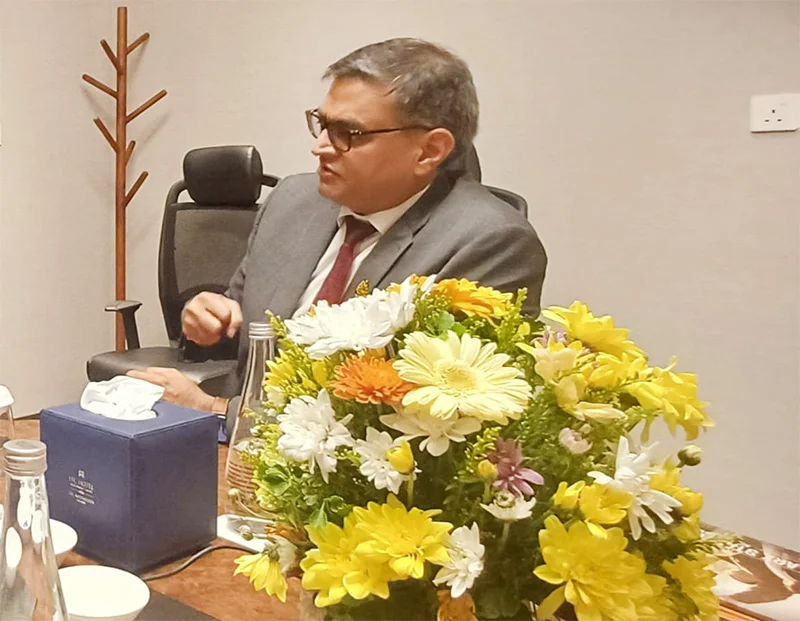
Sri Lanka’s renewable energy sector is poised for a significant investment surge as the International Solar Alliance (ISA) moves to operationalise a comprehensive Country Partnership Strategy (CPS), positioning the island as a key emerging hub for solar deployment and green financing in South Asia.
A high-level ISA delegation led by Director General Ashish Khanna is currently in Colombo (April 6–9), engaging with policymakers, multilateral lenders, and private sector stakeholders to fast-track a pipeline of solar projects exceeding 4 gigawatts (GW) under the Renewable Energy Project Development Plan (2025–2030).
From Policy to Projects: Unlocking Capital Flows
At the heart of the mission is a decisive shift from policy frameworks to bankable project execution. The CPS outlines a multi-year roadmap aimed at mobilising private capital, strengthening regulatory systems, and accelerating project approvals—long seen as a bottleneck in Sri Lanka’s energy sector.
Energy Minister Eng. Kumara Jayakody emphasised that the strategy provides “clarity across the solar value chain,” particularly in investment mobilisation and regulatory alignment. For investors, this signals reduced risk and improved predictability—two critical factors for scaling infrastructure financing.
Industry analysts note that Sri Lanka’s solar ambitions could unlock billions of dollars in investments over the next decade, especially as global funds pivot toward climate-aligned assets in emerging markets.
A key commercial opportunity emerging from the ISA mission is the focus on floating solar projects and battery energy storage systems (BESS). These segments are expected to attract both foreign direct investment (FDI) and technology partnerships.
Floating solar, in particular, offers Sri Lanka a competitive advantage due to its extensive reservoir network. Coupled with battery storage integration, it enhances grid stability—an essential requirement as renewable penetration increases.
The mission includes a dedicated Floating Solar Workshop aimed at accelerating project readiness, indicating near-term opportunities for engineering firms, developers, and financiers.
University-Industry Linkages to Drive Green Jobs
A landmark Memorandum of Understanding (MoU) to establish a Solar Technology Application Resource Centre (STAR-C) at the University of Moratuwa is expected to strengthen local technical capacity and innovation.
Beyond academia, the initiative is designed to support testing, certification, and workforce development—critical for creating a domestic solar ecosystem. This move aligns with broader efforts to localise value chains and reduce dependence on imported expertise.
Khanna highlighted that the STAR-C would play a pivotal role in job creation and skills development, reinforcing the economic multiplier effect of renewable energy investments.
Sri Lanka’s push toward solar is also driven by macroeconomic imperatives. With global fossil fuel prices remaining volatile, the country’s heavy reliance on imports has strained public finances.
Solar energy, which has already surpassed 1 GW in installed capacity, is expected to contribute nearly 75% of emissions reductions under Sri Lanka’s Nationally Determined Contributions (NDC 3.0) for 2026–2035.
More importantly, it offers a pathway to reduce foreign exchange outflows and enhance energy security—key priorities as the country navigates post-crisis economic recovery.

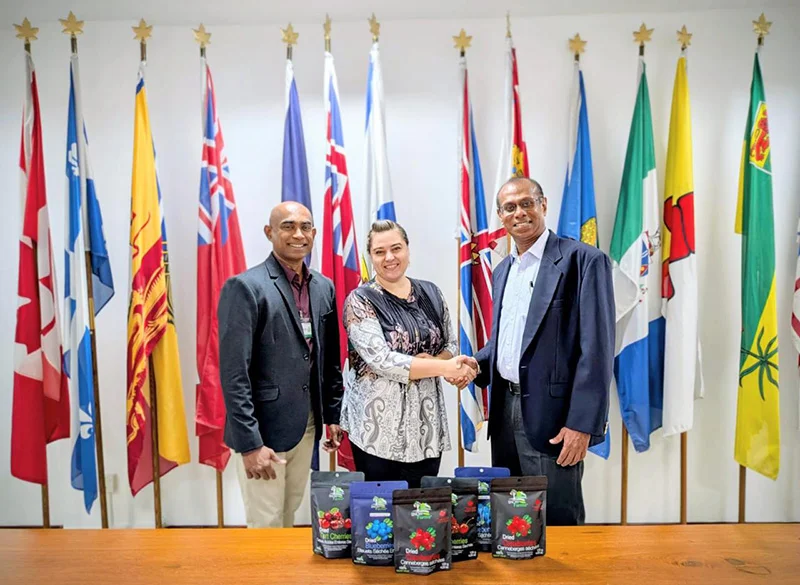
DevPro Guarantee Limited (DevPro) and Affno Virtual Market (Pvt) Limited (AVM) recently entered into a partnership to launch a cloud-based Software-as-a-Service (SaaS) digital marketplace platform “Green Tape Agri Exchange’ to uplift smallholder farmers/ producers in the spice value chain by connecting them with end buyers.
Smallholder farmers are the backbone of Sri Lanka’s agriculture sector, managing nearly 80% of the nation’s farmland and producing about 80% of nation’s food production. They are essential to food security, rural employment, and economic stability. However, poverty among smallholder farmers is a persistent rural crisis. Recent studies have highlighted the depth of this issue with approximately 82% of the country’s poor being concentrated in rural areas where agriculture remains the primary livelihood.
Due to inefficient marketing systems – poor market access, inadequate storage facilities and a lack of information on market prices – smallholder farmers often receive less than the optimal market prices which considerably limit their ability to expand operations, improve productivity and achieve scale.
Speaking on the partnership, DevPro’s Executive Director Chamindry Saparamadu said ‘as an organization committed to building a sustainable agriculture sector, we are pleased to collaborate with AVM to explore means to address market barriers through digital innovation. Our ultimate objective is to empower smallholder farmers and strengthen the local economy by creating a transparent and sustainable supply chain’. The CEO/ Managing Director of AVM Suren Kannangara said ‘we are excited to partner with DevPro to digitally transform the agricultural value chain. Green Tape Agri Exchange represents a scalable, data-driven model to digitize fragmented markets, improving price discovery, reducing intermediaries, and creating predictable, quality-driven market access for both farmers and buyers.
Business
Nestlé brands NESCAFÉ and MAGGI triumph at SLIM-KANTAR People’s Awards 2026 for fifth consecutive year
Nestlé’s household favourites continued their winning streak at the SLIMKANTAR People’s Awards 2026, taking home two awards this year. NESCAFÉ was voted People’s Hot Beverage Brand of the Year while MAGGI emerged as the joint-winner for People’s Snack Brand of the Year respectively for the fifth consecutive year. Organized by the Sri Lanka Institute of Marketing (SLIM), the SLIM-KANTAR People’s Awards is widely considered as one of the most prestigious awards ceremonies in the country, rewarding brands and personalities that are closest to the hearts of Sri Lankans.
Loved by Sri Lankans for its distinct aroma and rich taste, NESCAFÉ is made with the goodness of 100% pure coffee beans to create great coffee experiences that make life better. Made using Sri Lankan spices and the finest ingredients, the tasty goodness of MAGGI noodles has been a household favourite by Sri Lankans for over 40 years.
Sharing his thoughts, Bernie Stefan, Chairman and Managing Director of Nestlé Lanka said “The People’s Awards hold special meaning for us as they are shaped entirely by consumer choice. Being recognised for the fifth consecutive year for NESCAFÉ as Hot Beverage Brand of the Year and MAGGI as Snack Brand of the Year reflects the enduring trust Sri Lankan consumers place in our brands – trust that has been built over generations during our 120‑year journey in Sri Lanka. This recognition belongs to our teams, whose commitment to quality and understanding local tastes continues to earn the confidence of consumers. We are grateful for this continued support and remain focused on serving Sri Lankan households with tasty and nutritious products”.
Guided by its purpose of ‘unlocking the power of food to enhance quality of life for everyone, today and for generations to come’, Nestlé Lanka has been enriching Sri Lankan lives for 120 years, nourishing generations with tasty, and nutritious products across the country. The company remains committed to supporting healthier families, empowered communities, and a greener planet. Nestlé Lanka manufactures over 90% of its products locally at its state‑of‑the‑art factory in Kurunegala, upholding the highest standards of safety and quality.

Trump announces two-week ceasefire as Iran agrees to reopen Hormuz Strait

Yashasvi Jaiswal powers Royals past Mumbai Indians in 11-over thrash

Showers will occur at several places in the Western, Sabaragamuwa, Southern and North-western provinces and in Kandy, Nuwara-Eliya and Monaragala districts after 1.00 p.m.

The Sun is directly overhead Warakapola, Aranayaka, Gampola, Bibile, Inginiyagala, and Akkaraipattu at about 12:12 noon today (08)

AKD admits import of substandard coal, blames technicalities and supplier

‘Sri Lanka – China relations: Community with a Shared Future’ launched

‘Dates have the highest sugar content to fight Coronavirus’

Sunday Island 27 December – Headlines

#SundayIsland 17th December – Headlines

Sunday Island – 28th March

Sunday Island Headlines – 21 March

Sunday Island – 21st February – Headlines
-

 Features4 days ago
Ranjith Siyambalapitiya turns custodian of a rare living collection
-

 News7 days ago
2025 GCE AL: 62% qualify for Uni entrance; results of 111 suspended
-

 News4 days ago
Global ‘Walk for Peace’ to be held in Lanka
-

 Editorial7 days ago
Search for Easter Sunday terror mastermind
-

 News2 days ago
Lankan-origin actress Subashini found dead in India
-

 Opinion6 days ago
Hidden truth of Sri Lanka’s debt story: The untold narrative behind the report
-

 Opinion7 days ago
Is there hope for Palestine?
-

 Features4 days ago
Beyond the Blue Skies: A Tribute to Captain Elmo Jayawardena