
Business
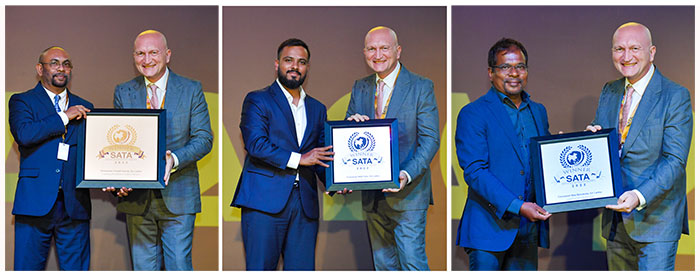
Cinnamon Hotels And Resorts Holds Winning Streak At SATA 2022

Exceptional Sri Lankan Hospitality awaits global tourists who visit this picturesque island
At the recently concluded South Asian Travel Awards (SATA) 2022 held in the Maldives, one of Sri Lanka’s biggest hospitality brands, Cinnamon Hotels and Resorts picked up three awards, one in the Gold category and two in the Silver category, continuing a fine winning streak since 2017. This is a true testament to the entire team at Cinnamon Hotels and Resorts, living and breathing hospitality with a dedicated focus on rebuilding and rejuvenating Sri Lanka’s struggling tourism industry. As the pearl of the Indian Ocean, Sri Lanka has so much to offer, including a rich blend of culture, gastronomic delights, pristine sandy beaches, picturesque scenery, stunning wildlife, and unparalleled natural beauty. With properties strategically located across Sri Lanka and Maldives to take advantage of these gifts, Cinnamon Hotels and Resorts’ win at SATA 2022 showcases that the brand is always committed towards the best standards of hospitality.
“We are pleased and truly humbled to receive these awards, competing against a backdrop of excellent competitors that include Taj Resorts, Heritance Resorts, and other top-level regional players” said Ilias Vamvakas, Area Vice President Sri Lanka resorts – Cinnamon Hotels & Resorts. “Winning these awards highlights our ongoing commitment towards delivering the highest standards of service and excellence in the hospitality industry. Sri Lanka has so much to offer, including a rich blend of culture, gastronomic delights, sandy beaches, picturesque scenery, stunning wildlife, and unparalleled natural beauty. Of course, this also helps us raise the profile of the Cinnamon brand locally, regionally, and globally, and cements our dedication towards providing travellers with truly enriching and inspiring moments and experiences throughout their holidays.”
Cinnamon Citadel in Kandy, situated on the banks of the mighty Mahaweli River, was awarded Gold in the Leading Riverfront Hotel/Resort category. Directly fronting Sri Lanka’s longest river and surrounded by the hill capital Kandy’s rolling hills, natural flora, and fauna, and beneath clear blue skies, the hotel is truly a must-experience for those visiting Kandy.
Cinnamon Wild Yala, a premium game lodge situated on the very fringes of Sri Lanka’s much celebrated Yala National Park, clinched Silver in the Leading Wildlife Lodge category. Offering four-star luxury services with the prime objective of ensuring all guests receive an immersive wildlife experience without disturbing the natural course of the resident wildlife, Cinnamon Wild Yala is another must-see, whether you are a seasoned wildlife pro, or a casual observer.
Sri Lanka’s beaches are renowned for their beauty and accessibility, and in the Leading Beachfront Resort category, Cinnamon Bey, Beruwala secured Silver. Sporting Moorish décor and style, Cinnamon Bey, Beruwala offers a regal experience that is just a few steps away from a wide, golden, sandy beach.
The South Asian Travel Awards was first held in 2016 and has since received endorsement by over fifteen international and Government agencies, including the Sri Lanka Inbound Tour Operators Association, The Hotels Association Of Sri Lanka (THASL), Maldives Marketing & PR Corporation (MMPRC), Association of Professionals In Tourism (APT) and Confederation of Accredited Tour Operators (India). Covering 37 categories across 10 segments, it is reputed to be one of the most coveted and influential regional travel industry awards. Being recognized as a SATA Gold, Silver or Bronze winner epitomizes the highest standards of that entity in their relevant segment.
About Cinnamon Hotels & Resorts – Cinnamon Hotels & Resorts is a diverse chain of hotels spanning Sri Lanka and the Maldives and a member of John Keells Holdings PLC, one of the largest listed conglomerates in Sri Lanka, with diverse interests in sectors ranging from Leisure, Transportation, Property, Consumer Food & Retail, Financial Services, Information Technology, Business Process Operations to Plantations. This pioneering hotel chain was launched at The World Travel Market in London on 14 November 2005. Since its launch, it has come to represent a uniquely Cinnamon experience and has steadily risen to become the leading choice for travellers in Sri Lanka. The Cinnamon brand boasts a portfolio of vibrant and modern hotels, colourful and inspiring, unswervingly hospitable and committed to satisfying our patrons varied and discerning needs.
Cinnamon Hotels & Resorts is the pinnacle of Sri Lankan hospitality through comfort, creativity, discovery, and inspired living. Each property is designed to highlight and complement the local environment, character, culture, and traditions of the area it serves. From Jungle cabanas to city luxury, water villas in the Maldives to beach chalets in Sri Lanka, each resort is designed to take you on a memorable journey into discovery. With three City properties in Colombo, eight Resort properties around Sri Lanka and four Resorts in the Maldives, and a host of new and exciting projects on the horizon, Cinnamon Hotels & Resorts is your partner and faithful guide to ‘The Jewel of the Indian Ocean’ and its timeless and fascinating ‘Emerald Isle

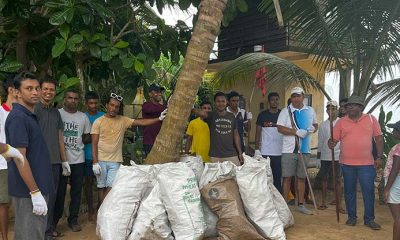

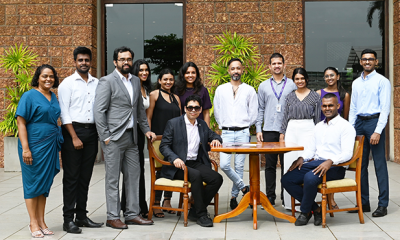




The Securities and Exchange Commission of Sri Lanka (SEC) successfully hosted a series of high-level meetings of the International Organization of Securities Commissions (IOSCO), bringing together leading securities regulators and enforcement officials from around the world to discuss emerging regulatory challenges, strengthen international cooperation, and enhance collective efforts to combat cross-border securities market misconduct.
The meetings, held at the Hilton Colombo from 13 to 16 October 2026, included sessions of the IOSCO Enforcement and Cooperation Committee and its Screening Group (Committee 4/SG), as well as meetings of the Monitoring Group and the Steering Committee. The event attracted approximately 50 senior representatives from securities regulators and exchanges across several jurisdictions, including Australia, Japan, the United States, the United Kingdom, France, Italy, Canada, New Zealand, India, Germany, Belgium, Singapore, China and Spain, reflecting the global significance of the discussions and the growing importance of international regulatory collaboration.
Welcoming delegates to Sri Lanka, Senior Professor D.B.P.H. Dissabandara, Chairman of the SEC, emphasized the critical role of international cooperation in safeguarding market integrity and investor confidence in an increasingly interconnected financial landscape.
“No regulator can effectively address cross-border misconduct in isolation. The speed with which information, transactions and illicit activities can move across borders requires an equally coordinated and timely regulatory response. Strong international cooperation, effective information sharing and mutual trust among regulators are essential to maintaining fair, transparent and resilient capital markets,” he stated.
The discussions focused on a range of enforcement and cooperation matters, including mechanisms for enhancing cross-border information exchange, strengthening investigative collaboration among regulators, addressing increasingly sophisticated forms of securities fraud and market abuse, and promoting the effective implementation of international standards and best practices. Participants also exchanged experiences and insights on emerging enforcement challenges arising from technological developments, digitalization of financial services, and increasingly interconnected global markets.
IOSCO is recognized as the leading international body that brings together the world’s securities regulators and serves as the global standard setter for securities regulation. Through its policy work and cooperative initiatives, IOSCO plays a central role in promoting investor protection, ensuring that markets are fair, efficient and transparent, reducing systemic risk, and strengthening confidence in capital markets worldwide.
Sri Lanka has maintained a strong and active relationship with IOSCO for more than three decades. The SEC became an Ordinary Member of IOSCO in 1993 and has been a signatory to the IOSCO Multilateral Memorandum of Understanding (MMoU) since 2004. The MMoU is the internationally recognised benchmark for cooperation and information sharing among securities regulators and serves as a critical tool in facilitating cross-border investigations and enforcement actions.

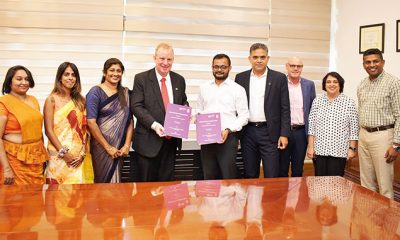
Pan Asia Bank recently entered into a one-year Memorandum of Understanding (MOU) with Ideal Motors (Pvt) Ltd, creating a new financing avenue for customers purchasing vehicles from the authorised Mahindra dealer. The strategic partnership will enable customers of Ideal Motors to access leasing facilities from Pan Asia Bank, making vehicle financing more convenient while supporting their mobility and business requirements. The agreement also provides an opportunity for the Bank to expand its leasing portfolio and strengthen its presence in Sri Lanka’s vehicle financing market.
Ideal Motors is the authorised dealer for the Mahindra vehicle range in Sri Lanka, including the Mahindra Bolero CPU Truck and Scorpio Jeep/Pickup. The vehicles cater to a range of requirements, from commercial and business applications to personal mobility, making accessible financing an important part of the purchasing decision.
The Bank’s vehicle leasing facilities are designed to simplify the financing process, with convenient repayment options and professional support to help customers select a solution suited to their requirements. For customers, the arrangement brings vehicle selection and financing closer together, reducing the need to navigate the two processes separately.
“Our partnership with Ideal Motors enables us to bring financing closer to customers at the point of vehicle purchase. We remain focused on providing convenient and flexible leasing solutions that support both personal mobility and the needs of businesses,” said Naleen Edirisinghe, Director/CEO of Pan Asia Bank.
Pan Asia Bank and Ideal Motors will work closely during the one-year partnership to maximise business opportunities and deliver a seamless financing experience to customers. The collaboration is expected to strengthen both organisations’ ability to respond to demand for commercial and personal vehicles while creating greater value for customers.
Yohan Ebell, Head of Retail Credit, Pan Asia Bank, said: “Through this partnership, we aim to make vehicle financing simpler and more accessible, with leasing solutions designed to meet the varied requirements of Ideal Motors’ customers.”
The collaboration also reflects Pan Asia Bank’s commitment to building partnerships that make financial services more accessible and responsive to the needs of individuals and businesses.
Pan Asia Bank has established a growing presence in vehicle financing, offering leasing solutions designed around customer convenience and flexibility. Its leasing proposition is supported by a nationwide branch network and a customer-focused approach, enabling customers to obtain guidance on financing options while completing their vehicle purchase.

Heritance Hotels and Resorts has secured four distinguished titles at the World Travel Awards 2026, with three national awards recognising its Sri Lankan properties and an international title for Heritance Aarah in the Maldives.
The three Sri Lankan titles recognise Heritance Tea Factory as Sri Lanka’s Leading Heritage Hotel 2026, Heritance Ahungalla as Sri Lanka’s Leading Luxury Hotel 2026, and Heritance Kandalama as Sri Lanka’s Leading Wedding Hotel 2026. Heritance Aarah was named the Indian Ocean’s Leading All-Inclusive Resort 2026.
Internationally recognised within the global travel and tourism industry, the World Travel Awards celebrate excellence across hotels, resorts, and destinations. Recognition at this level affirms the quality, distinctiveness, and consistency of the experiences delivered by Heritance Hotels and Resorts.

Heavy showers about 100 mm are likely at some places in the Northern, North-central, Central, Eastern, North-western and Uva provinces

Molineux, Dunkley enter WPL 2027 auction with top base price of INR 50 lakh

Ranawaka accuses govt. of using JVP cadres and police to suppress political opponents

Six killed as speeding bulker crashes into vehicles, shop in Akurana

Prof. Peiris, summoned by CIABOC, appeals for Ven. Gnanasara’s release

Tusker Agbo found safe and in good health

‘Dates have the highest sugar content to fight Coronavirus’

Sunday Island 27 December – Headlines

#SundayIsland 17th December – Headlines

Sunday Island – 28th March

Sunday Island Headlines – 21 March

Sunday Island – 21st February – Headlines
-

 Latest News7 days ago
Nissanka’s return headlines Sri Lanka’s Test squad against Pakistan
-

 Features2 days ago
Kotahena:A Small Enclave, An Extraordinary Legacy
-

 News6 days ago
Sri Lanka, India caught in US-Iran ship crisis
-

 News3 days ago
Asgiri Mahanayake calls for immediate release of Gnanasara Thera
-

 Latest News7 days ago
Imran Khan’s PTI braces to fight federal takeover of Khyber Pakhtunkhwa
-

 Latest News6 days ago
Missiles intercepted near Riyadh after Saudi coalition hits Yemen fuel depot
-

 Latest News6 days ago
Kusal Mendis’ unbeaten 87 hands Sri Lanka consolation win
-

 News5 days ago
AC President recuses himself from hearing prison attire case pertaining to Gnanasara Thera