
Features
Charles Ambrose Lorenz: an unsung artist of the 19th century


by Avishka Mario Senewiratne
“Every child is an artist; the problem is staying an artist when you grow up” – Pablo Picasso
Though forgotten by the present generation, it is no understatement to say that Charles Ambrose Lorenz was Ceylon’s most beloved son of the 19th century. The whole colony mourned his premature death in his prime in 1871. He was loved by people from all walks of life. This most accomplished and colourful personality wore several hats in lifetime.
He was well-known as one of the earliest Ceylonese appointed to the Legislative Council where he fulfilled his duties with zeal and integrity. Being a lawyer, he stood for justice, never compromising his principles for glory or monetary gain. Though Burgher by race, the Sinhalese called him as Lorenz Hâmuduruwwô, for he stood for all irrespective of caste, creed and race. A pioneering journalist, he founded The Ceylon Examiner. A prolific writer of letters and articles his was a fine balance of intellect, emotion, knowledge and virtue. Among the few who may have heard of him, not many are aware of what a fine illustrator, artist and musician he was in his day.
Lorenz hailed from Matara, where many Burghers had settled during their heyday. His father, Prussian-born Johan Freiderick Lorenz (1772-1845) was a traveller with little money when he settled in Ceylon and was fortunate be be appointed Magistrate of Matara by the colonial power. When Lorenz was born in 1829, Ceylon was going through a new phase under the British with the recommendations of the Colebrooke-Cameron Commission under implementation.
This was a much-needed change in a colony that was spending much more than it earned. Charles Lorenz was the youngest (ninth) child of Johan. Anna Petronella Smith, Lorenz’s mother was Johan’s third wife. Lorenz and his big family lived in a spacious house called ‘Lodge Harmony’ by the banks of the Nilwala River. ‘Lodge Harmony’ was said to be so named because of the various musical instruments played by the Lorenz family. The whole of Matara was aware of the musical talents of the Lorenz’.
Johan Lorenz, who was an accomplished scholar himself, taught English, Latin and Euclid (Mathematics) to young Charles. The late Justice Percy Colin-Thome reveals that Johan taught each of his children the rudiments of poetry, painting, music, dancing and amateur theatricals. By the tender age of 12, young Lorenz was an accomplished musician, able to play the violin and flute. Similarly, Lorenz loved to do skits and caricatures of himself and the people he adored.
Musicians of ‘Lodge Harmony’
One of the earliest surviving sketches by Lorenz is that of a musical group of his family in Lodge Harmony. In this illustration, Lorenz depicts his sister, Henrietta Agnes (to be married to John Drieberg in a week) seated in the centre playing the spinet. On her left, John Fredrick Lorenz (Charles’ elder brother) is seated playing the violoncello. On Henrietta’s right and slightly behind her, standing and playing the flute is the 12-year-old Lorenz, while tapping his foot on the floor, to the beat. On the right of Lorenz is his other sister, Nancy Catherine Louise, sitting right-angled to the harpsichord, working her fingers through its fine strings. In the foreground of this illustration are their parents; Johan standing at ease on the left and the mother watching seated on the right. Truly this sketch is illuminating.
This kind of illustration of casual family gatherings of this era in Ceylon is very rare. Glancing through the fine details of the work of Lorenz, many intricate details are revealed. ‘The picture of the Lodge Harmony’ writes the author of Lorenz’s Centenary Monograph, “is not without some historic value, as illustrating the interior and furnishing of a room of the period…”. (Quoted from Blaze p. 14) Apart from the different styles of the chairs and the piano stool, a square window with glass panes and short draped curtains is depicted. Though Johan Lorenz was an art enthusiast, the Lodge Harmony walls are bare. Perhaps it was because paintings were expensive or that he may have not been fond of displaying art. The floor is red brick or tiled squares marked out with white lime, a classic feature of old Dutch Houses in the South.
A lot can be observed by the style of dress depicted by Lorenz. The costumes of the boys were long trousers and a jacket. Evidently the customary schoolboy attire at the time. Johan Lorenz, lacking the wig, pigtail and three-cornered hat of the Dutch Burgher gentlemen of his day, seems to be quite modern for the 1830s. The gowns of the ladies illustrated are full skirts gathered tightly at the waist, billowing out towards the ankles. The sleeves are puffed and gathered at the elbows and tapers down to the wrist. A shawl is drawn over the mother’s shoulder. The older two ladies wear a day cap, covering their hair.
Rising musician of Colombo
After the Colebrooke-Cameron reforms, education in Ceylon made strong headway. The founding of many English medium schools took place during the time of Governor Robert Wilmot Horton. The Colombo Academy (Royal College) was the most important of these at the time. Realising this was the best opportunity for his multi-talented son, Johan Lorenz enrolled young Charles in the Academy in 1841. Leaving Matara, he lived with his brother-in-law, John Drieberg, an upcoming lawyer and his sister, Henrietta.
At the Academy, his many skills developed from strength to strength as did his talents in art and music. It was during this time that he met Hippolyte Silvaf, the art and music master, who had his own school not far from where Lorenz lived in Pettah. One day, the Driebergs with the young Lorenz accompanying, went to dine with the Prins family. As music was a must at Colombo dinners, Mrs. Prins played the piano, entertaining the guests. Soon she was accompanied by Silvaf (Violin), and young Lorenz (flute). This was the first time that Lorenz came to be known as a skilled musician. Unlike in Matara, the Harpsichord/Spinet was found to be old-fashioned in Colombo. Piano was the trend and Lorenz mastered playing it as well.

He would later start his own amateur band. Silvaf’s son, Napolean was its tenor/violinist. Other prominent young men in the band were Fredrick Kriekenbeek (second flute), Louis Nell (cornet), and the de Waas brothers (Soprano/violins). J. B. Siebel played second fiddle to Lorenz both then and later. The bass was provided by Gabriel Johannes Ohlmus, a music teacher. The group trained in Lorenz’s long room in John Drieberg’s House near Hulftsdorp. This band came to be in high demand in Colombo circles for socials, birthday parties and silver jubilee weddings. This was how Lorenz made his public debut, long before venturing into journalism, law and politics.
The performing artist
Lorenz, though serious and brilliant in his work, was known to play the fool more often than not. He was a great comic and creative punster who did not fail to leave his audience in fits of laughter. The famous Colonial Secretary, Sir James Emerson Tennant was one of his victims. Tennant had visited the Academy on one occasion and interviewed Lorenz, offering him a job for £48 a year. Here he reverently bowed to the Secretary multiple times saying “I’ll come back when I want £48 a year” (Blaze, p. 50). Soon his friends encourage Lorenz to pursue serious acting on stage.
Patronised by the educated youth of Colombo, especially the alumni of the Academy, the Grandpass Theatre was the best of its day. Encouraged by friends, Lorenz played his part acting and directing. B.R. Blaze, the biographer of Lorenz states: “Lorenz’s share was not limited to music. His bent for acting had full scope, as well as his gift for leadership and his organizing ability”.
It took hardly any time for those who were regulars at the plays to notice that Lorenz was the standout performer. One of his friends commented: “Lorenz was the life and soul of our Theatrical Company”. His musical prowess also came into good use as he later composed his own musicals and directed them. Blaze comments: “He was Stage Manager, scene-painter, actor; and leader of the Orchestra besides”. His popularity continued to expand as his versatility made him one of a kind. Even at that young age, he had by all standards reached the rank of pre-eminence.
One of Lorenz’s plays, George Barnwell, was a popular three-act play starring Lorenz (Rich Banker), his friend from the Academy: Bernard Edwin Alvis (George Barnwell – spendthrift nephew of the rich banker) and Owen Morgan. The latter played a female part. This play revolves around the prodigal folly of young George Barnwell, who spends lavishly and gets into severe debt. Later, he forges his uncle’s signature and swindles hundreds of pounds. Riotous in his spending, he goes bankrupt in no time. However, after this downfall, he makes ample amends and gets back on his feet. George Barnwell was well received in Colombo.
(To be continued next week)


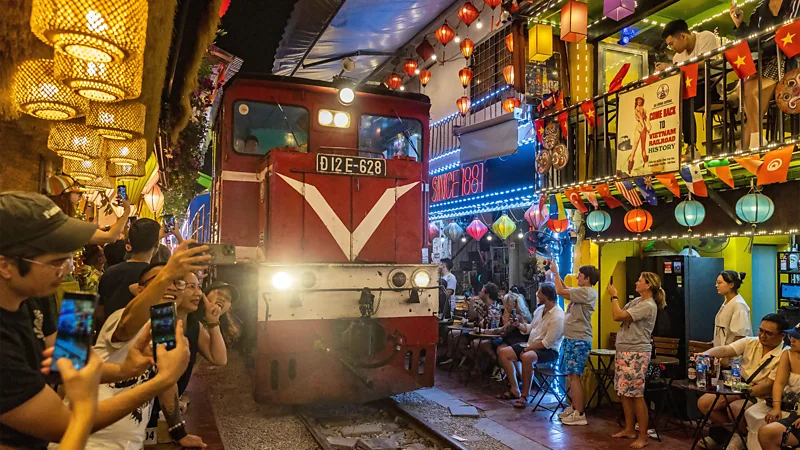
Train Street started life as a razor-thin alley with a train rushing through it. Now, it’s swarmed with Instagrammable cafes and tourists who can’t stay away, despite the risks.
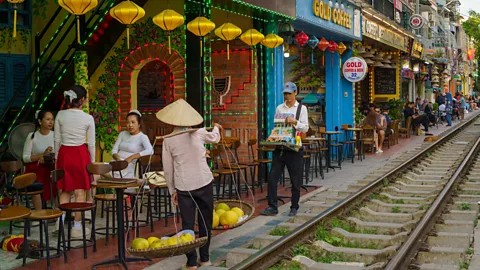
A train chugs through Hanoi, approaching a narrow passageway festooned with Chinese-style lanterns. Just as it screams into the station, a tourist jumps onto the tracks, attempting her most social-media friendly pose. Moments before the train strikes, its horn blaring into the humid air, she recoils to safety. Click, post.
It’s just an ordinary day on Hanoi’s Train Street, a 400m stretch of railway flanked by cafes where tourists nurse beers and watch, mesmerised, as trains roar past them at dangerously close proximity: sometimes crashing into tables and chairs.
Fun? Evidently – in a few short years, Train Street has entered Vietnam’s pantheon of “must-see” attractions, along with Ha Long Bay and the Cu Chi Tunnels. But the Vietnamese government is less impressed; since the site went viral in 2017, it has attempted various shutdowns, first in 2019, then 2022 and most recently further investigations and crackdowns in 2025 after an incident where a selfie-snapping tourist was nearly dragged under an oncoming train’s wheels. Police barricades go up between train arrivals; edicts are issued to tour operators and bar owners.
The tourists come anyway.
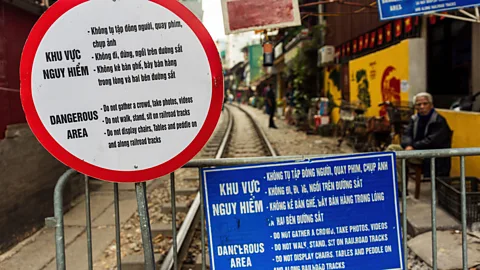
How did an ordinary street become one of Vietnam’s hottest tourist attractions? It started innocently enough.
The North-South Railway was built by colonialist French forces in 1902, connecting Hanoi to Ho Chi Minh City. Fifty-four years later, the General Department of Railway erected a series of squat buildings straddling a stretch in central Hanoi to house employees. By the 1970s, the area was considered a slum; residents regularly roused out of their sleep by trains rumbling through, their houses quaking.
“It was just an ordinary street with train tracks running through it,” said Minh Anh, a lifelong Hanoi local who works at local whisky distillery,
Alamy The Vietnamese government has attempted numerous shutdowns of the area (Credit: Alamy)Alamy
The Vietnamese government has attempted numerous shutdowns of the area (Credit: Alamy)
From ordinary to unmissable
How did an ordinary street become one of Vietnam’s hottest tourist attractions? It started innocently enough.
The North-South Railway was built by colonialist French forces in 1902, connecting Hanoi to Ho Chi Minh City. Fifty-four years later, the General Department of Railway erected a series of squat buildings straddling a stretch in central Hanoi to house employees. By the 1970s, the area was considered a slum; residents regularly roused out of their sleep by trains rumbling through, their houses quaking.
“It was just an ordinary street with train tracks running through it,” said Minh Anh, a lifelong Hanoi local who works at local whisky distillery, Về Để Đi’. “When it started popping up all over social media, I was honestly surprised.”
Nhi Nguyn, a tour guide for A Taste of Hanoi, used to walk tourists through, just before it exploded in popularity. “People were still living ordinary lives there back then and there weren’t so many cafes next to the tracks,” she said. “It had a much more authentic feel: scooters were locked up just meters from the tracks, laundered clothes hung outside, and people were cooking outside on small gas stoves.”
. “When it started popping up all over social media, I was honestly surprised.”
Nhi Nguyn, a tour guide for
Alamy The Vietnamese government has attempted numerous shutdowns of the area (Credit: Alamy)Alamy
The Vietnamese government has attempted numerous shutdowns of the area (Credit: Alamy)
From ordinary to unmissable
How did an ordinary street become one of Vietnam’s hottest tourist attractions? It started innocently enough.
The North-South Railway was built by colonialist French forces in 1902, connecting Hanoi to Ho Chi Minh City. Fifty-four years later, the General Department of Railway erected a series of squat buildings straddling a stretch in central Hanoi to house employees. By the 1970s, the area was considered a slum; residents regularly roused out of their sleep by trains rumbling through, their houses quaking.
“It was just an ordinary street with train tracks running through it,” said Minh Anh, a lifelong Hanoi local who works at local whisky distillery, Về Để Đi’. “When it started popping up all over social media, I was honestly surprised.”
Nhi Nguyn, a tour guide for A Taste of Hanoi, used to walk tourists through, just before it exploded in popularity. “People were still living ordinary lives there back then and there weren’t so many cafes next to the tracks,” she said. “It had a much more authentic feel: scooters were locked up just meters from the tracks, laundered clothes hung outside, and people were cooking outside on small gas stoves.”
, used to walk tourists through, just before it exploded in popularity. “People were still living ordinary lives there back then and there weren’t so many cafes next to the tracks,” she said. “It had a much more authentic feel: scooters were locked up just meters from the tracks, laundered clothes hung outside, and people were cooking outside on small gas stoves.”
In early 2013, Colm Pierce and Alex Sheal, co-founders of Hanoi-based photography tours Vietnam in Focus, launched a Hanoi on the Tracks tour to show visitors how local residents had adopted to the locomotive-sized challenge of living on railway tracks. Serendipitously, in June 2013, Instagram launched its new video-sharing feature. A year later, the Travel Channel show “Tough Trains” featured Pierce walking down Train Street with a camera crew, further enticing travellers.
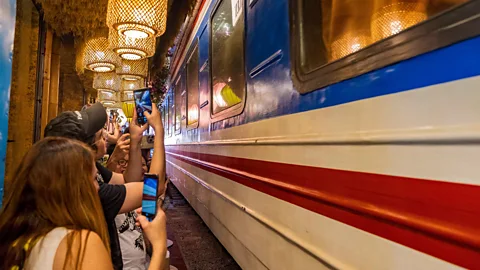
In 2017, an enterprising resident started selling beer and coffee, inviting curious tourists to stay to watch the train go by. Neighbours noticed the economic opportunity and cafes and bars rapidly spread. Soon, the formerly derelict alley, now dubbed Phố Đường Tàu (literally: “Train Street”) became bedecked with colourful lanterns and Christmas lights. Visitors learned to time their arrival for 30 minutes before a scheduled train and the “classic” Train Street experience was cemented: upon entering the tracks, tourists were shepherded into rail-side bars by local merchants and plied with beers and coffee, until the train shrieked through, rattling plates and causing hearts to pound.
Julia Husum, a university student from Norway, visited Train Street in February 2026, and “loved” the experience. “We put our beer caps on the railway, and the train flattened it, creating souvenirs for us,” she said. “I’d go back again.”
Without the advent of social media, would Train Street have become popular? As a travel writer, I’ve witnessed dozens of would-be influencers’ death-defying acts, like scaling down a rocky cliff above Dubrovnik and standing atop the side wall of 14th-Century Charles Bridge in Prague; wistfully looking off into the distance as the camera flashes. I’ve come to conclude that Train Street is no different; here, too, visitors risk their own safety for a picture-perfect opportunity.
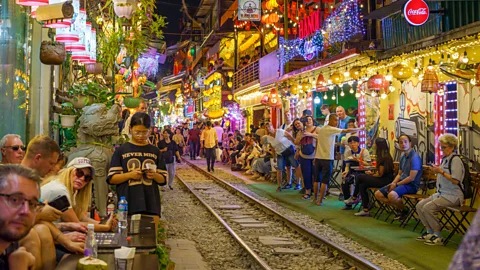
“Essentially social media has fuelled Train Street into what it is today, [where] tourists flock in droves to the area to feel the adrenaline of the passing train while sipping local coffee,” echoed Michael Stanbury, the creative director for Vietnam in Focus. “Even without the train, the Instagrammable decorated street holds a very Hanoian charm.”
Local debate; the government proposes halting passenger trains for good. And each attempted shutdown, tourists climb past the barricades. There are, to date, more than 100,000 posts tagging Train Street on Instagram. Men’s grooming blogger Adam Hurly visited because a friend had hyped it. “It felt more like an Instagram attraction rather than a neighbourhood street,” he admitted, noting that once the crowds arrive, it becomes congested and less enjoyable, “Especially if you’re just standing on the main sidewalk trying to get a picture.”
He added: “It’s one of those places that looks better in photos than it feels in reality.”
But Matthew Tran, an artisanal footwear designer who visits Hanoi regularly, loves the pull of Train Street.
“The coffees were absurdly overpriced, yet I paid for them every time because I couldn’t stop marvelling at how the place worked; how an entire economy could thrive in such an improbable space,” he said. “These vendors built something real out of something most people would call chaos – that, to me, is worth coming back for.”
He offers advice for future visitors: “It’s a unique experience you won’t get anywhere else. Although I wish more visitors would stop for a moment and remember that while it’s a tourist attraction to them, living beside those train tracks is someone else’s daily reality.”
Under more superficial reasons, visiting Train Street is similar to the appeal of visiting the Eiffel Tower during someone’s first visit to Paris, said Charlotte Russell, founder of The Travel Psychologist.
“Humans are a social species and if we perceive that other people are enjoying an experience, it is natural for us to want to do it too,” she said. “This goes back to our evolution, when we lived in small groups and it would be advantageous for us to emulate other people in this way. So the sense of fear of missing out that we experience when seeing other people visiting places like Train Street is part of being human.”
Bearix Stewart-Frommer, an American pre-med student, validates Russell’s theory: “I found out about Train Street from my mum,” she said. “I didn’t have some deep motivation to see it, but I was curious because it’s one of those quirky, very photogenic spots that people talk about on social media.”
But there may be a more deep-seated reason why we’re lured to such places, Russell notes: “With Train Street specifically, the risk element is part of what makes it so novel, especially those of us from countries like the UK… We are used to regulation and precaution, railings, barriers and painted lines that we must stand behind. In contrast, Train Street can feel unbelievable to see and experience… [it helps] us reflect on our own norms and realise that other perspectives do exist.”
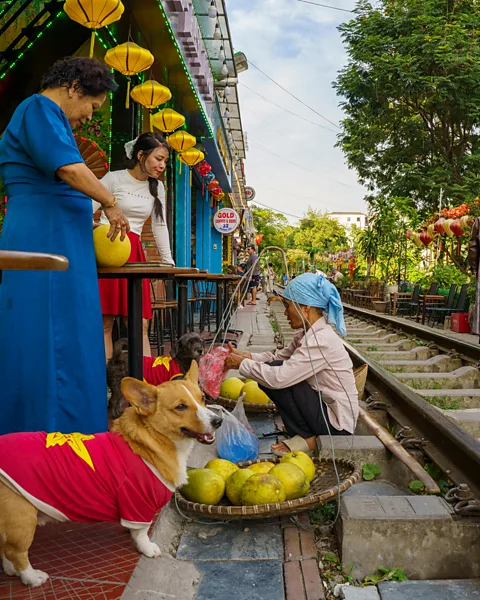
Local tour guide Phuong Loan Ngo offers one such alternative perspective: “The economic boost is undeniable, giving families who live along Train Street financial opportunities,” she said. “On the other hand, there are cultural challenges too. When an area becomes a ‘spotlight’ for social media, a place’s historical and cultural heritage can get lost. Instead of learning about how this railway has functioned since the colonial era, people often leave with only a photo, missing the true soul of the neighbourhood.”
The irony is that Vietnam in Focus has now moved their photography tours to another, far-less trammelled part of the railway, so they can show visitors that old, track-side way of life.
“As with all good things, the popularity of Train Street and the crowds it attracts are spreading,” said Sheal. “Thankfully, we have scoured Hanoi and found a fantastic local market that runs along the Hanoian railway further out in the suburbs – a new attraction.”
That is, until the social-media-obsessed travel masses find out about it. For better or worse, the unbearable lightness of Train Street is a permanent, but moveable feast.
[BBC]
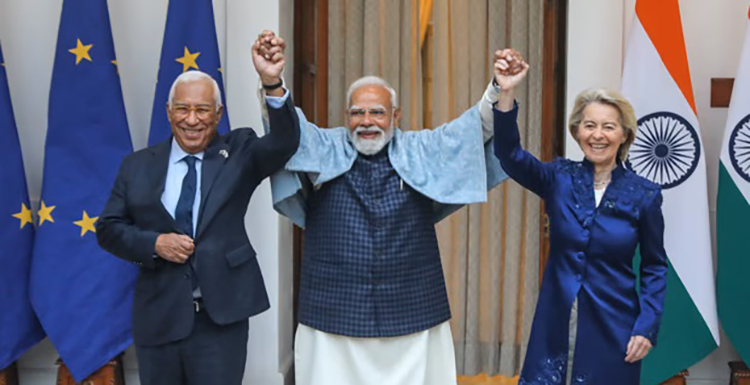
After nearly two decades of on-and-off negotiations that began in 2007, India and the European Union formally finally concluded a comprehensive free trade agreement on 27 January 2026. This agreement, the India–European Union Free Trade Agreement (IEUFTA), was hailed by political leaders from both sides as the “mother of all deals,” because it would create a massive economic partnership and greatly increase the current bilateral trade, which was over US$ 136 billion in 2024. The agreement still requires ratification by the European Parliament, approval by EU member states, and completion of domestic approval processes in India. Therefore, it is only likely to come into force by early 2027.
An Innocent Bystander
When negotiations for a Free Trade Agreement between India and the European Union were formally launched in June 2007, anticipating far-reaching consequences of such an agreement on other developing countries, the Commonwealth Secretariat, in London, requested the Centre for Analysis of Regional Integration at the University of Sussex to undertake a study on a possible implication of such an agreement on other low-income developing countries. Thus, a group of academics, led by Professor Alan Winters, undertook a study, and it was published by the Commonwealth Secretariat in 2009 (“Innocent Bystanders—Implications of the EU-India Free Trade Agreement for Excluded Countries”). The authors of the study had considered the impact of an EU–India Free Trade Agreement for the trade of excluded countries and had underlined, “The SAARC countries are, by a long way, the most vulnerable to negative impacts from the FTA. Their exports are more similar to India’s…. Bangladesh is most exposed in the EU market, followed by Pakistan and Sri Lanka.”
Trade Preferences and Export Growth
Normally, reduction of price through preferential market access leads to export growth and trade diversification. During the last 19-year period (2015–2024), SAARC countries enjoyed varying degrees of preferences, under the EU’s Generalised Scheme of Preferences (GSP). But, the level of preferential access extended to India, through the GSP (general) arrangement, only provided a limited amount of duty reduction as against other SAARC countries, which were eligible for duty-free access into the EU market for most of their exports, via their LDC status or GSP+ route.
However, having preferential market access to the EU is worthless if those preferences cannot be utilised. Sri Lanka’s preference utilisation rate, which specifies the ratio of eligible to preferential imports, is significantly below the average for the EU GSP receiving countries. It was only 59% in 2023 and 69% in 2024. Comparative percentages in 2024 were, for Bangladesh, 96%; Pakistan, 95%; and India, 88%.
As illustrated in the table above, between 2015 and 2024, the EU’s imports from SAARC countries had increased twofold, from US$ 63 billion in 2015 to US$ 129 billion by 2024. Most of this growth had come from India. The imports from Pakistan and Bangladesh also increased significantly. The increase of imports from Sri Lanka, when compared to other South Asian countries, was limited. Exports from other SAARC countries—Afghanistan, Bhutan, Nepal, and the Maldives—are very small and, therefore, not included in this analysis.
Why the EU – India FTA?
With the best export performance in the region, why does India need an FTA with the EU?
Because even with very impressive overall export growth, in certain areas, India has performed very poorly in the EU market due to tariff disadvantages. In addition to that, from January 2026, the EU has withdrawn GSP benefits from most of India’s industrial exports. The FTA clearly addresses these challenges, and India will improve her competitiveness significantly once the FTA becomes operational.
Then the question is, what will be its impact on those “innocent bystanders” in South Asia and, more particularly, on Sri Lanka?
To provide a reasonable answer to this question, one has to undertake an in-depth product-by-product analysis of all major exports. Due to time and resource constraints, for the purpose of this article, I took a brief look at Sri Lanka’s two largest exports to the EU, viz., the apparels and rubber-based products.
Fortunately, Sri Lanka’s exports of rubber products will be only nominally impacted by the FTA due to the low MFN duty rate. For example, solid tyres and rubber gloves are charged very low (around 3%) MFN duty and the exports of these products from Sri Lanka and India are eligible for 0% GSP duty at present. With an equal market access, Sri Lanka has done much better than India in the EU market. Sri Lanka is the largest exporter of solid tyres to the EU and during 2024 our exports were valued at US$180 million.
On the other hand, Tariffs MFN tariffs on Apparel at 12% are relatively high and play a big role in apparel sourcing. Even a small difference in landed cost can shift entire sourcing to another supplier country. Indian apparel exports to the EU faced relatively high duties (8.5% – 12%), while competitors, such as Bangladesh, Pakistan, and Sri Lanka, are eligible for preferential access. In addition to that, Bangladesh enjoys highly favourable Rules of Origin in the EU market. The impact of these different trade rules, on the EU’s imports, is clearly visible in the trade data.
During the last 10 years (2015-2024), the EU’s apparel imports from Bangladesh nearly doubled, from US$15.1 billion, in 2015, to US$29.1 billion by 2024, and apparel imports from Pakistan more than doubled, from US$2.3 billion to US$5.5 billion. However, apparel imports from Sri Lanka increased only from US$1.3 billion in 2015 to US$2.2 billion by 2024. The impressive export growth from Pakistan and Bangladesh is mostly related to GSP preferences, while the lackluster growth of Sri Lankan exports was largely due to low preference utilisation. Nearly half of Sri Lanka’s apparel exports faced a 12% tariff due to strict Rules of Origin requirements to qualify for GSP.
During the same period, the EU’s apparel imports from India only showed very modest growth, from US$ 5.3 billion, in 2015, to US$ 6.3 billion in 2024. The main reason for this was the very significant tariff disadvantage India faced in the EU market. However, once the FTA eliminates this gap, apparel imports from India are expected to grow rapidly.
According to available information, Indian industry bodies expect US$ 5-7 billion growth of textiles and apparel exports during the first three years of the FTA. This will create a significant trade diversion, resulting in a decline in exports from China and other countries that do not enjoy preferential market access. As almost half of Sri Lanka’s apparel exports are not eligible for GSP, the impact on our exports will also be fierce. Even in the areas where Sri Lanka receives preferential duty-free access, the arrival of another large player will change the market dynamics greatly.
A Passive Onlooker?
Since the commencement of the negotiations on the EU–India FTA, Bangladesh and Pakistan have significantly enhanced the level of market access through proactive diplomatic interventions. As a result, they have substantially increased competitiveness and the market share within the EU. This would help them to minimize the adverse implications of the India–EU FTA on their exports. Sri Lanka’s exports to the EU market have not performed that well. The challenges in that market will intensify after 2027.
As we can clearly anticipate a significant adverse impact from the EU-India FTA, we should start to engage immediately with the European Commission on these issues without being passive onlookers. For example, the impact of the EU-India FTA should have been a main agenda item in the recently concluded joint commission meeting between the European Commission and Sri Lanka in Colombo.
Need of the Hour – Proactive Commercial Diplomacy
In the area of international trade, it is a time of turbulence. After the US Supreme Court judgement on President Trump’s “reciprocal tariffs,” the only prediction we can make about the market in the United States market is its continued unpredictability. India concluded an FTA with the UK last May and now the EU-India FTA. These are Sri Lanka’s largest markets. Now to navigate through these volatile, complex, and rapidly changing markets, we need to move away from reactive crisis management mode to anticipatory action. Hence, proactive commercial diplomacy is the need of the hour.
(The writer can be reached at senadhiragomi@gmail.com)
By Gomi Senadhira
Dr. B.J.C. Perera (Dr. BJCP) in his article ‘The Education cross roads: Liberating Sri Lankan classroom and moving ahead’ asks the critical question that should be the bedrock of any attempt at education reform – ‘Do we truly and clearly understand how a human being learns? (The Island, 16.02.2026)
Dr. BJCP describes the foundation of a cognitive architecture taking place with over a million neural connections occurring in a second. This in fact is the result of language learning and not the process. How do we ‘actually’ learn and communicate with one another? Is a question that was originally asked by Galileo Galilei (1564 -1642) to which scientists have still not found a definitive answer. Naom Chomsky (1928-) one of the foremost intellectuals of our time, known as the father of modern linguistics; when once asked in an interview, if there was any ‘burning question’ in his life that he would have liked to find an answer for; commented that this was one of the questions to which he would have liked to find the answer. Apart from knowing that this communication takes place through language, little else is known about the subject. In this process of learning we learn in our mother tongue and it is estimated that almost 80% of our learning is completed by the time we are 5 years old. It is critical to grasp that this is the actual process of learning and not ‘knowledge’ which tends to get confused as ‘learning’. i.e. what have you learnt?
The term mother tongue is used here as many of us later on in life do learn other languages. However, there is a fundamental difference between these languages and one’s mother tongue; in that one learns the mother tongue- and how that happens is the ‘burning question’ as opposed to a second language which is taught. The fact that the mother tongue is also formally taught later on, does not distract from this thesis.
Almost all of us take the learning of a mother tongue for granted, as much as one would take standing and walking for granted. However, learning the mother tongue is a much more complex process. Every infant learns to stand and walk the same way, but every infant depending on where they are born (and brought up) will learn a different mother tongue. The words that are learnt are concepts that would be influenced by the prevalent culture, religion, beliefs, etc. in that environment of the child. Take for example the term father. In our culture (Sinhala/Buddhist) the father is an entity that belongs to himself as well as to us -the rest of the family. We refer to him as ape thaththa. In the English speaking (Judaeo-Christian) culture he is ‘my father’. ‘Our father’ is a very different concept. ‘Our father who art in heaven….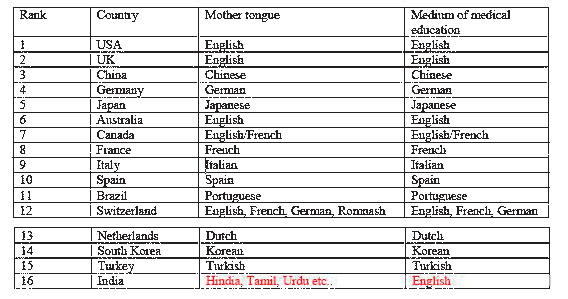
All over the world education is done in one’s mother tongue. The only exception to this, as far as I know, are the countries that have been colonised by the British. There is a vast amount of research that re-validates education /learning in the mother tongue. And more to the point, when it comes to the comparability of learning in one’s own mother tongue as opposed to learning in English, English fails miserably.
Education /learning is best done in one’s mother tongue.
This is a fact. not an opinion. Elegantly stated in the words of Prof. Tove Skutnabb-Kangas-“Mother tongue medium education is controversial, but ‘only’ politically. Research evidence about it is not controversial.”
The tragedy is that we are discussing this fundamental principle that is taken for granted in the rest of the world. It would not be not even considered worthy of a school debate in any other country. The irony of course is, that it is being done in English!
At school we learnt all of our subjects in Sinhala (or Tamil) right up to University entrance. Across the three streams of Maths, Bio and Commerce, be it applied or pure mathematics, physics, chemistry, zoology, botany economics, business, etc. Everything from the simplest to the most complicated concept was learnt in our mother tongue. An uninterrupted process of learning that started from infancy.
All of this changed at university. We had to learn something new that had a greater depth and width than anything we had encountered before in a language -except for a very select minority – we were not at all familiar with. There were students in my university intake that had put aside reading and writing, not even spoken English outside a classroom context. This I have been reliably informed is the prevalent situation in most of the SAARC countries.
The SAARC nations that comprise eight countries (Sri Lanka, Maldives, India, Pakistan Afghanistan, Bangladesh, Nepal and Bhutan) have 21% of the world population confined to just 3% of the earth’s land mass making it probably one of the most densely populated areas in the world. One would assume that this degree of ‘clinical density’ would lead to a plethora of research publications. However, the reality is that for 25 years from 1996 to 2021 the contribution by the SAARC nations to peer reviewed research in the field of Orthopaedics and Sports medicine- my profession – was only 1.45%! Regardless of each country having different mother tongues and vastly differing socio-economic structures, the common denominator to all these countries is that medical education in each country is done in a foreign language (English).
The impact of not learning in one’s mother tongue can be illustrated at a global level. This can be easily seen when observing the research output of different countries. For example, if one looks at orthopaedics and sports medicine (once again my given profession for simplicity); Table 1. shows the cumulative research that has been published in peer review journals. Despite now having the highest population in the world, India comes in at number 16! It has been outranked by countries that have a population less than one of their states. Pundits might argue giving various reasons for this phenomenon. But the inconvertible fact remains that all other countries, other than India, learn medicine in their mother tongue.
(See Table 1) Mother tongue, medium of education in country rank order according to the volume of publications of orthopaedics and sports medicine in peer reviewed journals 1996 to 2024. Source: Scimago SCImago journal (https://www.scimagojr.com/) has collated peer review journal publications of the world. The publications are categorized into 27 categories. According to the available data from 1996 to 2024, China is ranked the second across all categories with India at the 6th position. China is first in chemical engineering, chemistry, computer science, decision sciences, energy, engineering, environmental science, material sciences, mathematics, physics and astronomy. There is no subject category that India is the first in the world. China ranks higher than India in all categories except dentistry.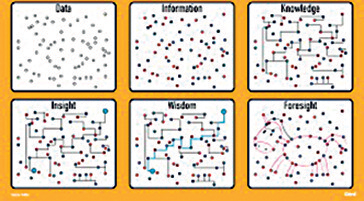
The reason for this difference is obvious when one looks at how learning is done in China and India.
The Chinese learn in their mother tongue. From primary to undergraduate and postgraduate levels, it is all done in Chinese. Therefore, they have an enormous capacity to understand their subject matter just not itself, but also as to how it relates to all other subjects/ themes that surround it. It is a continuous process of learning that evolves from infancy onwards, that seamlessly passes through, primary, secondary, undergraduate and post graduate education, research, innovation, application etc. Their social language is their official language. The language they use at home is the language they use at their workplaces, clubs, research facilities and so on.
In India higher education/learning is done in a foreign language. Each state of India has its own mother tongue. Be it Hindi, Tamil, Urdu, Telagu, etc. Infancy, childhood and school education to varying degrees is carried out in each state according to their mother tongue. Then, when it comes to university education and especially the ‘science subjects’ it takes place in a foreign tongue- (English). English remains only as their ‘research’ language. All other social interactions are done in their mother tongue.
India and China have been used as examples to illustrate the point between learning in the mother tongue and a foreign tongue, as they are in population terms comparable countries. The unpalatable truth is that – though individuals might have a different grasp of English- as countries, the ability of SAARC countries to learn and understand a subject in a foreign language is inferior to the rest of the world that is learning the same subject in its mother tongue. Imagine the disadvantage we face at a global level, when our entire learning process across almost all disciplines has been in a foreign tongue with comparison to the rest of the world that has learnt all these disciplines in their mother tongue. And one by-product of this is the subsequent research, innovation that flows from this learning will also be inferior to the rest of the world.
All this only confirms what we already know. Learning is best done in one’s mother tongue! .
What needs to be realised is that there is a critical difference between ‘learning English’ and ‘learning in English’. The primary-or some may argue secondary- purpose of a university education is to learn a particular discipline, be it medicine, engineering, etc. The students- have been learning everything up to that point in Sinhala or Tamil. Learning their discipline in their mother tongue will be the easiest thing for them. The solution to this is to teach in Sinhala or Tamil, so it can be learnt in the most efficient manner. Not to lament that the university entrant’s English is poor and therefore we need to start teaching English earlier on.
We are surviving because at least up to the university level we are learning in the best possible way i.e. in our mother tongue. Can our methods be changed to be more efficient? definitely. If, however, one thinks that the answer to this efficient change in the learning process is to substitute English for the mother tongue, it will defeat the very purpose it is trying to overcome. According to Dr. BJCP as he states in his article; the current reforms of 2026 for the learning process for the primary years, centre on the ‘ABCDE’ framework: Attendance, Belongingness, Cleanliness, Discipline and English. Very briefly, as can be seen from the above discussion, if this is the framework that is to be instituted, we should modify it to ABCDEF by adding a F for Failure, for completeness!
(See Figure 1) The components and evolution of learning: Data, information, knowledge, insight, wisdom, foresight As can be seen from figure 1. data and information remain as discrete points. They do not have interconnections between them. It is these subsequent interconnections that constitute learning. And these happen best through the mother tongue. Once again, this is a fact. Not an opinion. We -all countries- need to learn a second language (foreign tongue) in order to gather information and data from the rest of the world. However, once this data/ information is gathered, the learning needs to happen in our own mother tongue.
Without a doubt English is the most universally spoken language. It is estimated that almost a quarter of the world speaks English as its mother tongue or as a second language. I am not advocating to stop teaching English. Please, teach English as a second language to give a window to the rest of the world. Just do not use it as the mode of learning. Learn English but do not learn in English. All that we will be achieving by learning in English, is to create a nation of professionals that neither know English well nor their subject matter well.
If we are to have any worthwhile educational reforms this should be the starting pivotal point. An education that takes place in one’s mother tongue. Not instituting this and discussing theories of education and learning and proposing reforms, is akin to ‘rearranging the deck chairs on the Titanic’. Sadly, this is not some stupendous, revolutionary insight into education /learning. It is what the rest of the world has been doing and what we did till we came under British rule.
Those who were with me in the medical faculty may remember that I asked this question then: Why can’t we be taught in Sinhala? Today, with AI, this should be much easier than what it was 40 years ago.
The editorial of this newspaper has many a time criticised the present government for its lackadaisical attitude towards bringing in the promised ‘system change’. Do this––make mother tongue the medium of education /learning––and the entire system will change.
by Dr. Sumedha S. Amarasekara

Hanoi’s most popular street could kill you

At least 11 killed after military plane carrying banknotes crashes in Bolivia

Six balls that changed the night

“We welcome investors and tourists visiting Sri Lanka who contribute to strengthening economic and cultural ties”– PM

A ‘delicate’ balance for Canada and a ‘win-win’ for Modi as Carney visits India

Pakistan face stiff but straightforward equation for semi-final qualification

‘Dates have the highest sugar content to fight Coronavirus’

Sunday Island 27 December – Headlines

#SundayIsland 17th December – Headlines

Sunday Island – 28th March

Sunday Island Headlines – 21 March

Sunday Island – 21st February – Headlines
-
 Features6 days ago
Why does the state threaten Its people with yet another anti-terror law?
-
 Features6 days ago
Reconciliation, Mood of the Nation and the NPP Government
-

 Features6 days ago
Victor Melder turns 90: Railwayman and bibliophile extraordinary
-

 Features5 days ago
LOVEABLE BUT LETHAL: When four-legged stars remind us of a silent killer
-
 Features6 days ago
Victor, the Friend of the Foreign Press
-

 Business5 days ago
Seeing is believing – the silent scale behind SriLankan’s ground operation
-

 Business5 days ago
Bathiya & Santhush make a strategic bet on Colombo
-
 Features6 days ago
Barking up the wrong tree