
Business
Ceylinco General Insurance to distribute clothes to the needy via its new CSR initiative

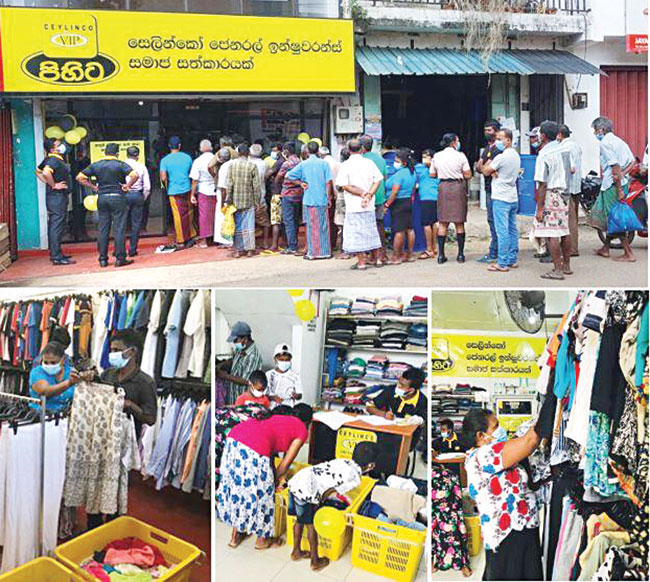
In its new CSR initiative, Ceylinco General Insurance commenced a programme to distribute clothes for free to people in need of clothing and to those who cannot afford to buy them. In the first stage the clothes are being distributed through ‘Ceylinco VIP Pihita’ centres in Bandarawela, Anuradhapura and Matara.
Introduced on a concept initiated by Ajith Gunawardena, Chairman / Chief Executive Officer of Ceylinco Insurance PLC, ‘Ceylinco VIP Pihita’ centres will be extended to other cities as well. All three Ceylinco VIP Pihita outlets are positioned in easily accessible locations and will be open three days a week. Each person is entitled to pick up two pieces of clothes for his or her own use.
Ajith Gunawardena, Chairman and CEO of Ceylinco Insurance PLC, commenting on the CSR initiative said, “To commence the project, we invited our own staff to bring in their used clothes but in good condition and well cleaned. The response was tremendous and our employees numbering over 3,500 gladly contributed. Every staff member considered it a good opportunity to participate in a worthy cause. Now, we have invited our customers, friends as well as the general public to bring-in their used clothes that are in good condition to the nearest Ceylinco VIP branch. These will be sent to the ‘Ceylinco VIP Pihita’ distribution centres. As a company that understands the pulse of the people, we realized that there are so many amongst us who cannot afford to buy clothes, especially in a time like this where income avenues of people are affected to a great extent.”
Patrick Alwis, Chairman / Chief Executive Officer of Ceylinco General Insurance said “This is one of amongst several other CSR projects carried out by us that serves to fulfill the aspirations of people who are undergoing financial hardships. All our CSR projects are aimed at enhancing the lives of people and to let them know that they are in our thoughts always. We expect those who have a desire to help the needy will come forward and contribute to this worthy initiative to ease the burdens of our fellow citizens in whatever way they could.”



As Sri Lanka confronts mounting environmental and economic pressures, a timely national conversation on resilience has underscored the urgent need to rethink how societies respond to change—by balancing resistance with alignment to nature.
The inaugural Nature Talks Webinar Series, titled “Nature’s Secrets for Building Resilience in a Changing World,” took place on Wednesday night, bringing together leading environmental thinkers who argued that resilience is no longer optional, but essential in navigating climate and ecological uncertainty.
Organised collaboratively by the International Centre for Biological Studies (ICBS), GAP HQ, and the Biomimicry Research Centre, the session aimed to bridge science, policy, and innovation, while drawing practical lessons from nature.
Leading the discussion, Professor Sarath Kotagama of the University of Colombo emphasised that resilience must be understood as a combination of resistance and alignment.
“Resilience is about resisting where necessary, but also forming alliances with change,” he said. “We are not saying we can stop everything. The real question is—can we adjust to live with it?”
He urged societies to reflect on their ability not only to prevent or resist environmental change, but also to adapt intelligently to it. Referring to global developments such as Artemis II, Kotagama noted that humanity is increasingly being reminded of how rapidly conditions are shifting on Earth.
Drawing lessons from the COVID-19 pandemic, Professor Kotagama outlined several insights that have reshaped thinking on resilience.
“One of the most important lessons was the role of microbes,” he said. “We always focused on large animals in biodiversity, but COVID showed us that invisible organisms can have a massive impact on the planet.”
He explained that while conservation has traditionally prioritised charismatic species such as elephants and birds, microorganisms—often overlooked—are equally critical to ecological balance.
Professor Kotagama also challenged assumptions about nature. “Nature is not always kind or caring. Under certain conditions, it can be harsh, and humans don’t necessarily feel affection for all forms of life—especially microbes,” he said.
At the same time, he stressed the decisive role of science. “If not for science, we would not have survived as we did,” he noted, pointing to the rapid development of vaccines despite global norms that typically require years of testing.
He further highlighted the importance of governance. “We may not always like governments, but during COVID, governments mattered. Without coordinated action, the outcome would have been far worse,” he said.
Professor Kotagama added that the pandemic exposed vulnerabilities in the global economic system, with industries such as tourism collapsing almost overnight due to what he described as “an invisible microbe.”
“It showed clearly that systems we thought were stable can be disrupted instantly,” he said, warning that unsustainable development models—particularly in tourism—must be reconsidered.
Meanwhile, Professor Sevandi Jayakody of Wayamba University of Sri Lanka highlighted biomimicry as a key pathway to resilience.
“The biggest answer to resilience is biomimicry,” Professor Jayakody said. “Nature already holds solutions—we just need to understand and apply them.”
She explained that biomimicry can operate at the level of form, process, or systems, and cited mangrove restoration as a practical example. Attempts to artificially recreate ecosystems often fall short unless they follow natural patterns such as tidal flows and species interactions.
“In restoring degraded mangroves, we learned that forcing systems does not work. When we followed natural contours and introduced resilient ‘nurse’ species, the ecosystem began to recover on its own,” she said.
Professor Jayakody emphasised that resilience must be embedded within environmental systems rather than imposed externally. “Resilience is a function of the environment we live in. If we ignore that, our interventions will fail,” she said.
She also cautioned against expecting rapid results. “Nature is slow. Humans are in a hurry,” Professor Jayakody noted, pointing to long-term data showing that even measurable ecological changes—such as seasonal shifts—can occur gradually over decades.
“Change is inevitable, but it is not always sudden. We need long-term data, patience, and the wisdom to interpret it correctly,” she added.
Moderating the session, Imaduwa Priyadarshana brought a practical perspective on sustainable design and adaptation, highlighting how nature-based thinking can inform urban planning and infrastructure.
With Sri Lanka grappling with climate variability, coastal degradation, and energy challenges, the experts stressed that such knowledge-sharing platforms are increasingly vital. The discussion aligned with a growing global shift towards nature-based solutions—learning from ecosystems that have evolved resilience over millennia.
By Ifham Nizam

Uber Eats is now live in Nuwara Eliya, making it easier for locals and tourists to enjoy their favourite meals – from a hot plate of kottu on a chilly evening to a comforting rice and curry spread or crispy egg hoppers – delivered right to their doorstep.
Known for its cool climate, old-world charm, and rolling tea estates, Nuwara Eliya sees a surge of Sri Lankan and international visitors during the April holiday season. But as temperatures drop in the evenings, food options have traditionally been limited, with many outlets closing early.
With Uber Eats now available, consumers can discover and order from a growing range of local restaurants and neighbourhood favourites – without stepping out. The platform also extends access to meals into the late evening, making it easier to find food even after most outlets have closed. In Nuwara Eliya, specially designed temperature-controlled insulated bags will help ensure meals are delivered hot. Consumers can choose from a wide variety of cuisines including Sri Lankan, Indian, Chinese, Thai, and Arabic or order from global brands such as KFC, Pizza Hut, and Domino’s.
The launch supports the local community by enabling restaurants to reach more customers across the city, while creating flexible earning opportunities for delivery partners, especially during the busy holiday season.
Varun Wijewardane, Country Manager – Delivery, Uber Sri Lanka, said: “Nuwara Eliya is one of Sri Lanka’s most loved destinations, especially during the April season. With Uber Eats now live, we’re making it easier to enjoy great food more conveniently – from everyday favourites to late evening short eats while also supporting local restaurants and creating earning opportunities within the community. This comes on the back of an aggressive expansion of our services across Sri Lanka – providing our consumers with convenient access to local favourites and unlocking earning opportunities for more Sri Lankan communities.”
Entry in Nuwara Eliya builds on expansion from last year across 6 districts including Hikkaduwa, Ambalangoda, Chilaw, Wennappuwa, and Puttalam, Jaffna, Gampola, Matale, Matara, Weligama, Mirissa, and Anuradhapura – further strengthening Uber Eats’ position as the country’s go-to delivery platform.

Union Assurance, Sri Lanka’s longest-standing private Life Insurer, was honoured as a ‘Company with Great Managers’ for fifth consecutive year at the CLA Great Managers Awards 2025, held at Cinnamon Grand Colombo. Presented annually by the Colombo Leadership Academy & CLA Coaching Inc, the award affirms that Union Assurance’s approach to leadership excellence is not episodic, but deeply embedded across the Company.
The CLA Great Managers Awards programme, powered by Colombo Leadership Academy & CLA Coaching Inc. in strategic partnership with People Business, The Culture Factor Group – Hofstede & Onehub, is regarded as the international benchmark for assessing managerial and leadership effectiveness in Sri Lanka. Using the scientifically grounded D-ACTI 5X meta-analysis framework, the programme evaluates managers across five leadership pillars: Driving Results & Execution Excellence, Aligning Organizational Vision, Coaching & Developing Others for Growth, Building Team Effectiveness & Collaboration & Leadership Integrality & Holistic Approach.
Reflecting the depth and diversity of managerial capability within the organisation, five Union Assurance leaders were individually recognised across distinct award categories this year. Sashika Perera, Senior Manager – Statutory Reporting & Taxation, and Ishanthi Umedha, Head of Governance & Valuation, were recognised for ‘Demonstration of Well-Rounded Performance and Managerial Effectiveness.

Myanmar pardons over 4,000 prisoners, including deposed president

Hormuz Strait shut down again over US ‘piracy’, says Tehran

Gill’s silken 86 keeps Kolkata Knight Riders winless after six games

Showers expected in the Western, Sabaragamuwa and Southern provinces and in Nuwara-Eliya district after 1.00 pm.

Ex-lawmakers group calls for IPU’s intervention to check “irregularities” in Parliament

Power and Energy Minister, Ministry Secy resign over coal probe

‘Dates have the highest sugar content to fight Coronavirus’

Sunday Island 27 December – Headlines

#SundayIsland 17th December – Headlines

Sunday Island – 28th March

Sunday Island Headlines – 21 March

Sunday Island – 21st February – Headlines
-

 News7 days ago
CEB orders temporary shutdown of large rooftop solar systems
-

 Features7 days ago
From Royal College Platoon to National Cadet Corps: 145 years of discipline, leadership, and modern challenges
-

 Latest News6 days ago
PNS TAIMUR & ASLAT arrive in Colombo
-

 Features7 days ago
CIA’s hidden weapon in Iran
-

 Latest News6 days ago
Prasidh, Buttler set up comfortable win for Gujarat Titans
-

 News3 days ago
PNS TAIMUR & ASLAT set sail from Colombo
-

 Features7 days ago
A Fragile Ceasefire: Pakistan’s Glory and Israel’s Sabotage
-

 Latest News7 days ago
Heat index likely to increase up to ‘Caution level’ at some places in the Northern, North-central, North-western, Western, Sabaragamuwa, Southern and Eastern provinces and Monaragala district