
Foreign News
Cat makes three flights in 24 hours after being left on plane


A cat has made three flights between New Zealand and Australia in just 24 hours after being forgotten on a plane.
Mittens, an eight-year-old Maine Coon, was booked to travel from Christchurch to Melbourne on 12 January – but her cage was left in the Air New Zealand aircraft’s cargo hold.
After waiting for three hours for Mittens at Melbourne airport, owner Margo Neas was told by ground staff the plane had already returned to New Zealand with her pet.
During that flight the heating was turned on to keep the cat comfortable, Ms Neas said. The pet – who had lost weight but was otherwise unharmed – was later flown again to Melbourne to reunite with her owner.
Speaking to NBC on Wednesday, Ms Neas said she and her son had been informed about the mishap by airport ground staff in Melbourne.
“They said: ‘Look, we have located your cat – but it’s actually on the return flight to Christchurch…’
“And I said: ‘When did you discover that the cat wasn’t taken off the plane?’ And they said: ‘We’ve only just discovered now.’ And I said: ‘How can this happen?'”
Ms Neas said she was told that the pilot had already been alerted to turn the heating on in the cargo hold where the temperature could be as low as 7C.
Air New Zealand is still looking into how Mittens was forgotten, but reports say a stowed wheelchair may have obscured a baggage handler’s view of her cage.
The airline has apologised for the distress caused and promised to reimburse all travel costs.
The company does not accept direct animal bookings from the public for international flights, so passengers must book via approved pet carrier firms.
Ms Neas said she had been relieved to be finally reunited with Mittens.
“She basically just ran into my arms and just snuggled up in here and just did the biggest cuddles of all time,” she was quoted as saying by the AP news agency on Wednesday. “It was just such a relief.”
Ms Neas, who had earlier decided to relocate to Australia, added: “It was not a great start to our new life in Melbourne because we didn’t have the family, we weren’t complete.”
The one-way flight time between Christchurch and Melbourne usually takes less than four hours.
[BBC]

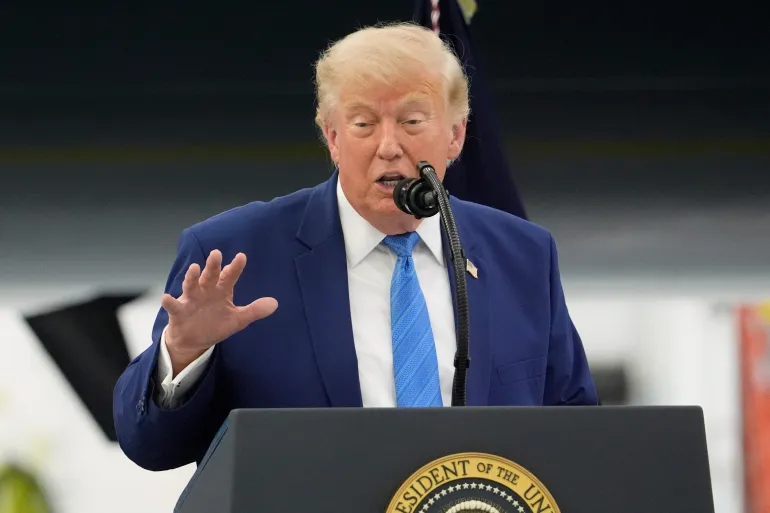
United States President Donald Trump has pledged there will be no tolls for passage through the Strait of Hormuz, unless they are collected by his own country.
Trump’s statement, made in a Saturday afternoon post on Truth Social, is the latest sign that a recently signed memorandum of understanding (MOU) may be unravelling.
“There will be NO TOLLS in the Hormuz Strait for 60 days during the Cease Fire Period, and there will be NO TOLLS after the 60 day period has expired,” Trump wrote, “unless they are imposed by and for the United States of America.”
Since the US and Israel launched a war against Iran on February 28, Iran has successfully used the Strait of Hormuz as a pressure point, closing the strategic waterway to traffic.
But under the terms of Wednesday’s ceasefire memorandum, the strait is supposed to reopen for an interim period of 60 days. During that time, Iran is barred from charging vessels for passage.
On Saturday, however, Iran’s joint military command said it had closed the Strait of Hormuz, citing a “clear breach” of the memorandum’s commitments.
US Central Command (CENTCOM), the agency that oversees military operations in the region, denied that report and maintained that the traffic continues to flow through the waterway.
The Strait of Hormuz has long been a flashpoint in the conflict between the US and Iran. Nearly 20 percent of the world’s oil and natural gas is transported through the strait, as well as about 30 percent of the global fertiliser trade.
Closure of the strait has caused global fuel costs to soar and has tested agricultural sectors across the world.
Trump had responded to Iran’s chokehold over the strait by imposing a US naval blockade on Iran’s ports in the region.
But that naval blockade was lifted under the terms of Wednesday’s memorandum. The deal also paused fighting on all fronts in the regional conflict, including in Lebanon.
The memorandum, though, was not intended as a long-term deal. It serves as a launching point for negotiations on key issues, including the future of Iran’s nuclear programme.
Several points of divergence also went unaddressed in the memorandum. Nowhere does the memo say that future tolls cannot be collected from the strait after the 60-day period expires.
Before the war, there was no charge for passage through the strait. Trump himself said in an interview with The New York Times that the waterway should remain “permanently toll-free”.
But he appeared to reverse course in Saturday’s post, once again floating the possibility that the US could extract tolls in the strait, while barring Iran from doing so.
No fees should be levied, Trump wrote, “unless they are imposed by and for the United States of America, should the deal not be completed”.
He explained that such a charge would compensate the US “for services rendered as the Guardian Angel to the countries of the Middle East for purposes of both past, present, and future reimbursement of costs”.
Trump used similar language in his New York Times interview earlier this week, floating the US becoming “the guardian of the Middle East” in exchange for 20 percent of its revenue.
Saturday’s post is not the first time Trump has mused about the US imposing tolls in the strait, either.
In April, for instance, he discussed the idea with reporters, saying, “What about us charging tolls? I’d rather do that than let them have them. Why shouldn’t we? We’re the winner. We won.”
There has been no indication that Trump’s plans have been officially presented to countries in the region, many of whom have struck a careful balance in their dealings with both the US and Iran during the war.
Iranian officials, meanwhile, have repeatedly said they will not rule out imposing tolls in the strait, framing the issue as a matter of sovereignty and regional negotiation. The strait sits between Iran and Oman.
Further discussions are expected on the matter in the coming weeks.
But such negotiations have been thrown into jeopardy amid ongoing Israeli military operations in Lebanon, which threaten to violate Wednesday’s ceasefire memorandum.
Iran claimed that Saturday’s closure of the strait was a result of new Israeli attacks in southern Lebanon, which killed dozens of people after the ceasefire was announced.
[Aljazeera]

The US government says it will stop funding programmes in South Africa intended to tackle the spread of HIV and Aids.
More than eight million South Africans are living with HIV – the highest number of any country in the world.
The US State Department appeared to link the decision to South Africa’s alleged failure to protect the white-minority Afrikaner community – an allegation the South African government has repeatedly rejected.
South Africa’s health ministry responded by saying that though it had not been informed of this decision, it had “long been working on a self-reliance plan”.
Until 2025, the US was supporting South Africa’s efforts to deal with the virus with an estimated $400m (£300m) a year through the President’s Emergency Fund for Aids Relief (Pepfar).
But since the inauguration of President Donald Trump, relations between the two countries have increasingly soured.
Shortly after he came into office, Trump issued an executive order alleging that “countless” South African policies dismantled equal opportunities and fuelled violence “against racially disfavored landowners”.
This is disputed by the South African government, which says its Black Economic Empowerment policy is needed to correct economic inequality dating from the apartheid era.
The executive order also highlighted South Africa’s case against Israel at the International Court of Justice and its links to Iran.
The White House said that given these “unjust and immoral practices”, further aid to South Africa would not be provided.
Trump has also falsely alleged that there is a “white genocide” taking place in South Africa, which has led to the administration setting up a refugee programme for Afrikaners – descendants of western Europeans who settled in southern Africa in the 17th Century. They are now just about the only refugees being allowed into the US.
The genocide claim has been widely discredited.
Pepfar funding, which had been providing about a fifth of South Africa’s total spending on HIV programmes, got a reprieve last October with what was called a “bridge plan”.
But a US State Department official has confirmed that a “phased drawdown” of Pepfar funding would now start.
This was because of “South Africa’s failure to make demonstrable progress on policy requests by the administration”, the official said.
The intention of the US government was to “foster self-reliance” and reduce dependency on American funding, they added, pointing out that “South Africa is a middle-income country and is more than capable of supporting its own health programs”.
South Africa’s health ministry has said that while Pepfar contributed to the country’s HIV programme, the provision of life-saving antiretroviral drugs was funded entirely separately, with most coming from the government.
Attempts to mend US-South Africa relations have floundered. These include a high profile White House meeting between Trump and South African President Cyril Ramaphosa just over a year ago when the US president confronted his counterpart with his claims of white persecution.
The US also boycotted the G20 meeting, a gathering of the world’s major economies, hosted by South Africa last November.
[BBC]

At least nine people remain in critical condition after two passenger trains crashed into each other and killed one driver near Bedford, about 56 miles (90km) north of London.
British Transport Police said on Saturday that more than 80 people had received hospital treatment on Friday night after the trains collided.
“As of this morning, 28 remain in hospital, and nine are in a critical condition,” Chief Constable Lucy D’Orsi said.
She added that “specialist investigators from British Transport Police are working with colleagues at the Rail Accident Investigation Branch (RAIB) to gather the facts and determine what has happened”.
Moreover, Transport Secretary Heidi Alexander said that it was “too early to speculate” on the cause of the crash, and promised that “a thorough investigation … to ensure that lessons are learnt” would be launched.
Friday’s crash involved two London-bound trains on the same track, according to East Midlands Railway (EMR), which operates both services.
On Friday, police confirmed that the driver of one of the trains had died at the scene.
In a statement from Buckingham Palace, King Charles said he was “greatly saddened” by the incident and sent “his thoughts and sympathies” to the dead driver’s family and to those injured.
The East of England Ambulance Service said on Saturday that 11 people sustained “very serious” injuries, while a further 32 suffered serious wounds and 56 others had minor injuries.
EMR’s managing director, Will Rogers, also called the crash “a profoundly sad day for the railway community”.
“We are deeply saddened that our driver has tragically died, and a number of other people have suffered injuries,” he said, speaking at the scene alongside other officials.
He added that EMR was “fully supporting” the RAIB probe.
More than 20 ambulances, specialist hazardous area rescue teams and six air ambulances were dispatched to the scene of Friday’s crash.
While the investigation continues, officials have not said whether signalling issues played a role in the incident.
[Aljazeera]

US and Iran begin talks on initial peace deal in Switzerland

Matthews, Taylor make it three in three for West Indies

Sooryavanshi thumps fastest List A fifty as India A win tri-series

Tunisia out of World Cup after 0-4 defeat by Japan

Vance arrives in Switzerland for US-Iran talks

FFSL renews National Team Head Coach Abdullah Almutairi under “The Next Chapter” program

‘Dates have the highest sugar content to fight Coronavirus’

Sunday Island 27 December – Headlines

#SundayIsland 17th December – Headlines

Sunday Island – 28th March

Sunday Island Headlines – 21 March

Sunday Island – 21st February – Headlines
-

 News7 days ago
Release of 2025 O/L results likely to be delayed
-

 Sports7 days ago
Tharanga set for high-profile javelin clash in Ostrava
-

 News7 days ago
Theft of USD 2.5 mn from Treasury: CoPF accused of complicity in NPP cover-up
-

 News6 days ago
Beijing Capital Airlines to resume flights to Colombo signalling boost to tourism
-

 Features5 days ago
Killing of Colombo’s ancient trees — a warning on UN’s World Desertification Day – 17 June
-

 Opinion7 days ago
Decoding Trump’s 12.5% “Forced Labor Tariff” on Sri Lanka
-

 News2 days ago
Creditor not yet paid
-

 News3 days ago
Creditor receives USD 2.5 mn as Lankan public bears loss from theft of Treasury funds