
Sports
Cabinet sub committee recommends cricket board to be overhauled

by Rex Clementine
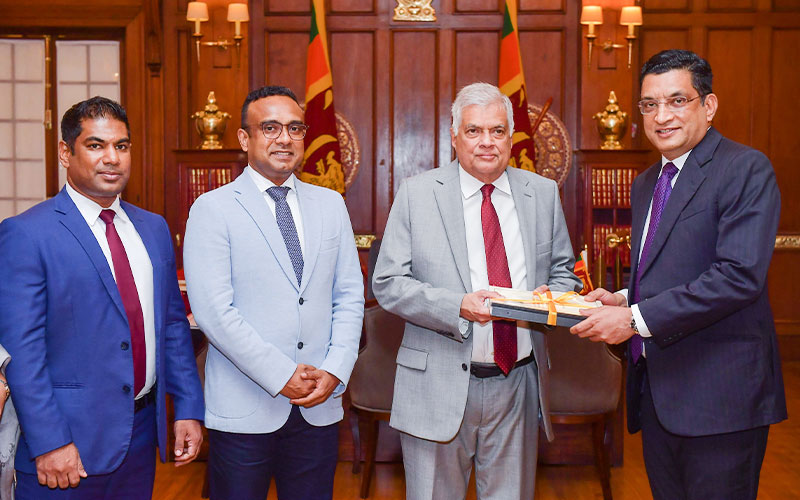
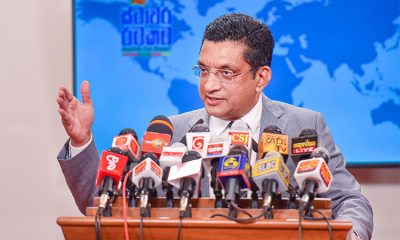
The Cabinet sub committee appointed to look into affairs of Sri Lanka Cricket and submit recommendations in a report has called for the complete overhaul of the governing body. The committee headed by Foreign Minister Ali Sabry comprised Tiran Alles, Kanchana Wijesekara and Manusha Nanayakkara gives thumbs up to constitutional reforms going along with the Chithrasiri Committee report. Retired Supreme Court judge K.T. Chithrasiri had presented a comprehensive new constitution to govern cricket.
The Cabinet Sub Committee in its report says, ‘we agree with several observations made by individuals who appeared before our committee, and it has come to our attention that many members of the SLC administration have made their employment at SLC their primary source of income. Consequently, they have utilized all available resources at their disposal to prolong their tenure at SLC.”
“The existing constitutional composition and structure of SLC must be reformed to ensure efficiency, transparency and good governance and that funds are used for development of cricket rather than for self-interest or favour.”
The report criticizes SLC’s controversial voting system. It points out that while cricket’s most successful team’s board; Australia has just six votes while the Board of Control for Cricket in India, the richest cricket board in the world, has just 38 votes while Sri Lanka has a staggering 147 votes.
“We believe that the current constitutional structure of allowing clubs which controlled 147 votes, which are supported by SLC, to decide the Executive Committee should be discouraged and that a new constitution in accordance with international standards should be introduced.”
The report notes that any change introduced for cricket’s governance will be fiercely contested by SLC’s Executive Committee.
“Any constitutional amendment that changes the status quo may be near impossible to implement as the process must be approved by the same stakeholders and present members. It has also been observed that any attempt to amend the constitution and the sport regulation has been consistently met with severe resistance from the incumbent office bearers and therefore has not yielded the desired results.
Indian cricket was faced with a similar situation to Sri Lanka with businessmen having a stronghold on the sport’s governance, but court’s intervention saw term limits being introduced and big boys of Indian cricket were sent packing.
“In order to discourage interested parties from perpetuating their stronghold on cricket administration, we recommend limits on holding key positions such as President, Secretary and Treasurer to a maximum of two years terms and any position in the Executive Committee to a maximum aggregate length of eight years,” the report says.
The report goes onto recommend that if the SLC Executive Committee resists change, an Interim Committee to be appointed to usher in change. “We further recommend a clear timeframe be established for the introduction of the new law and hold elections in compliance with such laws. In the event the current SLC administration is unwilling or unable to cooperate with the proposals we recommend that an interim committee be established with clear timelines and targets to implement the process and reconstruct the SLC in accordance with the newly adopted legislation.”
Sri Lanka Cricket is currently suspended and the members of the Executive Committee of SLC have gone onto point out that the board will continue to face trouble with the ICC if they aren’t allowed to have a free run. However, the Cabinet Sub Committee report disputes these claims.
“ICC is of the opinion that cricket must be administered by SLC with minimum interference. However, the ICC is not opposed to the implementation of local laws. The ICC will not and can not be expected to be a hindrance to ensuring proper administration of local laws to prevent mismanagement and corruption.
The report then goes onto quote an ICC regulation. ‘A government would not be prevented from investigating the affairs of a Member Board in order to ascertain whether any criminal offence has been committed including fraud,’ the ICC clause says.
Presenting their points to the Cabinet Sub Committee, Sri Lanka Institute of Chartered Accountants had observed that cricket administration for some had become a livelihood.
The Auditor General, meanwhile, had some interesting remarks to make to the Cabinet Sub Committee, “The ExCo had increased their per diem from around US$ 500 to US$ 700 recently whereas the Government of Sri Lanka had reduced the per diem of public servants due to the shortage of foreign currency.”
“In the Auditor General’s view, this incident exemplified corrupt practice where Ex Co members who were entrusted with the authority of SLC had utilized that authority for personal gain.”







Opener Hasini Perera’s second T20I fifty, on the back of two wickets apiece by left-arm spinners Sugandika Kumari and Inoka Ranaweera, capped off another strong effort by Sri Lanka as they beat West Indies by nine wickets to seal the three-match T20I series 2-0.
Captain Chamari Athapaththu won the toss and elected to field in Grenada, and much like in the second T20I, the spinners strangled the West Indies batters. Sugandika was introduced into the attack in the third over and she struck with her third ball, nipping out Hayley Matthews, caught and bowled for 8.
Ranaweera then struck with her second ball, prising out Shawnisha Hector, before Sugandika picked up a third wicket in the powerplay in the form of Eboni Brathwaite. Deandra Dottin struck three fours in her first ten balls as West Indies ended the powerplay on a high but slowed down spectacularly after that, only managing 28 off 39 balls as West Indies added just 34 runs in the ten overs after the end of the powerplay.
Ranaweera finished her frugal four-over spell by trapping Dottin lbw, and four balls later, Kavisha Dilhari cleaned up the other set batter, Stafanie Taylor, for 24.
At 83 for 5 after 18 overs, West Indies were in danger of falling short of 100 but Chinelle Henry gave the innings much-needed impetus, smashing an unbeaten 32 off 15 and helping them take 36 runs off the last two overs. Despite the late onslaught, West Indies finished on a below-par 119 for 5.
In reply, Athapaththu raced away again, crashing four fours in the first three overs with Sri Lanka going at nearly ten an over. Sri Lanka added 48 runs in the powerplay without losing a wicket and while Athapaththu fell soon after for a 22-ball 32 to Afy Fletcher, she had set a solid platform.
With the required rate less than six an over, Perera and Imesha Dulani focused more on rotating the strike, putting together an unbroken 72-run stand for the second wicket off 64 balls. Perera took 58 balls to reach her fifty before Dulani finished the match and the series by striking a four off Matthews. Sri Lanka won the game with 14 balls to spare, making it a double success for them, having earlier won the ODIs 2-1.
Brief scores:
Sri Lanka Women 121 for 1 in 17.4 overs (Hasini Perera 52*, Imesha Dulani 34*, Chamari Athapaththu 3; Afy Fletcher 1-14) beat West Indies omen 119 for 5 in 20 overs (Stafnie Taylor 24, Deandra Dottin 28, Chinelle Henry 32*; Inoka Ranaweera 2-16, Sugandika Kumari 2-32, Kavisha Dilhari 1-13) by nine wickets
[Cricinfo]
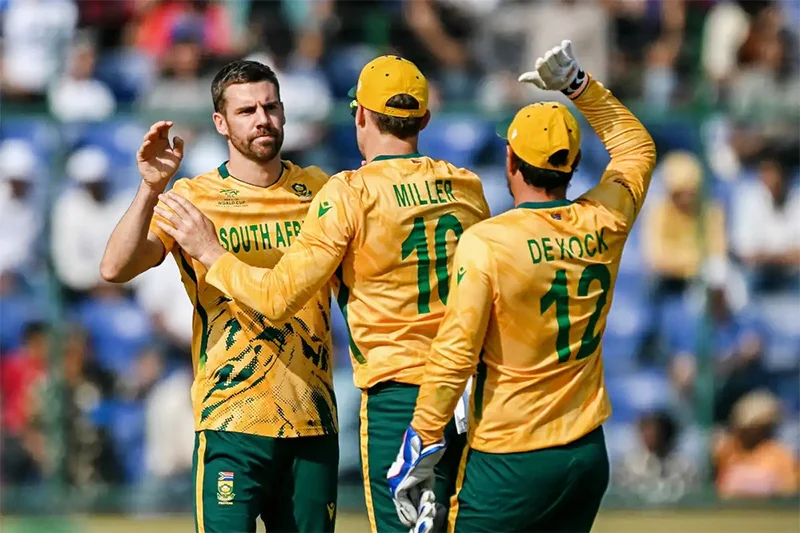
We are into the business end of a World Cup that has chewed up reputations, minted new stars and nudged a few old warhorses towards the pavilion for the final time. The caravan now rolls towards a weekend that promises either a fresh name on the trophy or a familiar heavyweight tightening its grip on global supremacy.
Of the four semi-finalists, South Africa and New Zealand have been model professionals in ICC events, always knocking on the door, rarely barging through it. Neither has laid hands on the T20 World Cup yet. Standing in their way are former champions India and England, sides that know how to hold their nerve when the heat is turned up. Whether it is a new champion or an old hand reclaiming the crown in Prime Minister Narendra Modi’s home state of Gujarat will be known on Sunday night.
The first semi-final sees South Africa lock horns with New Zealand at Eden Gardens in Calcutta, a venue where history hangs heavy in the humid air. We Sri Lankans love Calcutta for this is where the great Aravinda de Silva sealed India’s fate in the 1996 World Cup semi-final.
The second semi pits India against England at the Wankhede in Bombay, a ground that has staged more epics than a Shakespearean theatre. That includes Mahela Jayawardene’s stunning hundred in the 2011 World Cup final although Sri Lanka ended up on the losing side. Then it is on to Ahmedabad for the grand finale.
Ahmedabad, along with Surat, Baroda and Rajkot, forms the heartbeat of Gujarat, where Modi once served as Chief Minister before ascending to the top office in 2014. Like Sri Lanka’s Mahinda Rajapaksa, who built a stadium in his home constituency of Hambantota and named it after himself, Modi too has left his imprint. But unlike the Hambantota venue, which has drifted into a white-elephant, the Narendra Modi Stadium in Ahmedabad, with a capacity north of 100,000, is a cauldron of noise and colour. It successfully hosted the 2023 World Cup final and remains very much the jewel in India’s cricketing crown.
For all the talk of upsets in this World Cup, the established order has not exactly been turned on its head. Four of the top five ranked sides have made the semi-finals. Australia are the notable absentees, not for lack of skill, but for muddled thinking. Picking Steve Smith in the squad and then leaving him cooling his heels on the bench was a selection call that left many scratching their heads.
Sri Lanka and West Indies briefly threatened to rattle the cage, only to lose their footing when it mattered most. The Caribbean side were found wanting in bowling depth when the screws were tightened, while Sri Lanka’s campaign unravelled the moment captain Dasun Shanaka pressed the self-destruct button by opting to field first against New Zealand at the R. Premadasa Stadium.
Shanaka’s decision raised eyebrows not just in the stands but, by all accounts, within his own dressing room. Batting second at RPS on a wearing surface is no picnic. To choose to bowl first there was akin to Ajith Nivard Cabraal investing in Greek bonds, one involved a crumbling wicket, the other a crumbling economy. Both carried predictable consequences.
India, meanwhile, look every inch the team to beat. They bat deep, boast a battery of bowlers and possess half a dozen match-winners capable of flipping a contest on its head in the space of an over. To knock them off their perch will require something extraordinary.
South Africa’s attack has been particularly impressive. Their quicks have had the wood over opposition batters, not through extravagant reverse swing or toe-crushing yorkers, but by perfecting the art of the slower ball, cutters and off-pace deliveries that grip, hold and deceive.
New Zealand may not enjoy the luxury of a bulging bench, but they field like panthers and adapt to conditions with minimal fuss. England, on the other hand, bat all the way down and have enough spin options to choke the middle overs and dictate tempo.
One cannot help but wonder, though, why Sri Lanka are not hosting a semi-final in a tournament they are co-hosting. Earlier agreements suggested that even if Sri Lanka qualified, they would have to travel to India for the knockout stage. That clause was later revised, but surely co-hosts deserve a fair slice of the showpiece occasions.
Rex Clementine in Bombay
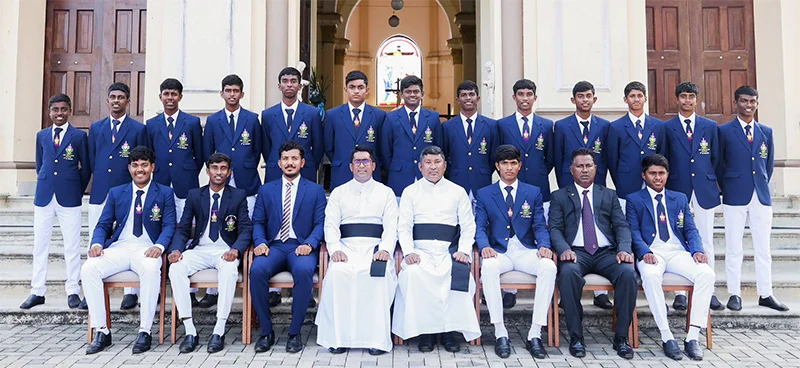
Holy Cross College Kalutara and St. Aloysius’ College Galle are set to stage the second edition of the Battle of Dreams Big Match on the 6th and 7th of March at the Galle International Stadium.
Holy Cross captained by Hirusha Gimhan and St. Aloysius’ skippered by Oshada Devinda will hope for two full days of cricket to achieve a result after the first edition was affected by rain.
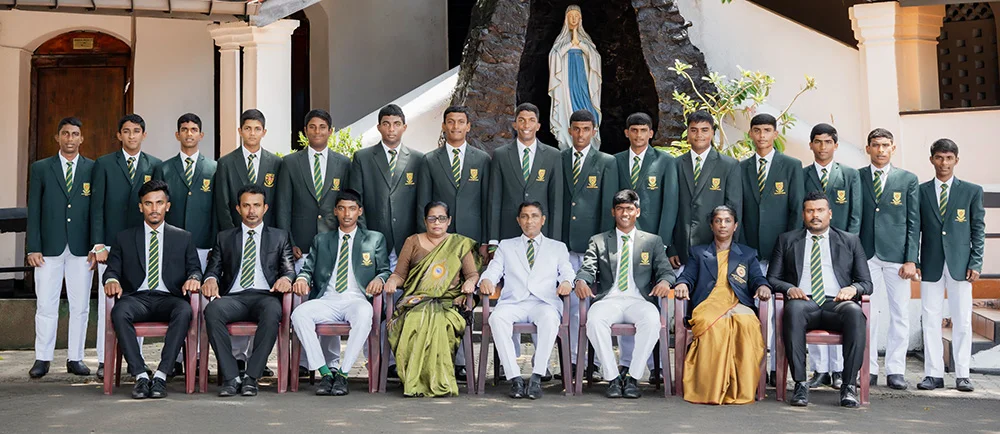
St. Aloysius’ Team (Front row from left) Dinith Malinga (Asst. Coach), Prasad Mihiran (MiC),
Dulshan Nimviru (V. Capt.), S.P. Alawaththa (Deputy Principal), A.J.P. Pubudu Sampath (Principal),
Oshan Dewinda (Captain), Shrinika Gamage (PoG), K. Sampath Perera (Coach).
(Back row from left) Sasindu Madusara Silva, Dihen Sinsith, Manodya Chandu Pabasara, A. S.
Hamsa, Chanul Sanketh, Pulith Banuja, Gimhan Hansana, Sevitha Dumal Weeratunga, Methsan
Lakmina, Vinod Dhanushka, Hiviru Nimtharana, Vinidda Ravishan Bopage, Chanul Nethmina
Karunaratne, Chauka Sadew Uddiipana, Sasindu Randeepa.

US embassy in Dubai hit; Israel pounds Tehran, Beirut

Perera, Sugandika, Ranaweera take Sri Lanka to T20I series win over West Indies

Maldives Coast Guard Ship Huravee arrives in Colombo

New charges for son of Norway’s crown princess on trial for rape

US sends planes to evacuate nationals from Middle East as Iran conflict spreads

Trump threatens to halt trade with Spain over military base access

‘Dates have the highest sugar content to fight Coronavirus’

Sunday Island 27 December – Headlines

#SundayIsland 17th December – Headlines

Sunday Island – 28th March

Sunday Island Headlines – 21 March

Sunday Island – 21st February – Headlines
-

 Opinion5 days ago
Jamming and re-setting the world: What is the role of Donald Trump?
-
 Features5 days ago
An innocent bystander or a passive onlooker?
-
 Features2 days ago
Brilliant Navy officer no more
-
 Features6 days ago
Ratmalana Airport: The Truth, The Whole Truth, And Nothing But The Truth
-
 Opinion2 days ago
Sri Lanka – world’s worst facilities for cricket fans
-
 Business6 days ago
IRCSL transforms Sri Lanka’s insurance industry with first-ever Centralized Insurance Data Repository
-

 Business5 days ago
An efficacious strategy to boost exports of Sri Lanka in medium term
-

 Features3 days ago
Overseas visits to drum up foreign assistance for Sri Lanka