
Features
Are We Making Rational Decisions in the Rice Sector


M. P. Dhanapala
former Director, Rice Research and Development
The agrochemicals, inclusive of chemical fertilizers, are to be replaced by non toxic organic manure and other environmental friendly products based on the expert advice that the modern agricultural products are toxic due to indiscriminate use of agrochemicals. An example frequently cited was the Chronic Kidney Disease (CKDu) of unknown origin in the North Central Province. Also, some critics insist that those who promote agrochemicals are rewarded by multinational companies involved in the agrochemical industry.
As a result, agrochemicals in agriculture was a topic debated in the media by policy makers. their advisors, specialist doctors, university professors, professionals of organic agriculture, scientists, politicians, leaders of farmer organizations etc. The above allegations were refuted as inaccurate, inconclusive and unscientific (Pethiyagoda, R., U-tube seminar https://www.youtube.com/watch?v=rGe6ld2q1vs). According to some scientists, the causal agent of CKDu was concluded as high concentration of Fluoride ion (Fl-) in drinking water. As a rice scientist, I have some issues bothering me in this whole dispute; especially in the area of chemical fertilizer, the most indispensable, one and only input, that increases productivity of crops.
Rice farming is the least remunerative of all occupations in Sri Lanka; the farmers in the past were involved in rice farming because of the social dignity, the pride of not consuming imported rice (Beven, 1914, Tropical Agriculturist, 1914 Dec.). Also, farming is considered an independent profession; it is a fact that one has to pay respect when dealing with the farming community.
Organic manure issue
Some critics insist that we have lost the organic manure technology practised 3000 years ago; probably a documentation failure. It would be great if we could recover the old technology from somewhere. However, in the recent past, as documented in the scientific journal “Tropical Agriculturist”, incorporation of bulk organic matter was recommended as early as in 1914 for rice fields to circumvent disintegration and deterioration of soil structure due to puddling during land preparation (Harrison, 1914). The nutritional status of the organic material concerned was not quantified or discussed. This recommendation was made during the British era, around the inception of the Department of Agriculture, and it is valid even today.
In the 1940s, farmers did cultivate traditional varieties with green manure, farmyard manure, compost, soybean cake, fishmeal etc. as organic manure but no specific recommendations were recorded. The targeted rice yield then was 15 bushels per acre (0.75 t/ha.) but realized only a national average of less than 13 bushels/acre (< 0.65 t/ha). The government then had to import two thirds of the rice requirement of the country to feed the population (Tropical Agriculturist, 1945 July – Sept.). The rice ration book continued till the modern varieties were developed and established. The present day advisors and policy makers may be unaware of or have ignored that the rice ration book each citizen had with 52 weekly stamps, to obtain the imported (Milchard/white raw) rice ration from the nearby cooperative shop.

Incorporation of paddy straw into fields was emphasized just before the turn of the century to sustain soil fertility and organic content of the soil, especially when the cropping intensity increased with the release of high potential short duration rice varieties. This recommendation was complemented with site specific soil test-based fertilizer recommendations, using the regional recommendations as guidelines, to prevent indiscriminate use of fertilizer. Also, the researchers were vigilant to keep the high organic soils with poor and impeded drainage (wet zone) devoid of organic manure while taking precautions to prevent straw/crop residue becoming a primary inoculum of diseases.
We have no doubt that organic manure improves physical, chemical and biological properties of the soil. Organic manure has colloids, composed of protein rich material with negatively charged amino acids, and help to buid up the soil structure and cation exchange capacity (CEC) thus improving the nutrient retention power of the soil. Organic manures are not known as rich sources of plant nutrients. The nutrient contents and efficiency of different sources of organic manure are shown in Table 1.
The nutrient content of organic manure from the above sources in Sri Lanka cannot be significantly different from values in Table 1, unless there had been some other additives are incorporated in the process of manufacture.
Now, let us consider the nutrient recommendation for the most popular group of rice varieties (3.5 month) grown under irrigation in the dry-zone.
The present recommendation per hectare is 105 kg Nitrogen (N), 25 kg Phosphorus (P2O5) and and 35 kg of Potash (K2O) (Page 15, Fertilizer Recommendation for Rice, Department of Agriculture, 2013). As an example, we will examine the requirement of the most controversial nutrient component, nitrogen (N), in this recommendation. To meet this N requirement, the farmer should have around 13 tons of moisture free compost (0.8% N) for one hectare of land, assuming that the harvested straw of the previous season is not incorporated in to the soil.
If the compost available has 20 percent moisture, this figure would be little more than16 tons. The farmer then will have to pay for and carry in the field a little more than three tons of water on his back for every hectare of rice land cultivated. Additionally, there are peak requirements of N at different growth stages of the crop to promote yield components of the plant. The compost, once applied, will release N consistently, irrespective of the peak requirements of the crop growth stages and may continue this process even beyond the life-span of the crop as long as the mineralization process continues.
This example may be too much of an exaggeration, but the advisors/policy makers should know how inappropriate it is, to substitute a technology, more relevant for home gardening, for extensive paddy cultivation; this probably will be the reason behind the denial of compost culture by commercially oriented rice cultivators. Besides, it is unethical to force on the farmers, a new technology unfamiliar to them altogether. The organic farming specialists can demonstrate in large scale field trials their intended package of practices, specifically in different agro-ecological regions, to ascertain its appropriateness; feasibility, economic viability, sustainability and other advantages, to convince and gain farmer acceptance.
The total package of the proposed organic rice farming may include other options; green manure crops, wormi-compost, bio films, effective microbes, bio-gas residual products, N fixing microbes, organic extracts of unknown origin and ingredient etc., but none of these technologies were field tested and demonstrated with modern rice varieties.
One good example of Inappropriate Technologies is “The System of Rice Intensification (SRI)” introduced in Sri Lanka around the turn of the Century. It was some form of environment friendly, water saving organic farming project with labor intensive field operations, specially the transplanting procedure aimed at the exploitation of potential plant growth and the tillering (production of side shoots) capacity in rice to maximize yield. After a few years lapse, no farmers involved in the project could be traced to review its progress. If a technology is appropriate, you may notice lateral spread of the technology from farmer to farmer without any extension effort.
Inorganic Nitrogen as a Plant Nutrient
In the beginnig of the 20th Century, application of Nitrogen (N) to improve rice yields was attempted using theAmerican experience of Sodium Nitrate (NaNO3) in upland crops (Soybean). Nagaoka (1905) and, Daikuhara and Imaseki (1907) reported the superiority of Ammonium Sulphate ((NH4)2SO4) to NaNO3 as the source of N for rice. Subsequently, the basic investigations on application of N for rice were made in Japan, India, Hawai etc. confirming the superiority of the Ammonium form of N (NH4+) in rice, the process of nitrification and ammonification under different soil moisture regimes and the Nitrite (NO2-) toxicity when the concentration exceeds five to six parts per million (5-6 ppm) upon submergence of aerobic/nitrate rich soil etc.. One should realize that N in submerged soil, irrespective of its source (organic or inorganic), exists in the form of Ammonium ion (NH4+), a fact established universally.
Joachim (1927) stressed the importance of liberal manuring to improve yields at the onset of genetic improvement of crops, particularly when pure-line selection was initiated with traditional rice varieties. However, excessive manuring succumbs the rice crop to diseases (Blast and Brown spot); the crop tends to grow excessively vegetative and lodges prematurely affecting yield. Though some improvement of N response was developed by introducing disease tolerant ‘H’ varieties from the late 1950s, the basic defects of the traditional plant type, leafiness and lodging, prevailed. The introduction of new plant type (modern varieties) improved significantly the harvest index of the plant and the grain yield response to added N. A new source of N, Urea (46 % N), was introduced in the early 1970s to contain soil acidity developed by the regular use of Ammonium Sulphate (21% N) and Urea is being utilized extensively thereafter as the major source of N.
It is clear that the 16 t/ha compost requirement (105 kg N) of the example discussed in the previous section can be fulfilled with 230 kilograms of Urea. Furthermore, the crop requirement at different growth stages can be met by split application of Urea, as the N content of Urea will be available to the plant shortly after its field application.
Urea, (CO(NH2)2), is an organic compound denied in organic farming with molecular structure composed of Carbon, Oxygen and two Amine groups with no toxic elements. The amine groups are apparently converted to ammonium ion (NH4+) by soil microbes under anaerobic conditions and get adsorbed to the cation exchange complex. Any source of N, whether organic or inorganic, undergoes the same process of ammonification in submerged soils to form ammonium ion. If the soil is rich in CEC, the ammonium ion is kept tightly bound to the Soil Cation Exchange Complex and leaching and contamination of ground water will be contained or minimized.
As it is, the most appropriate solution to the current crisis is the recommendation of organic-inorganic combination of fertilizers as recommended by the Department of Agriculture. This will enhance the efficiency of both factors, organic and inorganic, synergistically and prolong the availability of N for crop growth without contamination of groumd water. Also, the quantity of N can be reduced substantially without affecting the performance of the crop as the N component is thereby efficiently utilized.
Also, some scientists are investigating atmospheric N fixing microbes, specifically in the root zone soil (rhizosphere) and within the plant (endophytic). If this is a realistic goal and if the naturally occuring microbes can fix N beyond their biological limits, we are fortunate as the atmosphere around us is full of Nitrogen (80 %). To observe N fixing soil microbial activity, there were some rice plots maintained for more than 30 years at the RRDI, Batalagoda, without added fertilizer.
Intuitively, by judging from the rice yields, I infer that the microbes associated in the soil of these plots are not capable of fixing more than 40 kg N per hectare, probably the biological limit of microbes and that too will be diminished when the crop requirement is met with added Nitrogen. Similarly, the inoculated rice plants with endophytic bacteria to fulfil the N requirement of rice would be a long shot. There were other concepts considered promising in atmospheric N fixation in rice but were abandoned prematurely as the technologies were found to be inappropriate, e.g. Azolla-Anabinae complex and root nodulation in Sesbania spp. etc.
Any rubbish product should not be converted to compost/organic manure as some sources are contaminated with heavy metals and other toxic products. The animal waste may carry residues of antibiotics used as growth promoters. The danger of developing antibiotic tolerant/resistant human pathogenic bacteria by free exposure to antibiotic residues or by exchange of genetic material (conjugation) among bacterial mutants with human pathogens is not ruled-out.
The current status of rice production in the country was achieved through mutual development of related technologies for more than a century. It is not a matter to be ruled-out by the so-called expert advisors with one stroke of a pen; as a result of transition to nontoxic organic rice cultivation, the loss incurred in national rice production will be colossal. This is not the time to learn organic rice cultivation with text book experience of experts with no field experimental evidence. The incidence of COVID 19 and other natural calamities (floods, droughts etc.) would affect global rice production adversely and a surplus production in rice exporting countries cannot be predicted. In this scenario, national food security for Sri Lanka could be further threatened disastrously through this adventure in organic farming that has been launched almost overnight, without any foresight whatsoever.
In the past, we had an excellent Agricultural Extension and Education System composed of regular Technical Working Group Meetings, Research-Extension Dialogues, Inservice Training Programs, Field Visits etc., and a well qualified, dedicated set of extension staff promoted the Good Agricultural Practices (GAP) in rice production. This system should be revitalized to sustain food security of the country.
(The writer is a former Director Rice Research Development of the Batalagoda Rice Research Station with postgraduate (Msc and PhD qualifications from the U.S. and Japan) with over 50-years experience in rice breeding at home and abroad)

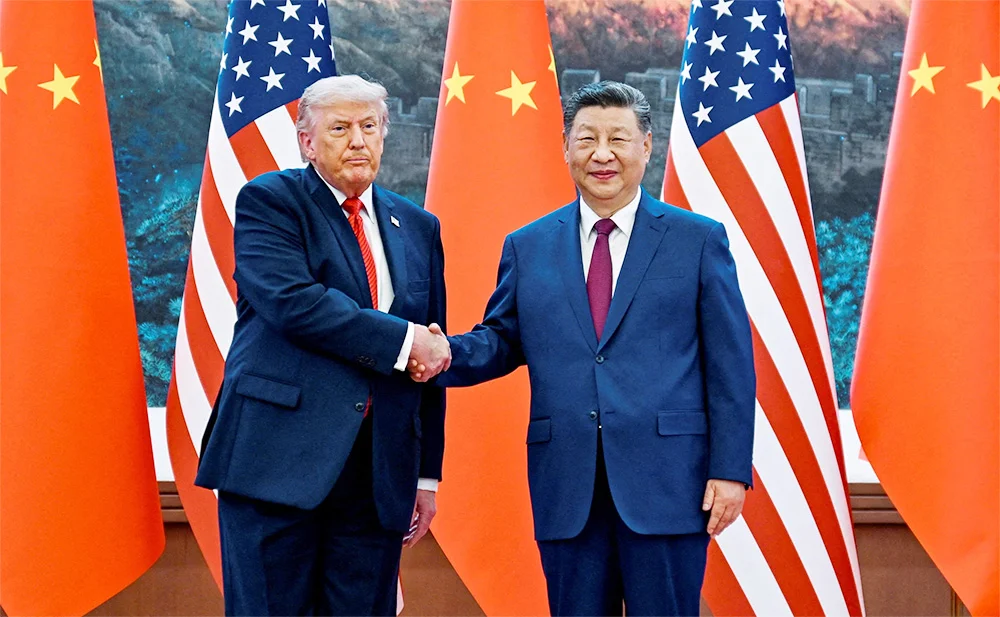
 The fact that some of the US’ topmost figures in business, such as Tesla chief Elon Musk and major US chipmaker Jensen Huang of NVIDIA fame, occupied as nearly a prominent a position as President Donald Trump at the recent ‘historic and landmark’ visit by the latter to China underscores the continuing vital importance of business in US-China ties. Business seemed to outweigh politics to a considerable degree in importance during the visit although the political dimension in US-China ties appeared to be more ‘headline grabbing’.
To be sure, the political dimension cannot be downplayed. For very good reason China could be seen as holding the power balance somewhat evenly between East and West. The international politics commentator couldn’t be seen as overstating the case if he takes the position that China could exercise substantial influence over the East currently; that is Russia and Iran, in the main. The latter powers hold the key in the Eastern hemisphere to shaping international politics in the direction of further war or of influencing it towards a measure of peace.
For example, time and again China has prevented the West from ‘having its own way’, so to speak, in the UN Security Council, for instance, in respect of the ongoing conflicts involving Russia and Iran, by way of abstaining from voting or by vetoing declarations that it sees as deleterious. That is, China has been what could be seen as a ‘moderating influence’ in international politics thus far. It has helped to keep the power balance somewhat intact between East and West.
At present a meet is ongoing between Chinese President Xi Jinping and Russian President Vladimir Putin in Beijing. This happened almost immediately after the Trump visit. Apparently, Beijing is in an effort to project itself as treating the US and Russia even-handedly while underscoring that it is no ‘special friend’ of the US or the West.
This effort at adopting a non-partisan stance on contentious questions in international politics is also seen in Beijing’s policy position on the Hormuz tangle and issues growing out of it. The Chinese authorities are quoted as saying in this regard, for instance, that China is for ‘a comprehensive and lasting ceasefire in the Middle East’.
Such a position has the effect of enhancing the perception that China is even-handed in its handling of divisive foreign policy posers. It is not openly anti-West nor is it weighing in with Iran and other Eastern actors that are opposed to the West in the West Asian theatre. A ‘comprehensive and lasting ceasefire’ implies that a solution needs to be arrived at that would be seen as fair by all quarters concerned.
On the highly sensitive Taiwan issue, President Xi was comparatively forthright during the Trump visit, but here too it was plain to see that Beijing was not intent on introducing a jarring, discordant note into the ongoing, largely cordial discussions with Washington. On the Taiwan question President Xi was quoted saying: ‘If mishandled, the two nations could collide even come into conflict.’ In other words, the US was cautioned that China’s interests need to be always borne in mind in its handling of the Taiwan issue.
The cautioning had the desired result because Trump in turn had reportedly conveyed to Taiwan that the latter’s concerns on the matter of independence had to be handled discreetly. He had told Taiwan plainly not to declare ‘independence.’
Accordingly, neither the US nor China had said or done anything that would have made either party lose face during their interaction. Apparently, both sides were sensitive to each others’ larger or national interests. And the economic interests of both powers were foremost among the latter considerations.
There is no glossing over or ignoring economic interests in the furtherance of ties between states. They are primal shaping forces of foreign policies and the fact that ‘economics drives politics’ is most apparent in US-China ties. That is, economic survival is fundamental.
Among the more memorable quotes from President Xi during the interaction, which also included US business leaders, was the following: ‘China’s doors will be open wider’ and US firms would have ‘broader prospects in the Chinese market.’
Xi went on to say that the sides had agreed to a ‘new positioning for ties’ based on ‘constructive strategic stability’. The implication here is that both sides would do well not to undermine existing, mutually beneficial economic relations in view of the wider national interests of both powers that are served by a continuation of these economic ties. That is, the way forward, in the words of the Chinese authorities, is ‘win-win cooperation.’
It is the above pronouncements by the Chinese authorities that probably led President Trump to gush that the talks were ‘very successful’ and of ‘historic and landmark’ importance. Such sentiments should only be expected of a billionaire US President, bent on economic empire-building.
One of the most important deals that were put through reportedly during the interaction was a Chinese agreement to buy some 200 Boeing jets and a ‘potential commitment to buy an additional 750 planes.’ However, details were not forthcoming on other business deals that may have been hatched.
Accordingly, from the viewpoint of the protagonists the talks went off well and the chances are that the sides would stand to gain substantially from unruffled future economic ties. However, there was no mention of whether the health of the world economy or the ongoing conflicts in West Asia were taken up for discussion.
Such neglect is regretful. Although the veritable economic power houses of the world, the US and China, are likely to thrive in the short and medium terms and their ruling strata could be expected to benefit enormously from these ongoing economic interactions the same could not be said of most of the rest of the world and its populations.
Needless to say, the ongoing oil and gas crisis, for instance, resulting from the conflict situation in West Asia, is taking a heavy toll on the majority of the world’s economies and the relevant publics. While no urgent intervention to ease the lot of the latter could be expected from the Trump administration there is much that China could do on this score.
China could use its good offices with the US to address the negative fallout on the poorer sections of the world from the present global economic crunch and urge the West to help in introducing systemic changes that could facilitate these positive outcomes. After all, China remains a socialist power.
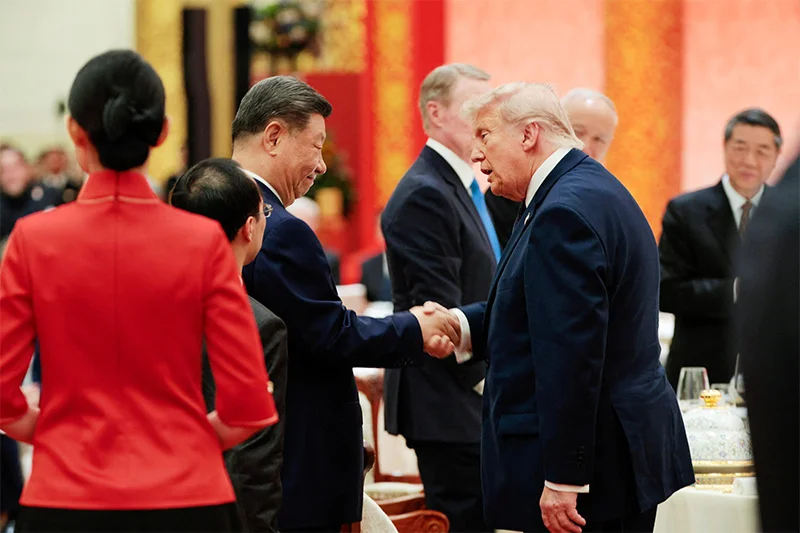
“Everything ever said to me by any Chinese of any station during any visit was part of an intricate design”
— Henry Kissinger
That design may already be complete before this week’s , a meeting that could shape the future balance of global power.
The wind arrives quietly. By the time it is heard, history has already begun to turn. Across Asia, that wind is no longer distant. It carries with it the exhaustion of an old order and the uncertain birth of another. The question now is not whether the world will change. It is whether those who hold power possess the wisdom to guide that change toward something less violent than the century behind us.
Since 1945, the United States has carried the burden of a global order built with its Western allies. To its credit, the world avoided another direct world war between great powers. The conflicts remained contained in distant lands—proxy wars fought in the shadows of ideology, oil, and influence. From Latin America to Asia, the American century expanded not only through prosperity, but through intervention. Yet empires, even democratic ones, grow tired. Fatigue settles slowly into institutions, alliances, and public memory. The role of global policeman no longer inspires certainty in Washington as it once did.
The “rules-based order” now confronts its own contradiction: it was built to be universal, yet it often appeared selective. During my recent visit to , a young researcher asked me quietly, “Does the West itself still believe in the rules-based order?” The question lingered long after the conversation ended. The rising century demands a more inclusive architecture—one that recognises the reality of Asian power, especially China.
My three years of field research across South and Southeast Asia, documented in , revealed a transformation too significant to dismiss as temporary. China has moved beyond being merely a competitor to the United States. In trade, infrastructure, technology, cultural diplomacy, and economic influence, Beijing has established itself as what may be called the world’s “US +1.”
Great powers often search for such a partner. History shows this tendency clearly. When an empire becomes overextended—burdened by wars, alliances, sanctions, tariffs, and crises—it seeks another center of gravity to stabilize the system it can no longer manage alone. The United States today faces disorder stretching from Venezuela to Iran, from Ukraine to the unsettled Middle East. In this landscape, China emerges not simply as a rival, but as a state powerful enough to broker peace where Washington alone no longer can.
Drawing from the lessons of the Nixon–Mao era, warned that “” The United States and China are now engaged in a long-term economic, technological, political, and strategic competition. Managing that competition wisely may become the defining challenge of this century. In such a deeply polarized and unstable world, recognising China as a “US +1” partner is not surrender, but strategic realism.
Donald Trump understood this reality before boarding his flight to meet Xi Jinping. Their meeting inside Zhongnanhai—the guarded compound where China’s leadership governs—was never merely ceremonial. It symbolized a deeper recognition already acknowledged quietly within the itself: China is the nearest peer competitor the United States has ever confronted. Before departing Washington, Trump seemed to reassess not only China’s strength, but its unavoidable position as a “” shaping the future global balance.
Yet the significance of a Trump–Xi meeting extends beyond trade wars, tariffs, or diplomatic spectacle. It presents an opportunity to confront two crises shaping the century ahead: global energy insecurity and regional instability. Washington increasingly understands the limits of direct engagement with Tehran. Decades of pressure, sanctions, and confrontation have produced exhaustion rather than resolution. In that vacuum, Beijing now possesses leverage that Washington does not.
For China, this is an opportunity to evolve from a development partner into a security actor. Xi Jinping’s (GSI) was never designed merely as rhetoric. It was intended as the next phase of Chinese influence—transforming economic dependence into strategic trust. The geopolitical spillover from the Iranian conflict now offers Beijing a historic opening to project itself as a stabilising force in the region, not against the United States, but alongside it as a “US +1” partner.
If China succeeds in helping stabilise the Gulf and secure energy corridors vital to Asia, it will reshape perceptions of Chinese power globally. Beijing would no longer be seen only as the builder of ports, railways, and industrial zones, but as a guarantor of regional balance. This transition—from infrastructure diplomacy to security diplomacy—may become one of the defining geopolitical shifts of the coming decade.
Xi Jinping does not seek open confrontation. His strategy is older, more patient, and perhaps more formidable because of its restraint. Beijing speaks not of domination, but of a “,” advanced through three instruments of influence: the Global Development Initiative (GDI), the Global Security Initiative (GSI), and the Global Civilization Initiative (GCI). These are not slogans alone. Across Asia, many governments increasingly trust China as a development partner more than any other power.
India, despite its ambitions, has not matched this scale of regional penetration. In both ASEAN and South Asia, China’s economic gravity is felt more deeply. Ports, railways, technology networks, and financial dependency have altered the geopolitical map quietly, without the spectacle of war.
In , I compared three inward-looking national strategies shaping Asia today: Trump’s MAGA, Modi’s emerging economic nationalism , and Xi’s strategy. Among them, China has demonstrated the greatest structural resilience. Faced with American tariffs and decoupling pressures, Beijing diversified its supply chains across Central Asia, Europe, and Southeast Asia. Rail corridors now connect Chinese industry to European markets through Eurasia. ASEAN has surpassed the United States as China’s largest trading partner, while the European Union follows closely behind. Exports to America have declined sharply, yet China continues to expand. Trump, once defined by confrontation, now arrives seeking a new “” with China—an acknowledgment that economic rivalry alone can no longer define the relationship between the world’s two largest powers.
Unlike Washington, which increasingly retreats from multilateral institutions, Beijing presents itself as the defender of multilateralism. Whether genuine or strategic matters less than perception. In geopolitics, perception often becomes reality.
What emerges, then, is not surrender between rivals, but interdependence between powers too large to isolate one another. The future may not belong to a bipolar Cold War, but to a reluctant coexistence. The United States now recognises that China possesses diversified markets and partnerships capable of reducing dependence on America. China, in turn, understands that its long march toward global primacy still requires strategic engagement with the United States.
This is where the true geopolitical shift begins.
Many analysts continue to frame China solely as a threat. Yet history rarely moves through absolutes. The next world order may not be built through confrontation alone, but through uneasy partnership. Artificial intelligence, technological supremacy, economic stability, and global governance now demand cooperation between Washington and Beijing, whether either side admits it publicly or not.
Trump will likely celebrate his personal relationship with Xi, presenting himself as the American leader capable of negotiating a “better deal” with China than his predecessors. But beneath the rhetoric lies something larger: the gradual acceptance of China’s indispensable role in shaping the future international order.
Even the question of war increasingly returns to Beijing. If Washington seeks an understanding with Tehran, China’s influence becomes unavoidable. Iran listens to Beijing in ways it no longer listens to the West. This alone signals how profoundly the balance of power has shifted. And Xi, careful as always, refuses to openly inherit the mantle of global leadership. He delays, softens, and obscures intention. It is part of a longer strategy: to rise without provoking the final resistance of a declining hegemon too early.
History rarely announces its turning point. Empires fade slowly, while new powers rise quietly beneath the noise of the old order. Washington still holds immense power, but Beijing increasingly holds the patience, reach, and strategic depth to shape what comes after.
The century ahead may not belong to one power alone, but to the uneasy balance between Washington and Beijing. And in that silence, a new world order is already taking shape.
By Asanga Abeyagoonasekera

Chit-Chat Nethali Withanage
 Three months ago, 19-year-old Nethali Withanage, with Brian Kerkoven as her mentor, walked the ramp at Colombo Fashion Week. On 06 June, she’ll walk for Sri Lanka in Hurghada, Egypt, as the country’s delegate to Top Model of the World 2026._
I caught up with Nethali as she prepares to fly out, this weekend, and here’s how our chit-chat went:
1. Tell me something about yourself?
I’m someone who blends creativity with ambition. I’ve always loved expressing myself, whether it’s through fashion, styling, or the way I present myself to the world. At the same time, I’m very driven and disciplined, especially when I was working, as a student counsellor, at Campus One, at a young age, where I’ve learned how to connect with people, understand them, and communicate with confidence. I believe I’m still evolving, and that’s what excites me the most … becoming better every single day.
2. What made you decide to be a model?
Modelling felt natural to me because it combines everything I love – fashion, confidence, and storytelling without words. I realised that modelling isn’t just about appearance, it’s about presence and how you carry your energy. I wanted to be part of an industry where I could express different sides of myself, while inspiring others to feel confident in their own skin.
3. What sets you apart from other models?
I would say my ability to connect. Whether it’s with the camera, a brand, or an audience, I bring authenticity. I also have a strong background in communication and sales, which gives me an edge in understanding how to represent a brand, not just wear it. I don’t want to just model clothes, I want to bring them to life.
4. What clothing do you prefer to model?
I enjoy modelling versatile styles, but I’m especially drawn to elegant and expressive fashion pieces that tells a story. I love looks that allow me to embody confidence and femininity, whether it’s a structured outfit or something soft and flowing.
5. What is the most important aspect of modelling?
Confidence combined with professionalism. Confidence allows you to own the moment, but professionalism ensures that you respect the work, the team, and the brand you represent. Both are equally important.
6. If you could change one thing about yourself, what would it be?
I would say I’m learning to trust myself more and not overthink. I’ve realised that growth comes from embracing who you are, not constantly trying to change it. So instead of changing something, I’m focused on becoming more confident in my own voice.
7. School?
I did my O/Ls at Seventh Day Adventist High School Kandana, and, while at school, I was actively involved in creative activities. I enjoyed participating in English Day events that allowed me to express myself and interact with others. Those experiences helped me build confidence, teamwork, and communication skills, which continue to shape who I am today.
8. Happiest moment?
One of my happiest moments is realising how far I’ve come from being unsure of myself to stepping into opportunities, like modelling, and representing myself with confidence. That feeling of growth is something I truly value, and also a dream come true!
9. Your idea of perfect happiness?
Perfect happiness for me is peace of mind, being surrounded by people I love, doing what I’m passionate about, and feeling proud of who I am becoming.
10. Your ideal guy?
My ideal partner is someone who is respectful, supportive, and confident in himself. Someone who values growth, understands my ambitions, and encourages me to be the best version of myself.
11. Which living person do you most admire?
I admire strong, self-made individuals who have built their identity through hard work and resilience. People who stay true to themselves, despite challenges, inspire me, because they show that success is not just about talent, but also about strength and consistency.
12. Your most treasured possession?
My most treasured possession is my confidence. It’s something I’ve built over time, and it allows me to face challenges, take opportunities, and believe in myself, even when things are uncertain.
13. If you were marooned on a desert island, who would you like as your companion?
I would choose someone who is calm, positive, and resourceful, someone who can turn a difficult situation into an adventure. The right mindset matters more than anything.
14. Your most embarrassing moment?
I’m 19 and still haven’t faced any most embarrassing moment. But I would say I’ve had small moments where things didn’t go as planned, but I’ve learned to laugh at myself. Those moments remind me that perfection isn’t necessary; confidence is about how you recover, not how you avoid mistakes.
15. Done anything daring?
Pursuing modelling and stepping into competitions is something I consider daring. It pushed me out of my comfort zone and challenged me to grow, both personally and professionally.
16. Your ideal vacation?
My ideal vacation would be somewhere peaceful, yet beautiful, like a beach destination where I can relax, reflect, and reconnect with myself, while enjoying nature.
17. What kind of music are you into?
I choose music that matches my mood at that time, whether it’s calm and relaxing or energetic and uplifting. Music is something that helps me express emotions and stay inspired.
18. Favourite radio station?
Usually I don’t listen to radio stations but whenever I get into a car I would search for Yes FM because it has a refined balance of contemporary hits and timeless music. I appreciate how it maintains a vibrant yet sophisticated energy, keeping listeners engaged while creating a consistently uplifting atmosphere. It’s something I enjoy because it adds a sense of positivity and elegance to my day.
19. Favourite TV station?
At the moment, I don’t have a television at home, but growing up, my favourite TV station was ‘Nickelodeon’. I genuinely loved the shows and series it aired; they were fun, creative, and full of personality. It was something I always looked forward to, and those memories still bring a sense of joy and nostalgia, whenever I think about it.
20. Any major plans for the future?
My future plans are to grow in the modelling industry, work with international brands, build a strong personal brand and finish completing a Bachelor’s Degree in Business Studies. At the same time, I want to explore my creative side further, especially in fashion and business, so I can create something of my own one day.

Alice Capsey 74 not out blazes trail in seven-wicket England win

Kolkata Knight Riders keep their IPL campaign alive with low-scoring win

Showers will occur at times in the Western, Sabaragamuwa Northern and North-western provinces and in Anuradhapura, Galle, Matara, Kandy and Nuwara-Eliya districts

Suspects involved in sureties controversy granted bail

Steps underway to safeguard Sri Lanka’s maritime heritage

CEJ’s landmark legal battles reshape Sri Lanka’s environmental justice landscape

‘Dates have the highest sugar content to fight Coronavirus’

Sunday Island 27 December – Headlines

#SundayIsland 17th December – Headlines

Sunday Island – 28th March

Sunday Island Headlines – 21 March

Sunday Island – 21st February – Headlines
-

 Features4 days ago
Sri Lankan Airlines Airbus Scandal and the Death of Kapila Chandrasena and my Brother Rajeewa
-
 News5 days ago
Lanka’s eligibility to draw next IMF tranche of USD 700 mn hinges on ‘restoration of cost-recovery pricing for electricity and fuel’
-

 News4 days ago
Kapila Chandrasena case: GN phone records under court scrutiny
-
 News4 days ago
Rupee slide rekindles 2022 crisis fears as inflation risks mount
-
 Business4 days ago
Expansion of PayPal services in Sri Lanka officially announced
-
 Features1 day ago
Octopus, Leech, and Snake: How Sri Lanka’s banks feast while the nation starves
-

 Features6 days ago
Mysterious Death of United Nations Secretary General Hammarskjöld
-

 News4 days ago
Court orders further arrests in alleged USD 42 Mn NDB fraud case