
News
Archaeologists discover a 140,000-year-old sunken world beneath the ocean floor


Deep beneath the sea, off the coast of Indonesia, a discovery is challenging long-held beliefs about early human life in Southeast Asia, said a report by the Daily Galaxy.
In a stretch of ocean between the islands of Java and Madura, scientists have uncovered the remnants of what they describe as the first underwater hominin fossil site ever found in the region. What they believe they’ve found is more than a collection of fossils—it may be the first physical evidence of the prehistoric continent known as Sundaland, a landmass that once connected much of Southeast Asia during the Pleistocene epoch.
The discovery centers around two skull fragments identified as belonging to Homo erectus, an early ancestor of modern humans. According to ScienceDirect, The bones, buried for more than 140,000 years beneath layers of silt and sand, were recovered from the Madura Strait during marine sand mining operations in 2011. But it wasn’t until recently that researchers, led by archaeologist Harold Berghuis from the University of Leiden in the Netherlands, confirmed the age and species of the remains.
A Chance Find Yields Thousands of Fossils
The breakthrough came as workers near Surabaya, the provincial capital of East Java, were dredging sediment from the seabed. During reclamation activities, they discovered fossilized remains that included over 6,000 specimens of vertebrates. The site, preserved by the dense accumulation of sand and marine deposits, revealed a surprising array of species: Komodo dragons, buffalo, deer, and a now-extinct genus of elephant-like herbivore known as Stegodon, which once stood more than 13 feet tall.
Among the remains were two human skull fragments—one frontal, one parietal. Their morphology closely resembled Homo erectus fossils previously found at the Sambungmacan site in Java. The fossils were dated using Optically Stimulated Luminescence (OSL), a method that determines when sediment was last exposed to sunlight. Researchers concluded the valley and its contents date to between 162,000 and 119,000 years ago.
In addition to the skeletal remains, geological analysis revealed the buried outline of a river system once part of the ancient Solo River, which likely flowed eastward across what is now the Sunda Shelf. According to sedimentary records, this river supported a vibrant fluvial ecosystem during the late Middle Pleistocene. The valley where the fossils were found had once been home to a diverse mix of herbivores and predators, including species of deer whose bones and teeth were found scattered throughout the area.
These details provide rare insight into a region that was eventually submerged by rising sea levels between 14,000 and 7,000 years ago. Scientists estimate that melting glaciers from the last Ice Age raised ocean levels by over 120 meters, drowning the low-lying plains of Sundaland and severing the connections between the Southeast Asian mainland and its islands.
Further analysis of the animal bones revealed distinct cut marks—evidence, researchers say, of deliberate butchery. These markings suggest that early hominins in the region employed tools to hunt and process large animals. “This period is characterized by great morphological diversity and mobility of hominin populations in the region,” Berghuis said. The findings indicate that the ancient population adapted to their environment using relatively advanced techniques for the time.
Fossils of antelope-like species, which generally prefer open grasslands, support the idea that this submerged landscape resembled a savanna more than a dense jungle. The presence of large herbivores and deer further suggests that the area provided ample food sources for both animals and early humans.
The skull fragments recovered from the Madura Strait extend the known range of Homo erectus in Southeast Asia. These early humans are known for their taller, more upright stature, longer legs, and shorter arms—features that brought them closer to modern human proportions. Their presence in Sundaland offers new perspectives on early human migration and adaptation across the region’s shifting landscapes.
What began as an accidental discovery by sand miners has become a pivotal moment in the study of early human history in Asia. By combining archaeological, geological, and paleoenvironmental methods, researchers are uncovering a lost chapter of human evolution—one that has remained hidden beneath the sea for millennia.


The Russian circumnavigation team, the 5 Oceans Club, made a brief stop in Sri Lanka as part of their second global sailing expedition.
The six-member crew, visited the Russian House in Colombo, on Friday, (24th April) where they shared insights from their journey.
What makes this expedition particularly inspiring is the club’s commitment to inclusivity. They actively encourage children with limb disabilities to experience the ocean and participate in sailing as equals, fostering confidence and a deep connection with nature.
The team also spoke about a specialized sailing school based in Siberia—one of Russia’s most picturesque regions—where children with such challenges are trained and introduced to maritime life. During the session, they offered a glimpse into their daily life aboard the yacht and highlighted how they integrate elements of science into their explorations, making their journey both adventurous and educational.
The crew consists of, Dmitry Kuznetsov – (captain of the boat of the 5 Oceans Club), Vladimir Dudkin – (crew member), Dmitry Dudkin –(cabin boy), Ksenia Kuznetsova – (cabin boy), Natalia Shahinyan – (founder of the charity foundation “Life on the Move”), Sofia Sheremet -(ward of the foundation)
Latest News
Heat Index at Caution Level in the Northern, North-central, North-western, Western, Sabaragamuwa, Southern, and Eastern provinces and in Monaragala district during the day time

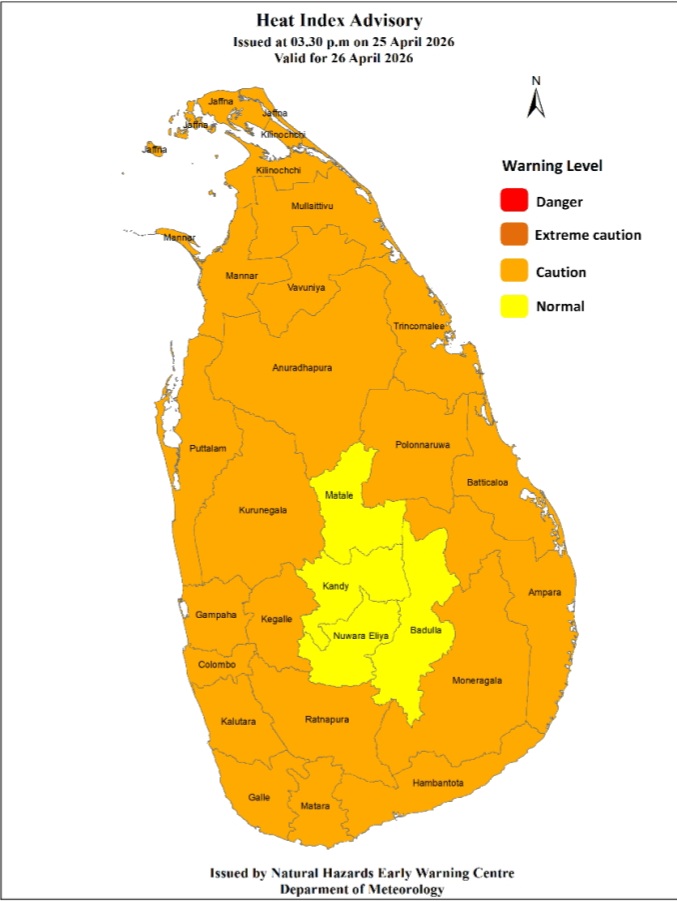
Warm Weather Advisory
Issued by the Natural Hazards Early Warning Centre
Issued at 3.30 p.m. on 25 April 2026, valid for 26 April 2026.
The Heat index, the temperature felt on the human body is likely to increase up to ‘Caution level’ at some places in the Northern, North-central, North-western, Western, Sabaragamuwa, Southern, and Eastern provinces and in Monaragala district during the day time.
The Heat Index Forecast is calculated by using relative humidity and maximum temperature and this is the condition that is felt on your body. This is not the forecast of maximum temperature. It is generated by the Department of Meteorology for the next day period and prepared by using global numerical weather prediction model data.

Effect of the heat index on human body is mentioned in the above table and it is prepared on the advice of the Ministry of Health and Indigenous Medical Services.
ACTION REQUIRED
Job sites: Stay hydrated and takes breaks in the shade as often as possible.
Indoors: Check up on the elderly and the sick.
Vehicles: Never leave children unattended.
Outdoors: Limit strenuous outdoor activities, find shade and stay hydrated.
Dress: Wear lightweight and white or light-colored clothing.
Note:
In addition, please refer to advisories issued by the Disaster Preparedness & Response Division, Ministry of Health in this regard as well. For further clarifications please contact 011-744649
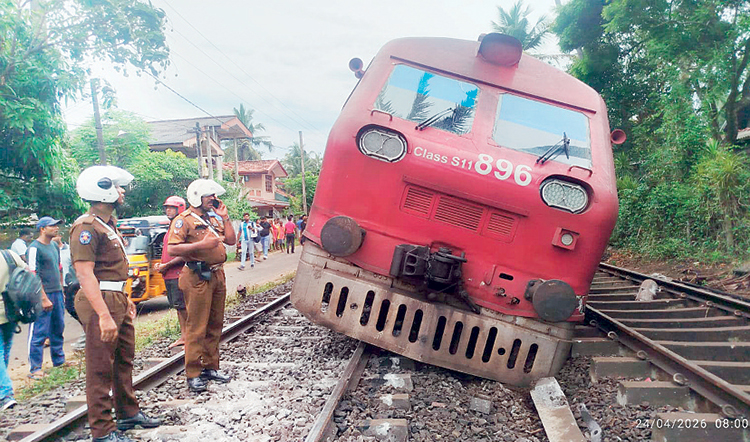
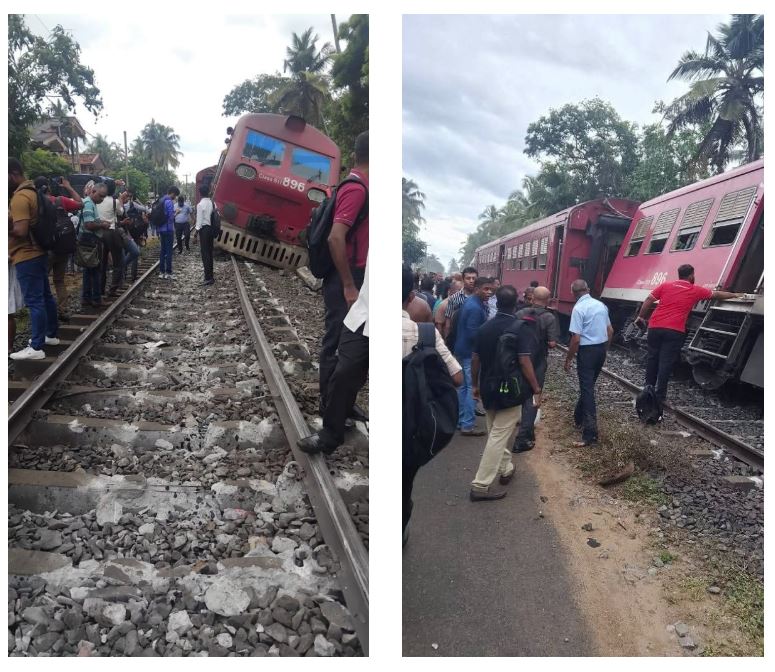
Railway General Manager Ravindra Pathmapriya said on Friday that re-railing operations of the derailed ‘Sagarika’ train have already commenced and that services on the Coastal Line are expected to be restored within two days.
Addressing the media, he said the Minister had instructed officials to take all necessary measures to minimise inconvenience to passengers.
Commenting on the incident, he said: “The damaged train is a significant loss for us, especially as our fleet is already limited. We have incurred this loss and hope to rectify the situation promptly. However, we will need to deploy an alternative train in its place, and discussions are currently underway.”
The ‘Sagarika’ train, operating from Beliatta to Maradana, derailed near the Wadduwa Railway Station on Friday morning (24), causing severe damage to one track of the dual-line section.
The Railway Department has since restricted services on the affected Coastal Line up to Panadura Railway Station.
Arrangements have been made to transport passengers from Panadura to South Kalutara by Sri Lanka Transport Board (SLTB) buses, from where train services will resume towards Matara and Beliatta.
Meanwhile, the Department said efforts are underway to clear the obstruction and restore at least one track by the end of the day.

Russian circumnavigation team arrive in Sri Lanka

Trump unhurt after shots fired at White House correspondents’ dinner

Sooryavanshi ton in vain as Sunrisers Hyderabad raze a 229 chase

Prabhsimran, Shreyas upstage Rahul’s 152* to mow down record T20 chase

Showers expected in the Western, Sabaragamuwa and North-western provinces and in Galle, Matara, Kandy and Nuwara-Eliya districts after 2.00 pm.

Heat Index at Caution Level in the Northern, North-central, North-western, Western, Sabaragamuwa, Southern, and Eastern provinces and in Monaragala district during the day time

‘Dates have the highest sugar content to fight Coronavirus’

Sunday Island 27 December – Headlines

#SundayIsland 17th December – Headlines

Sunday Island – 28th March

Sunday Island Headlines – 21 March

Sunday Island – 21st February – Headlines
-

 News5 days ago
Rs 13 bn NDB fraud: Int’l forensic audit ordered
-

 News3 days ago
Lanka faces crisis of conscience over fate of animals: Call for compassion, law reform, and ethical responsibility
-

 Opinion6 days ago
Shutting roof top solar panels – a crime
-
 News2 days ago
Whistleblowers ask Treasury Chief to resign over theft of USD 2.5 mn
-

 News2 days ago
No cyber hack: Fintech expert exposes shocking legacy flaws that led to $2.5 million theft
-

 News6 days ago
Church calls for Deputy Defence Minister’s removal, establishment of Independent Prosecutor’s Office
-

 News3 days ago
USD 2 mn bribe: CID ordered to arrest Shasheendra R, warrant issued against ex-SriLankan CEO’s wife
-

 Features6 days ago
The Digital Pulse: How AI is redefining health care in Sri Lanka?