
Features
An untold history of Sri Lanka’s Independence

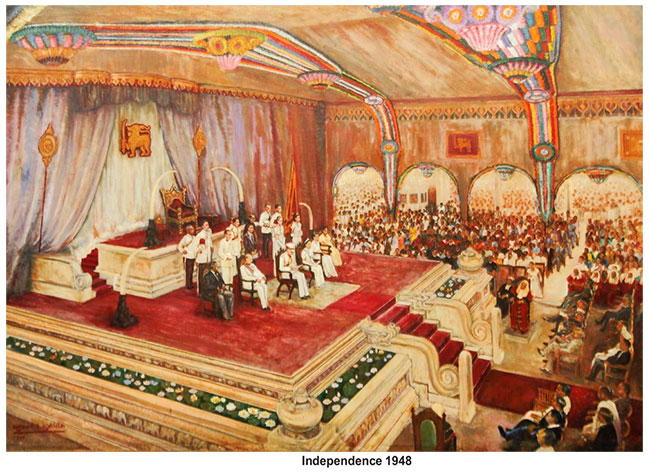
By Uditha Devapriya
In Sri Lank, as in every other colonial outpost, resistance to foreign domination predated Western intervention by well more than two centuries. Surviving numerous onslaughts of South Indian conquest, the Anuradhapura kingdom gave way to the Polonnaruwa kingdom in the 11th century AD. The latter’s demise 200 years later led to a shift from the country’s north to the north-west, and from there to the south-west. It was in the south-west that the Sinhalese first confronted European colonialism, a confrontation that pushed the Kotte and the Sitava kingdoms to the last bastion of Sinhalese rule, Kandy.
The shift to Kandy coincided with the commencement of Portuguese rule in the island. Both Portuguese and Dutch officials emphasised, and sharpened, the line between the Maritime Provinces and the kanda uda rata. The Sitavaka rulers, in particular Rajasinghe I, had fought both Portuguese suzerainty and Kotte domination. These encounters more or less breathed new life into the country’s long history of resistance to foreign rule.
The Kandyan kings inherited this legacy and imbibed this streak. But under them resistance to colonial subjugation acquired a new logic and a fresh vigour. That was to define the island’s struggle against imperialism for well more than three centuries.
Sri Lanka’s confrontations with European colonialism took place in the early part of what historians call the modern period. The social, political, and economic transformations inherent in this period had a considerable impact on the trajectory of European imperialism and anti-imperialism. For that reason, any examination of Sri Lanka’s fight against colonial rule and its eventual independence must evaluate a broad array of historical trends. While the island’s lunge into statehood in 1948 followed a long period of peasant, elite, and radical struggles against foreign domination, the analysis would be incomplete without reference to how European colonialism itself influenced the course of such struggles.
The period between the British annexation of the island and the declaration of independence (1815-1948) unfolded in four successive but interrelated stages. In the first stage between 1815 and 1848, British colonialism was compelled to reckon with the reality of an unending series of peasant uprisings, beginning in Uva-Wellassa in 1817 and culiminating in Matale three decades later. In keeping with similar insurrections in other colonial societies, these were essentially Janus-faced: on the one hand, they sought liberation for a repressed group, the Kandyan peasantry, while on the other they envisaged a return to a pre-colonial polity. Yet, whatever their motives, they wanted to free the country of foreign rule.
The British government realised too late, the folly of assuming that its political-military grip over the island would weaken, and prevail over, peasant resistance. Since the annexation of 1815, the colonial government had drawn and redrawn the country’s borders, breaking up the former Kandyan kingdom into Central and North-Western provinces and separating the Kandyan kingdom from its Sabaragamuwa and Wayamba peripheries. With these measures, officials hoped for the breakup of Kandyan unity. The aim of these processes, notes K. M. de Silva, was “to weaken the national feeling of the Kandyans”.
However, for obvious reasons, none of these reforms could quieten or dispel the spirit of resistance among the peasantry. The Kandyan peasantry never accepted the notion of Sri Lanka as a unitary and united administration overseen by the colonial government. Indeed, when the subject of constitutional reform came up in the 1920s, the Kandyan delegation demanded federal autonomy, predating Tamil nationalist claims for a separate homeland by three decades. This showed very clearly that the British policy of amalgamating the Kandyan provinces with the rest of the country had not really worked out.
To complicate matters further, while dealing with peasant rebellions colonial officials had to put up with the growth of an assertive, and often radical, middle-class. To give one example, the Matala Uprising was never limited to Matale and Kurunegala: it erupted in Colombo as well, where Sinhalese, Tamil, and Burgher middle-classes protested the government’s tax policies. K. M. de Silva observes that attempts by these middle-classes to influence Kandyan agitation “achieved little impact.” Yet that such an attempt was made at all showed that the colonial government had to reckon with two distinct dissenting groups.
The middle-classes may not have been revolutionaries, but as their interventions during the Matale Uprising showed, they could combine their dissatisfaction with the way things were with popular hatred of the government, to make their own demands. As a way of resolving this issue, between 1848 and 1870 – the second of the four periods pertinent to this essay – the colonial government began hiring and empowering a subservient elite, drawn from “the second echelon of the Kandyan nobility” as well as a low country bourgeoisie.
Newton Gunasinghe has noted the paradox underlying these reforms. While putting an end to the monopoly of the Kandyan aristocracy, the British government reactivated the very social relations that had undergirded traditional Kandyan society. By reviving rajakariya in modified form, feudal production relations in temple lands, and a network of gamsabhas, colonial authorities grafted archaic social customs and practices on what was, essentially, a capitalist mode of production. This had the effect of building up a class of subservient elites and reducing the revolutionary potential of the peasantry.
For a while, the strategy worked. However, while it kept the Kandyan peasantry in check and in control, it backfired when the same intermediate elite the government had employed to their ranks began demanding further reforms.
Here it’s important to clarify exactly what these elites wanted. In rebelling against the government, neither the newly co-opted aristocracy nor the middle-classes promoted the overthrow of the British government. They did not want a radical transformation of colonial society, largely because by then they had grown too dependent on that society to envisage, or desire, a Ceylon falling outside the British orbit. This is why, while clamouring for greater representation for themselves, they very carefully, and consistently, opposed the extension of the franchise. As Regi Siriwardena has noted, none of those celebrated as national heroes today – with the important exception of A. E. Goonesinha – wanted universal suffrage vis-à-vis the Donoughmore Commission. Such reforms had to be imposed on them.
Despite this, though, the British government’s policy of engaging with local elites worked fairly well. Colonial officials now had local emissaries through whom they could mediate potential peasant uprisings. Yet the policy necessitated the retention of archaic and quasi-feudal social relations, which in the long term stunted capitalist development. On the other hand, the new strategy paved the way for the revival of various art forms, most prominently the Dalada perahera. As scholars like Senake Bandaranayake have noted, the government defined the perimeters and the contours of cultural artefacts and objets d’art, ensuring that they were in line with the broader aim of legitimising colonial rule.
These reforms led, in the third period (1870-1915), to a Buddhist revival whose exponents alternated between championing opposing to and cooperation with colonial officials. These two lines were promoted, respectively, by the two Buddhist institutions of higher learning established in the late 19th century, Vidyalankara and Vidyodaya. While it’s rather difficult to draw a line between these two universities and their representatives, it is true, as H. L. Seneviratne suggests in The Work of Kings, that significant disagreements prevailed within the Buddhist clergy over the issue of British domination.
From their side, colonial authorities, especially governors like Henry Ward, William Gregory, and Arthur Gordon, sought closer cooperation with a conservative Buddhist bourgeoisie, legitimising British rule while implementing cultural and political reforms. Very often these reforms antagonised groups like Evangelical missionaries. Yet colonial officials ignored their concerns; endearing themselves to revivalists, orientalists, and moderate nationalist opinion to maintain the colonial administrative structure became the bigger priority.
The effect of these developments was to turn the Buddhist elite to the forefront of the reforms being supported by the British government. Towards the end of this period, the bourgeoisie, who were too entrenched economically in colonial rule to advocate radical change, yet too underrepresented politically to be content with the way things were, began to take the lead in these reforms through the Temperance Movement.
 The Temperance Movement provided an impetus for a number of other organisations. K. M. de Silva has argued that none of them – not even the ambitious Ceylon National Association – fulfilled the aims for which they had been set up. Ranging from communal outfits like the Dutch Burgher Union to commercial groups like the Plumbago Merchants Union, these organisations, for the most, preferred gradual to radical change, dispensing with the sort of agitation politics that would come to define the Indian National Congress.
Moreover, Hector Abhayavardhana has noted that the bulk of the Sinhalese elite leadership consisted of “small men with narrow vision” who wanted to bring religion into politics. Any hopes for a multicultural alliance faded away with the establishment of Mahajana Sabhas, which campaigned for Buddhist candidates. However highly one may have thought of outfits like the Jaffna Youth Congress, the lack of enthusiasm for such alliances, among the colonial bourgeoisie, paved the way for their inevitable and tragic demise.
Meanwhile, the colonial bourgeoisie faced a more formidable foe, or competitor, in the form of nationalist firebrands like Anagarika Dharmapala. In a bid to blunt the fervour of such firebrands, who they viewed with much distaste, the Sinhalese bourgeoisie toed the Vidyodaya line, promoting change within the framework of a plantation economy while seeking more representation for themselves. This was necessitated by expedience: by the early 20th century a working class movement had begun to emerge in the country, as the Carters’ Strike of 1906 showed, and though it lacked proper leadership, it nevertheless concerned the bourgeoisie. Their rather ambivalent response to these developments had the unfortunate effect of stunting the rise of a mass struggle in the country.
The comprador bourgeoisie shot to fame, so to speak, with the 1915 riots. A point often forgotten in contemporary reconstructions of the riots is that none of the elites arrested by the British government posed a direct threat to colonial rule. As Kumari Jayawardena has pointed out, it was a case of official overreaction to the faintest threat of an anti-colonial uprising. Much like the J. R. Jayewardene government proscribing the Left after the 1983 riots, there was no link between the riots and the causes attributed to it, be it the supposed agitation of Buddhist elites or the politics of the Temperance Movement.
Kumari Jayawardena and K. M. de Silva point out that the period after the 1915 riots – the fourth period relevant to our discussion – witnessed the dulling down and fading away of the Buddhist revival. This is indeed what happened. In the person of Anagarika Dharmapala, the revival had brought together both reformist and radical streams. The Sinhalese elites, obviously cooperating with British authorities, marginalised him to the extent of excluding him from political activity. Yet Dharmapala’s departure from the island gave rise to newer parties and forms of struggle, many of them inspired by his vision. Among these, the most prominent was the Labour Party, founded in 1928 by A. E. Goonesinha.
Naturally enough, working class unrest dominated much of the post-1915 period, leading to the formation of a broad, radical Left. The newly formed Left identified the limitations of Goonesinha’s politics and sought to transcend them. To this end the establishment of the Lanka Sama Samaja Party (LSSP), in 1935, marked a pivotal turning point in the country’s lunge towards independent statehood. Envisioning a complete, radical transformation of society, its representatives and ideologues broke with the dominant political outfit of the day, the Ceylon National Congress, charting their own course.
The LSSP’s original objectives, as radical in their time as in ours, included the socialisation of the means of production, the attainment of complete independence, and the abolition of all forms of inequality, including caste. Given the state of the economy at the time – it was a plantation enclave heavily dependent on a few sectors – no other programme would have sufficed for an organisation calling for a mass struggle against colonial rule. It goes without saying that it was the stalwarts of the Marxist Left – specifically Philip Gunawardena – who first advocated complete independence for Ceylon.
In the meantime, the colonial bourgeoisie managed, rather dismally, to turn the Ceylon National Congress into a pale echo of what it had once aspired to. With the departure of Ponnambalam Arunachalam in 1921, there came an end to an era where, as K. M. de Silva and Hector Abhayavardhana have observed, Sinhala and Tamil communities constituted in unison the majority of the country. In the hands of a predominantly Sinhalese bourgeoisie the Congress became a little more than a communal organisation, a point reinforced by the decision of its leaders to disenfranchise estate Tamils. In this they were occupied more than anything else with the preservation of their economic interests.
All these developments led to a situation where the Left could claim, very validly, that the ruling elite had not won independence, but had secured it on a platter from Whitehall. The elite themselves were not unaware of the inadequacy of their campaign for freedom: when the masses reacted vociferously against the cosmetic reforms they had obtained from the British government, the Congress bourgeoisie quickly went back and pressed for what was being demanded. Yet tied to three agreements which made the defence, foreign policy, and civil service blanks of the government subservient to British interests, Ceylon could become free only through a radical transformation of its political structures.
In breaking off all remaining ties with the colonial government, the 1972 Constitution sought to give effect to such a transformation. By then even the Sinhalese bourgeoisie had come to realise the folly of maintaining the status quo and the inevitability of change: whereas John Kotelawala could support Ceylon remaining a Dominion, Dudley Senanayake could a decade later support the idea of it becoming a Republic within the Commonwealth.
I believe we need a new account of our country’s emergence as an independent state. The accounts we have at present, barring very few, glorify one set of leaders over all others, marginalising and excluding everyone else. Conventional narratives depict the colonial elite as national heroes. This was not always so, though important differences did exist within the bourgeoisie. What we have learnt about our own independence is hardly adequate to the task of helping us understand our past. We badly need a new history.
The writer can be reached at udakdev1@gmail.com


 Going forward, it is hoped that a reported ceasefire agreement between the US and Iran would provide a basis for a degree of stability in the Middle East and pave the way for substantive peace talks between the powers concerned. The world is compelled to fall back on hope because there is never knowing when President Donald Trump would change his mind and plans on matters of the first importance. So erratic has he been.
Yet, confusion abounds on who has agreed to what. The US President is on record that a number of conditions put forward by him to Iran to deescalate tensions have been accepted by the latter, whereas Iran is yet to state unambiguously that this is so. For instance, the US side claims that Iran has come clear on the point that it would not work towards acquiring a nuclear weapons capability, but there is no official confirmation by Iran that this is so. The same goes for the rest of the conditions.
Accordingly, the peace process between the US and Iran, if such a thing solidly exists, could be said to be mired in uncertainty. Nevertheless, the wider publics of the world are bound to welcome the prospects of some sort of ceasing of hostilities because it would have the effect of improving their economic and material well being which is today under a cloud.
However, questions of the first magnitude would continue to bedevil international politics and provide the breeding ground for continued tensions between East and West. Iran-US hostilities helped highlight some of these divisive issues and a deescalation of these tensions would not inevitably translate into even a temporary resolution of these questions. The world community would have no choice but to take them up and work towards comprehending them better and managing them more effectively.
For example, there are thorny questions arising from the Treaty on the Non-Proliferation of Nuclear Weapons (NPT). Essentially, this treaty bans the processing and use of nuclear weapons by states but some of the foremost powers are not signatories to it.
Moreover, the NPT does not provide for the destroying of nuclear arsenals by those signatory states which are already in possession of these WMDs. Consequently, there would be a glaring power imbalance between the latter nuclear-armed states and others which possess only conventional weapons.
Such a situation has grave implications for Iran’s security, for instance. The latter could argue, in view of the NPT restrictions, that the US poses a security threat to it but that it is debarred by the Treaty from developing a nuclear arms capability of its own to enable it to match the nuclear capability of the US. Moreover, its regional rival Israel is believed to possess a nuclear weapons capability.
Accordingly, a case could be made that the NPT is inherently unfair. The US would need to help resolve this vexatious matter going forward. But if it remains, US-Iran tensions would not prove easy to resolve. The same goes for Iran-Israeli tensions. Consequently, the Middle East would remain the proverbial ‘powder keg’.
Besides the above issues, the world has ample evidence that it could no longer speak in terms of a united NATO or West. Apparently, there could be no guarantee that US-NATO relations would remain untroubled in future, even if the current Iran-US standoff is peacefully resolved. US-NATO ties almost reached breaking point in the current crisis when the US President called on its NATO partners, particularly Britain, to help keep open the Hormuz Straits for easy navigation by commercial vessels, militarily, on seeing that such help was not forthcoming. Such questions are bound to remain sore points in intra-Western ties.
In other words, it would be imperative for the US’ NATO partners to help pull the US’ ‘chestnuts out of the fire’ going ahead. The question is, would NATO be willing to thus toe the US line even at the cost of its best interests.
For the West, these fractious issues are coming to the fore at a most unpropitious moment. The reality that could faze the West at present is the strong opposition shown to its efforts to bolster its power and influence by China and Russia. Right through the present crisis, the latter have stood by Iran, materially and morally. For instance, the most recent Security Council resolution spearheaded by the US which was strongly critical of Iran, was vetoed by China and Russia.
Accordingly, we have in the latter developments some marked polarities in international politics that could stand in the way of the West advancing its interests unchallenged. They point to progressively intensifying East-West tensions in international relations in the absence of consensuality.
It is only to be expected that given the substance of international politics that the West would be opposed by the East, read China and Russia, in any of the former’s efforts to advance its self interests unilaterally in ways that could be seen as illegitimate, but what is sorely needed at present is consensuality among the foremost powers if the world is to be ‘a less dangerous place to live in.’ Minus a focus on the latter, it would be a ‘no-win’ situation for all concerned.
It would be central to world stability for International Law to be upheld by all states and international actors. Military intervention by major powers in the internal affairs of other countries remains a principal cause of international mayhem. Both East and West are obliged to abide scrupulously with this principle.
From the latter viewpoint, not only did the West err in recent times, but the East did so as well. Iran, for instance, acted in gross violation of International Law when it attacked neighbouring Gulf states which are seen as US allies. Neither Iran nor the US-Israel combine have helped in advancing international law and order by thus taking the law into their own hands.
Unfortunately, the UN has been a passive spectator to these disruptive developments. It needs to play a more robust role in promoting world peace and in furthering consensual understanding among the principal powers in particular. The need is also urgent to advance UN reform and render the UN a vital instrument in furthering world peace. The East and West need to think alike and quickly on this urgent undertaking.
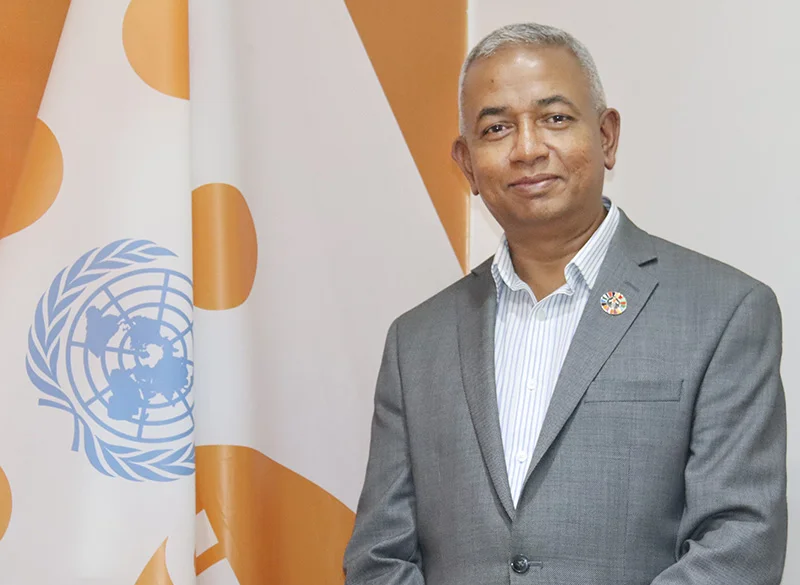
Marking World Health Day on April 7, health experts have called for a stronger commitment to science-based decision-making to address increasingly complex and evolving health challenges in Sri Lanka and beyond.
Dr. Dayanath Ranatunga, Assistant Representative of the United Nations Population Fund, stressed that health is no longer confined to hospitals or traditional medical systems, but is shaped by a broad spectrum of social, environmental, and technological factors.
“This year’s theme, ‘Together for Health. Stand with Science,’ reminds us that science is not only for laboratories or policymakers. It is a way of thinking and a tool that shapes everyday decisions,” he said.
Dr. Ranatunga noted that modern health challenges are increasingly interconnected, ranging from infectious diseases such as COVID-19 to climate-related risks, demographic shifts, and emerging forms of online violence.
He warned that maternal and newborn health continues to demand urgent attention despite progress. Globally, an estimated 260,000 women died from pregnancy and childbirth-related causes in 2023 alone—many of them preventable through timely, science-based interventions.
“In countries like Sri Lanka, where fertility rates are declining and survival rates improving, every pregnancy carries greater significance—not just for families, but for the future of communities and economies,” he said.
The UNFPA official also highlighted the growing threat of Technology Facilitated Gender-Based Violence (TFGBV), including cyber harassment and online abuse, noting that these forms of violence can have deep psychological consequences despite lacking visible physical harm.
He emphasised the need for multidisciplinary, science-informed approaches that integrate mental health, digital safety, and survivor-centered care.
Turning to demographic trends, Dr. Ranatunga pointed out that increasing life expectancy is bringing new challenges, particularly the rise of non-communicable diseases such as diabetes, cardiovascular illnesses, and cancers.
In Sri Lanka, nearly 13.9% of mothers develop diabetes during pregnancy, a trend attributed to obesity and unhealthy lifestyles, underscoring the urgent need for preventive healthcare strategies.
“Are we investing enough in prevention?” he asked, noting that early intervention and healthier lifestyles could significantly reduce long-term healthcare costs, especially in a country with a free public healthcare system.
He underscored the importance of data-driven policymaking, stating that scientific research and analytics enable governments to identify gaps, anticipate future needs, and allocate resources more effectively.
The UNFPA, he said, is already leveraging tools such as Geographic Information Systems (GIS) to improve access to maternal healthcare, including mapping travel times for pregnant women to reach health facilities.
Digital innovation is also transforming healthcare delivery, from telemedicine to real-time data systems, improving efficiency and ensuring continuity of care even during emergencies.
In Sri Lanka, partnerships between the government and development agencies are helping to modernise training institutions, including facilities in Batticaloa, equipping healthcare workers with both clinical and digital skills.
However, Dr. Ranatunga cautioned that technology alone is not a solution.
“It must be guided by evidence and grounded in equity,” he said, pointing out that women’s health remains significantly underfunded, with only about 7% of global healthcare research focusing on conditions specific to women.
He also drew attention to the growing health impacts of climate change, including extreme weather, food insecurity, and displacement, describing it as an emerging public health crisis.
“Health does not begin in hospitals. It is shaped by the environments we live in, the choices we make, and the systems we build,” he said.
Calling for renewed commitment, Dr. Ranatunga urged stakeholders to invest in prevention, embrace innovation, and ensure that science remains central to policy and practice.
“Science is not just about knowledge—it is about ensuring that everyone has the opportunity to live healthy, dignified lives, and that no one is left behind,” he added.
By Ifham Nizam

 Melantha Perera is well known as a very versatile musician.
He was involved with the band Mirage, as their keyboardist/vocalist, and was also seen in action with other outfits, as well, before embarking on a trip to Australia, as a solo artiste.
I now hear that he has plans to operate as a trio.
However, what has got many talking about Melantha, these days, is his awesome work with the visually impaired Bright Light Band.
They have worked out a special song for the Sinhala and Tamil New Year, aptly titled ‘Awurudu Kaale.’
Says Melantha: “This song has been created to celebrate the spirit of the Sinhala and Tamil New Year and to share the joy of the Awurudu season with all Sri Lankans”.
Yes, of course, Melantha composed the song, with the lyrics written collaboratively by Melantha, Badra, and the parents of the talented performers, whose creative input brought the song to life during moments of inspiration.
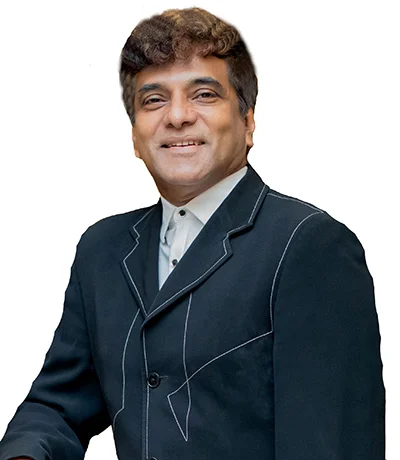
Melantha Perera: Awesome work with Bright Light Band
This meaningful collaboration reflects the strong community behind the Bright Light Band.
According to Melantha, accompaning the song is a vibrant video production that also features the involvement of the parents, highlighting unity, joy, and togetherness.
Beyond showcasing their musical talents, the visually impaired members of Bright Light Band deliver a powerful message, through this project, that their abilities extend beyond singing, as they also express themselves through movement and dance.
Melantha expressed his satisfaction with the outcome of the project and looks forward to sharing it with audiences across the country during this festive season.
He went on to say that Bright Light Band extends its sincere gratitude to Bcert Australia for their generous Mian sponsorship, the CEO of the company, Samath Fernando, for his continuous support in making such initiatives possible, and Rukshan Perera for his personal support and encouragement in bringing this project to completion.
The band also acknowledges Udara Fernando for his invaluable contribution, generously providing studio space and accommodating extended recording sessions to suit the children’s availability.
Appreciation is warmly extended to the parents, whose unwavering commitment from ensuring attendance at rehearsals to supporting the video production has been instrumental in the success of this project.
Through ‘Awurudu Kaale’, Bright Light Band hopes to spread festive cheer and inspire audiences, proving that passion and talent know no boundaries.

AG: Coal procurement full of irregularities

Rs 13.2 bn NDB fraud: House committee declares serious breach in banking system

Tariff shock looms as coal crisis drives Rs. 40 bn cost surge

Sajith responds to AKD’s low-quality coal admission

Ravi: Outdated regulations hindering tourism inflows, digital services, SME-led exports

Croospulle stars as Sri Lanka ‘A’ clinch one-day series against Kiwis

‘Dates have the highest sugar content to fight Coronavirus’

Sunday Island 27 December – Headlines

#SundayIsland 17th December – Headlines

Sunday Island – 28th March

Sunday Island Headlines – 21 March

Sunday Island – 21st February – Headlines
-

 Features4 days ago
Ranjith Siyambalapitiya turns custodian of a rare living collection
-

 News4 days ago
Global ‘Walk for Peace’ to be held in Lanka
-

 News2 days ago
Lankan-origin actress Subashini found dead in India
-
 Opinion6 days ago
Hidden truth of Sri Lanka’s debt story: The untold narrative behind the report
-

 Features4 days ago
Beyond the Blue Skies: A Tribute to Captain Elmo Jayawardena
-
 Features6 days ago
The Ramadan War
-

 Features4 days ago
Aspects of Ceylon/Sri Lanka Foreign Relations – 1948 to 1976
-

 Editorial5 days ago
Brouhaha over a book