
Latest News
AI-generated Iran war videos surge as creators use new tech to cash in

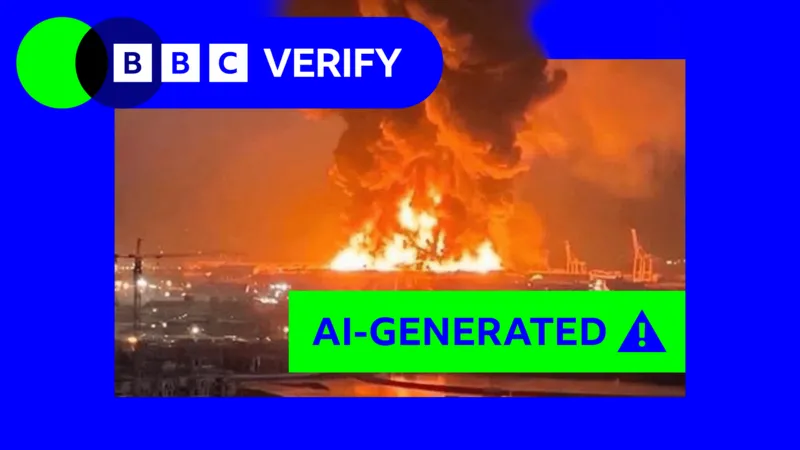
An unprecedented wave of AI-generated misinformation about the US-Israel war with Iran is being monetized by online creators with growing access to generative AI technology, experts have told BBC Verify.
Our analysis has found numerous examples of AI-generated videos and fabricated satellite imagery being used to make false and misleading claims about the conflict which have collectively amassed hundreds of millions of views online.
“The scale is truly alarming and this war has made it impossible to ignore now,” says Timothy Graham, a digital media expert at the Queensland University of Technology.
“What used to require professional video production can now be done in minutes with AI tools. The barrier to creating convincing synthetic conflict footage has essentially collapsed,” he says.
The US and Israel began launching strikes on Iran on 28 February. In response, Iran has launched drone and missile attacks on Israel, as well as multiple Gulf nations and US military assets in the region.
Many have turned to social media to search for and share the latest information and to help make sense of a fast-moving week of conflict.
The platform X announced this week it will temporarily suspend creators from its monetization programme if they post AI-generated videos of armed conflict without a label.
The scheme rewards eligible users whose posts create large numbers of views, likes, shares and comments with payments from the platform.
“It’s a notable signal that they’ve noticed that this is a big problem,” says Mahsa Alimardani, a researcher specialising in Iran at the Oxford Internet Institute.
We asked TikTok and Meta, the company of Facebook and Instagram, if they intend to take similar action, but they did not respond to our requests for comment.
A typical example of an AI-generated video that BBC Verify has tracked appears to show missiles striking the city of Tel Aviv in Israel as the sound of explosions rings out in the background.

This video has been featured in more than 300 posts which have then been shared tens of thousands of times across social media platforms.
Some X users turned to the platform’s AI chatbot Grok to confirm the video’s veracity. But in many cases seen by BBC Verify, Grok wrongly insisted that the AI-generated video was real.
Another fake video, viewed tens of millions of times, claims to show Dubai’s Burj Khalifa skyscraper in flames, while a crowd of people seem to be running towards the building.
This AI-generated footage spread widely online at a time of considerable concern from residents and tourists about the drone and missile strikes on the city.
“Fake videos like these have a detrimental impact on people’s trust in the verified information they see online and make it much harder to document real evidence,” says Alimardani.

A new feature of this conflict analysed by BBC Verify is the emergence of AI-generated satellite imagery.
We verified multiple real videos showing Iranian drone and missile strikes on the US Navy’s Fifth Fleet headquarters in Bahrain on the first day of the conflict.
A fabricated photo, shared on X by the state-linked newspaper The Tehran Times, began to spread the following day and claimed to show extensive damage to the base.
The fake appears to be based on real satellite imagery of a US naval base in Bahrain taken in February 2025, which is publicly available online.
According to Google’s SynthID watermark detector, the fake image was generated or edited with a Google AI tool.
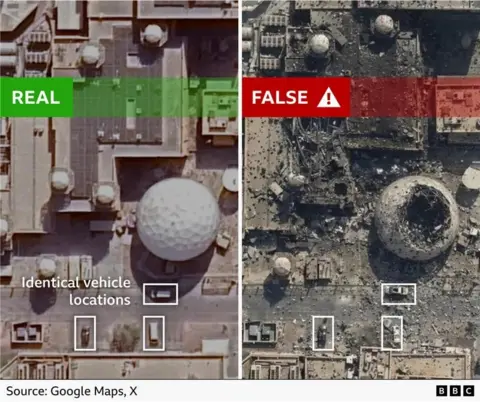
Three vehicles parked outside are also in the exact same spot in both the genuine satellite imagery and the AI picture – despite the photos allegedly having been taken a year apart.
Google’s AI tools, including its video generator Veo, are on the growing list of popular AI platforms, like OpenAI’s Sora model, Chinese AI app Seedance, and Grok which is built into X.
“The number of different tools that are now available to create a wide range of highly realistic AI manipulations is unprecedented,” says Henry Ajder, a generative AI expert.
“We have never seen these tools so available, so easy and so cheap to use,” he says.
This has led to a surge of AI-generated content online “because the pipeline onto social media can now be almost fully automated,” says Victoire Rio, executive director of the technology policy non-profit What To Fix.

X’s head of product said on Tuesday that “99%” of the accounts spreading AI-generated videos like these were trying to “game monetization” by posting content that will generate large amounts of engagement in return for payment through the app’s Creator Revenue Sharing programme.
The platform does not publish how many accounts are part of the programme, or how much money they can make.
But Graham estimates that X could pay about “eight to 12 dollars per million verified user impressions”.
“Creators have to hit five million organic impressions in three months, plus hold an X premium subscription, to be eligible,” he added.
“Once you’re in, viral AI-generated content is basically a money printer,” he says. “They’ve built the ultimate misinformation enterprise.”
X did not respond to our request for comment or our questions about the Creator Revenue Sharing programme.
Experts have told BBC Verify that while many social media companies say they are trying to change their moderation and detection systems to address the scale and speed at which AI-generated content spreads, there is no simple solution to the problem.
“The deeper issue is that engagement-driven monetisation and accurate information are fundamentally in tension, and no platform has fully resolved that tension or perhaps ever will,” says Graham.
[BBC]

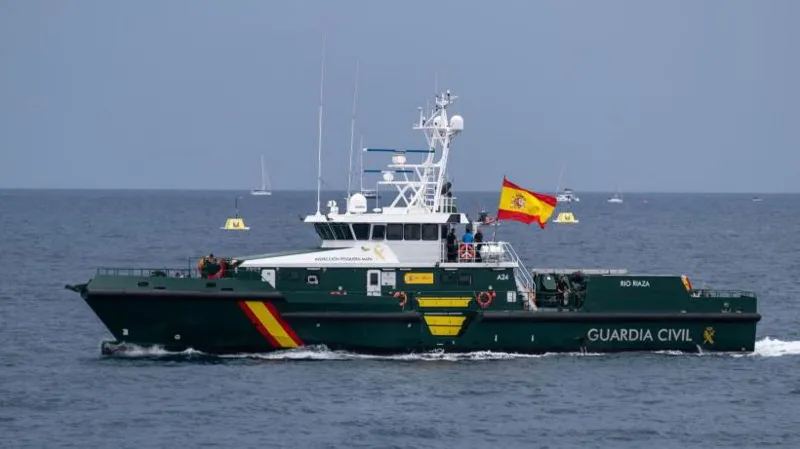
Spanish police have seized what is thought to be a national record haul of cocaine from a ship in the Atlantic Ocean.
Between 30,000 to 45,000kg were found when the Civil Guard intercepted a freighter in international waters, the body’s main union, the AUGC, announced. It called the move a “historic blow to drug trafficking”.
The vessel was intercepted off Spain’s Canary Islands on Friday and around 20 people were arrested, the AUGC told the AFP news agency. It had travelled from Sierra Leona and was on its way to Libya.
The Civil Guard has declined to give details of the investigation for legal reasons.
Interior Minister Fernando Grande-Marlaska told reporters in Madrid that the seizure was “one of the biggest, not only nationally but internationally”.
The Civil Guard shared a photograph on X showing the drugs stuffed into the hold of the intercepted vessel.
“Today history is being written in the Maritime Service of the Civil Guard,” it wrote.
“Intercepted in international waters the largest known seizure: between 30,000 and 45,000 kg of cocaine on board a freighter.”
While the boat was headed to Libya, AFP reported that the pattern of previous operations suggests that it was due to offload the drugs onto smaller vessels for distribution in Europe.
In January, Spanish authorities made its biggest seizure of cocaine at sea from a ship that was carrying almost 10 tonnes.
[BBC]

Three people have died and a UK national is seriously ill in hospital after a suspected hantavirus outbreak on a small cruise ship in the Atlantic Ocean.
The operator of the MV Hondius ship, tour company Oceanwide Expeditions, said a Dutch husband and wife, as well as a German national, had died but the cause has not yet been established.
However, the Dutch company said hantavirus has been confirmed in the case of the 69-year-old UK national who is in intensive care in Johannesburg, South Africa.
Hantavirus is usually passed to humans from rodents via their faeces, saliva or urine. It can cause severe respiratory illness. Rarely, it can be transmitted between people.
The MV Hondius vessel is currently off the coast of Cape Verde and has 149 people onboard.
Oceanwide Expeditions said there were also two crew members on board “with acute respiratory symptoms, one mild and one severe”.
They were of British and Dutch nationality and both required urgent medical care, it said. It said it had not been established that hantavirus had been confirmed in the pair. And it added that no other persons with symptoms had been identified.
Negotiations are in progress with local authorities following what Oceanwide Expeditions described as “a serious medical situation”.
Dr Aaron Motsoaledi, South Africa’s minister of health, said of the British patient that he was critical and had been admitted to a private facility.
“He’s being taken care of. As you know, hantavirus, like all viruses, don’t have any specific treatment, so they are giving symptomatic treatment and support as much as they could.”
He said health workers and anyone who had contact with the patient would now be traced and tested.
Outlining a timeline, the company said a passenger had become unwell while onboard and died on 11 April.
His cause of death could not be determined, and his body was taken off the ship after it docked at St Helena on 24 April.
The passenger’s wife also disembarked on St Helena and the firm said it was told she had become unwell during the return journey and later died.
“At this time, it has not been confirmed that these two deaths are connected to the current medical situation on board,” it added.
On 27 April, the firm said, another passenger – the British national – became seriously ill and was “medically evacuated” to South Africa.
The 69-year-old remains in a critical but stable condition in Johannesburg after it was confirmed a variant of hantavirus had been identified.
The firm added that on Saturday, a third passenger onboard MV Hondius died.
The cause of death has not been established, Oceanwide Expeditions said. It confirmed the passenger was German.
Oceanwide Expeditions said the cause of the deaths were being investigated.
“The disembarkation of passengers, medical evacuation and medical screening require permission from, and co-ordination with, the local health authorities,” it said. “Local health authorities have visited the vessel and assessed the situation.
“The medical transfer of the two ill persons on board has not yet taken place.”
It added that the option of sailing on to Las Palmas or Tenerife was being considered “to be the gateway for disembarkation, where further medical screening and handling could take place”.
The World Health Organization (WHO) said it was “acting with urgency” to support the MV Hondius, and thanked South African authorities for taking care of the British patient.
WHO’s regional director for Europe, Dr Hans Henri P Kluge, said: “I am in close contact with our teams to ensure a co-ordinated, science-based response.
“Hantavirus infections are uncommon and usually linked to exposure to infected rodents.
“While severe in some cases, it is not easily transmitted between people. The risk to the wider public remains low. There is no need for panic or travel restrictions.”
According to the South African government, MV Hondius departed from Ushuaia in southern Argentina about three weeks ago, before it completed its journey to Cape Verde, where it is anchored outside the capital, Praia.
It is described as a 107.6m (353ft) polar cruise ship, with space for 170 passengers in 80 cabins, along with 57 crew members, 13 guides and one doctor.
One passenger onboard the MV Hondius, who asked to remain anonymous, told the BBC: “The latest word is that a plane is on its way and once it gets here three people will be evacuated from the ship and flown straight to Europe.
“Then the rest of us will almost certainly sail to the Canary Islands.
“The Cape Verde authorities clearly want nothing to do with us. This is what we’re hearing from the captain and staff. From what I can see the mood (on the ship) is pretty good.
“Only one person has been tested (the one now in South Africa) and he tested positive for hantavirus. So, we don’t actually know yet if the other cases are that or something unrelated.
“If they are all hantavirus then the transmission is a bit mysterious. We’ve been informed that there are no rodents on board, and person-to-person transmission is difficult/rare.
“Hopefully the other patients on board will be tested soon and then we’ll know better what’s going on.”
President of the Cape Verdean Public Health Institute, Maria Da Luz, said passengers would not be disembarking in Cape Verde in order to protect the local population, Cape Verde’s media outlet A Nacao reports.
Oceanwide Expeditions said strict precautionary measures were in process on board, including isolation measures, hygiene protocols and medical monitoring.
“All passengers have been informed and are being supported,” it said.
“Oceanwide Expeditions is in close contact with those directly involved and their families, and is providing support where possible.”
Microbiologist Siouxsie Wiles told the BBC the time between people being exposed to hantavirus and showing symptoms could be anywhere from one to eight weeks.
“With this incubation period are we going to see more people coming down with the disease in the next days and weeks?”
The UK Foreign Office told the BBC it was monitoring reports, and ready to support British nationals.
Hantavirus was in the headlines last year after the wife of Oscar-winning actor Gene Hackman died from a respiratory illness linked to hantavirus in March 2025.
[BBC]
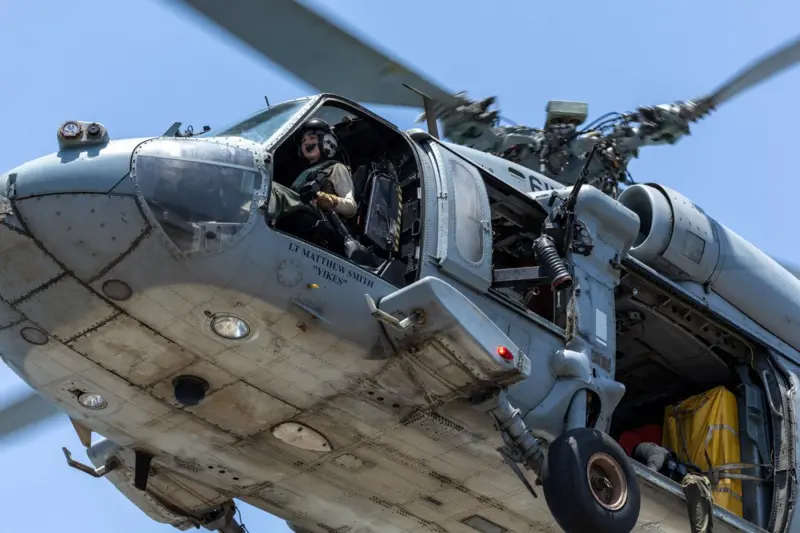
President Donald Trump says the US struck seven Iranian “fast boats” after vowing to help stranded vessels out of the Strait of Hormuz.
US Central Command (Centcom) says it has used helicopters to destroy Iranian small boats. “Earlier today, Sea Hawk and U.S. Army AH-64 Apache helicopters were used to eliminate Iranian small boats threatening commercial shipping”, Centcom writes in a social media update.
Iran’s military said it fired warning shots at American warships. The US Central Command denies a claim in Iranian state media that Iranian missiles hit a US destroyer.
Meanwhile, the US says Navy destroyers and US-flagged merchant ships have sailed through the waterway, with Iran claiming this is “entirely false”.
Shipping company Maersk has told the BBC that one of its US-flagged commercial vessels has successfully exited the Strait of Hormuz under US military protection.
In a statement, Maersk says the transit was “completed without incident, and all crew members are safe and unharmed”.
The ‘Alliance Fairfax’, it says, had been unable to leave the Gulf since February 2026, when conflict between Iran and the US began. Maersk says it was contacted by the US military and offered support. After the “development of a comprehensive security plan”, the vessel was cleared to leave, according to the statement.
The shipping company says the ship then exited the Gulf “accompanied by US military assets” and thanks them for their “professionalism and effective coordination” in making the operation possible.
Elsewhere, the UAE says it is defending itself against “missile and drone attacks originating from Iran” – Tehran has yet to comment
[BBC]

CJ urged to inquire into AKD’s remarks on May 25 court verdict

ITAK MPs representing East take their woes to Canadian HC

People demand release of Keppapilavu land

Sajith calls VAT hike extortion, demands relief for the public

Cricket and the National Interest

Prof. Peiris alleges Prez has violated Constitution

‘Dates have the highest sugar content to fight Coronavirus’

Sunday Island 27 December – Headlines

#SundayIsland 17th December – Headlines

Sunday Island – 28th March

Sunday Island Headlines – 21 March

Sunday Island – 21st February – Headlines
-
 News6 days ago
Treasury chief’s citizenship details sought from Australia
-
 News5 days ago
Rooftop Solar at Crossroads as Sri Lanka Shifts to Distributed Energy Future
-
 News4 days ago
“Three-in-one blood pressure pill can significantly reduce risk of recurrent strokes”
-

 News6 days ago
Central Province one before last in AL results
-

 Sports6 days ago
Well done AKD!
-

 News4 days ago
Alarm raised over plan to share Lanka’s biometric data with blacklisted Indian firm
-
 News2 days ago
Easter Sunday Case: Ex-SIS Chief concealed intel, former Defence Secy tells court
-

 News4 days ago
USD 2.5 mn fraud probe: Interdicted MoF official found dead at home