
Business
Adani wind power project in Sri Lanka offers ‘fixed tariff with no changes’ over next 20 years


Slams the practice of initial quoting of lower prices and increasing rates later
Highlights the success of Adani project in Bangladesh which faced similar negativity at the outset
By Sanath Nanayakkare
Anil Sardana, Managing Director of Adani Power Ltd and Adani Energy Solutions Ltd, who is also the Head of Adani Green Energy’s windmill project in Sri Lanka said recently that the tariff Adani has offered to Sri Lanka is fixed for the entire duration of the contract spanning 20 years.
He made this statement during a recent meeting with Sri Lankan journalists at the Adani Group’s global corporate headquarters.
Sardana emphasized the need for transparency in tariffs, pointing out that other power companies initially quoted lower prices but increased rates later, thereby burdening the consumers.
“Transparency is key here. If they charge a certain amount, that should be the bill. There should be no hidden elements. Should we offer a fixed tariff with no changes over the next 20 years, or should we present a seemingly lower figure that could potentially double through additional charges in the future? This dilemma demands clarity from Sri Lanka. Discerning individuals already know who can deliver and within what timeframe,” Sardana said.
“Adani Group is committed to the Sri Lankan power sector and will employ at least 95% of our workforce locally for both construction and operations and maintenance, contributing to skill and ecosystem development. We have also offered to aid the ancillary industries related to project commissioning so that in the future these skills could be sourced locally for future projects, instead of having to import them from outside,” he said.
Highlighting Sri Lanka’s renewable energy potential and economic benefits, Sardana said,” Sri Lanka has significant potential in renewable energy and the country has the ability to harness solar, wind, and pumped hydro storage to deliver consistent, traceable green energy round the clock. Your country has the resources to produce competitive green energy through its abundant solar, wind, and hydro capacities, therefore, the country should also focus on creating and exporting byproducts like green hydrogen and green ammonia, which can generate surplus revenue and benefit the populace through royalties.”
Adani has proposed to set up two wind power plants in in Mannar and Pooneryn region. With a cumulative installed capacity of 484 MW and entailing an overall investment of over a billion dollars, this would be the country’s largest FDI. The company has got a cabinet approval for USC 8.25/ unit tariff for the project.
Addressing environmental concerns which have been raised about the Adani project, Sardana explained that Adani’s windmills are equipped with AI-based radar systems to detect incoming bird flocks and stop the turbine, color-marked blades making them more visible for the birds, and noise boxes to prevent bird collisions.
He urged Sri Lanka to reconsider its reliance on expensive oil-based power generation and explore more cost-effective alternatives, such as establishing power transmission corridor with India for cheaper power. Sardana highlighted the success of an Adani project in Bangladesh, which initially faced similar negativity over fear of high tariff the company may charge, but now generates the cheapest power among imported power plants in the country.

Business
Mahindra Ideal Motors celebrates gala ‘Excellence Awards’ honouring outstanding performance and innovation
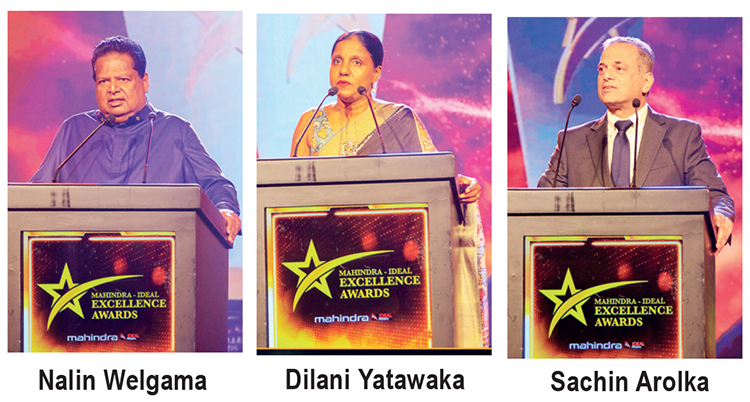
The Mahindra Ideal Motors Excellence Awards ceremony, a grand celebration to recognize dealers and other stakeholders of Ideal Motors, was held at the Wave n’ Lake Banquet Hall & Restaurant in Welisara recently.
The event was graced by the presence of special guests including Nalin Welgama, Founder and Chairman Ideal Motors, Dilani Yatawaka, Group Managing Director/CEO Ideal Motors, Nimisha Welgama, Director Legal and Corporate Affairs Ideal Motor, Sachin Arolka, Head International Operations, Auto Division Mahindra & Mahindra India. Senthil Selvaraju, Head International Operations and Customer Service Automotive Division Mahindra & Mahindra India, Sujeeth Jayant, Country Head Mahindra & Mahindra India and Shitam Kundu, Head Domestic Services Mahindra & Mahindra India.
Also, in attendance from Ideal Motors were Kasun Fernando, General Manager Commercial Vehicle Sales Division, Sameera Bamunuarachchi, Deputy General Manager Spare Parts, Logistics & Inventory and Prasanna Manamperi, Deputy General Manager After Seles Service.
Speaking at the event, Nalin Welgama Ideal Motors Founder and Chairman said, “When we began our journey with Mahindra in 2009, the previous company had sold 300 vehicles in the country, of which nearly 150 had various defects. At that time our journey began by engaging with the parent company in India and repairing those vehicles free of charge. That commitment has brought us to where we are today. As we believe, our journey truly begins after the sale. We are dedicated to strengthening our customers, and in doing so, strengthening ourselves. That is how we transformed the after-sales service experience.”
He added, “Our main strength is the Mahindra Bolero, which has sold more than 10,000 units in just two years. In a very short period, we grew from zero to over 100,000 vehicles sold. This is not my victory, but the victory of all of you who contributed to it. Despite the challenges of the COVID-19 pandemic and the economic crisis we faced, this awards ceremony was organized to express our gratitude to all of you who trusted our institution and stood by us. Let us continue our victorious journey together.”
Dilani Yatawaka, Group Managing Director Ideal Motors, said: “Today is a very happy day for us. This is the first time in history of the organisation, that representatives of our vehicles, spare parts, services, and financial institutions are meeting together under one roof.”
Speaking on the occasion, Sachin Arolka, Head International Operations, Auto Division Mahindra & Mahindra India, stated that Ideal Motors in Sri Lanka is one of the largest seller of Mahindra vehicles in Asia.
More than 300 dealers and finance partners participated in the event which concluded with dinner, fellowship and entertainment.
Strengthening conservation through active law enforcement
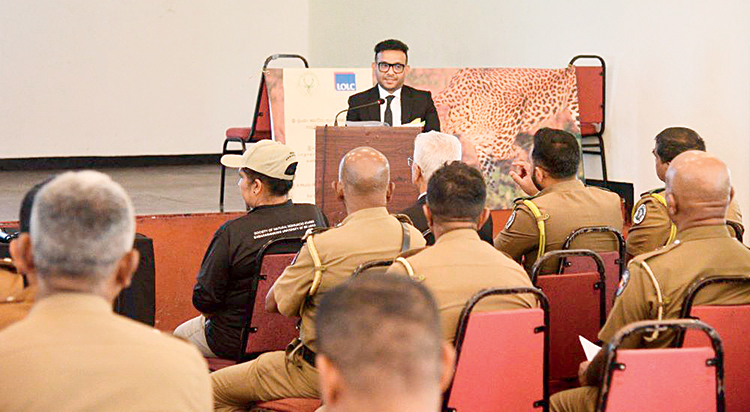
An awareness and capacity-building program on wildlife crime prevention, with a special focus on the Sri Lankan leopard (Panthera pardus kotiya), was successfully conducted on March 20 at the Dimbula Athletics & Cricket Club, Radella.
The session was organized under the ongoing Multi-Regional Leopard Research and Conservation Project implemented by the Wildlife & Nature Protection Society (WNPS), in collaboration with LOLC. It brought together senior officers representing 28 Police stations across the Nuwara Eliya and Kandy districts, underscoring the growing importance of law enforcement in conservation efforts within multi-use landscapes, a WNPS news release said.
The Central Highlands present a unique conservation challenge, where increasing habitat loss and fragmentation, depletion of natural prey, and use of snares continue to threaten leopards inhabiting these landscapes majority outside formally protected areas. The session therefore focused on strengthening the capacity of Police officers to identify, prevent, and respond to wildlife crimes, while fostering closer coordination with conservation stakeholders, it explained.
Co-Chair of the Wildcats Subcommittee, Prof. Enoka Kudavidanage, highlighted the ecological and economic significance of leopards as apex predators, emphasizing their role in maintaining ecosystem balance and supporting nature-based tourism. She also outlined the current conservation challenges in the Hill Country and presented ongoing interventions under the WNPS–LOLC project.
Dr. Sanjaya Weerakody, Postdoctoral Fellow at the Xishuangbanna Tropical Botanical Garden (XTBG), Chinese Academy of Sciences, shared key research findings on leopard mortality trends over the past 17 years revealing concerning patterns, including the disproportionate loss of mature male individuals and the increasing prevalence of snaring as a primary cause of death highlighting an urgent need for targeted enforcement.
Attorney – at – Law Charaka Jayaratne provided an in-depth overview of the legal provisions under the Fauna and Flora Protection Ordinance, with particular attention to offences related to snaring. He discussed how Police can take more proactive and effective action, identifying gaps in current approaches and suggesting practical measures to strengthen enforcement outcomes.
Adding further perspective, Samantha Gunasekara, former Deputy Director of Customs and Chairman of the Marine Environment Protection Authority (MEPA), spoke on the broader context of illegal wildlife trade in Sri Lanka. Drawing from past cases and recent observations, he highlighted emerging trends and risks associated with wildlife trafficking.
Representing the Department of Wildlife Conservation, Ranger Srinath Dissanayake of the Hakgala Wildlife Range shared recent cases on leopard deaths and rescue operations recorded in 2025. He emphasized on personal observations, importance of timely intervention, and strong collaboration between field officers and the Police to mitigate human–wildlife conflict and prevent avoidable losses.
An interactive discussion followed, allowing officers to raise questions, clarify procedures, and exchange experiences while sharing their feedback as well. This dialogue contributed to reinforcing the value of strategic engagement between the Police, the Department of Wildlife Conservation, and conservation partners while strengthening inter-agency understanding and highlighting the need for coordinated responses during leopard-related incidents.
The session commenced with opening remarks by WNPS President Graham Marshall, who expressed appreciation for the participation of the Sri Lanka Police and reiterated the critical role of law enforcement in safeguarding biodiversity beyond protected areas.
WNPS Past President and WNPS LOLC Project Head Spencer Manuelpillai, Project Coordinator Gihani Hettiarachchi, Regional Center Coordinators, Thilanka Dissanayake and Attorney-at-Law Malaka Palliyaguruge were also present as part of the WNPS team.
WNPS extends its sincere appreciation to all officers who participated for their commitment and active engagement. Supported by LOLC, these initiatives form part of a broader effort to strengthen practical conservation through collaboration, knowledge sharing, and effective enforcement in Sri Lanka’s Hill Country.

Fashion retail leader Mangala Tex celebrated the grand opening of its newest branch in Kurunegala on Saturday, March 14, 2026, adding a vibrant new dimension to the city’s commercial landscape.
Since its inception, Mangala Tex has been synonymous with style, durability, and quality, earning a lasting reputation as a premier clothing retailer. Guided by the visionary leadership of Chairman Ronald Nimal Hope, the brand has successfully established a strong presence with thriving outlets in Yatinuwara Veediya, Kandy, Cross Street, Kandy, and Peradeniya, Kandy.
The Kurunegala expansion marks a significant milestone in the company’s growth, bringing its signature fashion offerings closer to a wider customer base. True to its slogan, “Let Your Clothing Do The Talking,” the new store features an extensive range of apparel catering to all age groups, blending contemporary style with durable, high-quality fabrics.
Shoppers at the Kurunegala branch are greeted by a welcoming atmosphere and attentive staff, which long-time customers cite as key reasons for their loyalty. The store’s combination of trendy designs, reliable quality, and customer-centric service continues to set it apart in Sri Lanka’s competitive fashion retail sector.
Mangala Tex now employs more than 120 staff members across its branches, remaining a proudly family-driven enterprise alongside Managing Director Pahan Dissanayaka and Directress M M G P Dissanayaka.
With the official opening in Kurunegala, Mangala Tex demonstrates that consistent quality, style, and service can drive sustained growth, expanding the brand’s reach to new communities while reinforcing its status as a trusted name in Sri Lankan fashion.
Text and Pix by SK Samaranayake

National Namal Uyana Declared a ‘National Heritage of Sri Lanka’

Philippine transport strikers say Marcos Jr failing to control oil prices

One ant for $220: the new frontier of wildlife trafficking

Three Lebanese journalists killed in Israeli strike, say broadcasters

Showers will occur at a few places in the Sabaragamuwa province and in Colombo, Kaluthara, Galle, and Matara districts after 2.00 pm

War-linked power crunch pushes Lanka to four-day week

‘Dates have the highest sugar content to fight Coronavirus’

Sunday Island 27 December – Headlines

#SundayIsland 17th December – Headlines

Sunday Island – 28th March

Sunday Island Headlines – 21 March

Sunday Island – 21st February – Headlines
-

 News4 days ago
Senior citizens above 70 years to receive March allowances on Thursday (26)
-

 Features2 days ago
A World Order in Crisis: War, Power, and Resistance
-

 Features7 days ago
Trincomalee oil tank farm: An engineering marvel
-

 News3 days ago
Energy Minister indicted on corruption charges ahead of no-faith motion against him
-

 News4 days ago
US dodges question on AKD’s claim SL denied permission for military aircraft to land
-

 Features7 days ago
The scientist who was finally heard
-

 Business4 days ago
Dialog Unveils Dialog Play Mini with Netflix and Apple TV
-

 Sports3 days ago
SLC to hold EGM in April