
Latest News
ICC opens hearings into ex-Philippine President Rodrigo Duterte

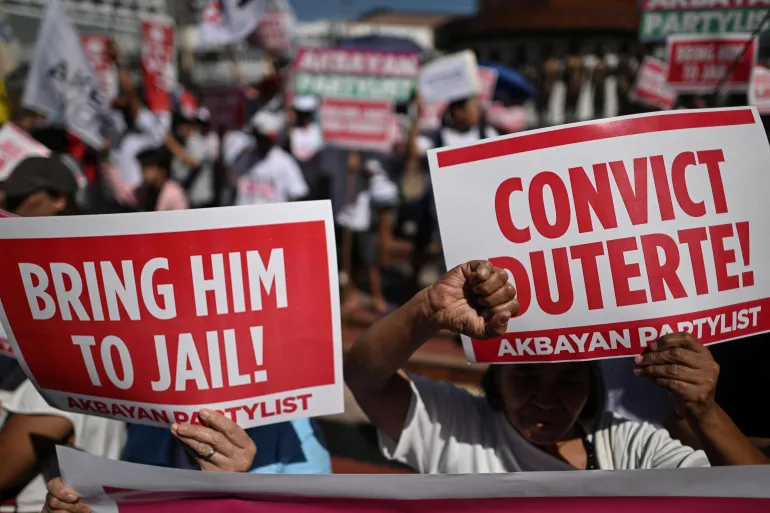
The International Criminal Court (ICC) has begun pretrial hearings for former Philippine President Rodrigo Duterte, who is facing three counts of crimes against humanity for deadly anti-drugs crackdowns he oversaw while in office.
Duterte, 80, was not in The Hague courtroom on Monday, having waived his right to appear as prosecutors began presenting evidence to support their charges of his alleged involvement in dozens of killings as part of his so-called war on drugs.
The four-day confirmation-of-charges hearing will determine whether there is enough evidence against Duterte to proceed to a formal trial.
After the hearing, the judges will have 60 days to issue a written decision.
The case marks a reversal of fortune for Duterte, who has repeatedly cursed the ICC, and offers families of victims and survivors of his six-year war on drugs a chance at justice.
The United States-based watchdog Human Rights Watch said the hearing on Monday was “a critical step in ensuring justice for victims of the Philippines’ ‘war on drugs’” while families of victims called it a “moment of truth”.
Llore Pasco, the mother of two men killed by unknown attackers in 2017, told Al Jazeera it was urgent that all those involved in the so-called war on drugs, including the former president, “are held accountable”.
“I feel a little bit nervous, but this is the moment of truth. We are all hoping that the ICC and the judges will hear the cry of the victims.”

Luzviminda Siapo, whose 19-year-old son was killed in 2017, said she was encouraged that there is progress in the case against Duterte, whom she described as the “brains” behind the killings.
“I hope other perpetrators will also be brought to justice,” she told Al Jazeera.
ICC prosecutors have charged Duterte with crimes against humanity, alleging his involvement in at least 76 murders from 2013 to 2018.
The true number of killings during his campaign in the Philippines is thought to be as high as 30,000 and lawyers for the victims have argued that a full trial could encourage many more families to come forward.
The first of the three counts against Duterte concerns his alleged involvement as a coperpetrator in 19 murders carried out from 2013 to 2016 while he was mayor of Davao City.
The second relates to 14 murders of so-called “high-value targets” in 2016 and 2017 when he was president.
The third charge covers 43 murders committed during “clearance” operations of lower-level accused drug users or pushers across the Philippines from 2016 to 2018.
Duterte denies the charges, his lawyer Nicholas Kaufman told journalists in advance of the hearing.
Duterte, who was president from 2016 to 2022, was arrested in Manila in March, flown to the Netherlands and has since been held at the ICC’s detention unit at Scheveningen Prison.
He followed his initial hearing three days later via videolink, appearing dazed and frail and barely speaking.
In a letter sent to the court on Tuesday, Duterte remained defiant, saying he does “not recognise” the jurisdiction of the court and he is “proud” of his legacy.
Duterte also accused the court of carrying out his “kidnapping” in cooperation with incumbent President Ferdinand Marcos Jr, a former ally and the 2022 running mate of his daughter, Vice President Sara Duterte.
The Philippines left the ICC in 2019 on Duterte’s instructions, but the court has ruled that it still has jurisdiction over offences committed there from 2011 to 2019.
The defence has appealed the ruling, and a decision on its filing is still pending.
Duterte, the first Asian former head of state to appear before the ICC, remains hugely popular in the Philippines, where many favoured his tough approach to crime.
Two demonstrations have been registered for Monday in The Hague – one in support of Duterte and another in support of the victims of the “war on drugs”.
[Aljazeera]


President Anura Kumara Dissanayake today (20) paid his last respects to the remains of Most Venerable Kappetiyagoda Siri Wimala Thera, Anunayake of the Sri Lanka Ramanna Maha Nikaya and Chief Incumbent of the Rajopawanaramaya Temple in Gatambe, Kandy, who passed away.
The President visited the Rajopawanaramaya Temple in Gatambe, Kandy, where the remains of the Thera are lying, and paid his last respects. He subsequently expressed his deepest condolences to the Maha Sangha and the temple’s Dayaka Sabha, who are mourning the passing of the Thera.
Central Province Governor and Consultant Physician Dr Harsha Suranga Fernando, Kandy District Secretary Indika Udawatta and several others were present.
President’s Media Division (PMD)

India opener Shafali Verma has received an official reprimand and a demerit point for breaching Level 1 of the ICC Code of Conduct during the second T20I against Zimbabwe on Sunday.
Shafali, an ICC release said, breached Article 2.2 of the ICC Code of Conduct for Players and Player Support Personnel, which relates to “abuse of cricket equipment or clothing, ground equipment or fixtures and fittings during an International Match.”
It was Shafali’s first offence in a 24-month period.
The incident occurred in the 12th over of Zimbabwe’s innings when Shafali threw the ball into the ground in frustration after dropping a chance at mid-off offered by Chipo Mugeri-Tiripano off Sree Charani.
Shafali admitted the offence and accepted the sanction proposed by match referee GS Lakshmi, which meant there was no need for a formal hearing.
Level 1 breaches carry a minimum penalty of an official reprimand, a maximum penalty of 50% of a player’s match fee, and one or two demerit points.
India currently lead the three-match series 2-0 with the third game to be played on Tuesday evening. The T20Is will be followed by three ODIs in Vadodara from October 23.
(Cricinfo)

A total of 146 players will be competing for 27 available slots in the WPL 2027 mini auction on October 28 in Kochi. Of these, England batter Sophia Dunkley and Australia captain Sophie Molineux are the only two players who have listed themselves at the maximum base price of INR 50 lakh.
The auction pool has 119 Indian players, including 22 capped and 97 uncapped players, with 20 slots available for Indian players. The overseas pool has 27 players – 14 capped and 13 uncapped – including six from Associate teams, with seven slots available.
G Kamalini (released by Mumbai Indians), Kiran Navigre (released by U P Warriorz), Heather Graham and Jess Jonassen have registered at the second-highest base price of INR 40 lakh, while a total of 30 players have registered at INR 30 lakh.
Among the notable absentees are West Indies allrounder Deandra Dottin, who was released by UPW, and Australia legspinner Alana King, who was released by Delhi Capitals. Lizelle Lee, who was DC’s highest run-scorer last season, has also not listed herself after being released by the franchise.
What the teams look like going into the auction
Only two English players – Dunkley and Kira Chathli (INR 10 lakh) – have registered for the auction, with several others, including Danni Wyatt-Hodge, Alice Capsey, Dani Gibson, Lauren Filer and Linsey Smith opting to skip the WPL next year.
Cricinfo has learned that England are likely to play three T20Is in Sri Lanka in early February, which will clash with the final week of the WPL. While the ECB is likely to allow players to stay in India to complete the tournament, most players have instead chosen to prioritise their international commitments ahead of the Champions Trophy later that month.
The relatively low salaries on offer at the WPL are also understood to be a factor in many English players deciding not to register, with most internationals earning significantly more to play in the Hundred (up to £190,000 last year) than the highest permitted base price in the WPL of INR 50 lakh (£40,000 approx).
Molineux was part of the Royal Challengers Bengaluru [RCB] title-winning squad in 2024, and had bagged 12 wickets in ten games at an economy rate of 7.31. She was retained by RCB for the 2025 season but a knee injury ruled her out of the season. Dunkley, meanwhile, played for Gujarat Giants [GT] in 2023 before opting not to register for the 2024 season. She went unsold in the 2025 auction.
Among the premier internationals who have listed themselves for INR 30 lakh are Australia allrounder Grace Harris (released by RCB), Sri Lanka captain Chamari Athapaththu, South Africa left-arm spinner Nonkululeko Mlaba and South Africa allrounder Chloe Tryon.
UPW, who released nine players, will go into the auction with the biggest purse of INR 3.75 crore.
[Cricinfo]

Environmental laws will be enforced equally against everyone

President pays last respects to Most Venerable Kappetiyagoda Siri Wimala Thera

Shafali receives demerit point for breaching Level 1 of ICC code of conduct

Heavy showers about 100 mm are likely at some places in the Northern, North-central, Central, Eastern, North-western and Uva provinces

Molineux, Dunkley enter WPL 2027 auction with top base price of INR 50 lakh

Ranawaka accuses govt. of using JVP cadres and police to suppress political opponents

‘Dates have the highest sugar content to fight Coronavirus’

Sunday Island 27 December – Headlines

#SundayIsland 17th December – Headlines

Sunday Island – 28th March

Sunday Island Headlines – 21 March

Sunday Island – 21st February – Headlines
-

 Features3 days ago
Kotahena:A Small Enclave, An Extraordinary Legacy
-

 News7 days ago
Sri Lanka, India caught in US-Iran ship crisis
-

 News4 days ago
Asgiri Mahanayake calls for immediate release of Gnanasara Thera
-

 Latest News7 days ago
Missiles intercepted near Riyadh after Saudi coalition hits Yemen fuel depot
-
 Latest News7 days ago
Kusal Mendis’ unbeaten 87 hands Sri Lanka consolation win
-

 News2 days ago
Record 1,600 students take Russian Classical Ballet examination in Sri Lanka
-
 News6 days ago
AC President recuses himself from hearing prison attire case pertaining to Gnanasara Thera
-

 Latest News7 days ago
Heavy showers above 100 mm are likely at some places in the Western, Sabaragamuwa, Southern, Central, and North-western provinces and in Anuradhapura district.