
Midweek Review
A philosopher emperor

by Charles Ponnuthurai Sarvan
The titles of books can be misleading. I recall the surprise of a colleague when she saw me carrying a work titled ‘Why is Sex Fun?’ In that book, biologist Jared Diamond explores why human sexual behaviour is so very different from that of animals, even though we are descended from them and still retain some of their behavioural characteristics. The book’s subtitle is ‘The Evolution of Human Sexuality’. The title of Professor Ronald Dworkin’s work, ‘Religion Without God’ (Harvard University Press), seems to be a contradiction, if not an absurdity. Can an atheistic doctrine (the negating particle ‘a’ + theo) be called a religion? But then atheist Einstein said he was religious: “To know that what is impenetrable to us really exists, manifesting itself as the highest wisdom and the most radiant beauty … this knowledge, this feeling, is at the centre of true religiousness. In this sense, and in this sense only, I belong in the ranks of devoutly religious men.” Some have argued that in true Buddhism, that is, as it was preached, there are no gods; even that Buddhism is not a religion but a set of moral precepts and wise, compassionate guidance. So much depends on our definition and concept of terms.
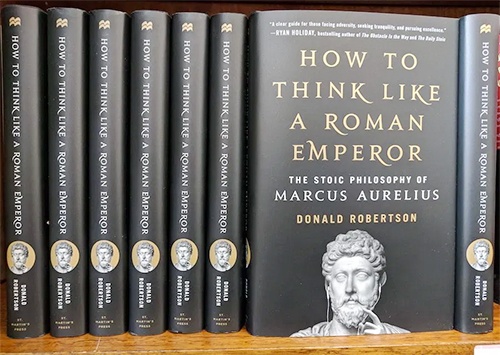
The title of the work that occupies us here, ‘How to Think like a Roman Emperor’ by Donald Robertson (New York, 2019), can initially be misleading. Did all Roman emperors think alike? Not being a Roman emperor, how can I possibly think like one? Again, the book’s subtitle clarifies: ‘The Stoic Philosophy of Marcus Aurelius’. This brings us to Aurelius (121 – 180 CE) and to Stoicism. Admittedly, I have long admired Marcus Aurelius and, to alter words from Ben Jonson, have honoured him “this side of idolatry”. As a note has it, “Marcus Aurelius was the first prominent example of a philosopher king. His Stoic tome ‘Meditations’, written in Greek while on campaign between 170 and 180, is still revered as a literary monument to a philosophy of service and duty, describing how to find and preserve equanimity in the midst of conflict by following nature as a source of guidance and inspiration.”
Socrates, at his trial at which he chose death, said that an unexamined life was not worth living. Aurelius began each morning by thinking about, planning and preparing for the day. The second phase was when he, as emperor, had to act. Finally, at night he reviewed the day and his conduct during it. The ‘Meditations’ was not written for others: it was a kind of “stock taking” of himself, his reactions and behaviour. Aurelius warns himself not to become a Caesar, that is, a dictator. He tried, as far as custom and circumstances permitted, to reduce the pomp which surrounded him (Pope Francis comes to mind) preferring a simple, unpretentious life. As the Greeks knew, we can never see our own face, except by reflection in a mirror. A true friend can act as a mirror, showing us as we really are. Aurelius, therefore, welcomed criticism. Severe on himself, he was patient and kind towards others. As history shows, this extended even to those who had rebelled against him. I wonder if Forster’s comment in his novel, ‘A Passage to India’, that truth is not truth unless spoken gently, derives from the words and example of Marcus Aurelius. Truth, if spoken unkindly, serves only to alienate and antagonise. It may silence the other but does not convince or persuade. In his ‘Meditations’, Aurelius records and rebukes himself when he falls short of the standards he has set himself. The emperor wondered how he could estimate the worth of an individual, and decided it was by seeing to what things that person gave value. In modern terms, it doesn’t mean we must not take an interest in cricket, fashion or food but how much importance and value do we place on such things? Aurelius as emperor couldn’t retreat to his library but had to act. When war broke out on the frontier, he left the safety and comfort of Rome and placed himself at the front with his soldiers. Nor was he solemn and humourless. He is reported to have been good-humoured, affectionate, and close to his family and friends. Before age and responsibilities burdened him, he had hobbies and, as was expected of Roman youths and young men, was active in sports.
At the end, knowing that he was dying; that doctors and medicines couldn’t help, the Emperor calmly and courageously declined food and drink so as not to engage in a futile prolongation of the inevitable. Such an attitude and action are the result of long and serious thought, and preparation: in Shakespeare’s ‘Macbeth’ (Act 1, Scene 4) it’s said of a man that he faced his own execution as one who had “studied” how to die. Aurelius must have known the Latin saying that someone who is not afraid of death cannot be enslaved. Changing time and place, John Donne in a sonnet that begins “Death be not proud” argues that since a person can die only once, having killed him, it’s Death that dies. And in Shakespeare’s ‘Julius Caesar’ (Act 2, Scene 2) Caesar says: “Cowards die many times before their deaths”. As he was dying, Seamus Heaney, winner of the Nobel Prize for Literature, managed to send a text message to his wife in the language he loved, Latin. It consisted of two words: Noli timere (Don’t fear).
Though I am in no way a specialist in either, I am struck by important similarities between Stoicism and Buddhism. For a start, the cornerstone of both is rationality. The Buddha lived from 563 – 483 BCE and Zeno, credited with being the founder of Stoicism, from 334 – 262 BCE. And long before Alexander the Great reached India in 326 BCE, there were links between India and the West. Did Asian Buddhism play a role in the development of Western Stoicism? If research has been done in this area, it has not received publicity: the most effective way of “sinking” a book is to ignore it. Take, for example, Martin Bernal’s thesis in his ‘Black Athena’ that the roots of Western Classical civilization were Afro-Asian. So too, many a male must have been outraged by Martin Stone when he argued in ‘When God was a Woman’ that the first divinities before whom we bowed our heads or prostrated ourselves were female, particularly the ‘mother goddess’. In Sri Lanka, that lucid and refreshing, if radical, work by Dr K S Palihakkara, ‘Buddhism Sans Myths & Miracles’ (Stamford Lake publishers, Pannipitiya) has not excited much, if any, public discussion. Dr Palihakkara’s declared effort was to rescue and cleanse Buddhism from the accretion over time of “myths and miracles and metaphysics”: these took away what was unique to Buddhism, making it more like other religions.
So much of our attitude to life and death depends on our eschatology, our ideas and beliefs about death and the afterlife. The Stoics were atheists believing that at death we disintegrate into and merge with the material, a material which is itself constantly changing. Whether there’s a similarity here with Buddhism, I leave to the reader. The cardinal virtues of Greek philosophy, as of Buddhism, include wisdom (the product of reason and thought), moderation and justice. With Buddhism, it’s not mere verbal and public protestation but actual practice, and so it was with the Stoics. Stoicism was a way of life, assiduously trained in; exemplified by character and conduct.
While in Islam representations of the Prophet are forbidden, Christianity has many paintings and sculptures of Jesus; Jesus with different expression, including pain, even agony. In contrast, the Buddha is almost invariably depicted as being serene. When we lived in Bonn, I used to admire the swans on the Rhine, their sedateness and dignity but, looking more carefully, one saw that these were the result of their feet working constantly, often against the current. So too, the serenity of the Buddha is the result of thought and effort: as is the calm associated with the Stoic.
Anger is temporary madness. Because a deranged person is not controlled by reason, it follows that someone who is angry, someone whose anger is not under control is, for the duration, mad. True Buddhists and Stoics do not give in to anger; they remain detached; free and above this “madness”.
Stoic calmness, the result of mental control, must not be mistaken for emotionlessness. To feel pain and sorrow is human: what counts is our reaction to them. The operative word here is “acceptance”. Sorrow, while it has its impact on us, must be met with wisdom; pain, with acceptance. (Related to acceptance is the key term and concept of relinquishment.) Thorns hurt, and the Bible advises us not to increase the pain by kicking against them. The Stoic image was of a dog tied to a cart: the dog can either walk along or make things worse for itself by struggling, futilely and painfully. A 20th century philosopher asked for the courage to change those things which can be changed; the serenity to accept what can’t be altered, and the wisdom to know the difference. Donald Robertson, a cognitive-behavioural psychotherapist, brings in modern terms and concepts to an understanding of Marcus Aurelius, among them the Stoic reserve-clause. Our expectations are ‘reserved’ for what is within our sphere of control: the rest is up to chance or, as believers would say, “Deo volente” or “Deo gratis”. (When I asked a friend why he often said “Inshallah” though he had never been a Muslim and was in fact a thorough atheist, he replied that it was in a philosophical and not in a religious sense: “If my effort and chance will it”.) As with emotions, so with our desires: of importance to the Stoics was (a) what we desired; (b) to what degree, and (c) how we set about achieving these desires.
Central to Buddhism and Stoicism is an awareness of transience, known in the former as “Anicca”. Heraclitus (500 BCE) famously declared that all is flux. We cannot step into the same river twice because fresh waters are ever flowing in. For better or worse, we are not the same as we were several, or even a few, years ago. We change, others change, relationships change, the world around us changes. All is flux. And as T S Eliot, borrowing from Hinduism, writes in ‘Murder in the Cathedral’, only a fool fixed in his folly thinks he can turn the wheel on which he turns.
I read that there’s a tribe which mourns birth and celebrates death, and Shakespeare in his major tragedy ‘King Lear’ suggests with ironic wit that all infants cry when they are born because they have come to this world! Freud suggested that in as much as we have an instinct for preservation and survival, there can also be a wish for death, for a return to a previous state of non-existence: see terms such as ‘Todestriebe’ and ‘Thanatos’. James Thomson in his poem, ‘City of Dreadful Night’ writes:
This little life is all we must endure,
The grave’s most holy peace is ever sure,
We fall asleep and never wake again;
Nothing is of us but the mouldering flesh,
Whose elements dissolve and merge afresh…
“And the cessation / of life’s peacock scream / will be relief” (Liebetraut Sarvan).
In Book 1 of his ‘Histories’, Herodotus relates the story of a mother who, full of love for and pride in her two sons, prays in the evening to the goddess Hera that she bestows on them “the greatest blessing” that can fall on mortals. The goddess answers the prayer, and the young men are found in the morning – dead. Diagones (412 – 323 BCE) who had a sharp sense of ‘humour’ requested that his dead body be thrown over the city walls so that the wild animals could have a meal: no longer having consciousness, what was done to his body didn’t matter. Respect for a corpse; gravestones and monuments; memorial services, prayers and rituals are for the living, and not for the dead. Buddhist nirvana means the final deliverance from suffering and sorrow: an escape into freedom effected by ceasing to be.
Given these conceptions of life and death, it is not surprising that suicide (not on impulse; not in despair or in a state of temporary madness) was accepted; indeed, in certain situations it was admired and highly honoured. Shakespeare’s Hamlet contemplating suicide and the “sleep” that follows it, saw death as a “consummation” devoutly to be wished for. Each individual must decide, with utmost clarity and calmness “whether the time is come to take leave of life” (‘Meditations’, Book 3). Or as Aurelius expresses it elsewhere, the chimney smokes and I leave the room (Book 5). To the Stoics, lamentation at death was for the loss that the living experienced, and not for the departed:
No motion has she now, no force
She neither hears nor sees;
Rolled round in earth’s diurnal course With rocks, and stones, and trees
(William Wordsworth)
Bertrand Russell (1872 – 1970) wrote: “I should scorn to shiver with terror at the thought of annihilation. Happiness is nonetheless true happiness because it must come to an end, nor do thought and love lose their value because they are not everlasting. Many a man has borne himself proudly on the scaffold; surely the same pride should teach us to think truly about man’s place in the world.” And so I return to the serenity of the Buddha and to the calm of Stoicism: the aim of both was (through rational thought and conscious, controlled, behaviour) to minimise pain and to increase peace and happiness. Both Buddhism and Stoicism are positive and life-enhancing.
Addendum.
I draw attention to what I wrote in ‘Colombo Telegraph’ (1 February 2018) under the caption ‘Religious doctrine and religion’. If we say that Christianity is a gentle, or Buddhism a compassionate, religion what we mean is these faiths as they were taught – most certainly, not as they are practiced in private and public life. I suggested a distinction between religious doctrine and religion with its rituals, paraphernalia, hierarchy, myths and superstitions. Religious doctrine has a divine or semi-divine origin or is from an exalted, exceptional, individual. Simplifying, one could say: “Religious doctrine is ‘divine’ but religion is a human construct”.


Coordinated suicide attacks targeted three churches—St. Anthony’s in Colombo, St. Sebastian’s at Katuwapitiya and Zion Church in Batticaloa—along with popular tourist hotels Shangri-La, Kingsbury, and Cinnamon Grand. No less a person than His Eminence Archbishop of Colombo Rt. Rev. Malcolm Cardinal Ranjith is on record as having said that the carnage could have been averted if the Yahapalana government shared the available Indian intelligence warning with him. Yahapalana Minister Harin Fernando publicly admitted that his family was aware of the impending attack and the warning issued to senior police officers in charge of VVIP/VIP security is evidence that all those who represented Parliament at the time knew of the mass murder plot. Against the backdrop of Indian intelligence warning and our collective failure to act on it, it would be pertinent to ask the Indians whether they knew the Easter Sunday operation was to facilitate Gotabaya Rajapaksa’s victory at the 2019 presidential poll. Perhaps, a key to the Easter Sunday conspiracy is enigma Sara Jasmin (Tamil girl from Batticaloa converted to Islam) whose husband Atchchi Muhammadu Hasthun carried out the attack on St. Sebastian’s Church, Katuwapitiya
By Shamindra Ferdinando
Pivithuru Hela Urumaya (PHU) leader Udaya Gammanpila’s Pasku Praharaye Mahamolakaru Soya Yema (Searching for the mastermind behind the Easter Sunday attacks) inquired into the 2019 April 21 Easter Sunday carnage. The former Minister and Attorney-at-Law quite confidently argued that the mastermind of the only major post-war attack was Zahran Hashim, one of the two suicide bombers who targeted Shangri-la, Colombo.
Gammanpila launched his painstaking work recently at the Sambuddhathva Jayanthi Mandiraya at Thummulla, with the participation of former Presidents Gotabaya Rajapaksa, who had been accused of being the beneficiary of the Easter Sunday carnage at the November 2019 presidential election, and Maithripala Sirisena faulted by the Presidential Commission of Inquiry (PCoI) that probed the heinous crime. Rajapaksa and Sirisena sat next to each other, in the first row, and were among those who received copies of the controversial book.
PCoI, appointed by Sirisena in September, 2019, in the run-up to the presidential election, in its report submitted to President Gotabaya Rajapaksa, in February, 2020, declared that Sirisena’s failure as the President to act on ‘actionable intelligence’ exceeded mere civil negligence. Having declared criminal liability on the part of Sirisena, the PCoI recommended that the Attorney General consider criminal proceedings against former President Sirisena under any suitable provision in the Penal Code.
PCoI’s Chairman Supreme Court Judge Janak de Silva handed over the final report to President Rajapaksa on February 1, 2021 at the Presidential Secretariat. Gotabaya Rajapaksa received the first and second interim reports on 20 December and on 2 March, 2020, respectively.
The Commission consists of the following commissioners: Justice Janak De Silva (Judge of the Supreme Court and Chairman of the Commission), Justice Nissanka Bandula Karunarathna (Judge of the Court of Appeal), Justice Nihal Sunil Rajapakse (Retired Judge of the Court of Appeal), Bandula Kumara Atapattu (Retired Judge of the High Court) and Ms W.M.M.R. Adikari (Retired Ministry Secretary).
H.M.P. Buwaneka Herath functioned as the Secretary to the PCoI.
It would be pertinent to mention that the Archbishop of Colombo Malcolm Cardinal Ranjith, declined an opportunity offered by President Rajapaksa to nominate a person for the PCoI. The Church leader asserted such a move would be misconstrued by various interested parties. Both the former President and Archbishop of Colombo confirmed that development soon after the presidential election.
Having declared its faith in the PCoI and received assurance of the new government’s intention to implement its recommendations, the Church was taken aback when the government announced the appointment of a six-member committee, chaired by Minister Chamal Rajapaksa, to examine the PCoI and recommend how to proceed. That Committee included Ministers Johnston Fernando, Udaya Gammanpila, Ramesh Pathirana, Prasanna Ranatunga and Rohitha Abeygunawardena.
The Church cannot deny that their position in respect of the Yahapalana government’s pathetic failure to thwart the Easter Sunday carnage greatly influenced the electorate, and the SLPP presidential candidate Gotabaya Rajapaksa directly benefited. Alleging that the Archbishop of Colombo played politics with the Easter Sunday carnage, SJB parliamentarian Harin Fernando, in June 2020, didn’t mince his words when he accused the Church of influencing a decisive 5% of voters to back Gotabaya Rajapaksa. At the time that accusation was made about nine months before the PCoI handed over its report, President Rajapaksa and the Archbishop of Colombo enjoyed a close relationship.
The Church raised the failure on the part of the government to implement the PCoI’s recommendations six months after President Rajapaksa received the final report.
The National Catholic Committee for Justice to Eastern Sunday Attack Victims, in a lengthy letter dated 12 July 2021, demanded the government deal with the following persons for their failure to thwart the attacks. The Committee warned that unless the President addressed their concerns alternative measures would be taken. The government ignored the warning. Instead, the SLPP adopted delaying tactics much to their disappointment and the irate Church finally declared unconditional support for the US-India backed regime change project.
Sirisena and others
On the basis of the 19th Chapter, titled ‘Accountability’ of the final report, the Committee drew President Rajapaksa’s attention to the following persons as listed by the PCoI: (1) President Maithripala Sirisena (2) PM Ranil Wickremesinghe (3) Defence Secretary Hemasiri Fernando (4) Chief of National Intelligence Sisira Mendis (5) Director State Intelligence Service Nilantha Jayawardena.
The 20th Chapter, titled ‘Failures on the part of law enforcement authorities’ in the Final report (First Volume), identified the following culprits ,namely IGP Pujith Jayasundera, SDIG Nandana Munasinghe (WP), Deshabandu Tennakoon (DIG, Colombo, North), SP Sanjeewa Bandara (Colombo North), SSP Chandana Atukorale, B.E.I. Prasanna (SP, Director, Western province, Intelligence), ASP Sisira Kumara, Chief Inspector R.M. Sarath Kumarasinghe (Acting OIC, Fort), Chief Inspector Sagara Wilegoda Liyanage (OIC, Fort)., Chaminda Nawaratne (OIC, Katana), State Counsel Malik Azeez and Deputy Solicitor General Azad Navaavi.
The PCoI named former Minister and leader of All Ceylon Makkal Congress Rishad Bathiudeen, his brother Riyaj, Dr Muhamad Zulyan Muhamad Zafras and Ahamad Lukman Thalib as persons who facilitated the Easter Sunday conspiracy, while former Minister M.L.A.M. Hisbullah was faulted for spreading extremism in Kattankudy.
Major General (retd) Suresh Sallay, who is now in remand custody, under the CID, for a period of 90 days, in terms of the prevention of Terrorism Act (PTA) ,was not among those named by the PCoI. Sallay, who served as the head of the Directorate of Military Intelligence (DMI/from 2012 to 2016) was taken into custody on 25 February and named as the third suspect in the high profile investigation. (Interested parties propagated that Sallay was apprehended on the basis of UK’s Channel 4 claim that the officer got in touch with would-be Easter Sunday bombers, including Zahran Hashim, with the help of Sivanesathurai Chandrakanthan, alias Pilleyan. However, Pilleyan who had been arrested in early April 2025 under PTA was recently remanded by the Mount Lavinia Magistrate’s Court, pending the Attorney General’s recommendations in connection with investigations into the disappearance of a Vice Chancellor in the Eastern Province in 2006. There was absolutely no reference to the Easter Sunday case)
The Church also emphasised the need to investigate the then Attorney General Dappula de Livera’s declaration of a ‘grand conspiracy’ behind the Easter Sunday carnage. The Church sought answers from President Rajapaksa as to the nature of the grand conspiracy claimed by the then AG on the eve of his retirement.
Sallay was taken into custody six years after the PCoI handed over its recommendations to President Rajapaksa and the appointment of a six-member parliamentary committee that examined the recommendations. The author of Pasku Praharaye Mahamolakaru Soya Yema, Gammanpila, the only lawyer in the six-member PCoI, should be able to reveal the circumstances that committee came into being.
Against the backdrop of the PCoI making specific recommendations in respect of the disgraced politicians, civilian officials and law enforcement authorities over accountability and security failures, the SLPP owed an explanation regarding the appointment of a six-member committee of SLPPers. Actually, the SLPP owed an explanation to Sallay whose arrest under the PTA eight years after Easter Sunday carnage has to be discussed taking into consideration the failure to implement the recommendations.
Let me briefly mention PCoI’s recommendations pertaining to two senior police officers. PCoI recommended that the AG consider criminal proceedings against SDIG Nandana Munasinghe under any suitable provision in the Penal Code or Section 82 of the Police Ordinance (Final report, Vol 1, page 312). The PCoI recommended a disciplinary inquiry in respect of DIG Deshabandu Tennakoon. The SLPP simply sat on the PCoI recommendations.
Following the overthrow of President Rajapaksa by a well-organised Aragalaya mob in July 2022, the SLPP and President Ranil Wickremesinghe paved the way for Deshabandu Tennakoon to become the Acting IGP in November 2023. Wickremesinghe went out of his way to secure the Constitutional Council’s approval to confirm the controversial police officer Tennakoon’s status as the IGP.
Some have misconstrued the Supreme Court ruling, given in January 2023, as action taken by the State against those named in the PCoI report. It was not the case. The SC bench, comprising seven judges, ordered Sirisena to pay Rs 100 mn into a compensation fund in response to 12 fundamental rights cases filed by families of the Easter Sunday victims, Catholic clergy and the Bar Association of Sri Lanka. The SC also ordered ex-IGP Pujith Jayasundara and former SIS head Nilantha Jayawardene to pay Rs. 75m rupees each, former Defence Secretary Hemasiri Fernando Rs. 50 million and former CNI Sisira Mendis Rs. 10 million from their personal money. All of them have been named in the PCoI report. As previously mentioned, Maj. Gen. Sallay, who headed the SIS at the time of the SC ruling that created the largest ever single compensation fund, was not among those faulted by the sitting and former justices.
Initial assertion
The Archbishop of Colombo, in mid-May 2019, declared the Easter Sunday carnage was caused by local youth at the behest of a foreign group. The leader of the Catholic Church said so in response to a query raised by the writer regarding a controversial statement made by TNA MP M. A. Sumanthiran. The Archbishop was joined by Most Ven Ittapane Dhammalankara Nayaka Thera of Kotte Sri Kalyani Samagri Dharma Maha Sangha Sabha of Siyam Maha Nikaya. They responded to media queries at the Bishop’s House, Borella.
The Archbishop contradicted Sumanthiran’s claim that the failure on the part of successive governments to address the grievances of minorities over the past several decades led to the 2019 Easter Sunday massacre.
Sumanthiran made the unsubstantiated claim at an event organised to celebrate the first anniversary of the Sinhala political weekly ‘Annidda,’ edited by Attorney-at-Law K.W. Janaranjana at the BMICH.
The Archbishop alleged that a foreign group used misguided loyal youth to mount the Easter Sunday attacks (‘Cardinal rejects TNA’s interpretation’, with strap line ‘foreign group used misguided local youth’, The Island, May 15, 2019 edition).
Interested parties interpreted the Easter Sunday carnage in line with their thinking. The writer was present at a special media briefing called by President Sirisena on 30 April, 2019 at the President’s House where the then Northern Province Governor Dr. Suren Raghavan called for direct talks with those responsible for the Easter Sunday massacre. One-time Director of the President’s Media Division (PMD) Dr. Raghavan emphasised that direct dialogue was necessary in the absence of an acceptable mechanism to deal with such a situation. Don’t forget Sisisena had no qualms in leaving the country a few days before the attacks and was away in Singapore when extremists struck. Sirisena arrived in Singapore from India.
The NP Governor made the declaration though none of the journalists present sought his views on the post-Easter Sunday developments.
During that briefing, in response to another query raised by the writer, Army Commander Lt. Gen. Mahesh Senanayake disclosed that the CNI refrained from sharing intelligence alerts received by the CNI with the DMI. Brigadier Chula Kodituwakku, who served as Director, DMI, had been present at Sirisena’s briefing and was the first to brief the media with regard to the extremist build-up leading to the Easter Sunday attacks.
The collapse of the Yahapalana arrangement caused a security nightmare. Frequent feuds between Yahapalana partners, the UNP and the SLFP, facilitated the extremists’ project. The top UNP leadership feared to step in, even after Justice Minister Dr. Wijeyadasa Rajapaksha issued a warning in Parliament, in late 2016, regarding extremist activities and some Muslim families securing refuge in countries dominated by ISIS. Instead of taking tangible measures to address the growing threat, a section of the UNP parliamentary group pounced on the Minister.
The UNP felt that police/military action against extremists may undermine their voter base. The UNP remained passive even after extremists made an abortive bid to kill Thasleem, Coordinating Secretary to Minister Kabir Hashim, on 8 March 2019. Thasleem earned the wrath of the extremists as he accompanied the CID team that raided the extremists’ facility at Wanathawilluwa. The 16 January 2019 raid indicated the deadly intentions of the extremists but PM Wickremesinghe was unmoved, while President Sirisena appeared clueless as to what was going on.
Let me reproduce the PCoI assessment of PM Wickremesinghe in the run-up to the Easter Sunday massacre. “Upon consideration of evidence, it is the view of the PCoI that the lax approach of Mr. Wickremesinghe towards Islamic extremists as the Prime Minister was one of the primary reasons for the failure on the part of the then government to take proactive steps towards tackling growing extremism. This facilitated the build-up of Islam extremists to the point of the Easter Sunday attack.” (Final report, Vol 1, pages 276 and 277).
The National Catholic Committee for Justice to Easter Sunday Attack Victims, in its letter dated 12 July, 2021, addressed to President Rajapaksa, questioned the failure on the part of the PCoI to make any specific recommendations as regards Wickremesinghe. Accusing Wickremesinghe of a serious act of irresponsibility and neglect of duty, the Church emphasised that there should have been further investigations regarding the UNP leader’s conduct.
SLPP’s shocking failure
The SLPP never made a serious bid to examine all available information as part of an overall effort to counter accusations. If widely propagated lie that the Easter Sunday massacre had been engineered by Sallay to help Gotabaya Rajapaksa win the 2019 presidential poll is accepted, then not only Sirisena and Wickremesinghe but all law enforcement officers and others mentioned in the PCoI must have contributed to that despicable strategy. It would be interesting to see how the conspirators convinced a group of Muslims to sacrifice their lives to help Sinhala Buddhist hardliner Gotabaya Rajapaksa to become the President.
Amidst claims, counter claims and unsubstantiated propaganda all forgotten that a senior member of the JVP/NPP government, in February 2021, when he was in the Opposition directly claimed Indian involvement. The accusation seems unfair as all know that India alerted Sri Lanka on 4 April , 2019, regarding the conspiracy. However, Asanga Abeygoonasekera, in his latest work ‘Winds of Change’ questioned the conduct of the top Indian defence delegation that was in Colombo exactly two weeks before the Easter Sunday carnage. Abeygoonasekera, who had been a member of the Sri Lanka delegation, expressed suspicions over the visiting delegation’s failure to make reference to the warning given on 4 April 2019 regarding the plot.
The SLPP never had or developed a strategy to counter stepped up attacks. The party was overwhelmed by a spate of accusations meant to undermine them, both in and outside Parliament. The JVP/NPP, in spite of accommodating Mohamed Yusuf Ibrahim, father of two Easter Sunday suicide bombers Ilham Ahmed Ibrahim (Shangila-la) and Imsath Ahmed Ibrahim (Cinnamon Grand), in its 2015 National List was never really targeted by the SLPP. The SLPP never effectively raised the possibility of the wealthy spice trader funding the JVP to receive a National List slot.
The Catholic Church, too, was strangely silent on this particular issue. The issue is whether Mohamed Yusuf Ibrahim had been aware of the conspiracy that involved his sons. Another fact that cannot be ignored is Attorney-at-Law Hejaaz Hizbullah who had been arrested in April 2020 in connection with the Easter Sunday carnage but granted bail in February 2022 had been the Ibrahim family lawyer.
Hejaaz Hizbullah’s arrest received international attention and various interested parties raised the issue.
The father of the two brothers, who detonated suicide bombs, was granted bail in May 2022.
Eric Solheim, who had been involved in the Norwegian-led disastrous peace process here, commented on the Easter Sunday attacks. In spite of the international media naming the suicide bombers responsible for the worst such atrocity Solheim tweeted: “When we watch the horrific pictures from Sri Lanka, it is important to remember that Muslims and Christians are small minorities. Muslims historically were moderate and peaceful. They have been victims of violence in Sri Lanka, not orchestrating it.”
That ill-conceived tweet exposed the mindset of a man who unashamedly pursued a despicable agenda that threatened the country’s unitary status with the connivance of the UNP. Had they succeeded, the LTTE would have emerged as the dominant political-military power in the Northern and Eastern Provinces and a direct threat to the rest of the country.

At present, the world stands in the midst of a transitional and turbulent phase, characterised by heightened uncertainty and systemic flux, reflecting an ongoing transformation of the modern global order. The existing global order, rooted in the US hegemony, shows unmistakable signs of decay, while a new and uncertain global system struggles to be born. In such moments of profound transformation, as Antonio Gramsci observed, morbid symptoms proliferate across the body politic. From a geopolitical perspective, the intensifying coordinated aggression of the United States and Israel against Iran is not merely a regional crisis, but an acceleration of a deeper structural transformation in the international order. In this context, the conduct of Donald Trump appears less as an aberration and more as a morbid symptom of a declining US-led global order. As Amitav Acharya argues in The Once and Future World Order (2025), the emerging global order may well move beyond Western dominance. However, the pathway to that future is proving anything but orderly, shaped instead by disruption, unilateralism, and the unsettling symptoms of a system in transition.
Origins of the Conflict
To begin with, the origins and objectives of the parties to the present armed confrontation require unpacking. In a sense, the current Persian Gulf crisis reflects a convergence of long-standing geopolitical rivalries and evolving security dynamics in the Middle East. The roots of tension between the West and the Middle East can be traced back to earlier historical encounters, from the Persian Wars of classical antiquity to the Crusades of the medieval period. A new phase in the region’s political trajectory commenced in 1948 with the establishment of Israel—widely perceived as a Western enclave within the Arab world—and the concurrent displacement of approximately 700,000 Palestinians from their homeland. Since then, Israel has steadily consolidated and expanded its territory, a process that has remained a persistent source of regional instability. The Iranian Revolution introduced a further layer of complexity, fundamentally reshaping regional alignments and ideological contestations. In recent years, tensions between Israel and the United States on one side and Iran on the other have steadily intensified. The current phase of the conflict, however, was directly triggered by coordinated U.S.–Israeli airstrikes on both civilian and military targets on 28 February 2026, which, as noted in a 2 April 2026 statement by 100 international law experts from leading U.S. universities, constituted a clear violation of the UN Charter and International Humanitarian Law (IHL).
Objectives and Strategic Aims
Israel’s strategic objective appears to be directed toward the systematic and total destruction of Iran’s military, nuclear, and economic capabilities, driven by the perception that Iran remains the principal obstacle to its security and its pursuit of regional primacy. Israel was aware that Iran did not possess a nuclear weapon at the time; however, its nuclear programme remained a subject of international contention, with competing assessments regarding its ultimate intent and potential for weaponisation.
The United States, for its part, appears to be pursuing more targeted political and strategic objectives, including eventual transformation of Iran’s current political regime. Washington has long regarded the Iranian leadership as fundamentally antagonistic to U.S. interests in the Middle East. In this context, the United States may seek to enhance its strategic leverage over Iran, including in relation to its substantial oil and gas resources, a point underscored in recent statements by Donald Trump. It must be noted, however, successive U.S. administrations since 1979 have avoided direct large-scale military confrontation with Iran, preferring instead a combination of sanctions, diplomatic pressure, and indirect military engagement.
The positions of other Arab states in the Persian Gulf are shaped by a combination of security calculations, sectarian considerations, and broader geopolitical alignments. While several Gulf Cooperation Council (GCC) members, notably Saudi Arabia and United Arab Emirates, have expressed tacit support for measures that counter Iranian regional influence, their involvement remains calibrated to avoid direct military confrontation. Their position is informed by the belief that Iran provides backing to militant non-state actors, including Hezbollahs in the West Bank and the Houthis in Southern Yemen, which they view as destabilising forces in the region. These states are balancing competing priorities: the desire to curb Iran’s power projection, maintain strong security and economic ties with the United States, and preserve domestic stability. At the same time, countries such as Oman and Qatar have adopted more neutral or mediating stances, emphasizing diplomatic engagement and conflict de-escalation.
Militarily, Iran is not positioned to match the combined military capabilities of U.S.–Israeli forces. Nevertheless, it retains significant asymmetric leverage, particularly through its capacity to influence global energy flows. Control over critical maritime chokepoints, most notably the Strait of Hormuz, provides Tehran with a potent strategic instrument to disrupt global oil supply. Iranian leadership appears to view this leverage as a key pressure point, designed to compel global economic actors to push Washington and Tel Aviv toward a cessation of hostilities and a negotiated settlement. In this context, attacks on oil and gas infrastructure, shipping routes, and supply lines constitute central components of Iran’s survival strategy. As long as the conflict persists and energy flows through the Strait of Hormuz remain disrupted, the resulting instability is likely to generate severe repercussions across the global economy, increasing pressure on the United States to halt military operations against Iran.
Now entering its fifth week, the conflict continues to flare intensely, characterised by sustained and intensive aerial operations. Joint U.S.–Israeli strikes have reportedly destroyed substantial elements of Iran’s air and naval capabilities, as well as critical military and economic infrastructure. Nevertheless, Iran has retained the capacity to conduct guided missile strikes within Israel and against selected U.S. economic, diplomatic, and military assets across the Middle East, including reported long-range attacks on the U.S. facility at Diego Garcia in the Indian Ocean, approximately 4,000 kilometers from Iranian territory. Initial U.S. and Israeli strategic calculations—anticipating that a decisive initial strike and the targeted killing of Iranian Supreme Leader Ali Khamenei would precipitate regime collapse and popular uprising—have not materialized. On the contrary, the destruction of civilian facilities has strengthened anti-American sentiment and reinforced domestic support for the Iranian leadership. While Iran faced initial setbacks on the battlefield, it has achieved notable success in the international media front, effectively shaping global perceptions and advancing its propaganda objectives. By the fifth week, Tehran’s asymmetric strategy has yielded tangible results, including the downing of two U.S. military aircraft, F15E Strike Eagle fighter jet and A10 Thunderbolt II (“Warthog”) ground-attack aircraft , signaling the resilience and operational efficacy of Iran’s military power.
The Military Industrial Complexes and ProIsrael Lobby
Why did the United States initiate military action against Iran at this particular juncture? Joe Kent, who resigned in protest over the war, stated that available intelligence did not indicate an imminent Iranian capability to produce a nuclear weapon or pose an immediate threat to the United States. This assessment raises important questions about the stated objective of dismantling Iran’s nuclear programme, suggesting that it may have served to obscure broader strategic and economic considerations underpinning the intervention. To understand the timing and rationale of the U.S. intervention in the Persian Gulf, it is therefore necessary to examine the influence of two powerful domestic pressure groups: the military–industrial complex and the pro-Israel lobby.
The influence of the U.S. military–industrial complex on American foreign policy is most clearly manifested through the institutionalized “revolving door” between defense corporations and senior positions within the U.S. administration. Over the past two decades, key figures such as Lloyd Austin (Secretary of Defence, 2021–2025), a former board member of Raytheon Technologies, Mark Esper (Secretary of Defence 2019–2020), who previously served as a senior executive at the same firm, and Patrick Shanahan (2019) from Boeing exemplify the direct movement of personnel from industry into the highest levels of strategic decision-making. This circulation is complemented by influential policy actors such as Michèle Flournoy (Under Secretary of Defence Under President Obama) and Antony Blinken (Secretary of State 2021 to 2025, Deputy Secretary of State 2015 to 2017), whose engagement with consultancies like WestExec Advisors further blurs the boundary between public policy and private defense interests. This pattern appears to persist under the present Trump administration, where the interplay between defense industry interests and strategic policymaking continues to shape procurement priorities and threat perceptions. Consequently, the military–industrial complex operates not merely as an external pressure group but as an internalized component of the policy process, shaping U.S. foreign policy in ways that align strategic objectives with the structural and commercial interests of the defense sector. Armed conflicts may also generate substantial commercial opportunities, as increased military spending often translates into expanded profits for defense contractors.
The influence of the pro-Israel lobby on U.S. foreign policy is best understood as a dense network of advocacy organisations, donors, policy institutes, and political actors that shape both elite consensus and decision-making within successive administrations. At the center of this network is the American Israel Public Affairs Committee, widely regarded as one of the most effective lobbying organisations in Washington, which works alongside a broader constellation of groups and donors to sustain bipartisan support for Israel. This influence is reinforced through the presence of senior policymakers and advisors with strong ideological or institutional affinities toward Israel, including Donald Trump and Benjamin Netanyahu, whose close political alignment has translated into consistent diplomatic and strategic backing. Policy decisions—ranging from the recognition of Jerusalem as Israel’s capital to continued military assistance—reflect not only geopolitical calculations but also the domestic political salience of pro-Israel advocacy within the United States. Consequently, the pro-Israel lobby operates not merely as an external pressure group but as an embedded force within the policy ecosystem, shaping U.S. foreign policy in ways that sustain a strong and often unconditional commitment to Israeli security and strategic interests. A fuller explanation of U.S. policy toward Iran emerges when the influence of both the military–industrial complex and the pro-Israel lobby is considered together. These two forces, while distinct in composition and motivation, converge in reinforcing a strategic outlook that prioritises the identification of Iran as a central threat and legitimizes the use of coercive military instruments.
Global Economic Fallout
After five weeks of sustained conflict, the trajectory of the war suggests that Iran’s strategy of resilience and asymmetric resistance is yielding tangible effects. While the United States, alongside Israel, has inflicted significant damage on Iran’s economic and military infrastructure, it has not succeeded in eroding Tehran’s capacity—or resolve—to continue the conflict through unconventional means. At the same time, Washington appears to be encountering increasing difficulty in bringing the war to a decisive conclusion, even as signs of strain emerge in its relations with key European allies. Most importantly, the repercussions of the conflict are no longer confined to the battlefield: the unfolding crisis has generated a widening economic shock that is reverberating across global markets and supply chains. It is this broader international economic impact of the war that now warrants closer examination.
The Persian Gulf conflict is rapidly sending shockwaves through the global economy. At the forefront is the energy sector: even partial disruptions to oil and gas exports from the region are driving prices sharply higher, placing severe pressure on energy-importing economies in Europe and Asia and fueling inflation worldwide. Maritime trade is also under strain, as heightened risk prompts longer shipping routes, increased freight rates, and rising war-risk premiums. These disruptions ripple through global supply chains, pushing up the cost of goods far beyond the energy sector.
Insurance costs for shipping and aviation are soaring as large zones are designated high-risk or even excluded from coverage, further elevating transport costs and pricing out smaller operators. Together, these pressures constitute a systemic economic shock: industrial production costs rise, supply chains fragment, and trade volumes contract, stressing manufacturing, logistics, and consumption simultaneously.
The cumulative effect is already slowing global growth. Major economies such as the EU, China, and India face slower expansion, while import-dependent states risk recession. Trade-driven sectors are contracting, reinforcing a scenario of high inflation and stagnating growth. Air travel is also impacted, with restricted airspace, higher fuel prices, and elevated insurance premiums driving up ticket costs and lengthening travel routes. Rising energy prices, logistics bottlenecks, and increased production costs are pushing up food prices and cost-of-living pressures, potentially forcing central banks into tighter monetary policy and slowing growth further.
Finally, global manufacturing—from chemicals and plastics to agriculture—is experiencing ripple effects as supply chain disruptions intensify shortages and price increases. The conflict in the Persian Gulf is thus not only a regional security crisis but also a catalyst for broad, interconnected economic disruptions that are reverberating across markets, trade networks, and everyday life worldwide.
(To be continued)

The hands faithfully ploughing the soil,
And looking to harvest the golden corn,
Are slowing down with hesitation and doubt,
For they are now being told by the top,
That what nations direly need most,
Are not so much Bread but Guns,
Or better still stealth bombers and drones;
All in the WMD stockpiles awaiting use,
Making thinking people realize with a start:
‘Mutually Assured Destruction’ or MAD,
Is now no longer an arid theory in big books,
But is upon us all here and now.
By Lynn Ockersz

Brazil bowler Laura Cardoso takes 9 Lesotho wickets in record-breaking T20 win

Zimbabwe Women set for maiden tour of Pakistan

Bangladesh advance match timings to save energy

PM on inspection tour of newly renovated Colombo Central Bus Stand

Israel to hold direct talks with Lebanon but no ceasefire, Netanyahu says

Sun directly overhead Nagawilluwa, Galgamuwa, Sigiriya, Palugasdamana and Mankerni about 12:11 noon today (10)

‘Dates have the highest sugar content to fight Coronavirus’

Sunday Island 27 December – Headlines

#SundayIsland 17th December – Headlines

Sunday Island – 28th March

Sunday Island Headlines – 21 March

Sunday Island – 21st February – Headlines
-

 Features6 days ago
Ranjith Siyambalapitiya turns custodian of a rare living collection
-

 News6 days ago
Global ‘Walk for Peace’ to be held in Lanka
-

 News4 days ago
Lankan-origin actress Subashini found dead in India
-

 Features6 days ago
Beyond the Blue Skies: A Tribute to Captain Elmo Jayawardena
-

 News2 days ago
AG: Coal procurement full of irregularities
-

 Features6 days ago
Aspects of Ceylon/Sri Lanka Foreign Relations – 1948 to 1976
-

 Business2 days ago
Hayleys Mobility introduces Premium OMODA C9 PHEV
-

 Sports2 days ago
DS to face St. Anthony’s in ‘Bridges of Brotherhood’ cricket encounter