
Features
A King’s Coronation: Nostalgia and Anomalies

by Rajan Philips
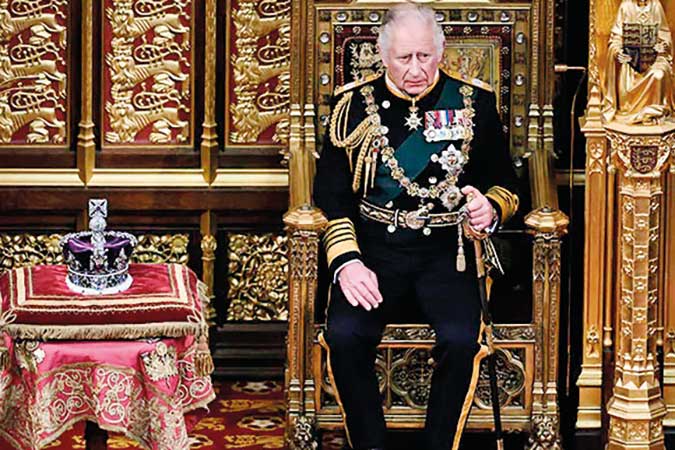
As a Sunday Island reader in Colombo, you would be having the paper in hand on Saturday as London wakes up to the full panoply of the coronation of King Charles the Third. The processions and the ceremonies will be watched by millions in the united Kingdom, across the Commonwealth, and even throughout the world. This is London’s first coronation in 70 years. The last one was when Elizabeth the Second was crowned the Queen of England and the Empire, on June 2, 1953. The Queen was young at 25, and Charles, today’s King, was a four-year old attendee. Today, he is the oldest king to be crowned in the long line of British monarchs spanning a thousand years. The 1953 coronation was the first to be televised, as a way towards modernizing the monarchy, against the opposition of traditionalists including then Prime Minister Sir. Winston Churchill. Seventy years on, the world is a different place, the means of communication have exploded to new levels, and the monarchy is also in a different place.
Charles is a historically ominous name for an English King, and today’s King is poignantly aware of it. King Charles I was the cause of the 17th century Civil War, and he ended up making parliament supreme by relentlessly trying to subordinate it. He was sentenced to death by the Parliament’s own High Court of Justice, and was beheaded on November 18, 1648. The monarchy was abolished by a resolution of parliament that called it “unnecessary, burdensome, and dangerous to the liberty, safety, and public interest of the people of this nation.” But the new republic was short lived, for after 11 years a new Parliament voted to reinstate the monarchy and inducted the eldest son of Charles I as the new King Charles II.
There is an important constitutional principle in the abolition of the monarchy by one parliament and its restoration by a successor parliament. That is the principle that one parliament must not rigidly bind a future parliament. That was a core principle for Colvin R. de Silva, the Marxist. Think of the rigidly frozen current constitution of Sri Lanka. Think as well of the superiority of the deliberative decision making process of an elected parliament to the copout device of a popular referendum. One is deliberative democracy, the other is populist demagoguery. Not surprisingly, the British people today are still ruing the stilted result of the 2019 Brexit referendum. Every time a Bill is drafted in Sri Lanka, the Supreme Court is called upon to pronounce if the Bill needs a referendum or not for its passage. Be that as it may.
The restored monarchy in the 17th century was a highly restricted monarchy predicated on the principle that Kings and Queens come into being only by the consent of the people and are subordinate to the House of Commons elected by the people. The ensuing system has lived and worked ever since: enabling the British isle to become the crucible of a mighty industrial revolution, while avoiding a corresponding sociopolitical upheaval by extending parliamentary representation; and creating along the way a worldwide empire and managing to shed it even if not always involuntarily, but almost always in a very orderly and constitutional way.
For all that and more, Britain has remained a polity without a written constitution and has preserved the apparent anomaly of fusing parliamentary democracy with an unelected monarchy. And parliament itself has limitations on its power in spite of its supremacy. Limitations that are mostly self-imposed by adherence to healthy conventions, and where necessary administered by the rule of law and the oversight of the courts. The system is anomalous but there is a reservoir of nostalgia for keeping the monarchy. To paraphrase Jennings, the monarchy is there for the people to cheer whenever they are provoked to damn the government.
At the same time, there is a generational divide with mainly the older generations retaining nostalgia for the monarchy and the younger generations increasingly finding it irrelevant to their universe. It is also fair to say that if the monarchy were to wither away, it would be more on account of the excessive indulgences of the royal family than due to any resentment among or revolt of the British people. Queen Elizabeth managed the transition from tradition to modernity quite magnificently. The new King has a tough act to follow, but is showing not unremarkable adaptability in spite of his age and his stodgy reputation as the prince in waiting seemingly forever.
Post-imperial Britain
The coronation ceremonies are being choreographed to reflect the changing faces of post-imperial Britain. The processions preceding the arrival of the King will include non-Christian faith leaders and representatives, as well as representatives from Commonwealth countries carrying the flags of their country and accompanied by their governors general and prime ministers. For the first time, the public will be given an active role in the ceremony, and the “homage of the people” will replace the traditional “homage of peers,” with the people and not the traditional squires called upon to swear in chorus their allegiance to the new King. Critics have called the people’s swearing of allegiance “complete nonsense,” but the idea seems to have originated not at the Buckingham Palace but at the Archbishop’s House. There is also criticism about the drastically reduced number of parliamentarians invited for coronation ceremonies in comparison to the number of MPs invited in 1953.
However, Rishi Sunak, a practising Hindu and Britain’s first Prime Minister of Indian heritage, will continue the tradition of British prime ministers participating in coronation ceremonies and other state functions. In a bow to the ecumenical tone of the coronation service, Mr. Sunak, will read the Epistle, a passage from what Paul wrote to the Colossians. The passage has been selected for the occasion by the Archbishop of Canterbury, Right Reverend Justin Welby, the chief celebrant of the Liturgy.
Leading Scotland’s political representation at the ceremony will be another Britisher of South Asian origin, Humza Haroon Yousaf, son of Pakistani immigrants in Glasgow, who recently succeeded Nicola Sturgeon as the leader of the Scottish Nationalist Party and Scotland’s First Minister. As I have commented before, the emergence of Sunak, Yousaf and others, men as well as women, to positions of political and institutional leadership in Britain is emblematic of the evolution of British society to the point of accepting women and men of colour regardless of their race, colour or creed.
Britain’s former colonies, on the other hand, especially countries in South Asia, have slid back from the early promises of secularism and inclusiveness to bigotry and exclusion. In Modi’s India, Muslims and other religious minorities are actively excluded and more than occasionally harassed. Sri Lanka’s record of exclusion targeting non-Sinhala Buddhists is even more longstanding. There are similar instances in other ex-colonies in the Commonwealth.
The United Kingdom might be coming of age in celebrating its diversity, but on the economic front it is in dire trouble, and it is the Tory government, and not the monarchy, which is being held accountable and will have to pay the price in the polls. The coronation week began with a massive a day long strike on Monday, May Day, by Nurses in England; and on Thursday, May 4, English and Welsh voters went to the polls for the Local Government elections in 230 of 317 local councils, practically everywhere except London and the other English major cities. As expected, early results are showing a “terrible night” for the Tories. On the eve of the coronation of King Charles III, the prospects for the Tories in the next national election that is due before 28 January 2025 have gotten locally gloomier, so to speak.
Postcolonial Commonwealth
The point here is that strikes and elections are not tampered with in monarchical Britain, but it is a different story in many of Britain’s former colonies. Sri Lankans are intimately familiar with the machinations of their governments past and present when it comes to sabotaging strikes and cancelling elections. It is the same story now in Pakistan. Even though elections are remarkably independent of governments in India, there are plenty of democratic deficits in Modi’s India. It is remarkable that governments both in India and Pakistan should be striving to keep their main political opponents – Rahul Gandhi in India and Imran Khan in Pakistan – out of contention by every foul means possible.
It is not only political opponents who are under threat in Modi’s India, but also intellectuals and academics. Even the aging, emeritus ones are not spared. Some years ago, Modi busybodies at the Jawaharlal Nehru University in Delhi wanted Romila Thapar, India’s foremost historian, to submit an updated curriculum vitae to maintain her emeritus status. Now, a similar kind of busybodies are trying to oust Nobel Laureate Amartya Sen from his ancestral house in Santiniketan, Kolkata. Rabindranath Tagore founded Santiniketan in 1921. It is now the Visva-Bharati university in Kolkota, the only central government university in West Bengal. Its Chancellor is the Prime Minister of India.
Visva-Bharati has sent an eviction notice to 89 year old Amartya Sen, who does not live in India, unless he vacates 0.13 acres of the 1.38 acre property owned by the Sen family, because the university claims ownership of 0.13 acres of the land. The real reason is that Dr. Sen has been critical of the Modi government. In a tit for tat response, West Bengal Chief Minister Mamata Banerjee has asked her State Ministers to conduct a sit-in at Dr. Sen’s residence to protest against the university’s eviction threat.
It is a quite a digression from King Charles’s coronation to Modi’s machinations. But there is a connection. India has been a special place both in the British Empire and in post-imperial Commonwealth. The unruptured continuity of Indo-British relations from the colonial era to post independence, has been the work of the genius of Jawaharlal Nehru, India’s first and longest serving Prime Minister. A central piece in the Modi agenda for India is the dismantling of every aspect of the Nehru legacy, and India’s relationship with Britain is part of it. The recent BBC documentary, India: the Modi Question, revisiting the 2002 anti-Muslim riots in Gujarat, when Modi was Chief Minister, has not diluted the bad blood between the Modi Government and its critics in India and elsewhere.
It may not be accidental that Prime Minister Modi is not attending the coronation of King Charles III, even though Britain now has a Prime Minister who is not only a Hindu of Indian origin, but is also of the same ideological bent. It was a different story in 1953. Then Prime Minister Nehru attended the coronation of Queen Elizabeth. He would not have missed it, even though ideologically he would have been poles apart from the British government. The Prime Ministers of Pakistan and Bangladesh, as well President Wickremesinghe are all in attendance today.
India is being represented by Vice President Jagdeep Dhankhar. And so is China, with Vice President Han Zheng and Foreign Minister Wang Yi both attending the new King’s coronation. In what is being called a “diplomatic choreography,” the Chinese Vice President is expected to extend an invitation to the British Foreign Minister, James Cleverly, to visit China. Mr. Cleverly is equally expected to accept the invitation. The China hawks in the British Conservative Party are not at all pleased, to put it mildly. The internal reaction in Delhi will also be anything but mild. But all of that is for another day. For today, sit back and enjoy the tradition and ceremonies on television with the Sunday Island in hand.







Features
Combining local resources,traditional knowledge and science to build a food-secure Sri Lanka

World Food Day 2026: Innovating today for a better food future
by Dr. Kaushalya Wijayasekara
What will be on the Sri Lankan dinner table ten years from now? Will our children be able to get nutritious food at a price their families can afford? Will farmers be able to grow enough despite changing weather and rising costs? And how much of the food we produce will actually reach the consumer, instead of being lost or wasted along the way?
These questions can’t wait. A farmer faces unpredictable weather. A family faces rising food costs. Fruit goes unsold after a good harvest. Some children do not get enough nutrition. The future of food is tied to the future of Sri Lanka itself.
World Food Day 2026 is a chance to look beyond the immediate problems and ask whether we can build a food system that feeds our people well, gives farmers better opportunities, protects the environment and makes better use of what we already have. The answer can be yes, but we will have to think differently.
We are not starting from zero. Sri Lanka has diverse crops, fisheries, traditional food knowledge, indigenous varieties, research institutions, universities and a young generation able to create new solutions. What we need is to bring these together and act. Producing more will not secure our food future on its own. It will depend on how intelligently we produce, process, preserve, distribute and consume food.
Making more of what we already have
Innovation does not always mean inventing something new. Often it means finding better uses for the resources we have.
Sri Lanka grows traditional rice varieties, kurakkan, green gram, cowpea, jackfruit, breadfruit, cassava, sweet potato, coconut and palmyrah. All of them have great potential for modern, nutritious, value-added foods. Jackfruit and breadfruit can be made into flour and other convenient products. Traditional rice varieties can go into new foods that suit changing consumer needs. Palmyrah, with its strong cultural heritage, can create new income through better processing, packaging, quality assurance and market development.
The aim is to connect our traditional food knowledge with modern consumer needs and technology, while keeping our food heritage.
Stop wasting the food we produce
Reducing food loss and waste should be a major priority. Seasonal fruits such as mango, banana, papaya and pineapple can be lost in large quantities when production exceeds demand or when storage, transport and processing facilities are inadequate. With suitable technology, these fruits can become dried products, pulps, powders, beverages and other shelf-stable foods.
Agricultural and fisheries by-products are resources too. They could be turned into food ingredients, animal feed, bio-based products and other useful materials, which would move us toward a more circular food economy.
Technology alone is not enough. We need stronger local processing facilities, cold storage, efficient transport, collection centres and market information systems, especially close to where food is produced. Cutting food loss raises the value of what our farmers and fishers already produce.
Nutrition and food safety come first
Food security means more than having enough food. People also need food that is safe and nutritious.
Sri Lanka can develop affordable, nutritious foods from local pulses, grains, vegetables, fruits and fish. Children and other vulnerable groups should get particular attention. Schoolchildren in particular deserve a focus: safe, nutritious, locally sourced products for school feeding programs would support child nutrition, local farmers and domestic food industries at the same time.
Food safety must stay at the centre of food innovation. Good hygiene, quality control, laboratory testing, traceability and appropriate food safety systems are what make new products safe as well as attractive and nutritious.
A food system that can cope with climate change
Climate change is already affecting agricultural production, water availability, crop yields and food prices. We need food systems that can handle changing conditions. That means climate-resilient crops, efficient water use, soil and water conservation, better storage and resource-efficient food processing.
Traditional knowledge matters here. Generations of Sri Lankan farmers have developed practices suited to local climates and ecosystems. Combining that experience with modern science can give us solutions that fit local conditions and are sustainable. Technology alone will not build the future of food. Science, experience and local knowledge together can.
Give young people a bigger role
Sri Lanka’s universities have an important part to play in shaping our food future. Young people should be encouraged to identify real problems in the food system and work on practical solutions in areas such as food waste, sustainable packaging, nutrition, food safety, modernising traditional foods and digital technologies.
A good research project should not always end as a research paper. Where appropriate, research should be supported to move on to products, technologies, enterprises and community solutions. That needs stronger partnerships between universities and industry, along with mentoring, research funding, business support and market connections. If young researchers and entrepreneurs can turn their ideas into viable food innovations, both consumers and producers will benefit.
A pathway designed for Sri Lanka
We do not need to copy food-system models from other countries. We can build a pathway that suits our own resources, culture and needs. It would bring together local resources, traditional knowledge, scientific research, appropriate technology and entrepreneurship, with farmers, fishers, universities, research institutions, food industries, entrepreneurs and policymakers working side by side.
The goal goes beyond selling raw materials. We need to create more value, reduce waste, improve nutrition, generate jobs and strengthen rural livelihoods. This matters especially for small and medium-scale food enterprises, which can drive local economic development when they get the right technical, financial and market support.
The choices we make today
The food future will not create itself. It will be shaped by what we grow, what we research, what we process, what we consume and what we choose not to waste.
So, the question for World Food Day 2026 is this: what can we do today so that every Sri Lankan has safe, nutritious, affordable and sustainable food tomorrow?
The answers are already around us, in our farms, fisheries, food businesses, universities, laboratories and communities. We have the resources, the traditional knowledge, the scientific expertise and talented young people. What we need now is to connect them and act.
A better food future begins with the choices we make today.
Dr. Kaushalya Wijayasekara
Senior Lecturer, Department of Biosystems Technology, Faculty of Technology, University of Ruhuna

By Admiral Ravindra C Wijegunaratne
WV, RWP and Bar, RSP, VSV, USP, NI (M) (Pakistan), ndc, psn, Bsc
(Hons) (War Studies) (Karachi) MPhil (Madras)
Former Navy Commander and Former Chief of Defence Staff
Former Chairman, Trincomalee Petroleum Terminals Ltd
Former Managing Director Ceylon Petroleum Corporation
Former High Commissioner to Pakistan
The Digampathana suicide truck attack on 16th October 2006 remains the deadliest single strike in Sri Lanka Navy history, leaving scars that time cannot erase.
It was a seemingly ordinary Monday morning on 16 October 2006, but the calm of that day would soon be shattered in a way none of us could have imagined. As the Commandant of the Naval and Maritime Academy and Flag Officer Commanding Naval Fleet at Trincomalee, I was aware that a number of my cadets were travelling that morning, part of a convoy of fifteen buses carrying naval personnel from Trincomalee, Colombo, and other bases, heading toward Dambulla to rendezvous with another group. The convoy also included trucks and escort vehicles, a routine movement planned and coordinated with the army to ensure the roads were clear. The morning started quietly. Some personnel greeted friends, handed over their weapons, or strolled to a nearby tea shop. It all seemed so ordinary—too ordinary for what would come next.

Sri Lanka Navy sunk LTTE Ships carrying arms, ammunition and warlike materials thousand miles away from Sri Lanka in Indian Ocean in September and October 2007.
By late morning, both convoys had reached the small ground at Digampathana, near the Sigiriya junction, and personnel mingled briefly, unaware that a carefully orchestrated act of terror was waiting. Then, suddenly, an empty half-truck veered directly into the convoy. It exploded with a ferocity I can still recall as if it were yesterday. Nuts, bolts, and high explosives tore through the air. Pandemonium erupted instantly. I later learned that 107 of our naval personnel were killed on the spot and another 153 critically injured. The scene was indescribable—bodies scattered, vehicles mangled, personal effects strewn across the ground. I remember later hearing that the head of the suicide bomber was recovered more than 100 meters away from the blast, a grim testament to the sheer force of the explosion.
I was in my office at the Naval and Maritime Academy when my mobile phone rang. A young midshipman from the 21st intake called, his voice trembling: “Sir, there was a huge explosion at the convoy point! Many are dead … my batch mate Wijesundara is among them.” I immediately jumped into my jeep with my escort Chief Petty Officer and driver and rushed to Digampathana, relying on every ounce of my driving skill to reach the scene. The journey, which usually took little more than an hour, felt endless that day, each passing mile weighed down by dread.
When I arrived, I was confronted with a sight that no training can prepare you for. The injured were being rushed to Dambulla Hospital, where doctors and nurses worked tirelessly, improvising in ways that saved lives despite the overwhelming chaos. I went back to the site after visiting the hospital. The remains of our naval personnel were scattered across the ground, and someone had begun collecting weapons and protective gear. I immediately contacted Surgeon Rear Admiral Nico Jayasekara and received his instructions: collect all body parts in separate bags and transport them to the Trincomalee Naval Hospital mortuary. This gruesome work had to be done with care and dignity, and it filled the icebox in my vehicle. Through DNA testing initiated by Rear Admiral Nico, we were able to identify every naval personnel lost that day, bringing some closure to grieving families.
The Navy Commander at the time, Vice Admiral Wasantha Karannagoda, was devastated. I had worked closely with him and knew how deeply he cared for his men. He ensured that the fallen were honoured with full ceremonial naval funerals at Welisara Naval Base, attended by families and comrades. Sixty-seven funerals were conducted in a single day—a number that still haunts me.
The Digampathana attack remains the largest single loss of naval life in our history. It was a day of sorrow, but also a day that reinforced our resolve. The tragedy galvanized the Navy to target the LTTE Sea Tiger wing with renewed determination and reshaped our maritime operations forever. Every time I think of that day, I remember not just the lives lost, but the courage, professionalism, and dedication of those who survived, those who treated the injured, and those who ensured the fallen were honored properly. May the souls of our naval hero’s rest in peace, their sacrifice guiding us and inspiring generations of naval personnel to come.

Tales of Mystery and Suspense – 24
I was intrigued by the title of a book I found in a book drop at the condominium of a friend, Murder at Whitby Abbey, and I brought it home with me though I will not be able to return it in the near future. It was described on the cover page as ‘a standout in the crowded medieval mystery field’, though I fear I do not know of other books in this field, apart from the Cadfael series, which I have dealt with earlier.
The book, by Cassandra Clark, is set during the reign of Richard II and has as a backdrop his precarious position, which led to his being replaced, and murdered, by his cousin Henry, who reigned as Henry IV. It is a gloomy book, the action taking place in the twelve days of Christmas leading up to the Epiphany. And the gloom is pervasive, even though this is supposed to be a time of festivity, with mummers performing, and many of those in the guest house where the heroine stays going to town to enjoy themselves, with much drinking and much music, which also fills the guesthouse.
The heroine Hildegarde is a nun, sent to try to acquire a relic being sold by Whitby Abbey, though this was also a penance set by the Abbot of the monastery that governed her abbess because she had had sex with a man. Soon after she and her companions reach the Abbey set high on a cliff, she finds that there are other bidders, and soon suspects that the hierarchy, not perhaps the Abbot who seems a weakling, but his rapacious bursar, is determined to make money, and not above creating false relics to sell to several aspirants.
After Hildegarde and her Cistercian companions – Whitby is a Benedictine Foundation – two monks, Gregory and Egbert, and a young priest Mark, reach the abbey, they find that Aelwyn, a monk they had met on their way to the guesthouse had died. This was in the apple store, and they realize, when they find the surplices of novices stuffed into the air vents, that he had been left to suffocate in the overwhelming scent of apples.

Clark
The Cistercians are asked to look into the death, perhaps because they are likely to get no cooperation from the Abbey folk, but perhaps because those in charge are keen to know what happened. And the infirmarer, an old monk, suggests Hildegarde talk to a man called Edred who worked for the bursar, and had been a friend of Aelwyn’s. But Edred too is killed, before he can keep an appointment he had made with Hildegarde, drowned in a pool near the farmhouse of the Abbey.
Meanwhile tensions arise between the fisherfolk and the abbey for the bursar wants to charge them for using the beach that technically belongs to the abbey to dry their fish and their nets. This leads to physical battles, when the guards used by the abbey, under the command it seems of the bursar whose determination to make money is not resisted by the abbot and the prior, try to storm the area where the fishermen live.
Hildegard finds out more about what had happened through two youngsters, one of whom Torold is the son of Aelwyn by a woman who worked as a prostitute for a cartel, and with whom Mark fell in love. The other works on the farm and had seen Edred meet someone near the pool, after which that someone left the place by himself. And the boy had also found in the pool a sort of dagger with the seal of the abbey.
He and his dog, and Torold who follows her, rescue Hildegarde from a man at arms who has waylaid her and tries to rape her earlier. Escaping into the abbey she was nearly been raped then by the bursar, but she managed to escape, in the process setting fire to him and the muniments room, which led, when he was rescued, to the discovery of a box with the money he said had been stolen, blame being cast on both Aelwyn and Edred.
Matters come to a head when the fisherfolk try to storm the abbey, being resisted by the men at arms stationed on the towers. But then Hildegarde realizes that behind the murders was the bursar’s clerk, whom she pursued to the cathedral. There is great drama then as she escapes from him when he tries to kill her, and then from the man at arms who had tried to both rape and kill her, but they both fall from the scaffolding she had climbed, the latter coming from a tower where he had been stationed.
Both of them think they run the rapacity of the abbey, the latter claiming to work for the nobles opposed to Richard, who is presented throughout the book as devoted to his subjects, not to power or money. But though the villains die, the bursar continues, having got over the hysteria the fire had caused and his acknowledgment then of guilt – and though the abbot and the prior seem less vicious, whether they will be able to assert themselves is questionable.
Before the climax, when the others in the guesthouse were leaving, Hildegarde found that two of them were in possession of the relic, for which they seem to have paid well. Hildegarde herself had made a derisory offer, but before she leaves the abbot gives her the relic, perhaps in gratitude for what she and her fellow Cistercians had discovered, the abbey having made as much money as it needed and more from the gullible other buyers.
Mark’s inamorata is saved from the stews because she moves in with Edred’s widow whom the bursar had thrown out of the rooms he occupied when her husband was found dead. Hildegarde had paid for lodgings, in a house run by the man who ran the brothels, but he had a kindly side and was going to finance them to make nets for the fishermen.
So, the Cistercians set off for their home as swiftly as they can to get there on the day of the Epiphany, having stopped en route to pray for King Richard whose birthday it was.

Namal, Janaki further remanded

Achintha smashes 1,500 metres record at All Island Schools Games

Rare pink diamond goes on display in France 100 years after amateur heist

Nursery owner in China jailed for life after hundreds of children poisoned

Pakistan, Sri Lanka look to find the right mix as World Cup countdown begins

Mumbai Indians and head coach Mahela Jayawardene part ways

‘Dates have the highest sugar content to fight Coronavirus’

Sunday Island 27 December – Headlines

#SundayIsland 17th December – Headlines

Sunday Island – 28th March

Sunday Island Headlines – 21 March

Sunday Island – 21st February – Headlines
-

 News7 days ago
Sri Lanka escalates anti-graft drive with Shiranthi’s jailing
-
 News7 days ago
Iranian ships stranded, Lanka fears US sanctions
-

 Latest News6 days ago
Farhan and Sadaqat help Pakistan seal series in style
-

 Latest News5 days ago
Nissanka’s return headlines Sri Lanka’s Test squad against Pakistan
-
 Features6 days ago
Intake 16: 45 years of duty and honour
-
 News6 days ago
Malwathu Chapter issues statement on talks with President over Gnanasara Thera’s robes
-
 News7 days ago
Navi Pillay’s Lankan affairs in focus as she wins 2026 Nobel Peace Prize
-
 News6 days ago
CP alleges NPP has taken the blame for illegal US sanctions on Iranian vessels