
Features
A Cabinet Secretary Remembers

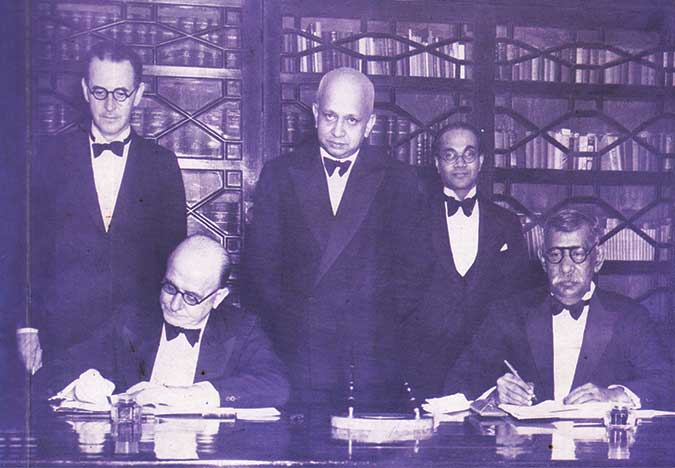
Extracted from Memoirs of BP Peiris
My father, family and early days at Panadura
According to my birth certificate, I, the eldest son of my parents, was born on March 29, 1908, at our ancestral home “Gorakapola Walauwa”, Panadura.My father was Edmund Peiris, then a clerk in the Colombo Kachcheri on the princely salary of Rs. 60 a month. He used to travel from Panadura to Colombo by train, and from his home to the railway station on a push bicycle. He very early caught the eye of the Government Agent, Mr J. G. Frazer (later Sir John) who noted him for promotion on the ground of ability. My mother was Somie, the eldest daughter of C. F. S. Jayawickrama, Mudaliyar of the District Court of Kegalle.
I have no recollection at all of my paternal grandfather, Mudaliyar Romanis Peiris, Customs Mudaliyar, who died while I was quite young, nor of my paternal grandmother. A drinking fountain gifted by my grandfather to the state still stands in the premises of the Colombo Port Commission.In commemoration of the Diamond Jubilee of Her Majesty Queen Victoria, he built a school which he called the Queen Victoria Diamond Jubilee Buddhist School, which served the needs of many of the surrounding villages. My father was manager for many years and later gifted the land and the buildings to the state.
Of my maternal grandparents I have vivid memories. My grandfather Jayawickrama, whose picture used to hang in my father’s house, was a man of honesty, integrity and strength of character. His face in the picture at home showed determination, independence and a strong will. He was not a man to bend his knee to any person, however high he might be. He had, I believe, 16 children, to all of whom he gave an excellent education.
His eldest son was Sylvester, Advocate, a very respected member of the Matara Bar, who died in 1940 at the age of 54 at a time when he was District Judge of that town. On the day of his funeral all the shops in the town were closed as a mark of respect. The second child was my mother. Another of his daughters came first in French in the Cambridge Senior in the whole of the British Empire and, after her marriage taught her brother (later Jayawickrama Q. C.) French to enable him to pass the London Inter-Arts Examination. Another son was “Sargo” of cricketing fame.
My grandfather Jayawickrama dressed, as all Mudaliyars did in those days, in trousers, cloth and coat, with a sort of a Dutch helmet on his head, used to visit periodically his married son and his daughters all the way from Panadura to Matara and Tangalle. He was a keen chess player and always carried a traveling board with him, the board having suitable holes and the pieces were pegs to fit them. The pieces were of ivory and ebony.
He was a man who worked to time; he would start a game with my mother at 7.00 p.m. and play till 8.00 p.m., having a chew of betel and a cigar during the game. At 8.00 he would close the board to dine, and continue the same game from day to day till its end. I have in vain attempted to trace that chess set. My brother and I used to watch him play with my mother and we soon, at the age of about seven, picked up the game.
On one of our return trips by train from Diyatalawa to Colombo, the old gentleman was kind enough to come to Polgahawela to meet his daughter (my mother) and his grandchildren. The next day he was dead of a heart attack. His body was brought from Kegalle to my father’s house and the cremation took place at Panadura.
He was the Jayawickrama referred to in the leading Privy Council case of Jayawickrama vs Amarasuriya (1918), which he won. He had lost the case in the District Court and the Supreme Court but had faith in justice. Before appealing to the Privy Council, he had told his children to be prepared to step on to the street and beg if he lost the final appeal.
The case was instituted by my grandmother against her brother who had benefited largely by his father’s death. There was no doubt, on the evidence, that it was his father’s wish that he should provide for his sister and her large family. The sister had threatened to institute an action against him for the assignment to her of an undivided half-share of the inheritance and he had promised to pay her Rs150,000 if she refrained from instituting the contemplated action.
The decisions of the Ceylon courts were based on the concept of “Consideration” in English law. The Privy Council applied the Roman-Dutch law concept of justa causa which was wider. They held that the brother’s promise was binding and enforceable as it was made deliberately after much negotiation, in discharge of the moral obligation found to rest upon the brother to do an act of generosity and benevolence to his sister, namely, to make provision for her and her children. The Privy Council allowed the appeal with costs in all courts.
I remember my grandmother as a most simple and kindly woman, dressed not in saree, but in skirt and jacket. She also used to visit her children regularly, and once, when I was about seven years old, my mother sent me with her by train and bus to Kegalle where my grandparents were then living. From the Polgahawela railway station, the journey was completed by bus.
For my parents I have nothing but praise for the education they gave us, which has enabled my brothers and sisters and me to hold responsible positions in life. My father was a Royalist, that is to say, an old boy of the Royal College, then situated at San Sebastian. His contemporaries were B. F. de Silva, O. L. De Kretser, T. F. Garvin, V. M. Fernando, R. L. Pereira, F. H. B. Koch, all of whom rose to the Bench.
My father, later when he was Mudaliyar of the Panadura and Kalutara Totamunes, used to tell us that he rarely used the school library while the others did, and he encouraged us and insisted that we use the library as much as possible, advice by which all his sons have profited.
He was at school in the days of Hayward and Hartley and was one who received the well-known caning for taking as their right a holiday on the Royal-Thomian match day. I remember an incident years later, after he had married and had five children and the family was having a holiday at Diyatalawa, when we crossed Hartley during our morning walk. My father raised his hat and said “Good morning, Sir”. Hartley returned the greeting and said, “Let me see -Royal? Yes, I remember. Left from the Remove.” It was a marvelous memory.
Even as a student father appeared to have been very methodical. He was a boarder at the house of (later Sir) James Pieris’ mother and kept a small notebook of his daily expenditure. I remember seeing this notebook, one item in which was “tiffin 11 cents”. He was as methodical up to the day of his death when we found a document telling us exactly what we should do – where his last will was, how he should be dressed, who his pallbearers should be, a list of his assets, a valuation of his property etc., with the result that I, as his executor, had no difficulty in answering any query from the Estate Duty Department.
The printed invitation cards sent by my mother’s parents on the occasion of her wedding, a copy of which is in my possession, show that the wedding took place at 11 a.m. on Thursday, June 28, 1906, at Amaragiri Walauwa, Unawatuna, Galle, the residence of Mr Thomas Amarasuriya. The wedding photograph shows the groom and his best man, Advocate B. F. de Silva, in morning suits. A newspaper account of the wedding states that “instead of the usual cake and wine the whole assembly sat down to a sumptuous lunch when the health of the newly wedded couple was pledged.”
In 1908 my father was appointed Muhandiram of the Colombo Kachcheri. In 1913 the post of Mudaliyar of the Panadura and Kalutara Totamunes having fallen vacant, he applied for the post. In the final selection, he told us that three applicants Mr A, Mr B and he were summoned for an interview. The interview was by the Colonial Secretary. Each candidate was asked what he thought of the other two.
Mr A and Mr B had apparently nothing very pleasant or creditable to say about the others. My father, when asked the same question, had said that he had nothing to say against the other candidates but had come to speak about himself. The Colonial Secretary’s concise minute to the Governor was, I learned, something on the following lines:
Your Excellency,
I have interviewed the three candidates. Mr A is an extremely able man, painfully conscious of his ability. Mr B is another clever man almost bordering on insanity. I recommend Mr Peiris.His Excellency minuted “Approved” and my father was appointed – the youngest man to be appointed Mudaliyar of the second most important revenue district of the island, second only to Colombo.
Congratulatory meetings on his appointment were held in different parts of the District sponsored by such gentlemen of quality as Gate Mudaliyar J. E. de Silva Suriyabandara (Magistrate of Kalutara), O. G. de Alwis, Clement Wijeratne, M. H. Jayatillake, H. Meritimus Fonseka, C. P. Samarasekera and M. E. Fonseka.
He held the office for over 25 years and was honoured with the titular rank of Mudaliyar and later of Mudaliyar of The Governor’s Gate. His district extended from the Moratuwa bridge in the north to the Bentota bridge in the south. He got to know the district and people so thoroughly that in his later years he was able to write a report from his office without inspecting the scene as he appeared to know every tree and culvert in the area.
His reports to the British Assistant Government Agent were always forwarded by them to the Government Agent with the endorsement “I forward herewith a report from the Mudaliyar, with which I agree.” Some Ceylonese Assistant Government Agents used to forward my father’s reports with his name deleted and the Assistant Government Agent’s name placed at the end in substitution.
Father had a rather peculiar habit of not getting permission to leave his station when he came from Panadura to Colombo. He always took leave when he had to go south beyond the Bentota Bridge. One day, a most amusing incident took place on the Galle Road at Ratmalana. Father had come to Colombo without leave and was returning home when he found the Assistant Government Agent’s car broken down on the way. He stopped his car and the two drivers between them got the car in order again.
The Assistant Government Agent thanked the driver and then asked my father, “Mudaliyar, aren’t you out of your station without leave?” Let me say here, in an age when the foreign British civil servant is being constantly vilified, that the officer concerned in this particular case was a Ceylonese. Father replied that in 20 odd years he had never asked for leave to come from Panadura to Colombo. His superior told him that in future he had better take leave before leaving his district in either direction, and father took that as an order.
Soon after that some affray had taken place within his district in the vicinity of the Moratuwa bridge and father was asked by the Assistant Government Agent to go personally to the spot, inquire and report. He went and held the inquiry but found that to complete proceedings he had to cross the bridge and, under the previous order, had no authority to do so without prior permission. He wired accordingly, and the order regarding prior permission to leave station was promptly withdrawn.
Father was a good host: he believed in entertaining well or not at all. Although a moderate drinker himself, he had ample liquor for his guests and a good table. If you invite people, he used to say, treat them well. If you cannot afford to treat them well, don’t invite them. He used to tell us that when we grew up, we should never get into debt and put ourselves in a position to allow the tailor to say “There goes my suit”.
He regularly took leave for the whole of April each year and took the entire family up-country. As we could not afford to rent a bungalow, he arranged through a friend of his in the railway that we occupy the bungalow of a bachelor station master who would be father’s guest during our stay. The arrangement worked extremely well. And so it was that we spent delightful holidays at Ohiya, Pattipola, Haputale, Diyatalawa and other upcountry stations.
Some of these stations were, at that time, also sub-post offices and it was, in one of these stations that, as a schoolboy, I picked up the Morse Code. I am still able to send a message in Morse but, unfortunately, I never was able to get my ear attuned to receiving one. For a holiday at Diyatalawa, the Brigadier placed a military hut at our disposal and we had a grand time with the soldiers, whom father entertained.
They were nervous about eating tomato sandwiches thinking it was red pepper.At home, Father was a strict disciplinarian. Dinner was a simple meal, within his means. It was punctually at 8 p.m. At 7. 30 p.m., whether there were visitors or not, he had his first drink. At 7. 45 p.m. his second, and then dinner. Should one of us brats come to table with hands unwashed or hair uncombed, he would be driven away from the table and not taken back until he had put himself in good condition.
At that time, a Chief Headman wielded great authority in his district, and I distinctly remember that every funeral procession and perahera stopped beating the drums whilst passing the Walauwa. I feel quite sure that the Headmen’s system was abolished by the State Council because the Councillors were jealous of the power and authority exercised by the Headmen in their districts. Today, this is replaced by a transferable Divisional Revenue Officers’ Service – able men no doubt, but men without any local prestige who do not know the district in the way my father knew his.
My father retired on the first of April 1940, after having served the Government for over 40 years. He had held the office of Mudaliyar of the Panadura and Kalutara Totamunes for 27 years and filled a large place in the official and social life of the district. On his retirement, the public accorded him a farewell dinner at the Panadura Town Hall, the largest gathering ever seen at a public dinner in the town.
Tributes to him as a man and as a public servant were paid by the speakers, and covers were laid for 183. Mr (later Sir) Susantha de Fonseka presided. Among the diners were Mr and Mrs D. S. Senanayake, Mr W. O. Stevens, Government Agent of the Western Province, and Mr P. J. Hudson, Assistant Government Agent. The Urban Council moved a vote of appreciation. His portrait in oils was unveiled at the Kalutara Kachcheri.
My father died, after a very short illness, on the first of February 1961, at the age of 81. His Excellency the Governor-General, Sir Oliver Goonetileke called at the house to pay his last respects. The following appreciation appeared in the press:
“The death yesterday of Gate Mudaliyar Edmund Peiris, at the ripe age of 81, has removed a landmark from Panadura Town. Since his retirement after 42 years of active service ending up as Mudaliyar of the Panadura and Kalutara Totamunes, which post he held for 27 years, he was always at the service of his fellow citizens and participated in many public activities in the town where he resided.
“Whatever service he performed, whether it was for the town, home for the aged, or personally looking after the urgent needs of the poor who called on him for help, or mediation, he performed his part with a great deal of method, never haphazardly.
“Method in fact was the guiding principle of his life. Even at death it was a matter for wonder to those whom he left to read his detailed and precise instructions as to the manner in which his funeral was to be conducted. He had even got prepared his own tombstone inscription leaving blank only the date of death. Few think of death while they are alive. Mudaliyar Peiris was one of the few, and it may be that because he was conscious that death comes to every man sometime or other that he was always ready to forgive and forget. That also is one of the rich legacies which he has left behind not only to the large band of sons and daughters and grandchildren but to those who enjoyed and valued his friendship.
“Till his last illness struck him down, age did not mar his zest for living and many of his friends both admired and envied the short dapper Mudaliyar out on the road ‘doing his constitutional’.
Many civic activities of the town of Panadura will be the poorer by Mudaliyar Peiris’ death, but the organization which would suffer most would be the King George V Silver Jubilee Home for the Aged which he dearly loved and cared for during the last few years of his life.
“Another act of the Mudaliyar is worthy of record. He was the owner of a school built by his father, Mudaliyar Romanis Peiris, who had named it the Queen Victoria Diamond Jubilee Buddhist School. Some years ago, Mudaliyar Peiris handed over the land and the school buildings to the State, so doing what a subsequent Government of the country was to decide to do as a matter of Government policy. Not many are now spared to live to the age of 81.
“The Mudaliyar has made the most of these many years he lived not for self alone (though he must have been a happy man to see his sons in good positions and his daughters well-married) but for others as well.”


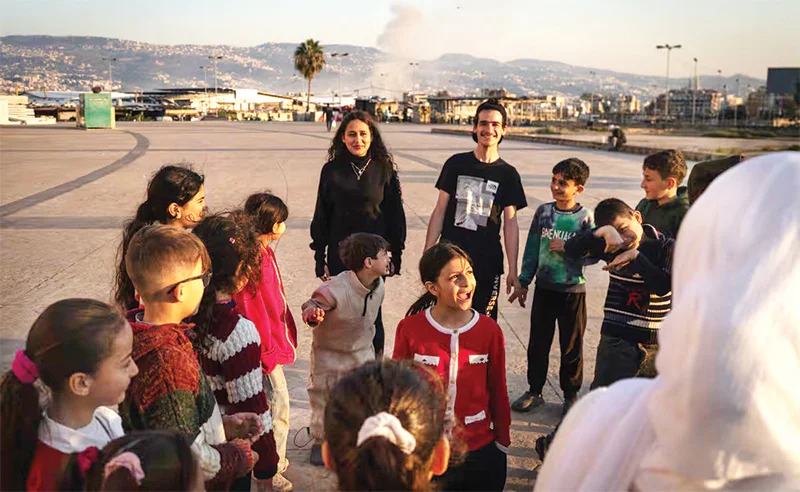
 It may be some time before the full impact of food inflation is felt in the West. Until such time the world would continue to keep itself in suspense over whether the Trump administration is in earnest when it seeks to convey the impression that it is backing a negotiated solution in West Asia.
As is usually the case, consumer stress would be one of the final determinants of political change. To the degree to which the average US consumer somehow ‘muddles through’ and puts the food on the table, to the same extent would the Republican sections of the US public in particular be tolerant of the Trump administration’s inconsistent handling of the West Asian war and the main issues stemming from it. That is, there would be no grave popular disaffection and a demand for political change in the short term.
However, the indications are that the Trump administration’s support base is suffering some erosion in the wake of the current economic crisis. While reports indicate that Democratic sections are firming-up their opposition to the political centre, Republican support for Trump is also showing signs of waning, we are given to understand.
The above developments are probably why Trump is on record as having given Israeli Prime Minister Benjamin Netanyahu a ‘dressing down’ recently on his seeming intransigence on the question of giving negotiations a chance in West Asia. The show of displeasure could be really aimed by Trump at containing the impatience of the American public.
However, the current ground situation in the Middle East, particularly the uncontained bloodshed, is likely to impress on the thinking sections of the world that more than temporary political change is needed in West Asia and the US.
A well thought out political solution that addresses all the contentious issues at the heart of the Middle East conflict is what enlightened opinion would demand, and very rightly. Right now, the ‘peace efforts’ initiated by the Trump administration give the impression of being piecemeal solutions at best.
There have been, of course, numerous initiatives in the past aimed at bringing permanent peace to the Middle East. These failed mainly because they did not address in full the root causes of the conflict.
At bottom the Middle East conflict is mainly about race and religious hate bred by socio-economic and material inequalities. For instance, if the Palestinian people were not displaced and deprived of land occupied by them at the time of the founding of the Israeli state, ethnic enmities would not have grown to the current unmanageable proportions.
When addressing the above questions, though, it must be remembered that the Israelis too were a displaced people who were entitled to land and a state of their own in the Middle East. Basically, out of these seemingly irreconcilable and conflicting demands have grown the Middle East imbroglio.
Middle East peace is considerably about reconciling these demands and arriving at a solution that would ensure the creation of two states that would opt for peaceful co-existence thereafter.
As long as the US does not see the need for a non-partisan solution that addresses the needs of both ethnicities and religions and goes all-out, as it were, to have it implemented, the Middle East would continue to bleed.
However, staunching the blood flow through the creation of two states would be only half the job done, though a very important part of it. More pernicious, pervasive and difficult to remedy are the inter-ethnic and inter-religious hatreds that have been unleashed over the decades.
However, if substantial, long-lasting peace is to be fostered in the region the latter ‘demons’ would need to be exorcised from the hearts and minds of the communities concerned. No doubt an uphill task but one that must be undertaken by those who wish the region well.
The UN would need to put its ‘best foot forward’ in such undertakings but it is time that it dawned on the international community and other caring quarters that Middle East peace, and all other such uphill challenges, require proactive peacemaking on the part of all civilized sections for their effective management. That is, public involvement in peacemaking too is a must.
Since hatreds are harboured in the human consciousness the enmities embedded in the latter need to be managed and defused judiciously alongside other undertakings in a peace process. In the case of West Asia, such enmities could be even spread globe-wide besides being multi-dimensional. For instance, it ought to be thought-provoking that Iran is insistent on a peace initiative that would also include Lebanon.
Besides security considerations it is also ethnic and religious affiliations that account for Iran making this demand. For instance, the Shias are a numerically important religious community in Lebanon and they provide a significant number of Hizbollah fighters, who are in a vital sense carrying out a ‘proxy war’ for Iran. It also needs to be factored in that Iran is a Shia-majority country.
Thus trans-border religious affiliations could add to the complexities and enormity of ethno-religious conflicts. However, the task of managing centuries-long enmities needs to be launched and prodded on with by peacemakers since a downing of arms alone would not guarantee substantive peace.
It is not realized sufficiently that the process of ending hatreds begins with mutual apologies by antagonists to a conflict for the harm inflicted on each other. This would be anathema in some ears but there is no getting away from the requirement. It is the vital first step to permanent peace anywhere.
In fact there could be no reconciliation worth speaking of without such mutual apologies. It is a point worth re-iterating in these times when even the government of Sri Lanka is voicing the need for national reconciliation. Well, without the words, ‘I am sorry’, there could be no permanent end to enmities – they would do well to remember.
The above requirements may not go down very well with governments, but they resonate in the hearts and minds of most people, since they are inheritors of religious traditions of some kind.
This is a principal reason why peacemaking works well when publics too are involved in them. The effectiveness of such campaigns increases several fold when they have a Mahatma Gandhi or a Jawaharlal Nehru at their helm. A strong proactive involvement by the public in peace could lead to the emergence of such leaders at some point in these campaigns.
Official Digital Partner of the 2026 ‘Dakshina Prabha’ National Vesak Zone
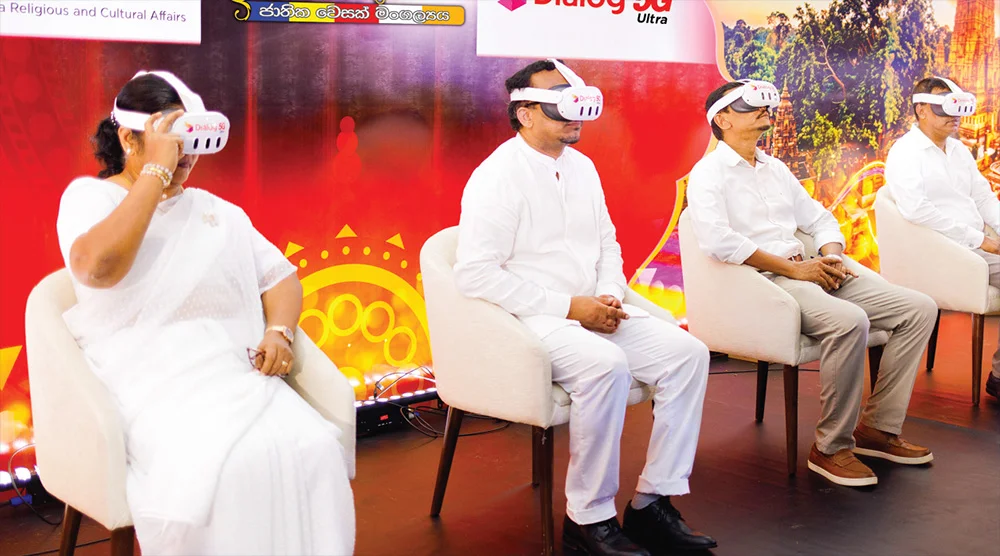
Dialog Axiata PLC, Sri Lanka’s #1 connectivity provider, collaborated with the Ministry of Buddha Sasana, Religious and Cultural Affairs to bring one of Sri Lanka’s largest and most technologically advanced Vesak experiences to the ‘Dakshina Prabha’ National Vesak Zone. The three-day celebration, in Matara attracted more than hundred thousand visitors, who engaged with a series of innovative digital activities powered by Dialog 5G Ultra, including Artificial Intelligence (AI) and Virtual Reality (VR) experiences, digital pandols and a Data Dansala. The opening ceremony was attended by Hon. Sunil Handunnetti, Minister of Industry and Entrepreneurship Development and Hon. Saroja Savithri Paulraj, Minister of Women and Child Affairs, along with distinguished guests and Dialog’s senior management.
One of the key attractions at the venue was the Dialog 5G Ultra-powered Virtual Reality (VR) experience, which attracted more than 35,000 participants. The activation enabled devotees to virtually visit and pay homage to sacred Buddhist sites, including the Jaya Sri Maha Bodhi in India and the Atamasthana in Anuradhapura, directly from the Vesak zone in Matara.

Visitors receive complimentary mobile data through Dialog’s QR-powered Data Dansala.
Dialog also conducted an AI Digital Vesak Greeting Card Competition from 21 May to 01 June 2026, attracting numerous entries from across the country. The shortlisted designs were showcased across 20 large LED screens throughout the venue and across Matara City, and were also made available for download via mobile devices. Further, through the use of AI, traditional Jathaka Katha were reimagined in a digital format, demonstrating how technology can be used to preserve and enhance cultural and religious heritage. Together, these initiatives blended traditional Vesak celebrations with emerging technologies, offering visitors a unique and immersive way to engage with Vesak traditions.
Extending the spirit of Vesak through connectivity, Dialog conducted a special Data Dansala powered by its QR Reload platform, enabling visitors to receive complimentary mobile data by scanning QR codes placed across the venue. In addition to the Matara National Vesak Zone, similar Data Dansala activations were also conducted at the Gangaramaya and Bauddhaloka Vesak zones in Colombo.Visitors also had the opportunity to create personalised Vesak-themed digital photos through an AI Photo Booth, generating AI-enhanced portraits using their own photographs and adding a contemporary digital element to the Vesak celebrations.
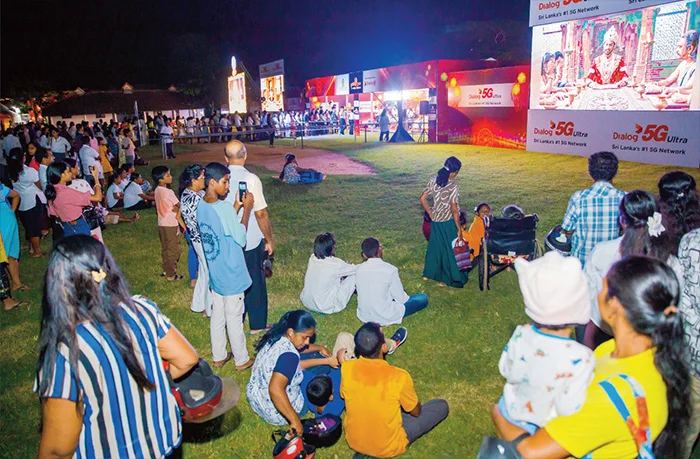
Visitors watch AI-generated Jathaka Katha
Commenting on the initiative, Hon. Sunil Handunnetti, Minister of Industry and Entrepreneurship Development, said, “The 2026 Dakshina Prabha Vesak Festival marked the first time AI-powered digital innovations were incorporated into a National Vesak Festival in Sri Lanka. Presenting Buddhist stories and teachings through technology created a new and engaging way for visitors to connect with these traditions. We thank Dialog for supporting this initiative and for working closely with us to bring our vision to life. Their contribution played an important role in making this first-of-its-kind event a reality.”
Lasantha Theverapperuma, Group Chief Marketing Officer of Dialog Axiata PLC said, “We thank the Government of Sri Lanka for the opportunity to support the 2026 Dakshina Prabha National Vesak Festival and for embracing technology as part of this year’s celebrations. As the Official Digital Partner, we were privileged to contribute through our Dialog 5G Ultra and AI capabilities, creating new ways for visitors to engage with Vesak traditions while preserving their cultural significance for future generations.”
Beyond supporting the National Vesak Zone in Matara, Dialog also enhanced the Gangaramaya and Bauddhaloka Vesak zones through a range of digital activations during the Vesak season. The company additionally continued its sustainability initiatives, including the Thirasara Aloka Poojawa, which illuminated rural places of worship through solar-powered lighting solutions.

Universal Woman is an international pageant focused on “beauty, elegance, and talent” for women, positioning itself as a platform to shape global ambassadors. The 2026 edition will be held in Cambodia, and Sri Lanka will be there, as well.
According to reports coming my way, contestants, at the international event, will work with industry trailblazers, under international standards.
Sri Lankan supermodel, runway and pageant trainer Chulpadmendra Kumarapathirana, is the National Director for Universal Woman Sri Lanka 2026.
With over two decades in the industry, Chula was crowned Miss Sri Lanka 2006, and has since shaped the next generation of titleholders through her Colombo-based Chulpadmendra Catwalk Studio, widely regarded as one of the country’s leading modelling academies.
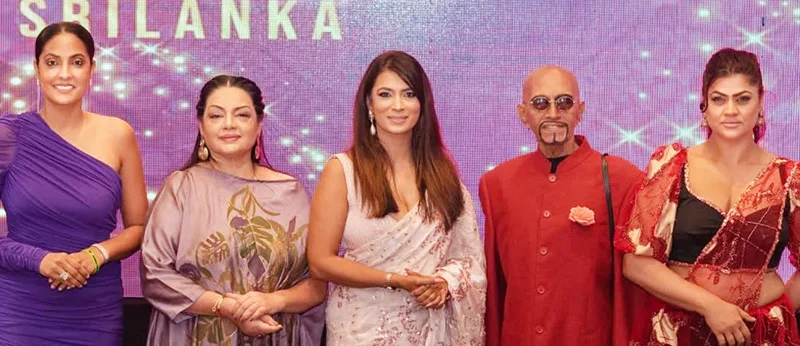
The team behind Universal Woman Sri Lanka 2026
A former host of Derana Miss Sri Lanka for Miss World 2008 and a judge for Miss Universe Sri Lanka 2025, Chula now serves as National Director for Universal Woman Sri Lanka 2026, leading the franchise’s search for Sri Lanka’s delegate to the international final in Cambodia.
Applications for Universal Woman Sri Lanka 2026 are being taken, via WhatsApp: 077 659 4994, says Chula.
The judging panel for Universal Woman Sri Lanka 2026 includes Senaka De Silva, Pageant Aesthetic Advisor & Chairperson of the Judging Panel, Angela Seneviratne, Caroline Jurie, Rozelle Plunkett, and Suraj Mapa.
Universal Woman Sri Lanka 2026 officially began its journey with a first round of auditions, held in Colombo, marking the start of an exciting new chapter in Sri Lanka’s pageant industry.
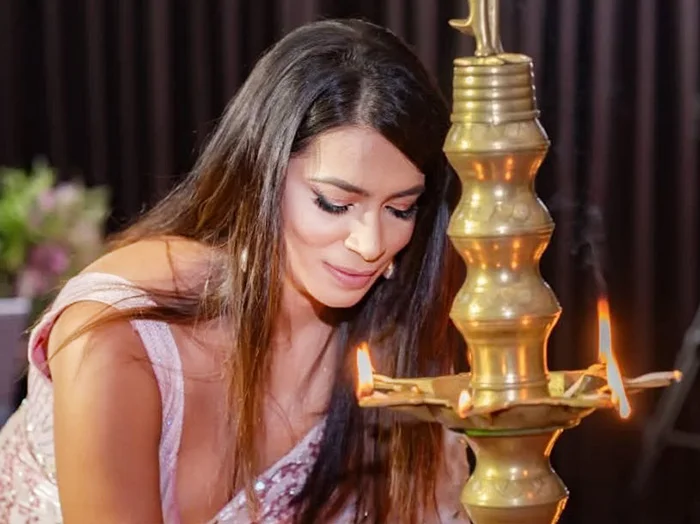
Launching the first round of auditions
The platform aims to empower women while selecting an intelligent, confident, and inspiring representative to compete at the Universal Woman International Pageant 2026 in Cambodia, this September.
Universal Woman Sri Lanka now moves forward with the vision of creating one of the country’s most prestigious and empowering pageants while preparing to crown a queen who will proudly represent Sri Lanka on the international stage.

INS Airavat makes port call in Colombo

Netanyahu downplays US-Israel rift after Trump confirms criticism

Sabalenka the latest French Open shock exit as Shnaider wins quarterfinal

Kusal Mendis, Pathum Nissanka, bowlers put Sri Lanka 1-0 up

Showers about 100 mm are likely at some places in the Western and Sabaragamuwa provinces and in Galle, Matara, Kandy and Nuwara-Eliya districts

BASL asks govt. to abandon plan to raise retirement ages of CA and SC judges

‘Dates have the highest sugar content to fight Coronavirus’

Sunday Island 27 December – Headlines

#SundayIsland 17th December – Headlines

Sunday Island – 28th March

Sunday Island Headlines – 21 March

Sunday Island – 21st February – Headlines
-
 News5 days ago
IMF urges Lanka not to meddle with exchange rate
-

 News2 days ago
Lankan duo emerge winners in Latin dance championship held in Blackpool, UK
-
 Business6 days ago
Sri Lanka’s construction industry losing ground while no one watches
-
 Business3 days ago
IMF’s unstated rate:Sri Lanka’s $695m loan costs about 5.33% per annum
-
 News5 days ago
State of emergency extended
-
 Features6 days ago
The Division Bell Mystery
-
 Features4 days ago
Are threats to Buddha Sasana external or from within?
-
 News3 days ago
UNP challenges NPP move to amend Vihara – Devalagam Act