
Opinion
Digital University~I


In view of the UGC Chairman’s latest announcement of a digital university to be set up in the coming academic session, it is time to mention that the spectre of Coronavirus haunted the policymakers of education.
By A K GHOSH |
In view of the UGC Chairman’s latest announcement of a digital university to be set up in the coming academic session, it is time to mention that the spectre of Coronavirus haunted the policy makers of education for more than two years and it is, undoubtedly, education technology that came to their rescue. Microsoft Teams, Zoom, Skype, Google Hangout and other apps helped all to communicate and exchange knowledge with each other.
The universities also embraced these solutions, but the time has come to ask if India can come up with the concept of a digital university, as visualised by the National Policy of Education (NEP 2000), thereby providing learners with a new experience of learning? It sounds exhilarating to think of attending a class whenever one wants to because of prerecorded sessions, asking the teacher questions and receiving answers instantly as the teacher is logged on at the same time. Also, it could be a moment of enjoying financial relief because one does not have to travel or stay at some hostel.
The plan to set up digital universities is premised on the National Education Policy’s objective of enhancing the gross enrolment rate in higher education in the country from the current 26 per cent to 50 per cent by 2035. However, on the basis of global experience, it is feared that the quality of education delivered by such universities may have to be compromised. The concept of digital universities has been developed for students to obtain almost immediate feedback from teachers through emails or online discussions. When the term came into existence it applied to things that were simulated by the computer, like virtual memory.
Now, this came to be applied to things that physically exist and are created by means of computers. In fact, the concept of digital universities first came with the idea of a wireless university at the BBC. In the tele-university concept, courses were taught on the radio and television in the name of “university on air” which came to take the shape of an open university. Online courses mean that students will learn in their own time by reading course materials, working on course activities, writing assignments, and interacting with teachers and other students through teleconferences.
Digital classroom environments will be accessible to any student provided he or she has access to a computer or internet connection. This may allow dynamic interaction with teachers and among the students themselves. The synergy that may exist in student-centred digital classes is one of the most vital traits of the digital learning format. Virtual Global University in Germany offers a graduate programme in information and management where students can have access to a wide network of people and interactions. They are able to work at their own pace. Hence, the importance of the development of such skills including creativity, communication, and knowledge application.
However, the fact remains that a digital university cannot provide face-to-face interactions. So, the students would be deprived of opportunities for better communication and deeper understanding. Their computer literacy may also deter them from adopting new technology which may lead to incomplete learning and low performance. The performance of many students at DeVry University in the US was examined some time ago. The university offers online and contacts versions of all its courses, using the same textbooks, assessments, assignments, and lecture materials for each format. Even though the courses are seemingly identical, the students who enrolled online performed worse.
As a result, online students would be more likely to drop out. The hardest hit would be the unwilling few and those who enter the virtual classes with low grades in their previous examinations. The weaker students would be the worst sufferers. An overwhelming advantage to student learning by thrusting information technology has not been perceived as yet when simple chalk and talk methods could have done equally well. We have not thought of an equally good alternative to the classroom lecture ~ the discussion method that has been at the heart of the teaching-learning experience.
No instructional technology has been developed to replace cooperative learning that takes place in group projects, field studies, recitals, and presentations. It is generally agreed that students do not learn merely from textbooks; if so, teachers would not be required. Only when textbooks and supplementary study materials are brought to bear upon a topic to be discussed in the classroom does the teaching-learning process become live. This is further accentuated through projects and assignments followed by term-end examinations.
Lack of access, whether it be for economic or logistic reasons, may exclude otherwise eligible students from the digital courses. This is an important issue in rural and lower socio-economic neighbourhoods. Internet access may pose a significant cost to the users in a digital university. Both students and facilitators must be able to use a variety of search engines and be comfortable navigating on the web, as well as be familiar with newsgroups, FTP procedures and e-mail. Even the most sophisticated technology is not hundred per cent reliable.
At the same time, to successfully participate in an online programme of a digital university, students must be well-organised, self-motivated and possess a high degree of time management skills. An online teacher must compensate for the lack of physical presence by creating a supportive environment in a digital classroom where all students feel comfortable participating. Computer-related frustration and the fear to face new things on the part of teachers may make them unacceptable to students.
A Digital class environment means the transfer of traditional pedagogy towards an electronic pedagogy in which the teacher becomes a facilitator of the learning process. This new pedagogy presupposes that the teacher should be qualified in new techniques. For many, it may be a threatening experience. It may be important to recognise that some subjects may not be taught online in a digital university because the electronic medium does not permit the best method of instruction.
Examples are hands-on subjects, such as public speaking, surgery, dental hygiene and sports where physical movements contribute to the achievement of the learning objectives. Hybrid courses may represent a solution, thus making that area of the course more accessible to a greater number of people who would otherwise have difficulty getting to the campus. An online curriculum should reflect the use of dialogue among students and group discussions. Quality education may be provided in a digital university only if the curriculum is developed or converted to meet the needs of the online medium.
The task of accessing both the curriculum products and curriculum experts is an important issue for the success of a digital university. As the students cannot have access to the entire curriculum products, it is likely that scientific visualisation is used as an educational tool. The curriculum may not be easily updated or very interactive. The use of email may be effective for the exchange of information. Video conferencing over the internet may not be a practical substitute. From the administrative point of view, the question of accreditation becomes pertinent. Where would the credits go? How can Intellectual Property Rights be maintained? How will the issue of faculty control over content and curriculum be preserved?
These questions must be addressed initially. The students may not be able to reach dramatic moments that occasionally result in witticism, humour and other such elements that help to enhance the joy of the teaching-learning process. If a colourful presentation using PowerPoint fails to lead to a lively classroom discussion, it will be of no use.
But the teacher on the dais in front of many students can do wonders. It is always challenging for the teacher in traditional mode to get his point across without facial gestures and vocal cues. He can create classroom animation ~ the thrill of being with the students ~ which is absent online. (The Statesman/ANN)


An archetypal journey of life towards self-discovery
By Dr Siri Galhenage,
Psychiatrist [Retd]
The Odyssey is a narrative poem by Homer, the revered Greek poet of antiquity. Along with its forerunner, The Iliad, it is regarded as one of the foundational works of Western Literature. Both epics were transmitted for generations through the oral tradition by travelling bards before being committed to writing several centuries later. In 2026, it has received a major cinematic adaptation, and is currently being screened in theatres around the world. Written and directed by Christopher Nolan, the movie has a renowned ensemble cast including Matt Damon and Anne Hathaway, and is expected to top the charts this year.
The enduring interest in the Odyssey is reflected in its continuing reinterpretation across the arts and psychology. My interest in the epic is in the deeper meaning to the narrative – ‘the subterranean flow’ – which I have endeavoured to explore in light of the theoretical concepts developed by pioneer psychiatrists Sigmund Freud and Carl Jung, mainly the latter, while also appreciating the aesthetic dimensions of its cinematic presentation. My attempt, admittedly, is no road less travelled; yet each journey along it may reveal something new beneath the surface of the narrative!
Applicable Psychoanalytical Concepts
The psychoanalytical concepts developed by Freud and Jung concerning the structure and workings of the human mind are complex, but I shall restrict myself to outlining those aspects that are relevant to exploring the deeper meaning of the narrative in The Odyssey.
In psychoanalytical terms the human mind is divided into two domains – the conscious and the unconscious. Sigmund Freud’s structural model of the psyche was primarily applied to the individual. It consists of the ‘personal unconscious’, which harbours experiences that have been repressed or kept beneath the ‘conscious’ level.
In contrast, Carl Jung, Freud’s junior colleague, conceived the idea of a ‘collective unconscious’ as a deeper and a universal layer of the psyche shared by humanity as a whole. It contains innate patterns of psychological experience, which Jung called archetypes. An archetype may therefore be understood as an underlying psychic pattern or predisposition. In a narrative, such a pattern may appear in the form of a character, theme, image or symbol that becomes recognisable to consciousness. It is capable of presenting in different cultures and historical periods. What we encounter in a narrative, therefore, are archetypal manifestations rather than the archetype itself.
The Narrative
The Odyssey is a mythical tale; its setting and characters probably would have been familiar to the original Greek audience. A modern day audience, however, may find it ludicrous!
It is the story of Odysseus, King of Ithaca, and his struggle to return home after the victory at Troy, longing to be united with his wife, Penelope, and son, Telemachus. Meanwhile, in Ithaca, Penelope is besieged by a group of conceited suitors who pressure her to remarry, assuming that Odysseus is dead. Telemachus, now grown up, sets out in search of news of his father.
Odysseus embarks on a perilous journey across the Mediterranean Sea with his fellow soldiers, but his homeward voyage becomes a ten year ordeal as he encounters not only the forces of nature but also an array of hostile gods and mythical creatures.
The journey had a calamitous start with a raid on the Cicones at Ismarus where Odysseus loses many of his men. Soon afterwards, storms drive them to the land of the Lotus-Eaters, where some of his crew consume the intoxicating lotus and lose all desire to return home.
Odysseus rouses his men from their lethargy and moves on to confront the Cyclops, particularly the gigantic Polyphemus, son of the sea god Poseidon. Odysseus blinds Polyphemus who is blocking the cave they were trapped in, and escapes by clinging beneath a flock of sheep. It provokes the enduring wrath of Poseidon, god of the sea.
As the fleet sailed on, lost across the vast seas, Aeolus, keeper of the winds, gives Odysseus a bag of winds that might carry them home. While Odysseus sleeps, however, his suspicious crew opens the bag, believing it contains treasure. The released winds drive the ship away from their planned direction.
They next encounter the Laestrygonians, a race of gigantic cannibals who destroy most of the fleet. Odysseus escapes, but grimly continues his voyage.
He then reaches the island of Circe, where the powerful enchantress transforms some of his men into swine, who indulge in gluttony. Odysseus overcomes her spell, and Circe becomes his ally. At her direction, he consults the prophet Tiresias in the Underworld, who warns him about the continued hostility of Poseidon and advises him to refrain from harming the sacred cattle of the sun god Helios.
Returning to the sea, Odysseus encounters the Sirens, who use alluring sounds to lure sailors to their deaths. Forewarned by Circe, he orders his men to plug their ears with wax and bind him tightly to the mast so that he can hear their songs without steering the ship towards them.
He then navigates between Scylla, a six-headed sea monster, and Charybdis, a terrifying whirlpool. Choosing the lesser danger, he loses six of his men to Scylla. The incident becomes one of the most painful episodes of his journey.
With the surviving crew, Odysseus reaches the island of Thrinacia, where his starving men slaughter the sacred cattle of Helios, against the wishes of the prophet Tiresias, while he is asleep. In response to Helios’s demand, Zeus destroys their ship with a thunderbolt, killing all the men except Odysseus.
Odysseus is subsequently washed ashore on the island of Ogygia, where the nymph Calypso keeps him captive because she loves him. She commands the waves to wash him back to shore, each time he tries to make a raft and sail to sea. Odysseus turns down her offer to make him immortal if he remains with her. He longs to return home. At the command of Zeus, the God of the Heavens, Calypso eventually releases him, and Odysseus sets sail once more.
Angered by the release, Poseidon, the god of the seas, summons the winds and smashes Odysseus’s raft. Thrown overboard, an exhausted Odysseus manages to swim ashore in the land of the Phaeacians, a peaceful people living in relative isolation. With the help of Athena, the goddess of wisdom, he is brought before their king and queen. Moved by his story, they offer him hospitality and provide him with a ship, which finally carries him safely to Ithaca.
In Ithaca, Penelope has been besieged by numerous suitors, who have consumed his wealth and assumed that he was dead. With the help of Athena, he disguises himself as a beggar and secretly returns to his palace. Penelope meanwhile remains faithful to Odysseus, and has devised strategies to postpone remarriage. She announces that she will marry the man who can string Odysseus’s great bow and shoot an arrow through a series of axe-heads. None of the suitors succeeds. The disguised Odysseus effortlessly strings the bow and reveals his identity. With Telemachus and a few loyal servants, he kills the suitors and restores order to his household and reunites with Penelope.
Exploration of the ‘Subterranean Flow’ of the Narrative
Derived from the Greek root odussia, the word odyssey has entered the English language, meaning ‘long adventurous journey’ while, interestingly, some linguists argue that it is also linked to the word odyne meaning ‘pain and suffering, distress or consuming grief’.
The Odyssey can be understood as more than an adventure story. It is an archetype of the journey through life itself: departure, ordeal, wandering, self-discovery and return.
The narrative embodies three archetypal elements – a character [a hero], a theme [his journey] and a symbolic destination [home]
The character of Odysseus represents a pattern of struggle, confrontation with danger and transformation. He emerges as the archetypal ‘hero’, fighting the Trojan War to secure the release of Helen, who has been taken from her husband, Menelaus, the king of the allied nation of Sparta. Helen came to be known as ‘Helen of Troy’, an enduring archetypal image of feminine beauty. The war was brought to a dramatic conclusion by Odysseus’s ingenious stratagem: he and his men concealed themselves inside a giant wooden horse which was brought into Troy enabling them to launch a surprise attack. The ‘Trojan Horse’ has since become a lasting allegory for deception and cunning.
Odysseus is characterised as a ‘hero’, not only due to his military prowess, but also to the courage, resourcefulness and perseverance he displays throughout his archetypal journey home. Tested by forces both external and within, he endures suffering, confronts his limitations and undergoes a process of transformation before finding his way home.
He encounters storms, monsters, seductive enchantresses, intoxicating flora [lotuses: the ‘lotus eaters’ becoming an allegory for Indulgence in idle pleasure], enthralling music and the supernatural world – a realm divided between forces that protect, obstruct, tempt and test him. Yet his journey is not without errors of judgement or disagreement with his fellow crew members, and he must face the consequences of his actions, and most poignantly, the loss of his companions. His greatest challenge, however, is not merely survival, but the preservation of his identity and sense of purpose. He must resist the temptations that threaten to keep him from home, recognise the limits of his own pride and ingenuity, and ultimately learn the value of humility. The theme represents, in varying degree, a recurring pattern or journey of human experience, transformation and self-discovery, beyond its literary presentation.
Ithaca becomes not merely a geographical destination but an archetypal ‘home’, a symbol of selfhood, continuity and the restoration of order after chaos and suffering. One must not overlook the crucial role played by Penelope in preserving the home, enduring her own trials, sustaining the household and preserving its continuity against overwhelming odds.
In essence, the archetypal pattern beneath the narrative in Homer’s Odyssey is the human journey home – through danger, temptation, loss and transformation – towards identity, belonging and restoration.
Conclusion
A good piece of Art – literary or cinematic – much like Psychology, seeks to illuminate the complexities of human experience. In this regard, The Odyssey can be seen as a timeless metaphor for the human journey – the difficulties, hardships, setbacks and emotional challenges that people inevitably encounter throughout their lives: the trials and tribulations that may alter the course of a life. Such trials are not merely tests of character in the face of suffering but, more importantly, they may serve as opportunities for self-discovery, growth and transformation.
As Carl Jung, the renowned psychiatrist, postulated, much of this experience is rooted in the ‘collective unconscious’, a deeper layer of the psyche beneath conscious thought and individual experience. It is perhaps this deeper, often unspoken dimension of our shared humanity that enables The Odyssey to transcend its ancient origins and continue to resonate universally, across cultures and generations.
[sirigalhenage@gmail.com]


by Capt. (Ret) G.A.Fernando
‘Meritocracy’ is held to be an essential part of good governance in any organisation. The other two essential components are ‘pragmatism’ and ‘honesty as in Singapore’. Unfortunately, meritocracy is also subjective. Reportedly, in the early days of Air Ceylon, the first officer (co-pilot) would sometimes help to pack the operations manager’s bags before an impending trip, in order to gain ‘merit’ in the airline. Alternatively, the first officer considered for command may have been a ‘boozing buddy’ of the captain. In short, there was no system.
In Air Lanka all our managers, instructors and chief pilots were expatriates. Fairly or unfairly, a rumour had it that pilot promotions were decided at the whites-only Colombo Swimming Club. There were many instances when promotions were offered to someone of so-called ‘good standing’, or ‘a friend of the family’, in the eyes of airline management. Thus, some junior pilots were unfairly by-passed for no valid reason. Such was life in those days.
Consequently, in the mid-1980s the Pilots’ Guild declared that ‘enough was enough’, and after a quick survey of other airline practices, using data supplied by the International Federation of Air Line Pilots’ Associations (IFALPA), it was demanded of Air Lanka management that they too should establish a seniority list to ensure that no-one will be overlooked when it came to pilot promotions.
Essentially, a pilot would be given a ‘seniority number’ at the time of joining the airline. If the date of joining was the same for a batch of pilots, then the number of hours of experience at the time of joining in decreasing order would be the factor in determining individual pilots’ seniority within that batch. The lower the seniority number the greater the seniority of the pilot. That, and only that, would be the consideration. In other words, it was a pecking order of sorts. In case a pilot was bypassed due to some valid requirement, that pilot would be entitled to a good and acceptable reason, and then to a bypass allowance.
While accepting it on principle, no one in the Flight Operations department was willing to ‘bell the cat’ or buck the system.
Therefore, it fell upon the Pilots’ Guild, and specifically me as its secretary, to establish a draft copy of a seniority list, which was eventually accepted by the management of Air Lanka, for pilot promotions.
The pilot was to carry that number until his career with the airline ended. It also gave an opportunity for management to pick candidates out of sequence (for good reason), as the seniority will eventually be re-established. However, if the pilot left the airline for greener pastures and returned, he/she would have to join at the bottom of the list (as the most junior pilot).
Narcotics, firearms, capital flight and a daylight massacre, and the duty of the security state
By Mahil Dole
Senior Superintendent of Police (Retired) | Former Head of Counter-Terrorism, State Intelligence Service
The past fortnight has not been a collection of isolated crime stories. It has been a pattern: a large maritime narcotics seizure in the North, inland heroin and ICE hauls in the West and South, a cache of military-pattern firearms on the outskirts of Colombo, a multi-billion-rupee foreign-exchange fraud through shell companies, and, worst of all, a daylight shooting in Halpethota, Baddegama. Gunmen in a car intercepted a three-wheeler and fired at point-blank range, leaving a man and a woman dead. Another woman succumbed to her injuries.
These are not good signs for a peace-loving people. Criminals operating in tandem, brandishing firearms, and treating a public road as an execution ground advertise an insecure environment. When that coincides with Easter Sunday judgments and a presidential claim that politics has been turned from a business into public service, the temptation in Colombo is to treat security as background noise. That would be a serious error.
What the record of two weeks actually shows
On 27 September, personnel of the Northern Naval Command and SLNS Agbo intercepted a consignment at Kusumanthurai Beach, Madagal, Jaffna. One suspect was arrested and a small boat recovered. Examination with the Police Narcotics Bureau established approximately 45.5 kilograms of ICE and 35.7 kilograms of heroin, nearly 81 kilograms, with a street value exceeding Rs. 1.5 billion. It was described as the Navy’s largest ICE-and-heroin haul from northern waters.
That same morning, in Halpathota, Baddegama, the victims were said to have been returning after signing at the Galle Crimes Division. Motive can wait. The method cannot: pursuit, interception and execution in daylight, with a military-pattern weapon, in a populated southern town.
In the days immediately preceding these events, officers of the Western Province North Crime Division arrested suspects in Bokundara, Piliyandala, with more than 11 kilograms of heroin and more than 6 kilograms of ICE, valued in the region of Rs. 300 million. In Walgama, Matara, a man and a woman were arrested with nearly 22 kilograms of ICE, together with cash and vehicles suspected of being used in trafficking. In Kolonnawa, raids recovered a 9mm pistol, seven firearms capable of firing T-56 ammunition, and more than 600 rounds of 9mm ammunition. The Financial Crimes Investigation Division produced before court a suspect alleged to have aided remittances equivalent to some Rs. 24.8 billion through shell companies, against imports that never arrived. He has been remanded until 1 October. The file sits inside a wider inquiry into scores of companies and tens of thousands of telegraphic transfers.
Taken separately, each arrest is a success. Taken together they describe a market: drugs arriving by sea, broken and distributed inland, protected by firearms, and accompanied by money moving through corporate vehicles that look lawful until they are examined.
Non-traditional threats in a crowded political climate
National security in Sri Lanka is still too often imagined as the business of preventing another Easter Sunday or another armed insurgency. Those remain real responsibilities. The Colombo High Court Trial-at-Bar has just convicted 15 of 24 accused in the principal Easter Sunday case and imposed sentences running to two centuries of rigorous imprisonment. That judgment matters for victims, for the record, and for deterrence. It does not, by itself, close the file on intelligence failure, institutional negligence, or the wider architecture that allowed a conspiracy to mature. Into that same week has come another publication, and it requires a different kind of honesty.
A book titled Navayay Paha Vikurthiya– (9:5 Distortion), has been launched after Qur’an 9:5. There is a particular hypocrisy in that naming while refusing to read 9:1 to 9:7. The verse is not a licence. It is a wartime clause after a broken treaty, a four-month warning, and an order to honour pacts that were kept. The next line requires safe-conduct for an enemy who only wants to hear the Word of God. To lift “kill the polytheists” and sell it as the meaning of Islam is not scholarship. It is the method Surah Al-Imran 3:7 condemns: those in whose hearts is deviation chase isolated lines to create fitnah, while those firm in knowledge take the Book as a whole.
The vested interest is not hard to see. The same launch that branded a Qur’anic verse as “distortion” was used to seek another presidential pardon and the cover of the Maha Sangha. A cleric already convicted for insulting Islam now packages that faith as a public threat, then asks the State for mercy so that he may continue the same politics. That is not national security. It is the old trade: isolate a line, inflame a crowd, and convert communal fear into personal and political capital. Sri Lanka has paid for that trade before, in broken streets, in a community placed under blanket suspicion after Easter, and in an intelligence culture that watched identity instead of behaviour. Say so plainly, without matching abuse with abuse, and without letting a slogan stand in for the text.
Narcotics, underworld firearms, capital flight dressed as trade, and contract-style public shootings are not “ordinary crime” in a country that still lives with organised violence. They feed corruption and create the cash and firepower on which larger threats later ride. A state that treats them as a blotter problem, while its political class argues in Colombo, has misread its own risk register.
From politics as business to public service, a test, not a slogan
At a mass rally in Gampaha this Sunday, under the theme “People’s Rule – Two Years Strong. Progress for All,” the President said that politics which had become a business has been transformed into public service. The sentence is well aimed. For decades office was inventory: licences, contracts, land, appointments and silence. That marketplace ran into Customs sheds, bank counters, landing points and the underworld’s procurement of weapons. If politics is now public service, the claim must be tested in the court and on the road.
The courts, in recent weeks, have not been idle. Political figures, public servants and entrepreneurs have been produced on corruption charges: a sitting parliamentarian on an alleged aircraft-procurement bribery file; a former Krrish Group director over an alleged Rs. 70 million payment tied to a Fort property; the former chairman of Lanka Mineral Sands; the General Manager of Lanka Salt; a former National Transport Commission chairman over Expressway permits; a former minister’s secretary over an alleged Rs. 8.1 million bribe. Earlier this year CIABOC reported more than thirty public officials arrested in four months. These files are the visible edge of an effort to make “politics as business” expensive.
That effort is a condition of national security, not a side-issue to be parked with the bribery commission. A dinghy does not beach at Kusumanthurai without facilitators. A T-56 does not appear in Kolonnawa or Baddegama without a supply chain that has passed through a compromised official or a bank that asked too few questions. Phantom imports on the FCID’s scale are the financial twin of the narcotics trade. Clean politics starves those networks. Dirty politics feeds them. But a remand is not yet public service, and a rally sentence is not yet a secure street. If directors are in court while a three-wheeler is raked in Halpethota, and if ICE still moves by the kilo through northern waters, the citizen is entitled to ask which marketplace has actually been closed.
There is a further caution. Campaigns against corruption succeed only when they are even-handed and evidence-led. Selective zeal recreates the old business of politics under a new label. An intelligence service used to settle scores will not be trusted when it later asks the public about a landing or a weapons dump. The Gampaha formulation is useful if it becomes an operational standard: the law applies to the powerful and the obscure alike, and the State’s first business is the ordinary person on an ordinary road.
Agency responsibilities: who must do what.
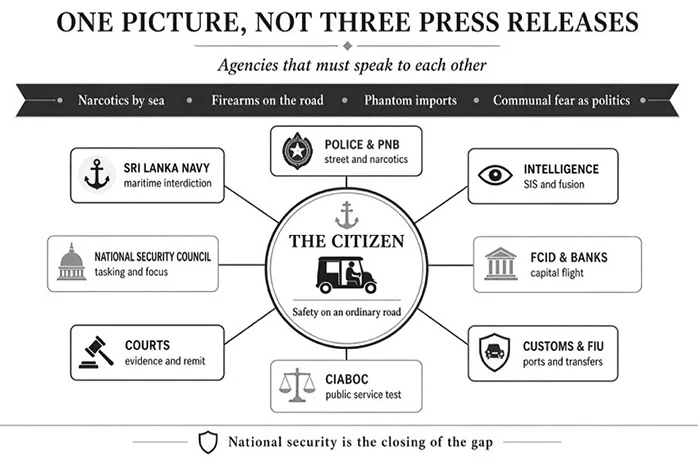
Figure: The citizen on an ordinary road is the test. The Navy, Police and Narcotics Bureau, intelligence desks, FCID and banks, Customs and the FIU, CIABOC, the courts and the National Security Council are not rival press offices. They are one picture — or they are three press releases.
The Navy’s duty on the northern and southern approaches is not ceremonial. The Palk Strait remains a preferred corridor: the crossing is short and fishing provides cover. Interdiction at Kusumanthurai is valuable only if it is followed by source-to-market mapping, packers, landing points, inland receivers, offshore facilitators. That work requires the Police Narcotics Bureau, Customs, the Financial Intelligence Unit, and a fusion cell that treats a dinghy, a bank transfer and a T-56 as one picture.
The Police duty is to prevent the next daylight murder, not merely to investigate the last. When a T-56 is used on a public road against people returning from a crimes division, the question is how the weapon moved, who sanctioned the hit, and why threat assessment failed. Inland ICE and heroin finds must be treated as distribution nodes, not trophies. A 22-kilogram haul in Matara and an 18-kilogram mixed find in Piliyandala, days apart from an 81-kilogram coastal seizure, should be one picture, not three press releases.
The FCID and the banks have a national-security function whether or not the statute uses that phrase. Phantom imports drain reserves, can wash criminal proceeds, and can pay for the consignments the Navy pulls off beaches. The Kotikawatte arrest should open a network case, not close a headline.
Intelligence agencies must resist waiting for a “terrorism” label before they sit up. Organised narcotics, contract killing and covert capital movement are intelligence problems. They require sources, financial intelligence, maritime awareness and the courage to share what is known before the next three-wheeler is stopped on a southern road.
Preventive measures that can be taken now
Prevention is a set of unglamorous tasks. First, a standing joint cell, Navy, Police Narcotics Bureau, Customs, FCID and the Financial Intelligence Unit, with one target list and one weekly assessment to the National Security Council. Measure networks dismantled, not only kilograms.
Second, treat firearms recovery as a campaign. The Kolonnawa cache is a logistics dump. Every recovery should be traced: origin, last custodian, end-user, cash trail. Unaccounted military-pattern weapons remain an unfinished post-conflict item.
Third, close the gap between court appearance and street vulnerability. People required to sign at a crimes division are known to the system. The system then owes a threat assessment. Public roads in Baddegama should not become killing grounds because two factions have a rifle.
Fourth, match telegraphic transfers against Customs and shipping data as routine, not as a special project after a complaint reaches Police Headquarters. The Rs. 24.8 billion file should rewrite that routine.
Fifth, political controversy must be ring-fenced from operational command, and the anti-corruption drive must speak to the anti-narcotics drive. A National Security Council on a fixed cycle, with a fused assessment and written tasking, keeps the permanent State at work while the temporary Government argues its constitutional case. CIABOC, the FCID, the Police Narcotics Bureau and Customs should not discover at a press conference that they have been chasing the same names.
The test that matters
Sri Lanka has spent a generation learning, at terrible cost, that security is not the same thing as the absence of a declared war. The peace-loving public does not ask the State to win arguments in Colombo, or to win applause at a Gampaha rally. It asks that a three-wheeler on a southern road can pass a car without being raked by a T-56; that a northern beach is watched before the dinghy beaches, not after; that a house in Kolonnawa is not a magazine; that billions of rupees cannot leave the country dressed as imports that never were; and that the man who once sold a licence and the man who now fires a rifle are both answerable to the same law.
The detections of the past two weeks prove that parts of the system still work. The Baddegama murders prove that other parts do not work in time. The court list proves that another part has at last been put to work. National security is the closing of that gap, by agencies that know their duty, by a centre that refuses to be distracted, and by a standard that treats public service as the protection of the ordinary citizen from the old business of politics and the new business of crime.
(This analysis is offered in the interest of national security, institutional reform, and public safety)
The writer is a Senior Superintendent of Police (Retired), former Head of the Counter-Terrorism Division of the State Intelligence Service, and a former Member of the Sri Lanka Wakfs Board. He writes on national security, intelligence and institutional reform. Email- mahildole54@gmail.com
Sources:
contemporaneous reports of the Sri Lanka Navy, Police spokesmen, CIABOC and court proceedings, News First, Newswire, Ada Derana, Daily Mirror and related parliamentary reporting, 21–27 September 2026; Qur’an 9:1–7 and 3:7; book launch of Navayay Paha Vikurthiya, 20 September 2026.

Ambassador of the UAE to Sri Lanka meets with the Prime Minister

EU rejects Trump’s diesel demand amid Iran war shortages

Sineth Jayawardena, Vijayakanth Viyaskanth in Sri Lanka squad for Pakistan T20Is

Bronze at stake as Bangladesh, Sri Lanka look to bring cheer to Asian Games contingents

Wanderers to host 2027 men’s ODI World Cup final as well as India vs Pakistan

Prime Minister joins Gandhi Jayanti Commemoration

‘Dates have the highest sugar content to fight Coronavirus’

Sunday Island 27 December – Headlines

#SundayIsland 17th December – Headlines

Sunday Island – 28th March

Sunday Island Headlines – 21 March

Sunday Island – 21st February – Headlines
-

 Editorial7 days ago
Birth of a bad law
-

 News5 days ago
Police remove Thileepan statue in Jaffna
-

 News7 days ago
TIN mandatory for key transactions from Nov. 1
-

 Features5 days ago
The 22nd Amendment, constitutional recovery and illiberal slippage
-

 Features5 days ago
Of foreigners as CEOs of Lankan ventures
-

 Latest News3 days ago
Gold winner Tharanga gets brand-new Honda Vezel from SLAAJ
-

 News5 days ago
Sajith rejects Jt. Opp. protest sabotage claim; SJB TU chief demands remedial action
-

 Features4 days ago
Thailand’s biggest new global star …