
News
22A throughwith required two thirdsmajority

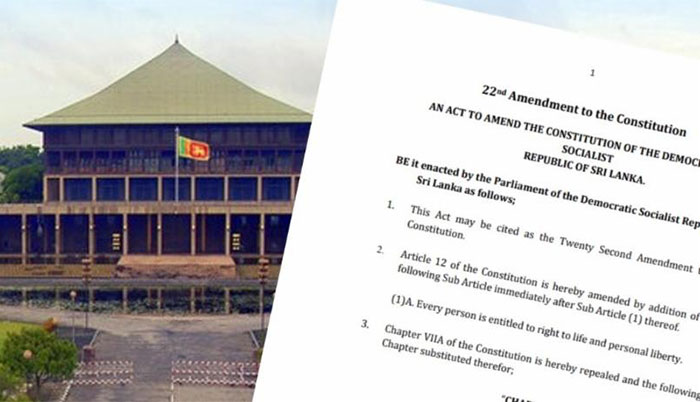
Sarath Weerasekera’s only second reading ‘no’ vote, abstains on third reading
The Second Reading of the 22nd Amendment to the Constitution was passed in Parliament on Friday with the required two thirds majority with the Bill receiving 179 votes in favour and one vote – that of Colombo District MP Rear Admiral (Retd.) Sarath Weerasekera – against. The Third Reading was passed with 174 votes for and none against with Weerasekera abstaining. The vote was originally due to be taken at 5.30 pm on Friday but got delayed till 6.15 pm as the debate dragged on. The Bill was debated on Thursday and Friday and over 50 MPs spoke.
Justice, Prisons Affairs and Constitutional Reforms Minister Wijayadasa Rajapakshe presented the Bill entitled ‘Twenty Second Amendment to the Constitution’ to amend the Constitution” on Aug 10. The Supreme Court cleared the Bill on Sept. 6 ruling that it could be adopted with a two-thirds majority in Parliament with some clauses requiring a nationwide referendum. Announcing the court decision the same day, Speaker Mahinda Yapa Abeywardene said the Bill could be adopted with a twothirds majority in Parliamentand a nationwide referendum on clauses two and three that are inconsistent with the Constitution.
The Supreme Court recommended changes to help Parliament pass the bill with only a special majority and no referendum. The bill aims to restore the independent commissions and also curbs some of the powers of the president.Interested parties were given time to petition the Supreme Court. There were 10 such petitions filed.
Speaking on Friday, Opposition leader Sajith Premadasa said that the youth and protesters who rose as the ‘Aragalaya’ deserve the credit and recognition for pushing through the 22nd Amendment. His party’s stance was not about the contents of the 20th or 22nd Amendments, but they believed their own 21st amendment was the most suitable.He said that the SJB would support the 22nd amendment, not because it offered a solution to the current crisis but because it was an improvement from the 20th amendment.
“Even though the 22A is not a solution at present, it is better than the 20A,” he said. He blamed the misuse of executive powers and the egoism derived from a two thirds parliamentary majority following a 6.9 million vote mandate at the Nov. 2019 presidential election for the downfall of the country.








India wants to upgrade the India-Sri Lanka Free Trade Agreement, signed in 2000 during Chandrika Bandaranaike Kumaratunga’s presidency.
Declaring that more than 65% of Sri Lankan exports use FTA benefits whereas only 5% of Indian exports use the same, Indian High Commissioner in Colombo, Santosh Jha, emphasised the urgent need to transform the FTA into a modern framework that delivers the full potential of the bilateral economic partnership.
Jha was addressing the Global Innovation & Leadership Summit “Sri Lanka & India Ties: A Civilisational Bond,” organised by Z Media & WION, in Colombo, recently.
Jha said: “We have spent too long talking about it (FTA); sometimes renaming it; but not actually moving with purpose and required political will to forge a new framework. I say this not to assign blame — but to note that every year of delay is a year of opportunity lost. Think of it, in the last six years, India has signed nine FTAs, covering trade with 38 countries.”
Jha dealt with the situation developing in West Asia where the unprovoked US-Israeli war against Iran has caused tremendous hardships all over the world.
“We are living through an extraordinary period of global turbulence. Supply chains, markets, and everything else available, as a leverage, are being weaponised, as never before. Geopolitical competition is reshaping trade, alliances and partnerships. Trust in global order is eroding; Utility of global institutions are in question. Wars and conflicts are proliferating; even if these wars are regional, nobody seems immune from its impact. Economic uncertainty in some form or another has become almost a permanent condition. And we are all struggling in different degrees to adapt, as nations.
In these circumstances, relationships built on shallow transactional foundations are the first to crack. They are the ones where a change of government, a shift in commodity prices, or a geopolitical tremor is enough to undo years of effort.”
Commenting on Indo-Lanka relations, Jha said: “Civilisational bonds are different. They are not dependent on who happens to be in office in any given year. They are not contingent on a favourable deal or a transaction. They are sustained by something far deeper and more durable: a shared sense of who we are and where we come from, and what we seek to build for ourselves.
When the world is uncertain, you turn to those you trust. And trust, real trust, is built over centuries, not decades. India and Sri Lanka have that in plenty. But we must not take it for granted. In fact, we should nurture it, build on it and use it to our mutual advantage.”
Jha underscored the need to connect India with Sri Lanka. Jha said: “Let me be direct. The distance between Colombo and Chennai by sea is roughly 300 kilometres. But the distance between Rameswaram and Talaimannar — the closest points of our two countries — is about 30 kilometres. Thirty kilometres. And yet, there is no direct road. No railway. No ferry service that runs at scale. No energy grid connection. No pipeline. It is, frankly, an anomaly. It is as if two neighbouring rooms are connected only through a corridor outside, even when there is a door that can be built between the two rooms, right in the shared wall of the two rooms. We need to open that door.”
Land connectivity via a bridge or tunnel across the Palk Strait has been discussed for decades. There are enough examples of such corridors across the world. The engineering is well understood. The economics are compelling. The benefits, wherever such bridges have been built, are unmistakable. But we continue to waver. But let me say clearly: the time for wavering is over. A fixed link between India and Sri Lanka would transform the economic geography of this entire region. It would make Sri Lanka a hub, it aspires to become, in a way that no port expansion or airport upgrade can achieve on its own.
Energy connectivity is equally transformative. India has made massive strides in renewable energy across solar, wind, nuclear and green hydrogen. Sri Lanka has its own targets. A submarine electricity interconnection between the two countries would give Sri Lanka access to affordable and clean power. It will also create a market for Sri Lanka’s energy exports and help realise its vast potential. In a power-hungry age of data centres, India’s demand for renewable energy will only increase; and Sri Lanka needs to fully understand that opportunity to forge ahead.
Beyond electricity, serious conversations must also take place about long-term energy supply arrangements, including the petroleum pipeline and the development of tank farms in a meaningful, sustainable way. It can provide Sri Lanka with price stability and energy security. Something that we know today after the West Asia crisis is at premium. These are not fantasies. They are projects that have been studied, scoped, and in some cases are ready for decision. India already has implemented similar projects with its other neighbours – Nepal, Bhutan and Bangladesh – who are benefitting not just by exporting their surplus power to Indian markets but also by enjoying a level of energy security, which would not have been possible otherwise in the current difficult global situation.

Sri Lanka’s creditors were unlikely to classify the recent USD 2.5 million Treasury fund heist as a technical debt default, Deputy Minister of Finance Anil Jayantha Fernando told Parliament yesterday (05), citing assessments by the Government’s financial and legal advisors engaged in the debt restructuring process.
Responding to queries raised by Opposition Leader Sajith Premadasa, Fernando said the incident is expected to be treated as a cybercrime matter rather than a failure or refusal by the State to honour its debt obligations.
“Although the funds remitted by Sri Lanka were not received by the Australian creditor, this does not indicate an inability or unwillingness on the part of the Government to repay,” he said, adding that given the nature of the incident and Sri Lanka’s relations with Australia, advisors believe neither Australia nor Paris Club members are likely to deem it a debt default.
Fernando said debt restructuring advisors had been consulted on whether the episode could amount to a technical default, while investigations are continuing to establish the nature of the alleged fraud.
Outlining the sequence of events, he said the Sri Lanka Computer Emergency Readiness Team was notified on January 9, 2026, with the Criminal Investigation Department also informed the same day. He said Australia Export Finance later notified Sri Lankan authorities on March 23 that the funds had not been received. A complaint was subsequently lodged with the CID by the Director General of the External Resources Department on March 24, while the Financial Intelligence Unit was informed on April 1.
Rejecting allegations that the Government had withheld information from Parliament, Fernando said there had been no attempt to suppress facts, noting that disclosure had been delayed pending further clarity from ongoing investigations, particularly regarding possible official involvement and internal control lapses.
He assured that all findings would be presented to Parliament in due course.
Premadasa questioned the delay in informing the House, given the timeline of events.
Fernando also cautioned against unverified speculation surrounding the death of a Ministry official linked to the incident, urging both the Opposition and the media to refrain from disseminating unsubstantiated claims.
Responding to claims raised by Premadasa that the deceased official was the first to detect and report the fund diversion, Fernando declined to confirm or deny the assertion, warning that such speculation could mislead the public and aggravate the situation.
He said investigations by the CID, in collaboration with the Finance Ministry’s External Resources Department and the Public Debt Management Office, are ongoing, adding that the continued service of the Ministry Secretary would not impede impartial inquiries.
“I am not prepared to present unverified information until investigations are concluded,” he added.
By Saman Indrajith
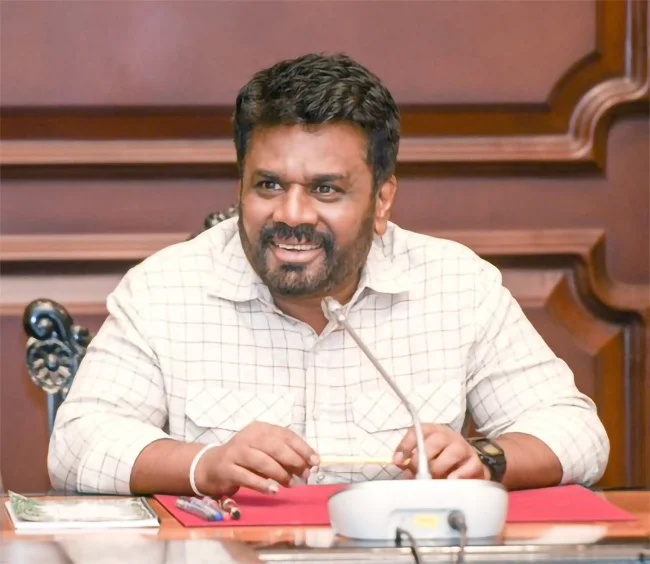
The BASL yesterday (05) said that President Anura Kumara Dissanayake’s May Day statement, regarding an impending judicial decision, may erode public confidence in the Judiciary.
The Text of the BASL statement: “An independent judiciary stands as the bedrock of a vibrant and enduring democracy, safeguarding the rule of law and ensuring that justice prevails without fear or favour.
The Preamble of the Constitution of the Republic provides that the independence of the judiciary as being part of the intangible heritage that guarantees the dignity and well-being of succeeding generations of the People of Sri Lanka.
Article 111 C (1) of the Constitution further provides that “Every judge, presiding officer, public officer or other person entrusted by law with judicial powers or functions or with functions … shall exercise and perform such powers and functions without being subject to any direction or other interference proceeding from any other person except a superior court, tribunal, institution or other person entitled under law to direct or supervise such judge, presiding officer, public officer or such other person in the exercise or performance of such powers or functions”. Article 111 C (2) of the Constitution further makes such acts an offence.
Judicial independence is not merely an institutional safeguard, it is fundamental to preserving the dignity of the individual, upholding the rule of law, and sustaining the moral authority of a democratic society.
It is in this light that we express grave concern at the statement made by H.E. the President at the recent May Day Rally referring to a Judicial decision due to be delivered on 25th May 2026 stating that the audience would be able to applaud the decision when delivered. The tenor of the statement is open to the suggestion that there is interference with the judicial process and as such the BASL apprehends that the statement may erode public confidence in the Judiciary.
In the past, whenever the independence of the judiciary has been under threat, whether it be from the executive arm or any other quarter, the BASL and its members throughout the island have fiercely opposed such interference.
The BASL is committed to ensure that the independence and integrity of the judiciary is at all times protected and safeguarded and will take all necessary steps towards that end and will continue to do so in the interests of democracy, the rule of law and the need to protect and safeguard the Constitution.”

Heavy showers above 100 mm are likely at some places in the Sabaragamuwa, Central, Uva and North-central provinces.

India pushes for direct link between Rameswaram and Talaimannar, FTA upgrade

Treasury theft won’t be treated by creditors as a default: Govt.

President’s May Day statement may erode public confidence in the judiciary – BASL

Speaker’s dual residences draw much mirth in the House

Airbus bribery case: Chandrasena granted bail, overseas travel ban imposed

‘Dates have the highest sugar content to fight Coronavirus’

Sunday Island 27 December – Headlines

#SundayIsland 17th December – Headlines

Sunday Island – 28th March

Sunday Island Headlines – 21 March

Sunday Island – 21st February – Headlines
-

 News6 days ago
Rooftop Solar at Crossroads as Sri Lanka Shifts to Distributed Energy Future
-
 News5 days ago
“Three-in-one blood pressure pill can significantly reduce risk of recurrent strokes”
-
 News1 day ago
CJ urged to inquire into AKD’s remarks on May 25 court verdict
-

 News2 days ago
USD 3.7 bn H’tota refinery: China won’t launch project without bigger local market share
-

 News5 days ago
Alarm raised over plan to share Lanka’s biometric data with blacklisted Indian firm
-
 News3 days ago
Easter Sunday Case: Ex-SIS Chief concealed intel, former Defence Secy tells court
-

 News4 days ago
Ten corruption cases set for court in May, verdict ordered in one case – President
-

 News5 days ago
USD 2.5 mn fraud probe: Interdicted MoF official found dead at home