
News
Geneva resolution: GTF disappointed over Lanka’s response; appreciates India’s efforts


The UK-headquartered Global Tamil Forum (GTF) said that Sri Lanka’s response to the latest Geneva resolution presented by Foreign Minister Ali Sabry – who insisted on an exclusive domestic mechanism to address wartime atrocities despite the country’s inability to take a single meaningful initiative for 13 years – is thoroughly disappointing.
Rejecting any external involvement in investigating the economic crimes – despite overwhelming evidence that such crimes partly contributed to the economic crisis, the President’s Counsel trivialised the efforts put in by many countries for Resolution 51/L1/Rev1, alleging it catered for their domestic politics and regional differences only.
The following is the text of the GTF statement issued by its spokesperson Suren Surendiran: “For Minister Ali Sabry, there was no sense of irony when invoking an outdated concept of sovereignty as an all-encompassing protective shield while the country is totally dependent on international assistance to overcome its deep economic crisis. Perhaps therein lies a pathway to make a meaningful transformation in Sri Lanka. Knowing Sri Lanka’s track record with past UNHRC resolutions, it makes complete sense to link the progress on implementing the key aspects of Resolution 51/L1/Rev1 to the financial packages provided by the international community.
Implementing key aspects of the UNHRC Resolution 51/L1/Rev1 is crucial for promoting human rights, accountability and economic stability in Sri Lanka
The GTF welcomes the passing of Resolution 51/L1/Rev1 with minimal opposition among the member countries of the UNHRC on 6 October 2022. It is particularly pleasing that several countries who would have traditionally voted against such a resolution recognised the criticality of the Sri Lankan situation and decided to abstain. For the thousands of victims of serious human rights abuses in Sri Lanka, who have been denied justice for more than a decade, UNHRC continues to offer hope, even if the process of seeking justice is painstakingly slow and arduous.
The process towards this important outcome commenced with the comprehensive report of the UN High Commissioner for Human Rights, which was highly critical of Sri Lanka’s failure to address wartime accountability; entrenched impunity for human rights violations; economic crimes; endemic corruption; and the application of draconian security laws to crackdown peaceful protests. The High Commissioner’s recommendations were ably converted into Resolution 51/L1/Rev1 by the core group of countries – in effect, a balancing act of highly concerning developments in Sri Lanka and challenging geopolitical reality.
GTF would like to express its gratitude to all progressive forces that made this outcome possible – the Office of the High Commissioner for Human Rights (OHCHR), the core group of countries led by the UK, countries that voted for or co-sponsored the resolution, the human rights organisations who championed the cause, and more importantly, the victims of human rights abuses in Sri Lanka who despite the long time elapsed and the risks involved, continue to provide inspiration by bravely fighting for accountability.
Resolution 51/L1/Rev1 recognises Sri Lanka’s total failure in addressing wartime accountability. It has extended and reinforced the capacity of the OHCHR to collect, consolidate, analyse and preserve information and evidence, and develop strategies for future accountability processes. Such options could include extraterritorial and universal jurisdiction as well as targeted sanctions against those credibly implicated in serious human rights abuses.
The resolution acknowledges the lack of freedoms and marginalisation endured by the Tamil and Muslim communities and calls for the government to fulfil its commitment to the devolution of political authority, specifically to ensure that all provincial councils, including the northern and eastern provincial councils, are able to operate effectively in accordance with the 13th Amendment to the Constitution.
The resolution also underscores how unaccountable governance, deepening militarisation and impunity for human rights violations eventually led to the unprecedented economic crisis in Sri Lanka and calls on the government to address the crisis, including by investigating and prosecuting corruption committed by present and former public officials, and offers assistance with the investigation into economic crimes.
Furthermore, Resolution 51/L1/Rev1 notes the heavy-handed approach adopted by the government against protesters calling for change, such as declaring multiple state of emergencies and continuing with detentions under the Prevention of Terrorism Act. It calls on the government to protect civil society actors and human rights defenders while emphasizing the positive contribution peaceful protests can make towards the effectiveness of democratic processes.
Notwithstanding India’s abstention, we are pleased with its strong statement in support of the Tamil people for equality, justice, dignity and peace. India noted inadequate progress in implementing the 13th Amendment to the Constitution and called for meaningful devolution and early elections for the Provincial Councils. GTF hopes India’s actions of goodwill – both the unprecedented assistance during the economic crisis and abstention at UNHRC – could be leveraged to protect and promote the legitimate political and economic aspirations of Tamils.
Resolution 51/L1/Rev1 which aims to address many legacies and emerging human rights and economic issues is timely. Its success depends entirely on the insistence and persistence of the international community in ensuring its full implementation. In this context, it is important to highlight the sense of frustration engulfing many victims and their families with no sense of accountability and justice even after 8 UNHRC resolutions and 13 years of waiting.
Unlike previous years when the outcome at the UNHRC was eagerly sought mainly by the Tamil community, the interests and expectations this year were much more widespread. The ruthless treatment meted out to those protesting against the government, and the authoritarian and militarised trajectory the country is increasingly adopting, has brought a new awareness about human rights and their universality among all citizens of the country.
GTF believes this convergence of concerns, fears and apprehensions offer hope for all the people of Sri Lanka to come together as equal citizens and communities. Such progress is possible only when all communities stop living a lie based on denial and come to terms with the truth based on evidence. The UNHRC resolution just passed provides a useful framework to work towards such an outcome in unity.”










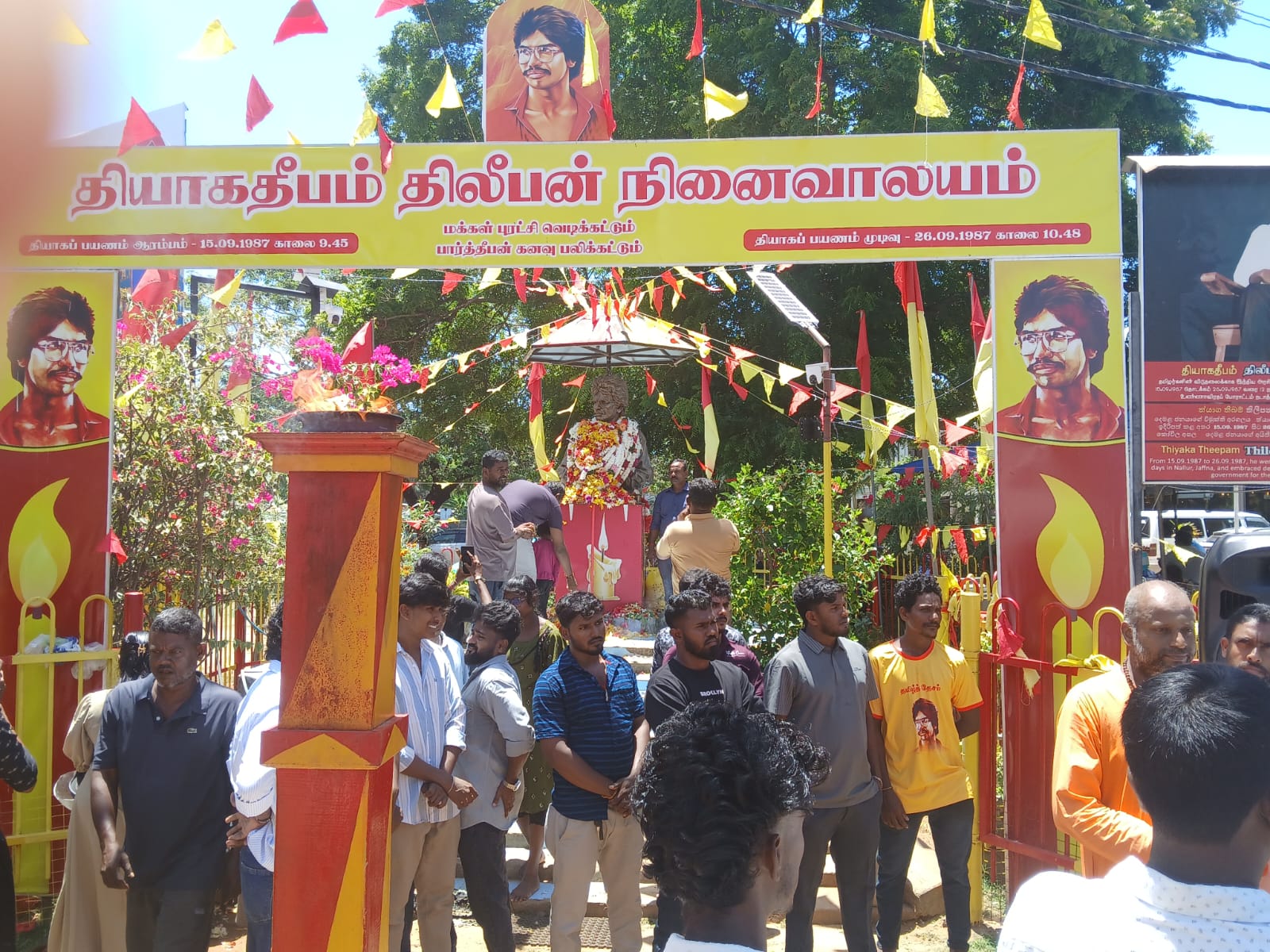
A commemorative service was held in memory of Rasaiah Parthipan commonly known by the nom de guerre ‘Thileepan’ in Nallur Jaffna this morning (26).
Parthipan a revolutionary member of the LTTE and a student of the University of Jaffna, commenced a hunger strike on 15th September 1987 untill his death on 26th September 1987. He was 23 years old at the time of his demise.
Latest News
Landslide Early Warnings issued to the districts of Colombo, Galle, Gampaha, Hambanthota, Kalutara, Kandy, Kegalle, Kurunegala, Matara, Nuwara Eliya and Ratnapura


The National Building Research Institute has issued landslide early warnings to the districts of Colombo, Galle, Gampaha, Hambanthota, Kalutara, Kandy, Kegalle, Kurunegala, Matara, Nuwara Eliya and Ratnapura from 16:00 hrs on 25.09.2026 To 16:00 hrs on 26.09.2026
Accordingly,
LEVEL III [RED] landslide early warnings have been issued to the Divisional Secretaries Divisions and surrounding areas of Neluwa, Nagoda, Niyagama and Thawalama inthe Galle district, Ganga Ihala Korale, Udapalatha, Doluwa and Pasbage Korale in the Kandy district, and Kothmale West, Ambagamuwa, Kotmale East and Norwood in the Nuwara Eliya district.
LEVEL II [AMBER] landslide early warnings have been issued to the Divisional Secretaries Divisions and surrounding areas of Elpitiya, Baddegama and Karandeniya in the Galle district, Walallawita in the Kalutara district, Deltota, Udunuwara, Gangawata Korale, Yatinuwara and Panvila in the Kandy district, Aranayake, Dehiowita, Mawanella, Deraniyagala and Yatiyanthota in the Kegalle district, Thalawakelle in the Nuwara Eliya district and Ratnapura and Pelmadulla in the Ratnapura district.
LEVEL I [YELLOW] landslide early warnings have been issued to the Divisional Secretaries Divisions and surrounding areas of Seethawaka and Padukka in the Colombo district, Attanagalla and Mirigama in the Gampaha district, Katuwana and Walasmulla in the Hambanthota district, Ingiriya and Bulathsinhala in the Kalutara district, Hatharaliyadda, Poojapitiya, Medadumbara, Kundasale, Ududumbara, Thumpane, Akurana, Pathadumbara, Harispattuwa and Pathahewaheta in the Kandy district, Warakapola, Bulathkohupitiya, Galigamuwa, Kegalle and Ruwanwella in the Kegalle district, Mallawapitiya, Alawwa, Polgahawela and Mawathagama in the Kegalle district, Pitabeddara, Kotapola and Pasgoda in the Matara district, Nuwara Eliya in the Nuwara Eliya district and Elapatha, Ayagama, Nivithigala, Kuruwita and Kalawana in the Ratnapura district
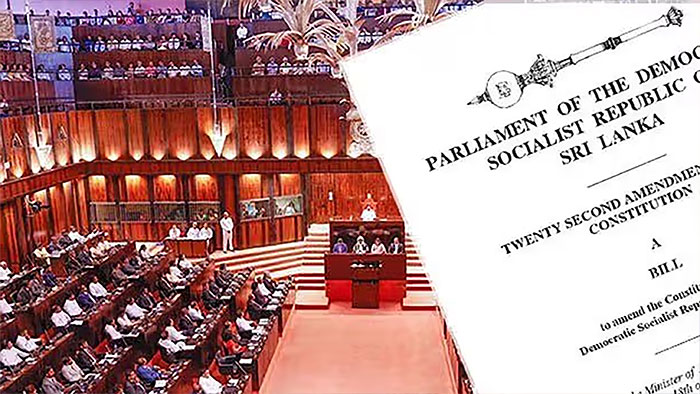
Parliament yesterday passed the Twenty-Second Amendment to the Constitution Bill and the Judicature (Amendment) Bill with two-thirds majorities, with 158 MPs voting in favour and 63 against each Bill.
The Illankai Tamil Arasu Kadchi (ITAK) and Sri Lanka Muslim Congress (SLMC) voted with the SJB against the Bills.
NDF MPs Ravi Karunanayake and Faizer Musthapha and SJB Badulla District MP Nayana Wasalathilaka were not present when the votes were taken.
The final vote on the Judicature (Amendment) Bill was announced at around 8.08 p.m. after Opposition MPs called for divisions on its clauses during the Committee Stage.
The votes followed a two-day debate which commenced on Thursday (24), after Justice and National Integration Minister Harshana Nanayakkara presented the Bills for their Second Reading.
The Supreme Court’s determination on the Bills was presented to Parliament on Tuesday (22) by Speaker Dr Jagath Wickramaratne. The Court determined that the 22nd Amendment Bill did not require approval at a referendum and could be passed by a special two-thirds majority in Parliament.
The amendment provides for raising the mandatory retirement age of Supreme Court judges from 65 to 67 and that of Court of Appeal judges from 63 to 65. It also provides for the Chief Justice to retire at 67 or after completing six years in office, whichever comes earlier.
The Speaker informed Parliament that the Judicature (Amendment) Bill could be passed by a simple majority.
The SJB opposed the legislation and its MPs attended Parliament dressed in black yesterday. The party also staged a protest at Polduwa Junction, Battaramulla, under the theme “No to 22, which destroys democracy”, with Opposition Leader Sajith Premadasa and several SJB politicians participating.

Thileepan rembered on 39th death anniversary

Landslide Early Warnings issued to the districts of Colombo, Galle, Gampaha, Hambanthota, Kalutara, Kandy, Kegalle, Kurunegala, Matara, Nuwara Eliya and Ratnapura

Showers in the Western, Uva and Sabaragamuwa provinces and in Galle, Matara, Kandy, Nuwara-Eliya, Batticaloa and Ampara districts.

22A, Judicature Amendment Bills passed with 2/3 majority

TIN mandatory for key transactions from Nov. 1

Navy brings 25 Indonesian fishermen ashore after trawler capsizes

‘Dates have the highest sugar content to fight Coronavirus’

Sunday Island 27 December – Headlines

#SundayIsland 17th December – Headlines

Sunday Island – 28th March

Sunday Island Headlines – 21 March

Sunday Island – 21st February – Headlines
-

 News7 days ago
Namal Rajapaksa Buddhist gambit fails, bail denied
-

 Features7 days ago
Why the spelling Sri Lankan names in English vary
-

 Features7 days ago
Three bands, a new identity: Sri Lankan wolf snake recognised as distinct species
-

 Business7 days ago
SLIIT holds largest-ever convocation
-

 News7 days ago
Vehicle prices drop by up to Rs. 1 mn, says importers’ body
-

 News7 days ago
Govt monitors reported Saudi death sentence – Foreign Ministry
-
 Business7 days ago
Lanka’s famed beach shack battles demolition
-

 Business7 days ago
All-new Bolero MaXX Pik-Up unveiled in Lanka