
News
Leading rice miller stops paddy purchasing citing losses, PMB still out of picture

By Sanath Nanayakkare
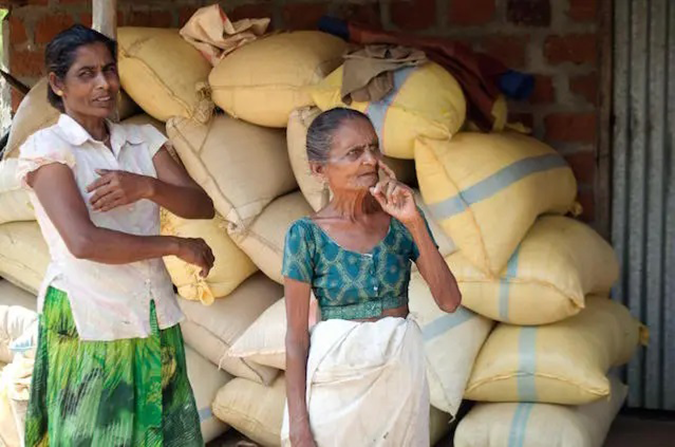
Leading rice miller, Lankeshwara Mithrapala says he has suspended purchasing paddy because it is not proper to purchase paddy from farmers at prices lower than Rs. 120 per kilo, and if he did purchase at that price, he would have to absorb a loss of Rs. 23 from each kilo of rice.
This is happening at a time the government has declared a certified price for paddy at Rs. 120 and the state-run Paddy Marketing Board (PMB) is keeping itself completely out of its main task of purchasing paddy from farmers to ensure a competitive and fair price to them.
When asked if there was some connivance between government officials and private millers to enable the purchasing of paddy at the lowest prices imaginable, Mithrapala said,” We don’t want anyone’s help to run our rice mills. But we can’t buy paddy at Rs. 120 per kilo and let the end-consumer buy a kilo of rice at Rs. 220-230 because of the loss we have to absorb in the process. There are various other brands, Nipuna, Araliya, Lak Sahal etc. If they could buy paddy at Rs. 120, they would because this is a competitive business. But they can’t buy at that price either because that would cause a substantial loss,” he said.
“If the government starts purchasing paddy, the farmers will be relieved,” he said.
Responding to queries, he said: “I bought paddy at Rs. 118-119 about 3-4 days ago. We can’t ask for paddy from farmers at prices lower than that. So, I decided to stop purchasing paddy and produce rice from existing stocks and release them to the market. It is better to stop buying paddy if Rs. 120 can’t be paid for a kilo of paddy. So, the government must intervene,” he said.
When asked if his business was running at a loss, he said,” I have enough money to operate my businesses. But I don’t have funds to collect and keep paddy stocks. What I am saying is that I will purchase paddy at Rs. 120 and will give rice at Rs. 220 per kilo. But to do that the government must declare a six-month moratorium on bank loans. If we have money to buy paddy stocks we would do so without seeking bank facilities because working with our own capital would bring us higher returns. But what do we do if we don’t have money?”
Elaborating on his costing issue he said: “When you buy paddy at Rs. 120 a kilo, there are other costs to take into calculation to run the business sustainably. It takes 1.6 kilos of paddy to produce a kilo of rice. This means the paddy cost itself would be Rs. 192. So when you buy at Rs.120, it actually costs Rs. 192 for paddy alone. For each kilo of rice; Rs. 7 for packaging, Rs. 7 for transport, Rs. 3.50 for electricity, Rs. 8.50 for employee salaries and food, Rs. 10-12 for bank interest.
Then there are the EPF and ETF payments and wear and tear costs of machinery. All these need to be calculated and recovered. These costs amount to about Rs 46 per kilo of rice. Effectively, therefore, the total cost of a kilo of rice is Rs. 238. But we sell to retailers at Rs. 215 and they sell at Rs. 220.
“So, this means that we are releasing our stocks to the market at a loss. That’s why we are saying that we can’t buy paddy at Rs. 120,” he said.
Meanwhile, a group of farmers in Polonnaruwa said: “We are compelled to sell our paddy to private sector traders because the government is just sitting around leaving the big rice millers to buy paddy. When the government does not come forward to break the monopoly of the private traders, we have no option but to sell our harvest to them at lower prices. When we sell them paddy at Rs. 100 a kilo, the income from one acre of paddy is only about Rs. 200,000 ,which is not enough to cover our inputs and labour cost. Big rice millers are making the most of this situation.”
The warehouses of PMB still remain closed and farmers have not been informed whether it would enter the market to purchase their paddy.A source familiar with state sector banking told The Island that PMB had outstanding loans of over Rs. 2 billion payable to the state banks.





News
President chairs discussion on 2027 Budget Proposals for the Ministry of Industry and Entrepreneurship Development

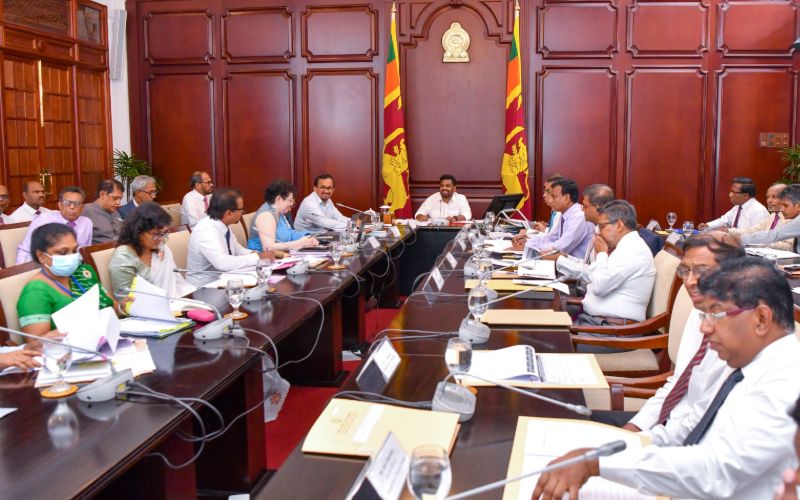
A pre-Budget discussion to review the progress of projects implemented under the 2026 Budget allocations for the Ministry of Industry and Entrepreneurship Development and to discuss proposals for the 2027 Budget was held under the patronage of President Anura Kumara Dissanayake at the Presidential Secretariat on Monday (13) afternoon.
The progress of projects implemented by each division of the Ministry of Industry and Entrepreneurship Development and the institutions under its purview using the 2026 Budget allocations, as well as proposals for the 2027 Budget, were reviewed separately during the discussion.
The President also focused on the current status of the programme to establish industrial zones in areas including Dambulla, Ingiriya, Valachchenai, Millaniya and Katunayake. Discussions centred on issues that have arisen in allocating land and developing infrastructure, including electricity, water and roads, as well as the urgent measures required to resolve these issues.
President Dissanayake instructed officials to make every effort to complete all projects already initiated under the Ministry of Industry and Entrepreneurship Development within the stipulated timeframes. He also highlighted the need to clearly identify the Government’s role and limitations in relation to the industrial sector.
Attention was also drawn to the current situation regarding the development of state-owned enterprises, while issues affecting the sugar and salt industries and alternative proposals to address them were also discussed.
The current status of the process to consolidate institutions under the Ministry of Industry and Entrepreneurship Development was also reviewed. The President pointed out that large institutions had been established at different times to meet various needs, ultimately creating a situation in which such institutions had to be maintained using taxpayers’ money.
He stressed that the consolidation of these institutions should not only improve their efficiency but should also result in a relative reduction in operational expenditure compared with the costs incurred prior to consolidation.
Officials also briefed the President on the proposal to establish the Entrepreneurship and Industry Transformation Authority (EITA) and the programme proposed under the Authority.
Attention was also focused on the challenges faced by exporters and industrialists in carrying out their activities. The President instructed officials to submit proposals on general concessions that could be provided to encourage exporters and industrialists.
The President further pointed out that Sri Lanka could develop distinctive expertise by identifying several key areas within the industrial sector and providing the facilities necessary for their development.
Minister of Industry and Entrepreneurship Development Sunil Handunnetti; Minister of Labour and Deputy Minister of Finance and Planning Anil Jayantha Fernando; Deputy Minister of Industry and Entrepreneurship Development Chathuranga Abeysinghe; Secretary to the President Dr Nandika Sanath Kumanayake; Chief of Presidential Staff Prabath Chandrakeerthi; Senior Additional Secretary to the President Russell Aponsu; Secretary to the Ministry of Finance, Planning and Economic Development Dr Harshana Suriyapperuma; and Secretary to the Ministry of Industry and Entrepreneurship Development Thilaka Jayasundara, along with officials from the Ministry of Finance and the Ministry of Industry and Entrepreneurship Development, participated in the discussion.
[PMD]
News
Prime Minister meets the Amir of the State of Qatar and conveys condolences on the passing of the Father Emir
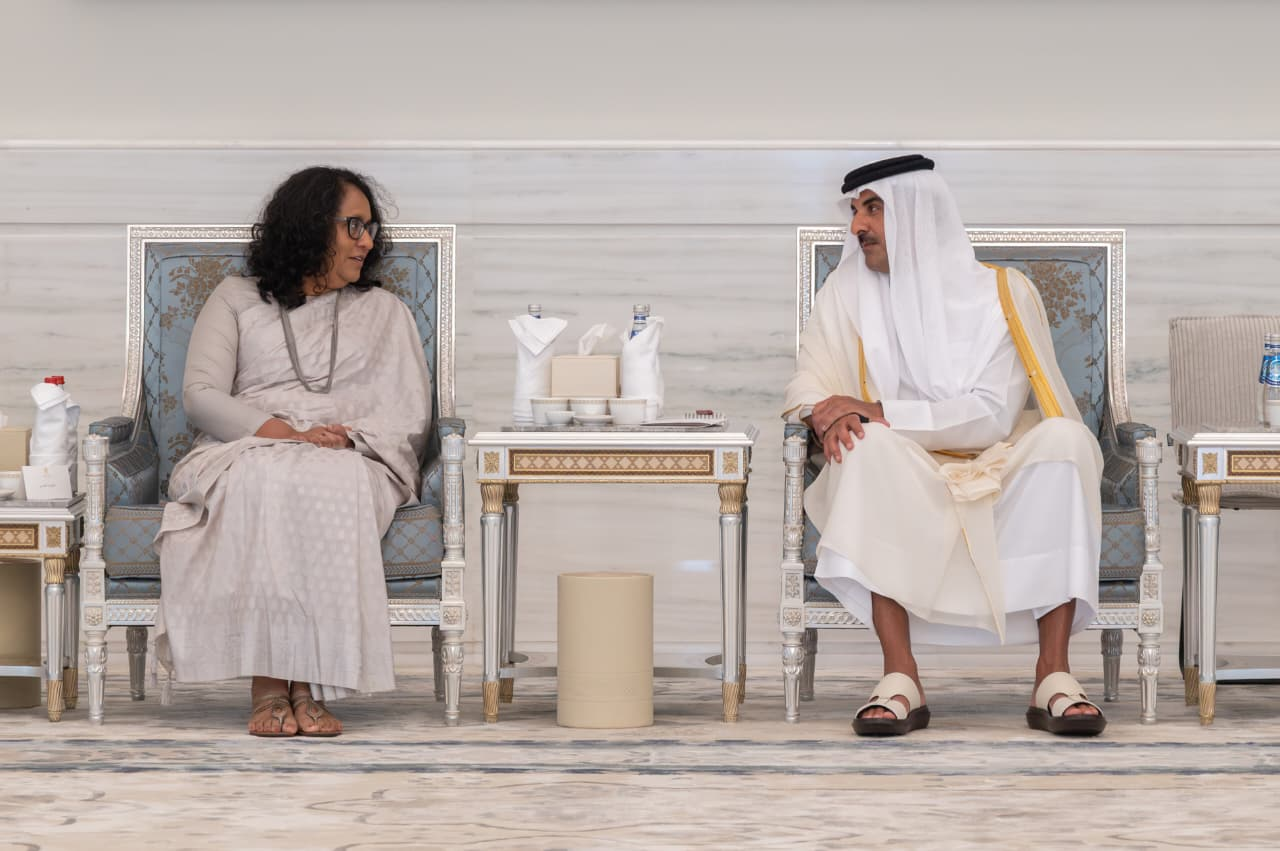
Prime Minister Dr. Harini Amarasuriya, visited the State of Qatar to convey condolences on the passing of the Father Emir, at Lusail Palace in Doha on Wednesday (15 July).
Upon her arrival, the Prime Minister was received by His Highness Sheikh Khalifa bin Hamad bin Khalifa Al Thani, Minister of Interior of the State of Qatar. The Prime Minister subsequently met with His Highness the Emir of the State of Qatar, Sheikh Tamim bin Hamad Al-Thani.
During the meeting, Prime Minister Dr. Harini Amarasuriya conveyed to the Emir the deepest condolences of the Government and the people of Sri Lanka on the passing of the Father Emir, Sheikh Hamad bin Khalifa Al Thani.
The occasion was attended by the Deputy Emir of the State of Qatar Sheikh Abdullah bin Hamad Al Thani; Prime Minister and Minister of Foreign Affairs, Sheikh Mohammed bin Abdulrahman bin Jassim Al Thani; Hassan bin Abdullah Al Ghanim, Speaker of the Shura Council; senior members of the Royal Family.
[Prime Minister’s Media Division]

At present, El Niño conditions have developed and are classified as being at a weak level. Forecasts indicate a 63% probability of a very strong El Niño event developing during the period from November 2026 to January 2027. According to the National Oceanic and Atmospheric Administration (NOAA), there is approximately a one-third probability that El Niño will remain below a very strong intensity.
Typical Climatic Conditions Associated with El Niño
Based on analyses of past El Niño events that occurred between 1950 and 2025:
• Rainfall during July and August may be below normal, particularly in the dry zone areas.
• From October onward, rainfall is generally expected to be above normal.
• If a positive Indian Ocean Dipole (IOD) develops, enhanced rainfall conditions may continue until December.
Sectors Requiring Attention
• Appropriate measures should be taken for water resource management during July and August.
• Increased rainfall expected from October onward may lead to floods and landslides, requiring preparedness and close monitoring. The forecasts are important for sectors such as, Agriculture /Water management /Livestock /Health /Energy /Other climate-sensitive sectors
• Attention should be paid to official information issued by the Department of Meteorology.
Actions by the Department of Meteorology
The Department of Meteorology continuously monitors the evolving situation and issues:
• Weekly and monthly seasonal forecasts and Monthly analyses of rainfall data to monitor meteorological drought conditions.
As weather conditions are influenced not only by El Niño but also by other climatic factors, updated forecasts and advisories are regularly shared with relevant stakeholder organizations (Irrigation/ Water Management Committee /Department of Agriculture/National Building Research Institute/Disaster Management Centre (DMC)/Ministry of Health /Sri Lanka Land Development Corporation…etc). The Department also provides technical support to the committee established through a Cabinet decision to address climate-related impacts. The Department’s monthly rainfall outlook for July to September 2026 is attached
Monthly Rainfall Forecasts for July, August and September 2026
Month Rainfall forecast
July 2026
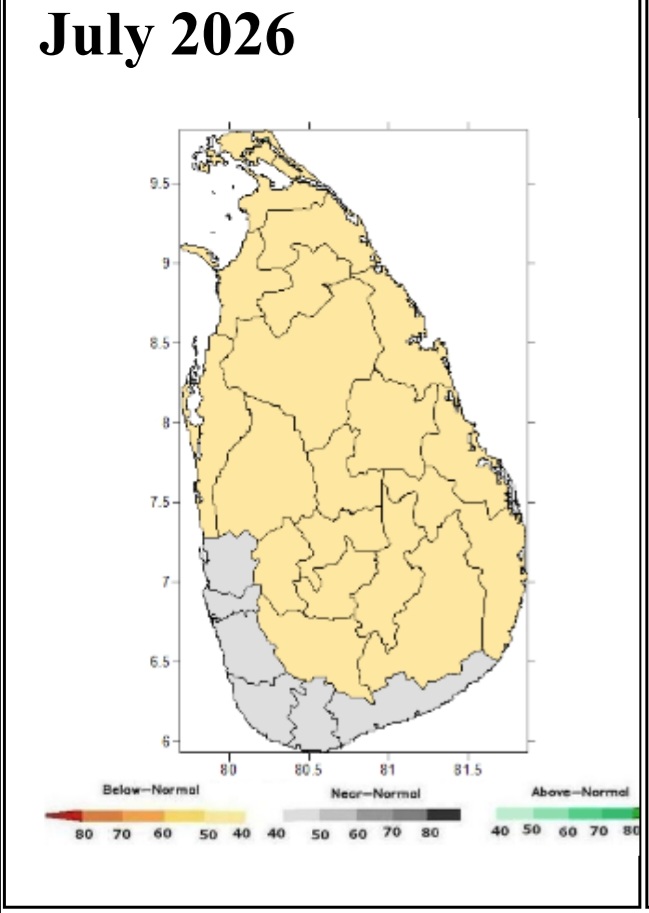
During July 2026, there is a higher probability of having near normal rainfall across most parts of the Western and Southern Provinces. The remainder of the country is expected to experience below normal rainfall.
August 2026
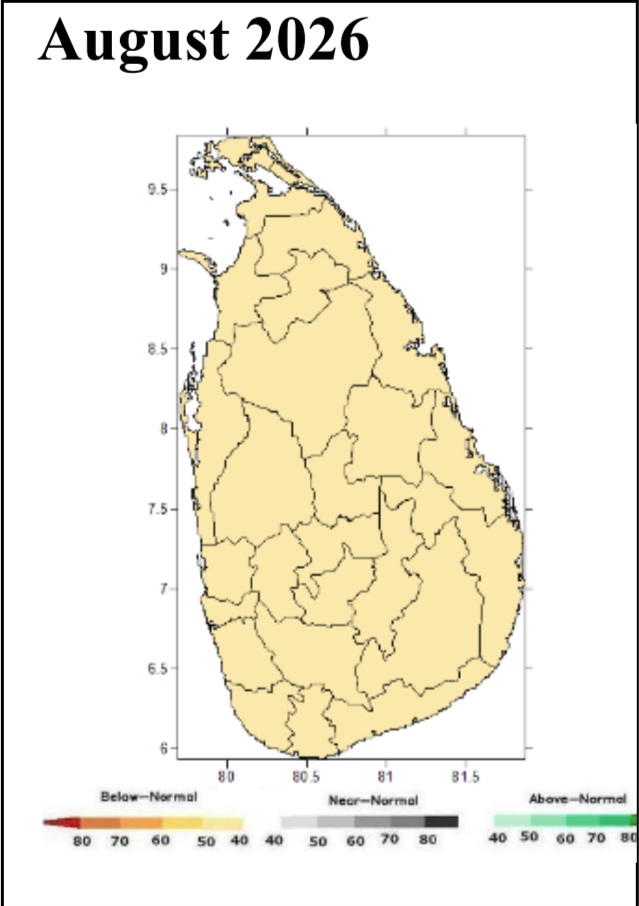
There is a higher probability of having below normal rainfall across most parts of the country during month of August 2026.
September 2026
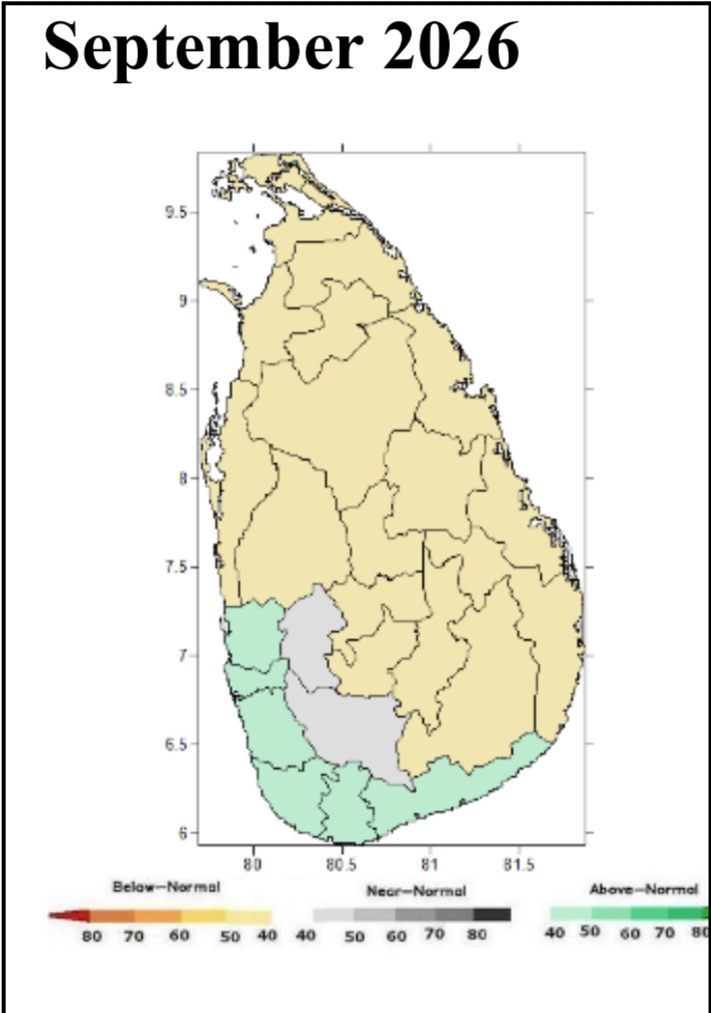
There is a possibility of above-normal rainfall across most parts of the Western and Southern Provinces, while near-normal rainfall is expected in the Sabaragamuwa Province. Below-normal rainfall is likely in the remaining areas during September 2026.
Note: These long-range forecasts may change due to strong day-to-day atmospheric variability associated with the movement of weather systems such as atmospheric disturbances, low-pressure areas, and depressions, as well as intra-seasonal oscillations such as the Madden–Julian Oscillation (MJO). Therefore, in addition to the weekly and monthly forecasts, it is important to pay attention to the Department’s official announcements, weather advisories and warnings, as well as the daily weather forecasts issued by the Department of Meteorology.

President chairs discussion on 2027 Budget Proposals for the Ministry of Industry and Entrepreneurship Development

Prime Minister meets the Amir of the State of Qatar and conveys condolences on the passing of the Father Emir

Current El Niño Status in Sri Lanka

A few showers may occur in the Western, Sabaragamuwa and North-western provinces and in Kandy, Nuwara-Eliya, Galle and Matara districts.

Argentina face fine for Falklands banner in semi-final win

US launches fresh strikes on Iran as Trump warns Tehran it ‘better behave’

‘Dates have the highest sugar content to fight Coronavirus’

Sunday Island 27 December – Headlines

#SundayIsland 17th December – Headlines

Sunday Island – 28th March

Sunday Island Headlines – 21 March

Sunday Island – 21st February – Headlines
-
 News7 days ago
Herath warns prospective migrant workers not to get fleeced by racketeers
-
 Features5 days ago
Prison riots and politics: NPP’s biggest challenge and Sri Lanka’s biggest opportunity
-

 Editorial6 days ago
What’s the world coming to?
-
 Foreign News7 days ago
Tensions erupt in Indian state after 11-year-old raped and murdered
-

 Features7 days ago
Devanesan Annan – in Memoriam
-
Editorial7 days ago
Punishment in hellholes
-
 Features2 days ago
Dirty Money
-

 Editorial5 days ago
Much ado about crime: Fish or cut bait