
Features
The JRJ Personal and how he ran the show


by Sarath Amunugama
In the early Ceylon National Congress of which he and Dudley became joint Secretaries, JRJ was a committed rationalist while Dudley was typically less sure and a person who sometimes succumbed to his father’s admonitions. Largely to target Bandaranaike and his vacillating members of the Sinhala Maha Sabha which included Dudley and Sir John, JRJ sponsored a motion in the Ceylon National Congress that its members could not concurrently be members of other political formations.
This was opposed not only by Bandaranaike but also DS. Of all the young politicians it was only JRJ who categorically refused to join the Sinhla Maha Sabha. JRJ believed in the superiority of rationality and unflinching will. His heroes were Napoleon and Disraeli, both of whom rose to leadership because of their tactical skills and tenacity. He and his brother Harry would boast that they had read every book written about these two personalities.
Of all our Presidents it was JRJ who had a scholar’s interest in history. He had read widely and was well informed of the history of Buddhism and Sri Lanka. He once told me that he used to visit historical sites with Archeological Commissioner Senerat Paranavitana. His speeches were full of allusions to Buddhist and Sinhalese history. It is my interpretation that he looked on the Executive Presidency not only through western eyes but also as a form of leadership which had evolved through Sinhala kingship.
To him the President was the equivalent of the Sinhala ruler in his powers as well as benevolence and concern for the public good. Like the Sinhala ruler he wanted to be ‘A father to his people’ He told his listeners, including President Ronald Reagan, that he came from a long line of Sinhala rulers who wielded power for 2,500 years. It must be stated here however that this was exactly what the opposition was worried about. As NM Perera and Colvin R de Silva had said on many occasions, they could not agree to a concept of an omnipotent President, just as much as they had criticized the pre-modern social structures of feudalism and kingship.
Not surprisingly this was the same criticism levelled by French critics of the Gaullist constitution as creating “Le roi De Gaulle” – De Gaulle the King. In many ways De Gaulle and JRJ shared common characteristics. The sense of history, the idea that previous attempts at governance had failed, the need for a strong leader who was tried and tested who put the national interest above all, a leader who distanced himself from the ‘hoi poloi’ and instilled fear in his own ranks were common to both leaders.
They were both thought to be aloof but committed to the glory of a nation with a sublime history. Both said “trust me and not the institutions” which have failed. Ironically both men ran into organized oppositions which were ruthless and unsparing and had to unhappily retire to their personal homes and away from the hurly burly of politics which had been their fifes mission.
Nayaka Thuma
Political parties have evolved modes of addressing their leaders. The left called their leaders ‘comrades’ which was translated into Sinhala as `sahodarayas’ [brothers]. It led to cultural misunderstandings when sons and daughters of leaders began to address their parents as `sahodarayas’ at public meetings leading to peals of laughter of disbelief from the party faithful. Both DS and Bandaranaike were called ‘Lokka’ by their followers, usually out of their hearing. Mrs. B was universally and respectfully addressed as `Methiniya’.
But JRJ preferred to be addressed as ‘Nayaka Thuma’ which is the closest approximation to undisputed leader or ‘Der Fuhrer’. In his watch there could be only one leader and `Nayaka Thuma’ made sure that all, including the ambitious Premadasa who was a great wordsmith himself, got the message. After JRJ other UNP leaders used the same appellation but with less and less acceptance by the rank and file till under Ranil it became a word of abuse.
It was with supreme confidence that JRJ adapted Napoleon’s phrase to say that he ‘had rolled up the electoral map of Sri Lanka’. Even when he addressed President Reagan and his guests at a White House dinner, JRJ claimed that as Head of State he was in a line with an uninterrupted leadership of over 2,500 years. He did not say that USA had only just celebrated its bi-centennial.
JRJ always crafted his speeches. They were short and full of memorable phrases. He was the earliest to end his speeches with quotations from the Buddha’s teachings. Bandaranaike, like JRJ a convert to Buddhism from Anglican Christianity, never resorted to the use of Buddhist stanzas and imagery. He was at home with Western classics. Once JRJ told me that if you cannot convey your message in ten minutes, even an hour of speech time would be of no use.
He had no time for the Bandaranaike type of oratory. On several occasions when he addressed small groups, like corporation workers, he would effortlessly speak in English and I would translate it to Sinhala. He was a much better speaker in English than in Sinhala, though with his usual thoroughness he had taken Sinhala lessons early in his political career. We were amused when he continued to use Sinhala phrases of the thirties but were now out of vogue.
JRJ believed that the leader should be exemplary. Whether he believed in the concept of the Nietzschean superman or not, he elevated the role of the National leader who in his life style and political acumen dominates society He was an admirer of Gandhi and in his heroic period as Leader of the Opposition he tried to use Gandhian tactics such as Satyagraha, long marches and pujas in Temples and Kovils. But, also like Gandhi, he did not encourage obscurantism.
While accommodating political forays into religion he had contempt for superstition and rituals. One of his oft related stories was about how he was sworn in as President. In 1977, he said, he took oaths as Prime Minister as soon as possible as he did not want any disruption by SLFPers and leftists. He had no time to consult astrologers. In 1983 it was different. Menikdiwela had consulted the best astrologers and he took his oaths at the appointed time. The first term was trouble free, he said, but the astrologically ordained second term was a disaster.
So much for astrology. His Buddhism, which he studied diligently, was of the intellectual type based on the translations of the Pali Text Society which some social anthropologists have called ‘Euro Buddhism’. But he is the only leader I know who had donated extensive personal properties to the Sangha [an exception is Wijepala Mendis who donated his lands to the Sangha in memory of his son who committed suicide.]
Under JR’s watch no priest was allowed to contest for seats from the UNP. When senior monks came to discuss ethnic relations with him, he asked them to mind their own business just as he did not advise them on Sangha matters. It was the concept of ‘the national leader’ that animated his drive to abolish the 1972 Constitution and establish a new Constitution with wide powers of the Executive President. The Executive Presidency had flourished ever since, in spite of the monotonous pledge of every Presidential aspirant to abolish it. The ‘Chintanaya’ introduced by him facilitating an Open Economy remains the same under different catchy phrases in the manifestos of all would be Executive Presidents. The Executive Presidency itself still remains with added powers.
Two years after his death a newspaper asked me to reminisce about JRJ’s personality. I wrote the following article entitled `Thinking of JRJ’:
“Before 1983, even the casual caller at ‘Braemar’ in Ward Place was likely to find the door being opened for him by President Jayewardene himself. Then calling his big black dog to heel he would lead you with that characteristic shuffle of his feet to a little front office with a ‘swing door’.
“The first things that struck you about JRJ was his simplicity and neatness. Everything about him was unpretentious but neatly and methodically arranged. It stood in stark contrast to the vulgar displays of many of his ‘nouveau riche’ parliamentary colleagues. There is a saying that ‘old money never shows’. This was very true of JRJ. Visitors were taken aback when JRJ after politely inquiring whether you wanted tea or a cool drink would a little later shuffle towards you to serve the drink himself From time to time he would take his confidantes out onto his spacious garden where they would be served a choice whisky or a brandy.
“As President he would invite his close friends for dinner at his table in Queen’s House and linger over brandy and cigars reminiscing about great political figures. He admired D.S. Senanayake and would regale his young devotees with stories about the Old Man’s political acumen. One of his favourite stories was about how he and the young Turks of the Ceylon National Congress including Dudley, went to issue an ultimatum to Sir Don Baron Jayatillake at his residence and was so moved by the kindly old leader and his fatherly advice that they hastily aborted their plans.
“The ‘Wap Magula’ was one of JRJ’s brain waves which he drew from his readings of the ancient lore of Sri Lanka — another of his intellectual pursuits. During Dudley Senanayake’s first premiership, he arranged a ‘Wap Magula’ at which Sir Oliver Goonetillake, who was usually dressed in Saville Row clothes, was forced to step into a paddy field with a China silk sarong tucked between his legs. This naturally caused much mirth among the poor village farmers of Akmeemana where the ceremony was held. Sir Oliver had to endure the barbs of satirists like Tarzie Vittachi for the rest of his life for his unfamiliar sartorial transformation.
“The JRJ sponsored Wap Magula’ at Panduwasnuwara in 1978 was not much better. The Agriculture Minister EL Senanayake turned up in a sarong, banian, Nike tennis shoes and Gucci sunglasses. As soon as he set foot in the paddy field he sank up to his knees. There was pandemonium as ministers jostled to appear with JRJ in the news photos. They did not have a clue about ploughing and were thrashing about. The President however confidently handled the plough even though he was warned that the buffaloes might bolt because of the huge klieg lights flashed on them by the Government Film Unit.
“A week later a documentary film made of that ceremony was screened at ‘Braemar’ for the President’s friends. JRJ was mightily pleased when all agreed that he, at 73, had the best figure among the politicians who had stripped down to their loin cloths for the ‘Wap Magula’.
“One of JRJ’s great characteristics was that he was never excited or overawed by anything. Once he made up his mind he would go to the bitter end, come what may. He used to relate how an inner clique had tried to isolate him in the Dudley Senanayake cabinet. This group would meet beforehand and plan to humiliate him at Cabinet meetings. He was stripped of some of the departments in his ministry – particularly control of the media, as someone had carried tales that he was trying to build himself up in the public eye.
“Unperturbed JRJ had taken the ‘Time’ magazine to cabinet and was busy reading it while his ministerial colleagues waited in vain for him to speak, to begin their attack. When Lalith and Gamini left the Premadasa Cabinet he recalled this episode and advised them to remain within the government. They ignored his advice and faced many difficulties later.
“After the historic signing of the Indo – Sri Lanka Accord JRJ shuffled up to the microphone and looking Rajiv Gandhi straight in the eye said “We can forgive but we cannot forget”. But the trust that was soon built up between the two leaders was so strong that Rajiv threw caution to the winds and came to JRJ’s rescue by inducting Indian troops to the North and East thereby releasing Sri Lankan security forces to fight the JVP in the South.
“It is one of the supreme ironies of modern times in our country that had Rajiv not come to Sri Lanka and had he not been subjected to an attack by a JVP indoctrinated naval rating, India may not have intervened, and certainly not so swiftly, and thereby caught the JVP on the wrong foot. The JVP rating made a costly mistake. The JVP by turning to violence opened the door to Indian intervention which JRJ meant to be only an action of the last resort. A section of the UNP that stabbed JRJ in the back, after the Indo-lanka agreement was signed were also responsible for encouraging the JVP. During those days the President was at his stubborn best resolutely refusing to yield to communalism and going back on a pledge given to a neighboring country.
“Coming from a distinguished legal family one of his failings was that he looked on most problems in legal terms. This is a common failing of lawyers in Parliaments all over the world. Since they spend a lifetime preparing, presenting, and defending bits and pieces of legislation they think that changes and additions to the statute book solves all problems.
“Life is rarely like that. But the over dependence on the law and cynical interpretations of legal provisions led JRJ and his supporters to many undemocratic acts and to violations of human rights. Amendments to the constitution to solve parochial political issues led to the debasement of the Constitution and the Presidency. The cynical manipulation of power to harass Vijaya Kumaratunga and his hypocritical persecution of the left, including the JVP after the April disturbances, were examples of the abuse of executive authority. He also condoned the abuses of the army under ‘Bull’ Weeratunga in the north against the Tamil youth which hastened the militarization of the conflict and added to the bitterness of the combatants.
“One always sensed that ‘Papa knows best’ type of feeling when JRJ discussed constitutional issues. He knew that so called legal eagles and human rights activists who confronted him were his intellectual inferiors. ‘This was one aspect of his ego which was assiduously massaged by acolytes like Lalith and Gamini. This legal ambience in the cabinet was galling to Premadasa who was a realist brought up in the school of hard knocks. He too then went about saying “I also know the law”, since he was brought up in Hulftsdorp. Later he gave free rein to the military and para-military formations who battled the LTTE and the JVP.
“President Jayewardene’s death removes from the scene a dominant personality of post-independence Sri Lanka. He was a political giant in every way”.
Cabinet
It would be fair to say that JRJ had the most competent Cabinet of Ministers of modern times. As usual the new Prime Minster had been very thorough in his decision making. He first accommodated all the seniors who were Cabinet ministers in previous UNP governments. Premadasa, M.D.H. Jayawardene, Monty Jayawickreme, E.L. Senanayake, Mohamed and Hurulle were all thus accommodated. He also brought in party seniors who had helped him like Mathew, Hameed, Festus Perera, Jayasuriya and Wijetunga.
Having secured that flank he chose two technocrats Ronnie de Mel and Nissanka Wijeratne, both ex-CCS, to man key ministries-Finance for de Mel and Education for Wijeyaratne. Last, he inducted two young stars of the party, Gamini Dissanayake and Lalith Athulathmudali. They too were given plum portfolios. Everybody could see the logic of the leader’s decisions and there was little of the heartburn that usually follows the selection of cabinet ministers.
Another key factor was that JRJ was clearly ‘Primus inter pares’. While he acknowledged that the victory was a combined effort, ministers knew that he was supreme, having brought the UNP to a historic and unprecedented win which would have been unthinkable under the Senanayakes. He also made it known that he would not brook any underhand maneuvering which had been a regular feature of Sri Lankan party politics.
Later on, we will see that there was some dissatisfaction among his senior colleagues -M.D.H. Jayawardana, Gamini Jayasuriya and E.L. Senanayake. JRJ showed no mercy to them in asking for their resignation from their ministerial positions when disagreements came to the surface. But both sides stuck to the rules and the transitions took place in a civilized manner with JRJ writing to them to thank them for services rendered.
While the cabinet ministers were able and willing, several of them were highly ambitious and had no doubts about their fitness to succeed the Old Man who in his own words had “climbed to the top of the greasy pole” at the ripe age of 72. He was fighting fit and unfailingly followed every morning, a rigorous exercise regime tailored for the Canadian Air Force, but that did not prevent several of his Ministers nursing ambitions of succeeding him one day.
Their hopes were raised even before the 1977 election when JRJ, with no warning, held a straw poll to form a 10-man committee to manage the election campaign. Premadasa came first by a small margin. The surprise was Gamini Dissanayake’s performance coming a strong second, thus fueling his already vaulting ambition. Ronnie de Mel and Lalith Athulathmudali also made it to the group. It sent a clear signal to Premadasa and the party seniors that they would not have a cakewalk to the top. It also created a sense of competition among the front runners which simmered right through JRJ’s two terms and blew the party apart after Premadasa donned the mantle.
While this competition helped in running an efficient administration it must be recognized that it exacerbated tensions among the front runners. JRJ gave ear to them all and while not discouraging them did not overtly back any one of them either. He was a master at giving each of them hope, while not showing his hand in any way. To complicate matters there were two others outside this ring who believed that they had JRJ’s blessings to go to the top. One was Anandatissa de Alwis, a party grandee who managed both the political and personal entanglements of Sir John Kotelawala.
He was the kingpin of the UNP youth league in the early days and had been recruited by JRJ as his Permanent Secretary in the 1965 Dudley led administration. They were close friends and the leader’s unilateral decision to make him Speaker of the House did not please Ananda who wanted to be a Minister, preferably in charge of the old ministry in which he was Permanent Secretary. The other was Upali Wijewardene, JRJ’s cousin who had emerged as a clever and ambitious business magnate.
He wrapped himself in the mantle of a hero of the south because his mother and the source of his wealth came from a prominent family in the southern heartland. This was a direct affront to Ronnie de Mel, who also was burnishing his southern credentials as the representative for Devinuwara, the abode of Vishnu- the guardian god of the South. Vishnu is believed to be the only god who did not run away when the Buddha was threatened-by Mara.









 Should Sri Lanka consider an 18th IMF programme? Some academicians exploring Sri Lanka’s development prospects in depth are raising this issue. It is yet to emerge as a hot topic among policy and decision-making circles in this country but common sense would sooner rather than later dictate that it be taken up for discussion by the wider public and a decision arrived at.
The issue of an 18th IMF programme was raised with some urgency locally by none other than Dr. Ganeshan Wignaraja,Visiting Senior Fellow, ODI Global London, one of whose presentations, made at the Regional Centre for Strategic Studies (RCSS), Colombo, was highlighted in this column last week, May 7th. An IMF programme is far from the ideal way out for a bankrupt country such as Sri Lanka but a policy of economic pragmatism would indicate that there is no other way out for Sri Lanka. Such a programme is the proverbial ‘Bird in the hand’ for Sri Lanka and it may be compelled to avail of it to get itself out of the morass of economic failures it is bogged down in currently.
While local economic growth possibilities are far from encouraging at present, such prospects globally are far from bright as well. Some of the more thought-provoking data in the latter regard were disclosed by Dr. Wignaraja. For example, ‘The IMF’s April 2026 World Economic Outlook projects global growth slowing to 3.1 percent in 2026; with downside risks dominating: prolonged conflict, geopolitical fragmentation, renewed trade tensions, bearing down hardest on emergent and developing economies.’
However, as is known, an ‘IMF bailout’ is fraught with huge risks for the people of a developing country. ‘The Silver Bullet’ brings hardships for the people usually and they would be required by their governments to increasingly ‘tighten their belts’ and brace for perhaps indefinite material hardships and discontent. For Sri Lanka, the cost of living is unsettlingly high and 20 percent of the population is languishing below the poverty line of $ 3.65 per day.
These statistics should help put the spotlight on the people of a country, who are theoretically the subjects and beneficiaries of development, and one of the main reasons, in so far as democracies are concerned, for the existence of governments. Placing people at the centre of the development process is urgently needed in the global South and shifting the focus to other considerations would be tantamount to governments dabbling in misplaced priorities.
Technocrats are needed for the propelling of economic growth but a Southern country’s main approach to development cannot be entirely technocratic in nature. The well being of the people and how it is affected by such growth strategies need to be prime focuses in discussions on development. Accordingly, discourses on how poverty alleviation could be facilitated need urgent initiation and perpetuation. There is no getting away from people’s empowerment.
In the South over the decades, the above themes have been, more or less, allowed to lapse in discussions on development. With economic liberalization and ‘market economics’ being allowed to eclipse development, correctly understood, people’s well being could be said to have been downplayed by Southern governments.
The development issues of Southern publics could be also said to have been compounded over the years as a result of the hemisphere lacking a single and effective ‘voice’ that could consistently and forcefully take up its questions with the global powers and institutions that matter. That is, the South lacks an all-embracing, umbrella organization that could bring together and muster the collective will of the South and work towards the realization of its best interests.
This columnist has time and again brought up the need for concerned Southern sections to explore the potential within the now virtually moribund Non-Aligned Movement to reactivate itself and fill the above lacuna in the South’s organizational and mobilization capability. In its heyday NAM not only possessed this institutional capability but had ample ‘voice power’ in the form of its founding fathers, with Jawaharlal Nehru of India, for example, proving a power to reckon with in this regard. The lack of such leaders at present needs to be factored in as well as accounting for the South’s lack of power and presence in the deliberative forums of the world that have a bearing on the hemisphere’s well being.
The Executive Director of the RCSS, Ambassador (Retd) Ravinatha Aryasinha, articulated some interesting thoughts on the above and related questions at a forum a couple of months back. Speaking at the launching of the book authored by Prof. Gamini Keerewella titled, ‘Reimagining International Relations from a Global South Perspective’, at the Bandaranaike Centre for International Studies, Colombo, Amb. Aryasinha said, among other things: ‘Historically, there is a precedent that has been realized by the Non-Aligned group of countries – unfortunately, rather than being reformed and modified at the end of the Cold War, it has been tossed away.’
The inability of the nominally existent NAM to come out of its state of veritable paralysis and voice and act in the name of the South in the current international crises lends credence to the view that the organization has allowed itself to be ‘tossed away.’ The challenge before NAM is to prove that it is by no means a spent force.
As indicted, NAM needs vibrant voices that could advocate value-based advancement for the global South. Moral principles need to triumph over Realpolitik. Such transformative changes could come to pass if there is a fresh meeting of enlightened minds within the South. Pakistan by offering to mediate in the ongoing conflict between the US and Iran, for instance, proved that there are still states within the South that could look beyond narrow self-interest and work towards some collective goals. Hopefully, Pakistan’s example will be emulated.
Along with Pakistan some Gulf states have shown willingness to work towards a de-escalation of the present hostilities in West Asia. This could be a beginning for the undertaking of more ambitious, collective projects by the South that have as their goals political solutions to current international crises. These developments prove that the South is not bereft of visionary thinking that could lay the basis for a measure of world peace. That is, there are grounds to be hopeful.
NAM needs to see it as its responsibility to make good use of these hopeful signs to bring the South together once again and work towards the realization of its founding principles, such as initiating value-based international politics and laying the basis for the collective economic betterment of Southern people.

 (The author is on X as @sasmester)
I have often been told by university colleagues how soulless and dangerous ‘artificial intelligence’ (AI) is to academia and humanity. They lament that students no longer read anything as they can now get various AI programmes to summarise what is recommended which is mostly in the English language to Sinhala or Tamil or get easier versions in English itself. They get their assignments and even dissertations fully or partially written by AI. And I am led to believe that universities do not have reliable detection software to assess plagiarism and academic fraud that have been committed using AI beyond the software freely available on the internet with their own limitations. This is due to financial restrictions in these institutions. Even these common malpractices have been done mostly with the aid of free AI programmes which are readily available, which means cheating in this sense is free and mostly safe. For teachers, this is a ‘menace’ in the same way ‘copying’ once was. But its implications are far worse.
But given the global investments made over AI, it cannot be wished away despite the enormous negative impact its use has on the environment, particularly due to its massive demand for energy. So, AI is with us to stay, and it has a considerable role to play in human civilisation even though like most innovations and inventions, this too carries its own burden of negativity. In this context, instead of demonising AI and lamenting its replacement of human agency and ingenuity, one needs to think seriously about how to deal with and engage with it reflectively and pragmatically as there is much it can offer if people are intelligent enough to make rational and sensible choices.
When I am making these observations, I am restricting myself to a handful of practices involving only writing both in university-based examination processes and in the fields of creative writing.
My initial introduction to AI was through the Research Methods class I used to teach in New Delhi. In 2022, this class was supposed to go to Dharmshala in Uttar Pradesh for fieldwork training, and we needed to write a funding proposal quickly. One of the students in the class, already familiar with ChatGPT introduced by OpenAI as a free programme in 2022, did the proposal with its help before the two-hour class was over. I edited it soon after and sent it off to the university administration for funding which we received. That stint of field work was completed in five days and was the most detailed work undertaken as a training programme up to that time in the university which had considerable output ranging from a documentary film to a detailed ethnography based on the findings.
While the technical details, the format of the proposal and its basic writing were done by AI due to the time constraints the class faced, its fine-tuning was done by me and a few students. AI could not then and even now cannot undertake that level of specificity without close human intervention. But the film, the ethnography and the actual process of research had nothing to do with AI. It was the result of human labour, thinking, planning and at times creativity and ingenuity. This was an early example of how AI could coexist in an academic environment if its technical usefulness was clearly understood and potential for excesses was also understood. But this was a time, easily accessible AI was just emerging, and we did not know much about it. But I was fortunate enough to have intelligent students in my class who gave me a crash course into this kind of AI use, which I followed up with my own reading and experimentation later on. As a result, I am keener now to see how it can be used for the betterment of academic practice rather than taking an uncritically demonising position, which I know will not lead anywhere.
But how is this possible? The lamentations of my colleagues about the abuse of AI in academic practice is not unfounded. It is a serious threat that remains mostly unaddressed not only in our country but almost everywhere else in the world too. This is mostly because the advancements of AI even in day-to-day free usage have far exceeded any thoughts for actionable codes of ethics to ensure its practice is sensible and ethical. At the same time, I cannot see why a student should not use AI to correct his spelling and grammar in assignments. I also cannot see why a student cannot seek AI’s help to secure research material from secondary sources available online which I have been doing for years. For instance, the originals of specific books and rare manuscripts might not be available in any repositories in our part of the world. In such situations, what AI might find us is all we have access to in a world where we are restricted in our mobility due to semi-racist visa regimes of failed empires and former superpowers as well as our own lack of ability to travel due to our own unenviable economic conditions. But unfortunately, the materials we need are often only available in research centers and libraries in those nations.
Similarly, when it comes to academic prose, it makes no sense now to take years to translate works from multiple languages to Sinhala and Tamil. This has always been a time-consuming, cumbersome and expensive process. Non-availability of Sinhala and English translations of core originals in languages such as English, French, German and so on has been a long-term problem for our country. But this can now be done well – at least from English to our languages – quite quickly and with a very low margin for error by using specific AI programmes which are meant to do precisely this. What this means is a quick expansion of knowledge in local languages which would have ordinarily taken years to achieve or might not have been possible at all. But still, this needs significant human intervention and time towards perfection. However, I do not think AI-based translations work as well for fiction and poetry or creative works more generally. But the ability for AI to emulate nuance and feeling in language is fast emerging. These are two clear examples of improving technical abilities in research and writing in which AI can be of help.
But looking for sources of information with help the help of AI or using it as a tool to undertake essential translations from one language to another is quite different from simply using it without ascertaining the accuracy of collected information, getting AI to do all your work without any reflection or without any hard work at all, including engaging AI to do the final product in a writing assignment — be that a term paper or a work of fiction. If one proceeds in this direction, as many unfortunately do nowadays, then, our ability to think and be creative as a species will become diminished over time and our sense of humanity itself will take a toll. This is what my colleagues worry about when they say AI is making younger generations soulless.
It is here that ethical practices on how to use AI responsibly without compromising our sense of humanity must play a central role. But these ethical practices must be formally written and taught, followed by viable programmes for detection and publication if unethical practices are followed. This needs to be the case particularly in teaching institutions as well as the broader domain of creative writing. After all, what is the fun in reading a novel or a collection of poetry written by AI?
It is time people began to think about what AI can do in their own fields without falling prey to its power and their own laziness. This brings to my mind Geoffrey Hinton’s words: “There is no chance of stopping AI’s development. But we need to ensure alignment; to ensure it is beneficial to us …” Similarly, as Yann LeCun observed, “AI is not just about replicating human intelligence; it’s about creating intelligent systems that can surpass human limitations.” In this sense, it is up to us to find our edge in creativity and common sense to find the most sensible way forward in using AI.
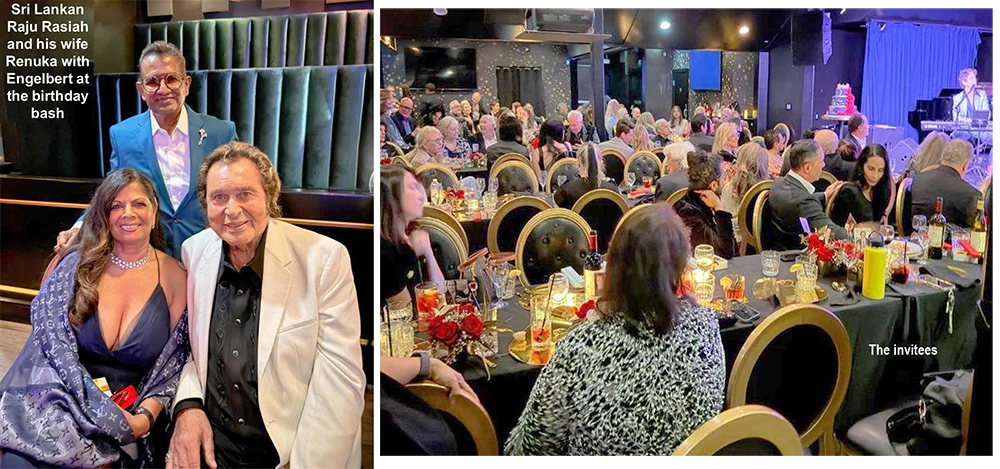
 The legendary Engelbert Humperdinck, who is known for his hit songs such as ‘A Man Without Love’, ‘Release Me’, ‘Spanish Eyes’, ‘The Last Waltz’, ‘Am I That Easy To Forget’, ‘Ten Guitars’ and ‘I Can’t Stop Loving You’, turned 90 on 02 May, 2026, and there were some lovely Hollywood-related celebrations.
Before his birthday, Engelbert’s new single ‘I’ve Got You’ was released – on 23 April – and Engelbert had this to say: “‘I’ve Got You’ is especially close to my heart. It speaks to love, loyalty, and the quiet strength we find in one another”.
The main birthday event was held at The Starlight Cabaret, in Los Angeles, California, and Sri Lankan Raju Rasiah, now based in the States, and his wife Renuka, who are personal friends of Engelbert, were invited to participate in the celebrations, along with Ingrid Melicon – also a Sri Lankan, now domiciled in America.
The invitation said “An evening of music, memories and celebration. Let’s make it a night to remember!” And it certainly turned out to be a night never ever to be forgotten!
Invitees experienced a “magical entrance” with Engelbert’s name lighting up the screen and showing him performing his hit songs.
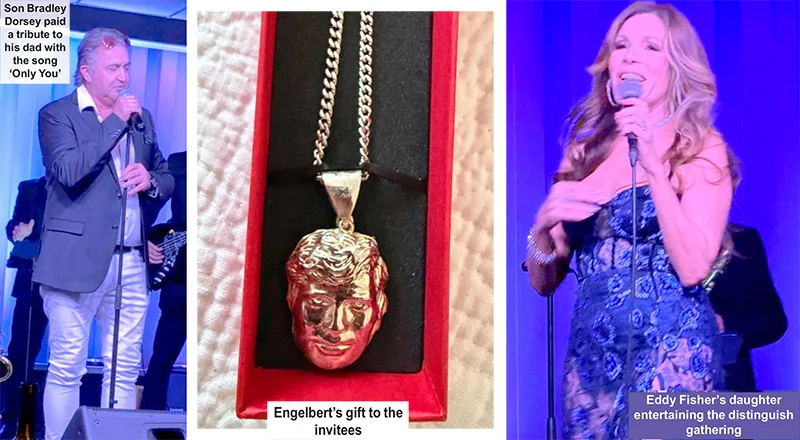
The invitees were also presented with a unique gift – a necklace with Engelbert’s face, engraved with the words “Remember, I Love You.”
Engelbert’s son, Bradley Dorsey, sang a tribute song ‘Only You’ for his dad, while Eddy Fisher’s daughters, Tricia and Joely, also got on stage to entertaining the distinguish gathering.
Engelbert didn’t perform but got on stage for the cutting of the birthday cake.
There was also a video compilation of birthday wishes from fellow celebrities, and the lineup included Gloria Gaynor, Micky Dolenz, Wayne Newton, Pat Boone, Lulu, Judy Collins, Deana Martin, Angélica María, Rupert Everett, Matt Goss, and more.
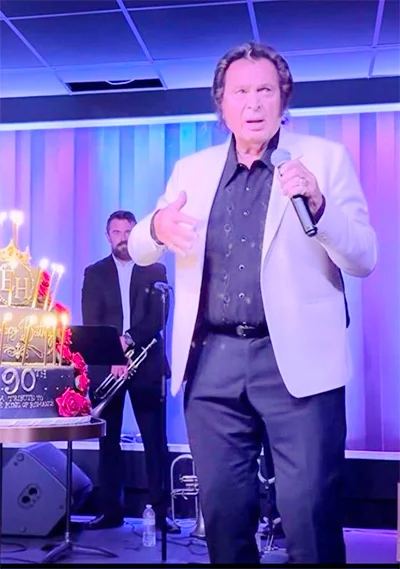
Birthday boy Engelbert Humperdinck
At 90, Engelbert is still performing. He’s on THE CELEBRATION TOUR for his 90th year, with over 50 international dates in 2026, including Australia, Germany, the US, and Canada. He’ll be at Massey Hall in, Toronto, on 06 October, 2026. He said: “The stage is my home… Canada has always been a highlight”.
He performed 60+ concerts, worldwide, in 2025, and says karaoke keeps his songs fresh: “Most of my songs are on karaoke because people love to sing them”.

‘Watermelon deaths’ in Mumbai puzzle investigators

Mass sex abuse allegations force closure of boarding school in Indonesia

Gunshots fired in Philippine Senate where lawmaker wanted by ICC is holed up

Kohli’s ninth IPL hundred powers Royal Challengers Bengaluru to the top

Special Coordination Committee meeting for Badulla District chaired by the President

Showers or thundershowers will occur at times in the Western, Sabaragamuwa, Central, Southern, North-western and Northern provinces

‘Dates have the highest sugar content to fight Coronavirus’

Sunday Island 27 December – Headlines

#SundayIsland 17th December – Headlines

Sunday Island – 28th March

Sunday Island Headlines – 21 March

Sunday Island – 21st February – Headlines
-
 News4 days ago
Lanka Port City officials to meet investors in Dubai
-
 News1 day ago
Ex-SriLankan CEO’s death: Controversy surrounds execution of bail bond
-
 News5 days ago
SLPP expresses concern over death of former SriLankan CEO
-

 Editorial6 days ago
The Vijay factor
-
 News5 days ago
Police inform Fort Magistrate’s Court of finding ex-CEO of SriLankan dead under suspicious circumstances
-
Features2 days ago
High Stakes in Pursuing corruption cases
-
 Features2 days ago
When University systems fail:Supreme Court’s landmark intervention in sexual harassment case
-
 Features6 days ago
Palm leaf manuscripts of Sri Lanka – 1