
News
CEB GM forwards draft agreement giving exclusive rights to Chinese company


Supply of natural gas to power plants
By Ifham Nizam
The Ceylon Electricity Board (CEB) General Manager has forwarded a draft agreement to the Ministry of Finance recommending that exclusive rights be granted to a Chinese company for supplying natural gas (regasified LNG) to power plants at Kerawalapitiya and Kelanitissa.
The CEB invited international bids in February 2021 for the development of a floating storage and regasification unit (FSRU) at Kerawalapitiya on build, own and operate (BOO) basis on a 10-year contract.
Under this tender, the FSRU stationed offshore at Kerawalapitiya will regasify the natural gas delivered by ship in liquid form (LNG) and then deliver it to power plants at Kerawalapitiya and Kelanitissa through gas delivery pipelines to be constructed under a separate tender floated by the Ceylon Petroleum Corporation.
The CEB has engaged an Indian consulting firm using funds provided by the Asian Development Bank (ADB) to prepare the request for proposal (RFP) documents of this tender, which includes the FSRU agreement and the implementation agreement (IA).
The FSRU agreement is to be signed between the CEB and the project company that would be set up by the selected bidder. The IA is an agreement signed between the project company and the Sri Lankan government, which sets out terms on which the government will provide incentives (such as tax concessions) and assistance (for obtaining statutory approvals such as environmental permits) to the prospective project company.
Under the IA, the GOSL will guarantee the payment due to the project company from the CEB under the FSRU agreement. The IA published with the RFP in February 2021 has not offered exclusivity to bidders, as it is unnecessary to offer such a guarantee since the FSRU agreement will ensure that the project company will operate the FSRU for 10 years.
The bids were closed on 25 June 2021, and the CEB has received only two bids despite some 18 companies purchasing the bidding documents.
The CEB Engineers’ Union (CEBEU) at the time claimed that potential investors had been discouraged by the government’s decision to entertain an unsolicited proposal by the US Company New Fortress Energy (NFE) to supply LNG to two private power plants in Kerawalapitiya including the FSRU and delivery pipeline.
However, according to a senior CEB engineer, this allegation was baseless because another international tender for a combined cycle power plant at Kerawalapitiya published around the same time attracted only a single bid. Industry experts blame international developers’ lack of interest in the dire financial situation in the country that existed at the time.
Out of the two bids received, the offer submitted by a leading US firm that owns and operates a large fleet of FSRUs was rejected by the technical evaluation committee (TEC) because the bidder had sought to conduct on its own expense a complete hydrological study of the offshore location assigned for the FSRU.
Some experts, contacted by The Island agreed that such studies were required for designing the offshore mooring system of the FSRU, which is one of the most critical items in the FSRU operation.
They were of the opinion that it was not usual for FSRU developers to rely on preliminary studies conducted by a third party because mooring system design is a highly specialised job that was not entrusted to unknown parties. However, the CEB has refused the bidder’s request, citing the urgency of implementing this project as the proposed study would take approximately two months. Accordingly, the bid has been rejected without further consideration.
However, despite CEB’s claim of urgency, the TEC is yet to complete the evaluation of the single bid and award the tender, 14 months after the bids were closed. The then CEBEU President Saumya Kumarawadu told The Island in September 2021 that the CEB’s tender was based on a comprehensive feasibility study carried out by experts and the tender was in its final stage of evaluation.
He expressed confidence that the CEB would soon select a suitable investor through a transparent and competitive bidding process, to procure the LNG infrastructure to supply LNG for all existing and future power plants in the country at the most competitive prices.
The TEC has accepted the only remaining offer received from a Chinese company, which is already engaged in road construction contracts in Sri Lanka, submitted in partnership with the Pakistani supplier of the FSRU. It is understood that this “qualifying offer” had quoted a price that is nearly twice that of the offer rejected by the TEC.
Based on the prices offered in the two bids received and the total LNG throughput guaranteed by the CEB in the RFP for the FSRU operation (443 million MMBtu for the 10-year period), the Chinese offer would cost around USD 560 million more than the offer of the US company over the 10-year contract term.
Because of the substantially high price quoted by the selected bidder, it has been decided to negotiate with the bidder with a view to reducing the price. Although the government tender guidelines allow negotiating the price with the selected bidder, they do not permit amendments to original commercial conditions or technical specifications during price negotiations in BOO/BOT projects. However, it is understood that the TEC has agreed to several material changes to the bid conditions including the bidder’s demand to change the designated location of the FSRU, a request adamantly rejected by the CEB during tendering.
The CEB has turned down repeated requests from potential bidders during the pre-bid meetings to change the location of the FSRU specified in the RFP. These parties have claimed that the location specified in the RFP did not have sufficient depth of water needed to float the FSRU.
Industry experts contacted by The Island believed that the CEB’s refusal to change the location may have resulted in the CEB ending up with only two bids. In any event, changing the assigned location of the FSRU is a material deviation from the original tender conditions, especially since the CEB has been clear from the beginning that this change could not be allowed.
The amended IA forwarded by the CEB General Manger is believed to contain several other unfavourable conditions not included in the original IA published with the RFP.
One such amendment is the GOSL’s undertaking to grant exclusive rights to the Chinese company for FSRU operation and delivery of gas to power plants for 10 years. Such a condition will effectively give this company full control of gas supply to nearly 2000 MW of generation capacity in the country, regardless of who supplies LNG.
Ironically, the strong opposition by the CEBEU to the proposal by the US company NFE was based on the allegation that NFE would be given a five-year monopoly for LNG supply in the country under that proposal.
It is also understood that the amended IA has added a new section that will effectively prevent the proposed restructuring of the CEB. Some question whether this is a clever ploy by the CEB engineers, who are opposed to the government’s restructuring of the CEB, to force the GOSL to abandon its reform process.
It is also understood that the amended IA has shifted the burden of obtaining numerous governmental and statutory approvals to the GOSL and CEB. Obtaining such approval is the Project Company’s obligation and the government generally agrees in the IA to provide reasonable assistance.
A senior CEB official contacted by The Island agreed that changing mandatory tender conditions after the award was made would be unlawful and likely to be challenged in court. He stated further that it would be most unlikely that the Ministry of Finance would agree to the changes proposed in the amended IA forwarded by the CEB, as some of these conditions may impinge on the rights of the government.







More than 1,600 students sat this year’s Russian Classical Ballet Examination, the largest number ever to take part in the examination in Sri Lanka. Exams were held in Colombo from 5, to 18, October and in Galle on 10 October.
Students aged four and above came from across the island, including Colombo, Galle, Gampaha, Negombo, Matara, Kelaniya, Panadura, Wattala, Kiribathgoda, Ratnapura, Kandy, Kurunegala, Bandarawela and Badulla. They are taught by 15 dedicated teachers trained in the Vaganova method, the renowned Russian system of classical ballet training.
They were examined by Dr. Oxana Karnovich of the Moscow State Academy of Choreography, a distinguished academic and curator.
The Russian School of Ballet and Dancing was established in 2001 by Michael Ustinov, Buddhapriya Ramanayake and Mrs Chandi Aluvihare, with Mrs Galina Pleshakova as its founding instructor. Today the School is led by Director Madam Maria Popova, Counsellor of the Embassy of the Russian Federation in Sri Lanka.


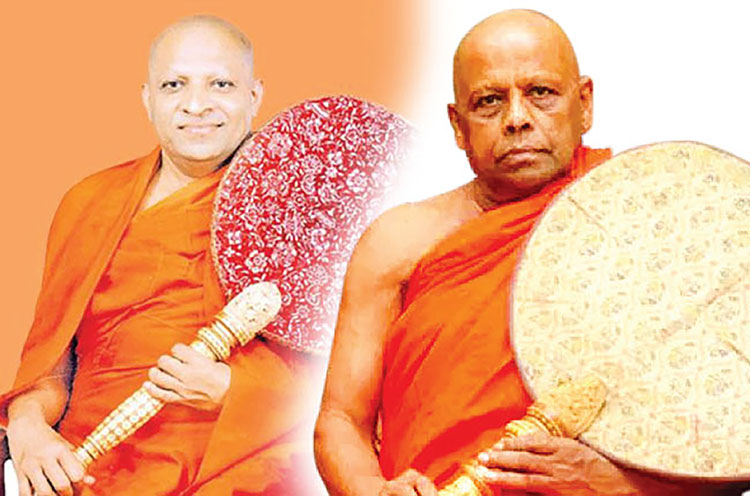
MONETABRIEF– Sri Lanka’s two most senior Buddhist chapters, Malwatte and Asgiriya, demanded special concessions for monks serving prison sentences, following the disrobing of convicted monk Ven. Galagodaatte Gnanasara in line with established procedures.
The chief prelate of the Asgiriya chapter, Most Venerable Warakagoda Sri Gnanarathana, told Prisons Commissioner Senaka Palletenna that Ven. Gnanasara, who is serving a six-year sentence for contempt of court, must be released immediately.
Prison authorities have no power to release or pardon convicts, but Palletenna told the monk in Kandy on Friday that he would convey his request to the relevant government authorities.
“There is no point in talking about this and that… The entire country has been shaken (??????? ) . He must be released,” the Asgiriya chief prelate said.
The Malwatte chief prelate, Most Venerable Thibbatuwawe Sri Siddhartha Sumangala, appeared to accept the court verdict against Ven. Gnanasara, but asked the prisons chief whether a separate section could be established for convicted monks.
Palletenna noted that a special ward for the clergy already existed at Welikada Prison.
At least 63 convicted Buddhist monks are currently incarcerated within Sri Lanka’s criminal justice system.
Meanwhile, a group of 34 Buddhist monks named in a Colombo Fort Magistrate’s Court order to vacate the vicinity of the Presidential Secretariat ended their protest and dispersed after lunch on Friday.The monks are demanding an unconditional pardon for Ven. Gnanasara, who has previously been imprisoned, making him a reconvicted prisoner.
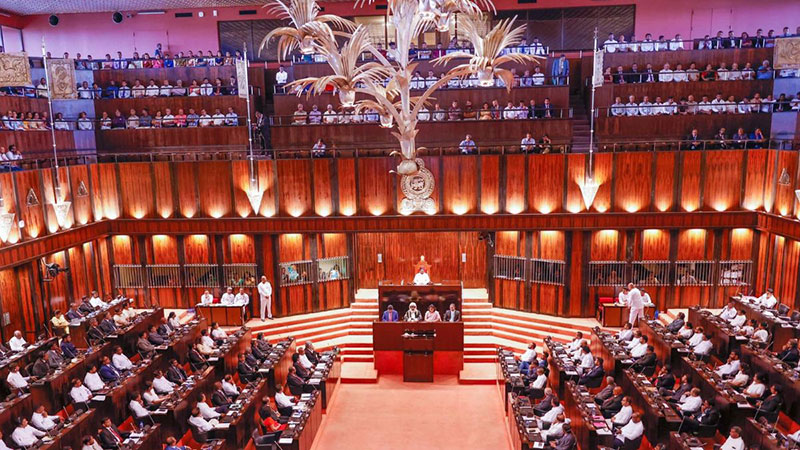
The debate on the no-confidence motion against Speaker Dr. Jagath Wickramaratne, submitted by the Samagi Jana Balawegaya (SJB), has been postponed indefinitely pending the Attorney General’s opinion on certain technical issues in the motion.
Government representatives raised the matter at a meeting of the Committee on Parliamentary Business, pointing out that several provisions of the motion required clarification and that the Attorney General’s advice should be obtained.
As obtaining the opinion would take time, the debate could not be scheduled for the next parliamentary week, parliamentary sources said.
Chief Opposition Whip Gayantha Karunatilaka said a date for the debate would be decided after the Attorney General’s advice was received.
Meanwhile, Parliament is scheduled to meet from October 20 to 23, Secretary General of Parliament Kushani Rohanadeera announced.
The parliamentary business for the week was finalised at a meeting of the Committee on Parliamentary Business held on Friday (16) under the chairmanship of Deputy Speaker Dr. Rizvie Salih.
On each sitting day, the period from 9.30 a.m. to 10 a.m. will be allocated for parliamentary business under Items 1 to 6 of Standing Order 22. Questions for Oral Answers will be taken up from 10 a.m. to 11 a.m., followed by questions under Standing Order 27(2) from 11 a.m. to 11.30 a.m.
On Tuesday, October 20, an Opposition-sponsored Adjournment Motion will be debated from 11.30 a.m. to 5.30 p.m.
On Wednesday, October 21, a resolution under the Public Debt Management Act and a Supplementary Estimate will be taken up for debate and approval from 11.30 a.m. to 5 p.m. The annual reports of five statutory institutions will subsequently be presented for approval without debate, while questions at the Adjournment Time will be taken up from 5 p.m. to 5.30 p.m.
On Thursday, October 22, the Second Reading debates on two Bills to amend the Poisons, Opium and Dangerous Drugs Ordinance (Bills Nos. 79 and 80) will be held from 11.30 a.m. to 5 p.m.
The annual reports of five statutory institutions will then be taken up for approval without debate, followed by an Opposition-sponsored Adjournment Motion from 5 p.m. to 5.30 p.m.
On Friday, October 23, the Second Reading debate on the Elimination of Rabies and Registration of Dogs Bill will be held from 11.30 a.m. to 5 p.m. A Government-sponsored Adjournment Motion will be debated during the final half-hour of the sitting.

Record 1,600 students take Russian Classical Ballet examination in Sri Lanka

Half a million people join protests in France, but some turn violent

Deadly fire breaks out at Canada military base

Showers or thundershowers will occur in most parts of the island after 1.00 p.m.

Buddhist hierarchy demands prison perks for monk convicts

Debate on NCM against Speaker postponed indefinitely

‘Dates have the highest sugar content to fight Coronavirus’

Sunday Island 27 December – Headlines

#SundayIsland 17th December – Headlines

Sunday Island – 28th March

Sunday Island Headlines – 21 March

Sunday Island – 21st February – Headlines
-

 Latest News5 days ago
Nissanka’s return headlines Sri Lanka’s Test squad against Pakistan
-

 Latest News7 days ago
Farhan and Sadaqat help Pakistan seal series in style
-

 Features7 days ago
Intake 16: 45 years of duty and honour
-
 News7 days ago
Malwathu Chapter issues statement on talks with President over Gnanasara Thera’s robes
-
 News7 days ago
CP alleges NPP has taken the blame for illegal US sanctions on Iranian vessels
-

 News5 days ago
Sri Lanka, India caught in US-Iran ship crisis
-

 Opinion7 days ago
How long can Sri Lanka remain silent on its demographic crisis?
-
 Latest News5 days ago
Kusal Mendis’ unbeaten 87 hands Sri Lanka consolation win