
Features
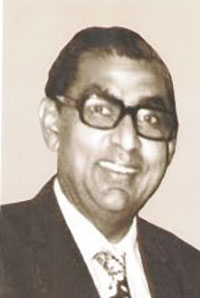
AN ENCOUNTER WITH FELIX DIAS BANDARANAIKE IN THE EARLY 70s


by Eric. J. de Silva
I had always an interest in the subject of public service training and when Mr B.H. (Buddhi) de Zoysa, the Director of the Academy of Administrative Studies (re-named later in the eighties as the Sri Lanka Institute of Development Administration – SLIDA for short), asked me whether I would like to come as his Deputy with the prospect of being able to succeed him in the event of his leaving to take up a job in the World Bank which he was fairly hopeful of getting,
I had no reason to say ‘no.’ This was at the very end of December 1971 when I was working as General Manager of the Industrial Development Board, a statutory body which came under the Ministry of Industries. Though this was a ‘cushy job’ as one would call it with the additional advantage of being able to draw a handsome allowance over and above one’s substantive salary, I felt somewhat uncomfortable working there – the reason being that its Board of Directors was full of theoreticians and was trapped in a `No Action – Talk Only’ type of syndrome, to use a popular expression, despite the valiant efforts made by its Chairman, Somapala Gunadheera who was responsible for getting me there and was no longer there by that time.
I had come to know Buddhi when he was Government Agent, Colombo and I happened to serve as his Addl. G.A. for a few months after the dissolution of Parliament in December 1964, ahead of the General Elections of March 1965 and, together with the very capable and experienced Asst. Elections Officer D.S.Ratnadurai, relieved him of much of the burden of running the elections – Colombo being the district with the largest number of electorates.
On being assured by Buddhi that he had got the necessary approval of his Minister (Mr. Felix Dias Bandaranaike, who held the portfolio of Public Administration, Home Affairs and Local Government) for the proposed move, I readily agreed. Even if Buddhi was not to get the World Bank job and I ended up as Deputy there, I felt it was well worth taking up the offer with at least a long-term prospect of succeeding him, considering the many attractions that the Academy offered for a person with my sort of interests.
Shortly thereafter, I found the Minister addressing a letter to Mr. T.B. Subasinghe, the Industries Minister, stressing the important role the Academy had to play in improving the quality of administration, and asking for my release from the IDB for the position of Deputy Director in the Academy for which I was very well suited (‘ithamath yogya’ were the words used). Mr. Subasinghe, the genial gentleman and veteran politician, called me up on receiving this letter and said that he had no option but agree to the request made by his colleague though he was sorry to let me go.
I came over to the Academy as the year 1971 ended and was appointed as its Director on March 01, 1972 on Buddhi’s departure for Washington having got his World Bank appointment. This was a position that many of my seniors would have aspired to hold, considering the reputation and the recognition the Academy had already acquired as a vital instrument for improving the overall performance and efficiency of the public service.
I found the work at the Academy to be both interesting and challenging and, to the surprise of many, had no problems with the Minister who was considered to be a hard task-master and a very difficult person to please. He went to the extent of saying openly at regular meetings of Heads of Divisions of the Ministry (the Academy was concurrently the Administrative Training Division of the Ministry) that he was satisfied with the work the Academy was doing.
He was particularly pleased when I broke new ground by running the first Management Course in Sinhala for mid-level SLAS officers. Not only did he come for the ceremonial opening of this course, he also paid me and my staff a huge compliment for having worked tirelessly to prepare the course material.
I had no problems whatever with the Secretary of the Ministry, Mr. B. (Baku) Mahadeva, whom I had known as Secretary, Ministry of Agriculture and Food during the 1960s when I worked as Deputy Commissioner in the Department of Agrarian Services, and later moved to the Ministry to take up the position of Deputy Director of Agricultural Planning.
So was it with Mr. P.H. Siriwardhana, the Additional Secretary under whose wing the Academy directly came and whom I had not known earlier at a personal level. An economist by training, who had been in the service of the Central Bank for more than half his lifetime, he was a man of few words, and did not want to tread into areas he was not too familiar with. He kept in close touch with me, quietly appreciating the work that we were doing and giving us his fullest support as and when necessary.
Things, however, changed with the departure of Mr. Mahadeva to take up an assignment in Kuala Lumpur, resulting in the elevation of Mr. Siriwardhana to take his place, and the appointment of someone from totally outside the government sector who was a close relative of the Minister to take up the position that the latter held.
The new Additional Secretary, arrived on the scene with pre-conceived ideas about what sort of training public servants needed to be given, and wanted many changes done almost overnight. These, in my view and in the view of senior officers at the Academy, were of an ad hoc nature and would have disrupted programs that had been developed over the years on the basis of comprehensive needs assessments conducted by the Academy. This naturally led to many disagreements between him and me.
He bided his time until the Minister left for England on some official business and had to extend his stay there to be with his wife cum Private Secretary who had to undergo an eye surgery (if I remember right), and asked that I be replaced immediately with a person of his choice. When the Secretary called me up and asked me what the problem I had with the Additional Secretary was, I explained to him that I had no problem with him at a personal level, but there were some issue-based differences of opinion between us.
I also reminded the Secretary that on no occasion had he found me wanting in my job during the period he was overlooking the Academy, which he acknowledged with a smile. Being a man of few words, he quickly went on to say that there was no point in my staying on in the job if the Additional Secretary wants a change, and I said I felt the same.
He then offered me the post of Government Agent, Galle which was vacant or about to fall vacant if I was willing to take it, and I indicated that I did not like to go as G.A. to my home town if I had a choice. This he fully appreciated and said that the Secretary, Ministry of Planning and Employment (Prof H.A. de S. Gunasekara) was looking for someone to fill the vacant post of Director, Regional Development in his Ministry and that he would speak to him shortly and get back to me.
Not stopping at that, he gave me the assurance that he would keep me attached to the Ministry office until a suitable position comes up in keeping with my seniority. It appeared he felt there was no reasonable ground to get me out of the Academy, but was in no position to prevent it. All this happened on a Saturday which was a half-working day at the time.
After having got home, I mulled over the options-available to me considering the suddenness of my fall from grace. I had reservations about taking up the Planning Ministry job for more than one reason. Not only had Prof Gunasekara been one of my teachers at Peradeniya, he was also one of my immediate neighbours at Wijerama Mawatha where I resided at the time, with our two families maintaining very cordial relations.
In the circumstances, I thought it was better if things were left at that. However, the prospect of being ‘attached’ to the Ministry of Public Administration for too long was not very pleasing as it would have given the impression that I had been relegated to the so-called ‘pool’ – not the most enviable prospect for a former Director of the Academy, the main function of which was providing management training to public servants at middle and senior levels.
The very next day (Sunday) I happened to meet Mr. W.T. Jayasinghe, Secretary to the Ministry of Defence and External Affairs quite by chance when I drove in to a ‘petrol shed’ near the Thunmulla Junction to get some petrol for my car. I had known him from the time he was Controller of Immigration and Emigration in the early sixties and I was an Assistant Secretary in the Defence Ministry under which his department came.
He asked me how I was doing at the Academy and went on to say “you must be enjoying your work there.” When I told him that I had just been “unceremoniously kicked out” from there, and that I will be in the so-called ‘pool’ from the very next day he raised his eyebrows in disbelief. I briefly told him about the events that preceded my ‘fall from grace’ and said that there was a possibility of my being sent as Director, Regional Development in the Planning Ministry which, like his Ministry, came directly under the Prime Minister at the time.
“Why not come back to your old Ministry?” he asked, and followed it by saying “If you are agreeable, the post of Senior Assistant Secretary (Defence) is there for you subject, of course, to the Prime Minister’s approval. (I had been Assistant Secretary – Administration and thereafter Assistant Secretary – Defence in that Ministry in the early sixties.) In fact, we have kept the position vacant for some time since Ridgeway Tillekeratne left, until a suitable person is found. I will ask the Prime Minister and get back to you before Hillary (Prof H.A.de S.Gunasekara) gets hold of you.”
I was, no doubt, delighted to accept the offer and rushed back home to break the news to my wife. Of course, the final decision was in the hands of the Prime Minister who, I thought, may not remember me working in her Ministry in the early sixties.
Later in the evening that same day, Mr. Jayasinghe phoned me at home to say that the Prime Minister had given her approval, and asked me to report to his office on the following morning saying that he would speak to his counterpart at the Public Administration Ministry and get the formalities attended to.
Thus within a single working-day after being “dismissed summarily” from the Academy, I had arrived in the Ministry of Defence and External Affairs much to the surprise of those whom I had left behind at the Academy, as well as those who had been following developments at the Public Administration Ministry itself.
When Minister Felix returned to the island a few weeks later, he would have found that the Director of the Academy had left his job while he was away and I wondered what reasons would have been given for his sudden departure. Obviously, it had to be something seriously wrong that could not wait till the Minister got back to the island.
Be that as it may, I felt it was MY duty to meet him and formally bid him farewell while thanking him for having given me the opportunity of heading that important institution as well as the courtesy and support he had always extended to me in my work. It was not possible, however, to get a suitable time to meet him as he was extremely busy attending to matters that had awaited his return not only in the Ministry of Public Administration but also in the Ministry of Justice which too had been entrusted to him in January 1972, following the resignation of Senator J.M. Jayamanne.
In the meantime, the Prime Minister convened a meeting at the Parliament building to discuss some important issue relating to Defence that had legal implications, regarding which the presence of the Justice Minister and his officials was also required. I went with the Defence Secretary to the meeting and sat next to him at the conference table.
The Justice Minister came to the meeting a few minutes late as he had been participating in a debate which was taking place in Parliament and, soon after taking his seat, threw a sharp glance at me the moment he saw me across the table which made me feel like an accused in the dock.
As soon as the meeting was over and the Prime Minister left, Felix made one big dash towards the Chamber where the debate was still going on. I virtually ran behind him and having caught up with him, asked whether I could have a word with him. He threw another sharp glance at me and said somewhat brusquely: “So you got a more powerful job and left, eh?” I said “No sir, that is not what happened” quite emphatically, and followed it up by saying “I would never have left in your absence if I had a choice. I have been waiting, ever since you came back to meet you and explain to you what actually happened”.
With a look of surprise on his face he said “Well, come and see me sometime at my office in Hulftsdorp”, and dashed off towards the chamber. It became clear to me that the Minister had been misinformed about what had taken place, and I did not find it difficult to understand why he wanted me to meet him at the Justice Ministry rather than at the Public Administration Ministry where the offending parties were more likely to learn about my meeting with the Minister.
The very next day, I phoned his office at the Justice Ministry in Hulftsdorp and got the earliest possible appointment to meet him. When I went there, I found that the Minister had gone to attend a ceremonial sitting of the Supreme Court which is usually held when a Supreme Court judge retires or a new appointee takes office, and it took quite some time for him to get back.
He saw me in the waiting area right outside his office room and asked me to come in, apologizing for having kept me waiting. Once we sat down, he asked me as to what really happened. He listened to what I said very intently and said without the slightest hesitation “Oh I see, but what the people over there told me was that you got a more powerful job and left the Academy.”
He then paused for a moment and said: “Anyway you have got a good job and I wish you well” – words that resonate in my ears to this day. I left his office as a much relieved man, wondering what the result would have been if I had not sought a meeting with him to put the record straight.!
During my stay at the Defence Ministry, I met him a couple of times along with the Secretary in his capacity as Minister of Justice regarding matters connected with the Emergency Regulations operative at the time, but he never looked at me the way he did that evening at the meeting presided over by the Prime Minister at the Parliament building or when I ran behind him to have a few words with him after the meeting ended.
(Excerpted from A Peep into the Past, the memoirs of Eric. J. de Silva)

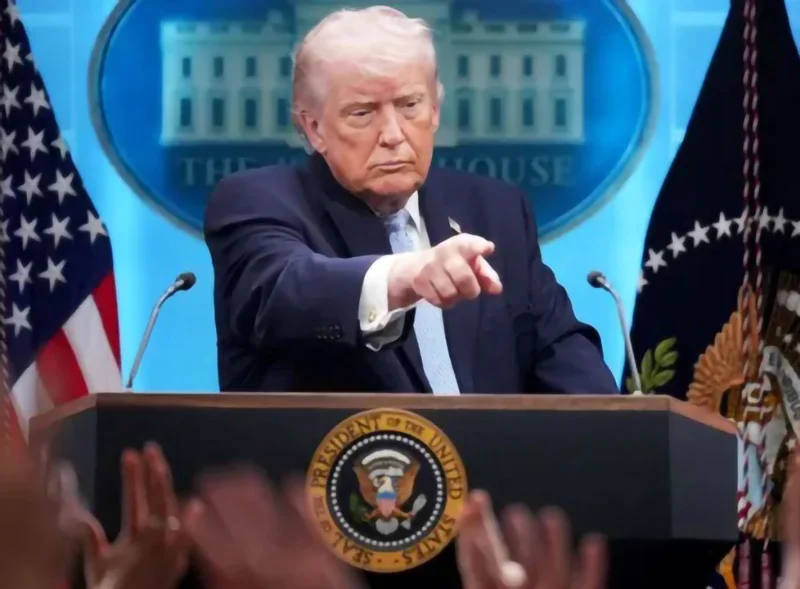
 Some fundamental freedoms seen to be at the heart of democracy in the US – religion, speech, the press, assembly and the right to petition the government – are at risk of being undermined at present by the country’s Executive President. However, the latter is being legally challenged on this score by some sections of the US media and the citizenry of the country could take heart from this notable defense of media freedom.
In fact this is good news for the world of democracy. The push back is coming from organizations such as CNN, ABC, CBS, Fox, NBC who constitute the nucleus as it were of the US media and their solidarity no less than their resourcefulness calls for commendation.
Following a recent White House decision to suspend CNN from what was referred to as ‘participation in presidential pool coverages’, the other media organizations mentioned refused to replace it in the pool. Their position was that the public had a right to receive ‘accurate and independent information about the government.’
Earlier, the White House decided to bar MS NOW and Politico from entering its premises following the restrictions imposed on CNN. The organizations were accused of publishing “FAKE NEWS’ , ‘Fiction’ and ‘lies’ in respect of the administration. These organizations lost no time in initiating a federal lawsuit accusing the central administration of violating their rights guaranteed by the First Amendment.
However, the latter litigating organizations could now consider themselves as having been vindicated because the federal court hearing their case has ordered the Trump administration to temporarily restore White House press access to journalists from the mentioned media institutions. Notably, the court has declared that the ban is ‘likely unconstitutional’. The case is proceeding.
The mass media of the most vibrant democracies of the West ought to be no strangers to such inspirational acts of solidarity and exemplifications of independence but there are lessons here for the democracies of the South that could stand them in good stead. Minus the right of a people to be informed, the rest of fundamental rights featuring in Southern Bills of Rights and legislation of the kind are bereft of substance and meaning.
It is informed decision-making on the part of a citizenry that makes for democratic vibrancy and on this score many a Southern democracy fails. While Southern publics generally demand of their governments continuous economic well being and substantive material benefits they are not equally desirous of being informed and knowledgeable.
This lacuna in the consciousness of many Southern publics enables their governments ‘to get off the hook’, so to speak and govern, or more often misgovern, their countries with impunity. Among other factors, this species of mass ignorance makes it possible for governments to dismantle democracy and rule in perpetuity.
Accordingly, an educated and constantly informed public is an essential precondition for the flourishing of democracy and independent media are integral to this process. Minus an independent mass media sector that meets the knowledge needs of the people responsibly, democracy is as good as dead.
Needless to say, those sections of the US media that are currently taking the Trump administration to task over its media curbs are acutely aware of the cruciality of these fundamental knowledge requirements.
The hope of democratic opinion worldwide and locally is likely to be that media independence would thrive in the manner in which it is flourishing in the most vibrant and accountable democracies of the West.
Southern countries such as Sri Lanka that lay claim to democratic credentials, but are democracy-deficient in many ways, need to be particularly cognizant of these requirements. The publics of these countries need to go the extra mile to ensure the thriving of an independent but responsible mass media sector.
In fact it is veritably a matter of life and death. It is only an independent media sector that could, while ensuring the existence of an informed public, impress on the latter the need to protect and perpetuate its fundamental rights. In the absence of these campaigns, such publics could be eventually having on their hands governments that boast of ruling in perpetuity.
Taking a leaf from the sections of the US media referred to independent media organizations in Southern states need to act in solidarity as well. They would need to act on the basis of the principle that acts of victimization suffered by members in their fold at the hands of governments, for instance, are in fact inimical acts directed at their collectivity and which call for united remedial action. In short, no independent mass media institution could see itself as ‘an island’.
Besides some general guidance on the importance of media independence and solidarity, the message coming from the US with regard to media praxis is that power must be stood-up to unblinkingly. The mentioned sections of the US media are primarily in a struggle to ward off encroachments on their independence in the areas of policy and practice by the political executive, that is the President.
The latter would ride rough-shod over the media in the absence of robust opposition by the media itself to inimical executive action of this kind.
While media independence needs to be seen as crucial to democratic development, an obligation is cast on the media to ensure that it uses such independence responsibly and constructively.
The worst that could afflict a media sector is for it to fall prey to the clichetic ‘freedom of the wild ass’. In fact recurring irresponsibility on the part of the media could lend credence to the perception that a tightly regulated media is best for a country. It is a short step from this misguided view to the position that political authoritarianism is best for a state. That turn of events would be of course catastrophic for a democracy.
The issues discussed thus far point to the need for a broad discourse among Southern democracies in particular on what is best for them in this connection. Given the risks underscored earlier for Southern countries in particular a broad discussion on the matters at hand, which includes the public, emerges as a must for Sri Lanka. Besides, media solidarity within democratic countries and internationally is a must.

by Prof. M. W. Amarasiri de Silva
Following public controversy over an inappropriate web link found in an English study module, the Sri Lankan government formally deferred the full rollout of the Grade 6 curriculum reforms to January 2027. In the interim, state schools will maintain the existing syllabus, reverting to standard eight-period daily timetables and previous textbooks to ensure uninterrupted instruction. Prime Minister and Minister of Education Dr. Harini Amarasuriya emphasized that this temporary pause allows the Education Ministry to thoroughly review all instructional materials, fix editorial flaws, and conduct scientific impact assessments across pilot schools prior to nation-wide implementation.
To address the oversight, an expert committee evaluated the flawed materials, completed necessary amendments, and finalised discussions to resubmit corrected modules for printing. Beyond revising written texts, the Ministry established a broader preparation roadmap—allocating funds for extensive teacher training programs set to begin mid-year, alongside scheduled informational briefings for parents, teachers, and students. Prime Minister Amarasuriya reaffirmed that none of the valid first-term modules were completely discarded or scrapped, preserving state resources while systematically rebuilding public trust and strengthening quality assurance protocols.
In this respect, this article reviews the current grade 6 syllabus comparing it with similar syllabi of India and the USA, with a view to make recommendations for the upcoming grade 6 syllabus revision.
Architecture of nation’s future
Education is the quiet architecture of a nation’s future. It is the unseen scaffolding upon which generations build their character, their intellect, and their capacity to contribute meaningfully to society. In Sri Lanka, the Grade 6 syllabus occupies a particularly important place in this architecture. It is the bridge between primary learning and the more demanding intellectual terrain of secondary education. It is the moment when children begin to move from learning basic facts to understanding concepts, from memorising information to applying knowledge, and from passive reception to active engagement. Yet, despite its importance, the Grade 6 curriculum in Sri Lanka has long struggled with issues of breadth, depth, relevance, and pedagogy. As global education systems evolve, Sri Lanka must examine what lessons can be learned from international models—particularly India and the United States—to strengthen its own curriculum and prepare students for a rapidly changing world.
The first lesson Sri Lanka can learn is the value of conceptual clarity. India’s NCERT curriculum, especially in Mathematics and Science, is globally respected for its logical progression and conceptual depth. Indian students are introduced early to the idea that mathematics is not merely a set of procedures but a language of reasoning. They learn why a ratio works, not just how to compute one. They understand the structure of an equation, not merely the steps to solve it. In Science, they explore the properties of materials, the structure of plants, and the principles of motion with a clarity that encourages curiosity rather than rote memorisation.
Sri Lanka’s Grade 6 syllabus, while competency-based, often leans heavily toward content coverage. Students are expected to learn many topics, but the time allocated for each is limited, and the teaching culture often emphasizes memorisation over understanding. If Sri Lanka wishes to improve the quality of its syllabus, it must embrace the idea that fewer topics taught well are better than many topics taught superficially. Conceptual mastery builds confidence, and confidence builds lifelong learners.
Lesson from the US
A second lesson comes from the United States, where the curriculum is built around skills rather than content. American students in Grade 6 are expected to read complex texts, analyse arguments, write essays supported by evidence, conduct experiments, and engage in collaborative projects. The emphasis is not on how much they know but on what they can do with what they know. This skills-based approach encourages critical thinking, creativity, and independence—qualities essential for success in the modern world.
Sri Lanka’s syllabus, by contrast, often rewards students for reproducing information rather than interpreting it. The exam culture reinforces this tendency, as students are assessed primarily through written tests that measure recall. To improve the syllabus, Sri Lanka must integrate more opportunities for students to think, question, debate, and create. The classroom should become a space where students learn to solve problems, not just memorize solutions.
Another important lesson comes from the breadth of Sri Lanka’s own curriculum. One of the strengths of the Sri Lankan system is its inclusion of cultural and religious education. Subjects such as Buddhism, Hinduism, Islam, and Christianity provide moral grounding and cultural identity. Art, Music, Drama, and Health contribute to holistic development. These subjects remind students that education is not merely about academic achievement but about becoming a balanced human being. However, breadth without depth can become burdensome. Grade 6 students in Sri Lanka often juggle more than ten subjects, each with its own textbook, competencies, and assessments. This creates pressure not only for students but also for teachers, who must rush through content to meet syllabus requirements. The lesson here is not to reduce cultural subjects but to integrate them more meaningfully. Religious education can be taught through ethical discussions, community projects, and reflective writing. Art and Music can be connected to history, literature, and social studies. Health can be linked to science and physical education. Integration reduces overload while enriching learning.
Another lesson from India
India offers another valuable lesson in the form of standardised textbooks. NCERT books are used across the country, ensuring consistency in quality and content. They are written by subject experts, reviewed rigorously, and updated periodically. Sri Lanka’s textbooks, while generally well-structured, vary in quality and often lag behind modern pedagogical standards. Some are dense, text-heavy, and lacking in visual aids or real-world examples. To improve the syllabus, Sri Lanka must invest in high-quality textbooks that are engaging, accessible, and aligned with contemporary educational research. Textbooks should not merely transmit information; they should inspire curiosity. They should include stories, diagrams, experiments, and activities that make learning enjoyable and meaningful.
The United States provides a lesson in inquiry-based science education. American students conduct experiments, build models, observe natural phenomena, and engage in engineering design challenges. They learn science not as a set of facts but as a process of discovery. Sri Lanka’s science curriculum includes experiments, but many schools lack the resources, laboratory facilities, or teacher training to implement them effectively. Improving the syllabus requires improving the ecosystem around it. Schools need laboratories, equipment, and teacher development programs that empower educators to teach science through inquiry. A syllabus is only as strong as the environment in which it is taught. ***
International models
Another area where Sri Lanka can learn from international models is language education. In India, students often learn three languages—English, Hindi, and Sanskrit or Urdu. This heavy language load has its challenges, but it also produces students with strong linguistic skills. In the United States, English Language Arts emphasises reading complex texts, writing arguments, and analysing literature. Sri Lanka’s English curriculum, while improving, still struggles with uneven implementation across schools. Many students reach secondary school without adequate proficiency in English, limiting their access to global knowledge. To improve the syllabus, Sri Lanka must strengthen English instruction through better teacher training, more reading opportunities, and a shift from grammar-heavy teaching to communication-focused learning. At the same time, Sinhala and Tamil instruction should be modernised to include creative writing, literature appreciation, and critical reading.
Social Studies is another area ripe for improvement. Sri Lanka’s curriculum includes History, Geography, and Civics, but the teaching often emphasises memorization of dates, definitions, and facts. India’s Social Science curriculum, while also content-heavy, provides clearer conceptual frameworks. The United States, however, excels in teaching civics and citizenship. American students learn how governments function, how laws are made, how communities solve problems, and how citizens participate in democracy. Sri Lanka can strengthen its Civics curriculum by incorporating more discussions on governance, rights, responsibilities, and community engagement. Students should learn not only the structure of government but also the values that sustain it—justice, equality, and participation.
One of the most important lessons Sri Lanka can learn is the value of reducing exam pressure. In both India and Sri Lanka, exams dominate the educational landscape. Students are judged primarily by their ability to perform on written tests. The United States, while not free from assessment challenges, uses a wider range of evaluation methods—projects, presentations, portfolios, and continuous assessment. These methods allow students to demonstrate learning in diverse ways. Sri Lanka should consider adopting a more balanced assessment system that values creativity, collaboration, and practical skills alongside academic knowledge.
Technology integration is another area where Sri Lanka can improve. The United States incorporates digital literacy, coding, online research, and digital citizenship into the curriculum. Sri Lanka’s ICT syllabus is well-structured, but implementation varies widely. Many schools lack computers, internet access, or trained ICT teachers. Improving the syllabus requires improving infrastructure. Students must learn to navigate the digital world safely and effectively. They must learn coding not as a luxury but as a basic skill. They must learn to evaluate online information critically, a skill essential in an era of misinformation.
Teacher training
Teacher training is perhaps the most critical lesson of all. A syllabus is only as effective as the teachers who deliver it. India invests heavily in teacher training through national programs, workshops, and online platforms. The United States emphasises professional development, peer collaboration, and instructional coaching. Sri Lanka must strengthen its teacher training programmes, ensuring that educators understand not only what to teach but how to teach it. Teachers should be trained in inquiry-based learning, differentiated instruction, formative assessment, and classroom management. They should be empowered to adapt the syllabus to the needs of their students rather than follow it mechanically.
Sri Lanka must learn the lesson of relevance. A syllabus must prepare students not only for exams but for life. It must teach them how to think, how to communicate, how to solve problems, and how to work with others. It must prepare them for a world where knowledge is abundant, but wisdom is scarce. It must help them navigate a future shaped by technology, globalisation, environmental challenges, and social change. To improve the syllabus, Sri Lanka must ask: What kind of citizens do we want to produce? What kind of thinkers? What kind of leaders? The answers to these questions should shape the curriculum.
Lastly, improving the quality of Sri Lanka’s Grade 6 syllabus requires learning from both international models and local strengths. From India, Sri Lanka can learn the value of conceptual clarity and standardised textbooks. From the United States, it can learn the importance of skills, inquiry, and creativity. From its own traditions, it can preserve cultural education, moral development, and holistic learning. The goal is not to copy another country’s system but to build a uniquely Sri Lankan curriculum that is modern, relevant, and empowering. A curriculum that honours the past while preparing students for the future. A curriculum that nurtures thinkers, creators, and compassionate citizens. A curriculum worthy of a nation with immense potential and a proud educational heritage. If Sri Lanka embraces these lessons, the Grade 6 syllabus can become not just a bridge to secondary education but a foundation for national progress.

 Melloney Dassanayaka is certainly a familiar name here, and abroad, as well, having represented Sri Lanka at the Miss Universe 2024 pageant, held in Mexico.
A former National Basketball player, she is also involved in several projects, beneficial to the community, including financial literacy for single women-headed families in the country.
A banker by profession, Melloney hold a Bachelor’s Degree in Business Administration.

Melloney with Asanka de Mel of Lovi Sri Lanka
This extremely talented old girl of Holy Family Convent, Bambalapitiya, was in the limelight, once more, when she was seen on the ramp at Colombo Fashion Week.
It was her very first experience, at this prestigious event, and she loved every minute of it, she said, and, what’s more, she was featured on three consecutive days.
 According to the itinerary, on day 01 she walked for Lovi Sri Lanka; day 02 Rizwan Beyg (Pakistan designer), Arsath Furkhan (Indian designer), Haoyi Yan (Chinese designer) and Samant Chauhan (Indian designer); and on day 03 Vaishali Shandangule (Indian designer).
In today’s edition of The Island SceneAround, we spotlight Melloney, on the ramp, at Colombo Fashion Week.
Melloney will also participate at Miss Grand All Stars to be held later in the year, in Thailand, as Miss Universe Sri Lanka 2024.

Sri Lanka bowl first in semi final clash against India

Trump hints US could strike Iran, warns time coming

Showers or thundershowers will occur at most part of the island after 1.00 p.m.

US-assisted ‘Ice’ detection: NPC to examine IGP’s move to transfer drug-busting team

2027 Budget to be held from 12 Nov. to 14 Dec.

CB Governor confident over timely disbursement of next IMF tranche; hands post-2027 programme decisions to govt.

‘Dates have the highest sugar content to fight Coronavirus’

Sunday Island 27 December – Headlines

#SundayIsland 17th December – Headlines

Sunday Island – 28th March

Sunday Island Headlines – 21 March

Sunday Island – 21st February – Headlines
-

 Editorial5 days ago
Birth of a bad law
-

 Features6 days ago
Beyond traditional jobs: Why Sri Lanka needs to facilitate the gig economy
-

 News3 days ago
Police remove Thileepan statue in Jaffna
-
 Latest News6 days ago
Kusal, Wellalage star as Sri Lanka defend 322 in Headingley thriller
-

 News5 days ago
TIN mandatory for key transactions from Nov. 1
-

 Features3 days ago
The 22nd Amendment, constitutional recovery and illiberal slippage
-

 Features3 days ago
Of foreigners as CEOs of Lankan ventures
-

 News3 days ago
Sajith rejects Jt. Opp. protest sabotage claim; SJB TU chief demands remedial action