
Features
Tribute to a patriot – HassinaLeelarathne

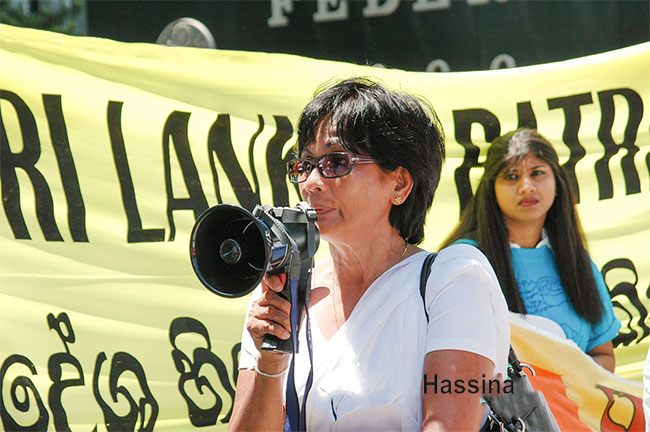
By Podinilame Dissanayake
When Sri Lanka Express (SLE), the only registered newspaper of Lankan origin in Northern America was confronted with a lawsuit, some decades ago for allegedly defaming a Lankan-born wealthy businessman in the US, the request of the accuser to halt legal action was to publish an apology. The defiant co-editor of SLE, Hassina Leelarathne, burst out, “It has to be over my dead body… I will sell or mortgage my house to fight it in court because my act is nothing less than professional journalism.” Fight in court she did skillfully. The case was thrown out for lack of substance.
A subtle attempt to tame and muzzle a community voice was halted.
Hassina’s character was marked by two distinct traits; passion for journalism and uncompromising patriotism towards her country of birth. Her actions, on both counts, were marked by bravery and forthrightness.
Hassina Gnei Sourjah was born on June 22, 1948, to well-known members of the Malay community in Sri Lanka. Her brothers Baba Sourjah and late Faisal were outstanding Rugby players at Royal College, Colombo, and club rugby thereafter; Faisal being a star place-kicker who was instrumental in converting the almost impossible penalties for the Royal College team that ‘stole’ the Bradby Shield in the famous 1971 encounter, beating the much-fancied and undefeated Trinity College, Kandy team by a considerable margin (22 to 3). The famous Sourjahs at Trinity College (son and father of rugby lions who captained Trinity) too were her distant relatives.
She had her early education at the Girls’ convent in Kollupitiya and St. Paul’s Milagiriya, Bambalapitiya, and went on to earn a Bachelor’s degree from Peradeniya with English honours. (she completed her Masters in English from San Jose State University, California in 1975). Hassina hailed from a devout and conventional Islamic family who prayed five times a day and had elderly relatives taking pride in exhibiting the permanent scratch marks on their foreheads through having done so.
This form of conservatism, ingrained in her, gradually began to erode during her undergraduate study days when she was introduced to ‘Kalama Sutra’; the Budhdha’s charter of free inquiry. The inquisitiveness continued until she became a fully pledged ‘Upasika’ and became a vegetarian which she was for the rest of her life. She could recite ‘Gathas’ that an ordinary lay Buddhist would yet with full knowledge of what they meant. She knew the ‘Ratana Sutra’ in Pali, by heart and its deep meaning.
Hassina began her journalism career at The Times of Ceylon group, in the early 1970s, after a brief stint as an English teacher in a school in Maggona, off Beruwela. She had developed an interest in journalism during her early teens, and this was when female journalists were very few and rare and almost nonexistent from the Malay community. She made her mark in the male-dominated profession of journalism that was characterised by neck-breaking competition laced with aqua vitae. Hassina was successfully making her way up as a noted writer/reporter when she was introduced to Dolamulla Gamage Deeptha Leelarathne, a well-known senior journalist at the popular Sinhala newspaper Lankadeepa; a product of Dehiwela Madya Maha Vidyalaya. Common work ethics, creativeness and the perseverance of the two towards their profession bound them for life. They were married soon amidst many raised eyebrows of colleagues and associates for such were the days when English journalists rode high, assuming super-status over the non-English.
Their foreign sojourn began when Deeptha visited the United States on a fellowship of journalism, offered by Stanford University, in 1971, and another in 1975 when Hassina joined him. The fellowship invitations primarily originated from Deepatha’s foray into the literary world of science and space explorations, via the Apollo project: his extensive writing, covering the moon landing and other series of articles on scientific aspects, in Sinhala.
Their fervour for journalism continued in the US when they began the Sri Lanka Express newspaper and the radio programme Tharanga in the late ‘70s from the City of Palo Alto in Northern California. The former was an English by-weekly publication and the latter a monthly bi-lingual (Sinhala and English) two-hour programme. This was the period of the rotary phone and the cyclostyle machine, decades before the influx of electronic media. All content (news and views) had to be typed, cut and pasted manually on special boards, transported to the print shop, printed, stamped and mailed to readers; a laborious task for the couple who were fully employed elsewhere. SLE readers were supplied with news from the world media and through other sources privy to the editors when the world knew very little of Sri Lanka. It was heartening for the Sri Lankan listeners to welcome Amaradeva, Nanda Malini, Jothipala, Milton Perera and other popular musicians to their households in California, making their way through Tharanga. Wesak, Aluth Aurudu neketh, Poya ceremonies, Dalada perahera were brought home to an eagerly awaiting diaspora whose travels to their homeland were not as frequent as at present.
The couples’ skill sets were complementary to each other. Apart from the strengths they derived from diverse societal backgrounds, there existed among them the capability and flexibility to switch roles between the conceptual and technical roles, as the situation demanded.
The Leelarathnes moved to Southern California, in the mid-’80s, and continued with SLE and a shortened version of Tharanga; radio programmes being curtailed due to State budget restrictions. Both had their employment engagements and now a happy addition to the family; newborn son Sahan.
The post-’80s were a challenging period. The devastating separatist war in Sri Lanka, in particular, had many facets to report and write on. The assassinations and the brutal annihilations, amidst political swings back at home, were covered in SLE. Newsworthy local community developments in Los Angeles were given equal importance. The publication carried on for more than 25 years; Hassina carried on the task single-handedly after the passing away of Deeptha in 2006.
SLE openly campaigned against separatism in Sri Lanka, which included the disclosure of suspected terrorist moles hiding behind the veil of benevolent activities. She bared the hidden agendas of the dubious fundraising activities of ‘Operation USA’ which was allegedly in cahoots with the TRO. The agitation campaign in front of the ‘Operation USA’ office while a fundraiser was on, by the ‘Sri Lankan Patriots’ (SLP) Organisation is memorable.
Hassina was the live wire behind the SLP’s bold and creative plans and strategies. The organisation’s motto ‘Simply patriotic’ was her suggestion. The last act of the organisation which was the construction of a 3,000 square foot library and community hall for the first ‘Ranaviru Gama’, in Pangolla off Kurunegala, was her bright idea, which saw fruition in record time. SLP members had visited the location to donate computers to the children of Ranaviru Gama, when Hassina abruptly promised them a community centre when she witnessed the lack of facilities to house the computers.
Hassina strategised the peaceful invasion of a Congressman’s town hall meeting with more than a hundred SLP activists, questioning him on his alleged involvement with separatist activities in Sri Lanka. The Congressman’s responses were childish at best; he left the meeting through the backdoor, leaving behind his bewildered constituents. The Congressman has been silent on this issue for a long period thereafter until he resurfaced with the new regime of President Biden with his support for resolution 413, which again failed to be enacted.
When the separatists organised a walk from Canada to appear on the famous Oprah Winfrey show in the US, it was Hassina’s strategy that ended the publicity stunt. When the Sri Lankan born popular rapper MIA took the opportunity in the PBS talk show with Tavis Smiley to sanitise activities of Sri Lankan terrorism as those emanating from freedom fighting, Hassina lost no time in taking active measures to counter same and to instigate a response via the same show; Palitha Kohona, the permanent representative of Sri Lanka to the United Nations responding to false propaganda.
She challenged some mushroom programme activities under the auspices of the United Nation, that were aimed at destabilising developing nations; activities of WIDER and UNHCR.
There were numerous other disclosures that Hassina made public and acted against which could only be detailed through research on the same. Equally important is the stand she took over the growth and development of the expatriate community she lived in, the greater Los Angeles area.
She was critical of personal aggrandizements at the expense of public and religious affairs, and other developments detrimental to the society at large.
She along with others travelled to Washington DC to campaign for a Sri Lankan Consul General’s office for Los Angeles, during a visit there, by the Minister of Foreign Affairs of Sri Lanka. When minister Lakshman Kadiragamar queried whether the project would be financially feasible she replied boldly … “Yes, through trade.” Yet in later years she was highly critical of the office when it became an aid mechanism for political favouritism and trade was virtually extinct.
The reporting she did uncovering the acts of an honorary Consul General of Sri Lanka in LA (before the Consular office was instituted) to evade a traffic ticket and the emergence of a Sri Lankan gang are two cases among many worth mentioning here.
The story of the emergence of the ‘Sri Lanka gang’ is the pathetic tale of a situation that arose when responsible institutions in the community failed to nip unhealthy developments in the bud. The gang was gaining momentum influencing the youth. Hassina’s requests to religious organisations to intervene fell on deaf ears. She took it upon herself to disclose the story in SLE with some catchy photographs and a write-up on probable adverse effects. A few weeks later, the gang leader, with his friends, was seen at a Sinhala New Year festival in a public park. When he introduced himself for a handshake with Hassina, she spurted out, “You don’t deserve a handshake from me… I do not extend my hand to gangsters.” She was not ruffled by the mini scuffle that ensued. Later when she left the event before its conclusion, she refused a friendly escort to guard against the gang making merry at the gate. “I am responsible for my actions and no one else should”; there were no murmurs or catcalls thrown at her by the seemingly inebriated gang when she walked through them.
While being a practising Buddhist she also took up causes that others would dare not comment upon. Her open stand against the subtle incursion of Scientology into the Sri Lankan community through Buddhist institutions and cultural events is noteworthy. A ‘wealthy’ attempt to force-feed Scientology material to a captive Sri Lankan audience at the nation’s independence celebration was brought to task and subjected to open criticism by her when there was none to stand against it, let alone speak about it.
At the time of her death, Hassina was writing a book on the early Sri Lankan settlers in the US, on which she did extensive research. She was fascinated by the story of the American philanthropist Marie De S Canavarro who arrived in Sri Lanka to engage in Buddhist missionary work along with the revered Anagarika Dharmapala. Marie was also instrumental in starting the Sangamitta Balika Vidyalaya in Colombo. Hassina painstakingly discovered the tombstone of Marie in the Forest Lawn Memorial Park in Glendale, California. Hassina’s plans to educate the diaspora on the contribution made by Marie and to celebrate her life on Women’s Day in March 2020 did not materialise due to the Coronavirus pandemic. She gave publicity to worthy Buddhist news that came up in the community. The misuse of the Buddhist flag for commercial purposes and thieves entering Buddhist temples dressed in hijab were some of her late coverages, a couple of months before she passed away.
She listened to Dhamma talks and observed ‘Ata-sil’ and practised ‘Samadhi’ at home while visiting temple after temple seeking the essence of Dhamma.
When Sri Lanka was shaken by the Easter Sunday massacre, a couple of years ago, it was Hassina who instigated and encouraged the Sri Lankan Catholic community, in Los Angeles, to conduct a memorial and a dialogue with the multi-religious community living in LA. She was personally instrumental in coordinating the same with the Archdioceses of Torrance. It was a great success, giving an opportunity to all religious groups to express their sorrow and thoughts; our Muslim brethren in particular. She advised the Sri Lankan Catholics to begin a fund in aid of the child victims from the terror blast, which was done instantaneously under the name ‘Sarana’, and continue to date with monthly remittances to Sri Lanka.
She was an animal lover and her residence had an open gate for stray dogs. Some dogs refused to leave her after the owner arrived to fetch them. There were special categories of friends waiting for her when she visited Sri Lanka; Stray dogs, crows and three-wheel drivers. The first two were for the feeding they received and the third for the benevolent tipping she did. She contributed funds to save cattle from slaughter.
It was the love of labour for journalism that kept her working long hours on her pet projects. There were no financial rewards; brickbats and gibes were many from those who wished the caravan to continue its aimless merry ride driven by the powerful and abled. Her immense contribution to the community went largely unrecognised in a world of self-centred institutions and beings in hot pursuit of fame, glory and material enrichment.
She kept going heartily till the very last, shunning her rapidly deteriorating health condition. The Financial Analyst of the Department of Veteran Affairs of California breathed her last in the morning of 17 October 17 2021.
A watchperson who kept vigil on her community’s wholesome developments is no more. The open campaigner for fair play, who refused to bow down to the whims and fancies of the mighty, is now silent. May sanity prevail in our community despite her silence!
May she attain the supreme bliss of nirvana!

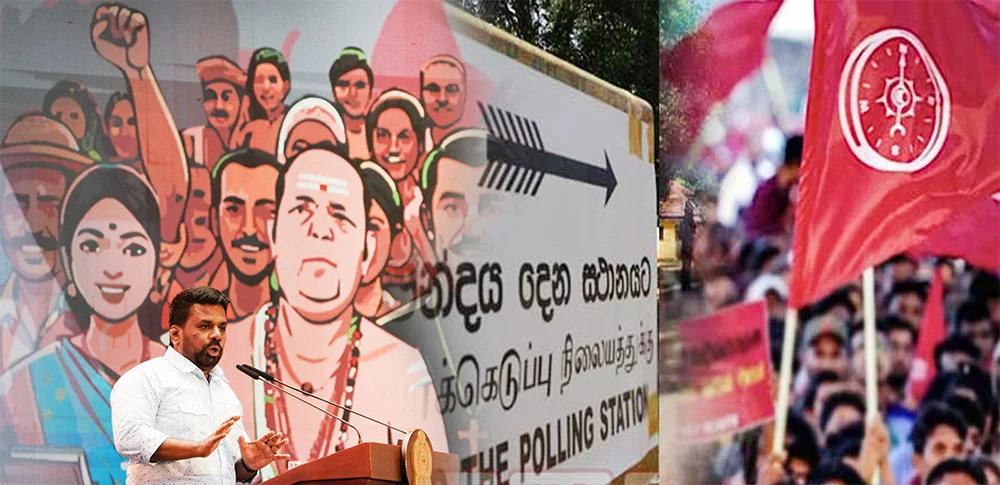
 President Anura Kumara Dissanayake’s demeanour, body language, and speaking style appear to have changed noticeably in recent weeks, a visible sign of embarrassment. The most likely reason is a stark contradiction between what he once publicly criticised and analysed so forcefully, and what his government is actually doing today. His own recent speeches seem to reflect that contradiction, sometimes coming across as confused and inconsistent. This is becoming widely known, not just through social media, YouTube, and television discussions, but also through speeches on the floor of Parliament itself.
Doing exactly what the previous government did
What is now becoming clear is that instead of doing things the way the President promised, his government is simply carrying on with what the previous administration, particularly Ranil Wickremesinghe’s government, was already doing. Critically, some of the most senior positions in the state, positions that demand the most experienced and capable officers, are being filled by people who are loyal to the JVP/NPP party but lack the relevant qualifications and track record.
Such politically motivated appointments have already taken place across various government ministries, some state corporations, the Central Bank, the Treasury, and at multiple levels of the public service. There have also been forced resignations, bans on resignations, and transfers of officials.
What makes this particularly serious is that President Dissanayake has had to come to Parliament repeatedly to defend and “clean up” the reputations of officials he himself appointed. This looks, at times, like a painful and almost theatrical exercise.
The coal procurement scandal, and a laughable inquiry
The controversy around the country’s coal power supply has now clearly exposed a massive disaster: shady tenders, damage to the Norochcholai power plant, rising electricity bills due to increased diesel use to compensate, a shortage of diesel, higher diesel prices, and serious environmental damage. This is a wide and well-documented catastrophe.
Yet, when a commission was appointed to investigate, the government announced it would look into events going back to 2009, which many have called an absurd joke, clearly designed to deflect blame rather than find answers.
The Treasury scandal, 10 suspicious transactions
At the Treasury, what was initially presented as a single transaction, is alleged to involve 10 transactions, and it is plainly a case of fraud. A genuine mistake might happen once or twice. As one commentator said sarcastically, “If a mistake can happen 10 times, it must be a very talented hand.” These explanations are being treated as pure comedy.
Attempts to justify all of this have sometimes turned threatening. A speech made on May 1st by Tilvin Silva is a case in point, crude and menacing in tone.
Is the government losing its grip?
Former Minister Patali Champika has said the government is now suffering from a phobia of loss of power, meaning it is struggling to govern effectively. Other commentators have noted that the NPP/JVP may have taken on a burden too heavy to carry. Political cartoons have depicted the NPP’s crown loaded with coal, financial irregularities, and political appointments, bending under the weight.
The problem with appointing loyalists over qualified professionals
 Appointing own supporters to senior positions is not itself unusual in politics. But it becomes a betrayal of public trust when those appointed lack the basic qualifications or relevant experience for the roles they are given.
A clear example is the appointment of the Treasury Secretary, someone who was visible at virtually every NPP election campaign event, but whose qualifications and exposure/experiences may not match the demands of such a critical position. Even if someone has a doctorate or professorship, the key question is whether those qualifications are relevant to the role, and whether that person has the experience/exposure to lead a team of seasoned professionals.
By contrast, even someone without formal academic credentials can succeed if they have the right skills and surround themselves with advisors with relevant exposure. The real failure is when loyalty to a political party overrides all other considerations, that is a fundamental betrayal of responsibility.
The problem is not unique to this government. In 2015, the appointment of Arjuna Mahendran as Central Bank Governor was a similar blunder. His tenure ended in scandal involving insider dealing and bond market manipulation. However, in that case, the funds involved were frozen and later confiscated by the following government, however legally questionable that process was.
The current Treasury losses, by contrast, may be unrecoverable. Critics say getting that money back would be next to impossible.
The broader damage: Demoralisation of capable officials
When loyalists are placed above competent career officials in key positions, it demoralises the best public servants. Some begin to comply in fear; others lose motivation entirely. The professional hierarchy breaks down. Junior officials start looking over their shoulders instead of doing their jobs. This collective dysfunction is ultimately what destroys governments.
Sri Lanka’s pattern: every government falls
This pattern is deeply familiar in Sri Lankan history. The SWRD Bandaranaike government, which swept to power in 1956 on a wave of popular support, had declined badly by 1959. The coalition government, which came to power reducing the opposition to eight seats, lost in 1977, and, in turn, the UNP, which came in on a landslide, in 1977, crushing the SLFP to just eight seats, suffered a similar fate by 1994.
Mahinda Rajapaksa came to power in 2005 by the narrowest of margins, in part because the LTTE manipulated the Northern vote against Ranil Wickremesinghe. But he was re-elected in 2010 on the strength of ending the war against the LTTE. Still, by 2015, he was voted out, because the benefits of winning the war were never truly delivered to ordinary people, and because large-scale corruption had taken root in the meantime. Gotabaya Rajapaksa didn’t even last long enough to see his term end.
Now, this government, too, is showing early signs of the same decline.
The ideological contradiction at the heart of the NPP
There is another challenge: though the JVP presents itself as a left-wing, Marxist-socialist party, many of those who joined the broader NPP coalition, businesspeople, academics, professionals, do not hold such ideological views. Balancing a left-leaning party with a centre-right coalition is extremely difficult. The inevitable tension between the two pulls the government in opposite directions.
The silver lining, however, is that this has produced a growing class of “floating voters”, people not permanently tied to any party, and that is actually healthy for democracy. It keeps governments accountable. Independent election commissions and civil society organisations have a major role to play in informing these voters objectively.
In more developed democracies, voters receive detailed candidate profiles and well-researched information alongside their ballot papers, including, for example, independent expert analyses of referendum questions like drug legalisation. Sri Lanka is still far from that standard. Here, many people vote the same way as their parents. In other countries, five family members might each vote differently without it being a scandal.
Three key ministries, under the President himself, all in trouble
President Dissanayake currently holds three of the most powerful portfolios himself: Defence, Digital Technology, and Finance. All three are now widely seen as performing poorly. Many commentators say the President has “failed” visibly in all three areas. The justifications offered for these failures have themselves become confused, contradictory, and, at times, just plain pitiable.
The overall picture is one of a government that looks helpless, reduced to making excuses and whining from the podium.
A cautious hope for recovery
There are still nearly three years left in this government’s term. There is time to course-correct, if they act quickly. We sincerely hope the government manages to shed this sense of helplessness and confusion, and finds a way to truly serve the country.
(The writer, a senior Chartered Accountant and professional banker, is Professor at SLIIT, Malabe. The views and opinions expressed in this article are personal.)

The appointment of former minister Eran Wickremaratne to chair the Sri Lanka Cricket Transformation Committee is significant for more than the future of cricket. It signals a possible shift in the culture of governance even as it offers Sri Lankan cricket a fighting possibility to get out of the doldrums of failure. There have been glorious patches for the national cricket team since the epochal 1996 World Cup triumph. But these patches of brightness have been few and far between and virtually non-existent over the past decade. At the centre of this disaster has been the failures of governance within Sri Lanka Cricket which are not unlike the larger failures of governance within the country itself. The appointment of a new reform oriented committee therefore carries significance beyond cricket. It reflects the wider challenge facing the country which is to restore trust in public institutions for better management.
The appointment of Eran Wickremaratne brings a professional administrator with a proven track record into the cricket arena. He has several strengths that many of his immediate predecessors lacked. Before the ascent of the present government leadership to positions of power, Eran Wickremaratne was among the handful of government ministers who did not have allegations of corruption attached to their names. His reputation for financial professionalism and integrity has remained intact over many years in public life. With him in the Cricket Transformation Committee are also respected former cricketers Kumar Sangakkara, Roshan Mahanama and Sidath Wettimuny together with professionals from legal and business backgrounds. They have been tasked with introducing structural reforms and improving transparency and accountability within cricket administration.
A second reason for this appointment to be significant is that this is possibly the first occasion on which the NPP government has reached out to someone associated with the opposition to obtain assistance in an area of national importance. The commitment to bipartisanship has been a constant demand from politically non-partisan civic groups and political analysts. They have voiced the opinion that the government needs to be more inclusive in its choice of appointments to decision making authorities. The NPP government’s practice so far has largely been to limit appointments to those within the ruling party or those considered loyalists even at the cost of proven expertise. The government’s decision in this case therefore marks a potentially important departure.
National Interest
There are areas of public life where national interest should transcend party divisions and cricket, beloved of the people, is one of them. Sri Lanka cannot afford to continue treating every institution as an arena for political competition when institutions themselves are in crisis and public confidence has become fragile. It is therefore unfortunate that when the government has moved positively in the direction of drawing on expertise from outside its own ranks there should be a negative response from sections of the opposition. This is indicative of the absence of a culture of bipartisanship even on issues that concern the national interest. The SJB, of which the newly appointed cricket committee chairman was a member objected on the grounds that politicians should not hold positions in sports administration and asked him to resign from the party. There is a need to recognise the distinction between partisan political control and the temporary use of experienced administrators to carry out reform and institutional restructuring. In other countries those in politics often join academia and civil society on a temporary basis and vice versa.
More disturbing has been the insidious campaign carried out against the new cricket committee and its chairman on the grounds of religious affiliation. This is an unacceptable denial of the reality that Sri Lanka is a plural, multi ethnic and multi religious society. The interim committee reflects this diversity to a reasonable extent. The country’s long history of ethnic conflict should have taught all political actors the dangers of mobilising communal prejudice for short term political gain. Sri Lanka paid a very heavy price for decades of mistrust and division. It would be tragic if even cricket administration became another arena for communal suspicion and hostility. The present government represents an important departure from the sectarian rhetoric that was employed by previous governments. They have repeatedly pledged to protect the equal rights of all citizens and not permit discrimination or extremism in any form.
The recent international peace march in Sri Lanka led by the Venerable Bhikkhu Thich Paññākāra from Vietnam with its message of loving kindness and mindfulness to all resonated strongly with the masses of people as seen by the crowds who thronged the roadsides to obtain blessings and show respect. This message stands in contrast to the sectarian resentment manifested by those who seek to use the cricket appointments as a weapon to attack the government at the present time. The challenges before the Sri Lanka Cricket Transformation Committee parallel the larger challenges before the government in developing the national economy and respecting ethnic and religious diversity. Plugging the leaks and restoring systems will take time and effort. It cannot be done overnight and it cannot succeed without public patience and support.
New Recognition
There is also a need for realism. The appointment of Eran Wickremaratne and the new committee does not guarantee success. Reforming deeply flawed institutions is always difficult. Besides, Sri Lanka is a small country with a relatively small population compared to many other cricket playing nations. It is also a country still recovering from the economic breakdown of 2022 which pushed the majority of people into hardship and severely weakened public institutions. The country continues to face unprecedented challenges including the damage caused by Cyclone Ditwah and the wider global economic uncertainties linked to conflict in the Middle East. Under these difficult circumstances Sri Lanka has fewer resources than many larger countries to devote to both cricket and economic development.
When resources are scarce they cannot be wasted through corruption or incompetence. Drawing upon the strengths of all those who are competent for the tasks at hand regardless of party affiliation or ethnic or religious identity is necessary if improvement is to come sooner rather than later. The burden of rebuilding the country cannot rest only on the government. The crisis facing the country is too deep for any single party or government to solve alone. National recovery requires capable individuals from across society and from different sectors such as business and civil society to work together in areas where the national interest transcends party politics. There is also a responsibility on opposition political parties to support initiatives that are politically neutral and genuinely in the national interest. Not every issue needs to become a partisan battle.
Sri Lanka cricket occupies a special place in the national consciousness. At its best it once united the country and gave Sri Lankans a sense of pride and international recognition. Restoring integrity and professionalism to cricket administration can therefore become part of the larger task of national renewal. The appointment of Eran Wickremaratne and the new committee, while it does not guarantee success, is a sign that the political leadership and people of the country may be beginning to mature in their approach to governance. In recognising the need for competence, integrity and bipartisan cooperation and extending it beyond cricket into other areas of national life, Sri Lanka may find the way towards more stable and successful governance..
by Jehan Perera

Court vacation this year came with an unexpected lesson, not from a courtroom but from the streets of Dhaka — a city that moves, quite literally, on three wheels.
Above the traffic, a modern metro line glides past concrete pillars and crowded rooftops. It is efficient, clean and frequently cited as a symbol of progress in Bangladesh. For a visitor from Sri Lanka, it inevitably brings to mind our own abandoned light rail plans — a project debated, politicised and ultimately set aside.
But Dhaka’s real story is not in the air. It is on the ground.
Beneath the elevated tracks, the streets belong to three-wheelers. Known locally as CNGs, they cluster at junctions, line the edges of markets and pour into narrow roads that larger vehicles avoid. Even with a functioning rail system, these three-wheelers remain the city’s most dependable form of everyday transport.
Within hours of arriving, their importance becomes obvious. The train may take you across the city, but the journey does not end there. The last mile — often the most complicated part — belongs entirely to the three-wheeler. It is the vehicle that gets you home, to a meeting or simply through streets that no bus route properly serves.
There is a rhythm to using them. A destination is mentioned, a price is suggested and a brief negotiation follows. Then the ride begins, edging into traffic that feels permanently compressed. Drivers move with instinct, adjusting routes and squeezing through gaps with a confidence built over years.
It is not polished. But it works.
And that is where the comparison with Sri Lanka becomes less about what we lack and more about what we already have.
Back home, the three-wheeler has long been part of daily life — so familiar that it is often discussed only in terms of its problems. There are frequent complaints about fares, refusals or the absence of meters. More recently, the industry itself has become entangled in politics — from fuel subsidies to regulatory debates, from election-time promises to periodic crackdowns.
In that process, the conversation has shifted. The three-wheeler is often treated as a problem to be managed, rather than a service to be strengthened.
Yet, seen through the experience of Dhaka, Sri Lanka’s system begins to look far more settled — and, in many ways, ahead.
There is a growing structure in place. Meters, while not perfect, are widely recognised. Ride-hailing apps have added transparency and reduced uncertainty for passengers. There are clearer expectations on both sides — driver and commuter alike. Even small details, such as designated parking areas in parts of Colombo or the increasing standard of vehicles, point to an industry slowly moving towards professionalism.
Just as importantly, there is a human element that remains intact.
In Sri Lanka, a three-wheeler ride is rarely just a transaction. Drivers talk. They offer directions, comment on the day’s news, or share local knowledge. The ride becomes part of the social fabric, not just a means of getting from one point to another.
In Dhaka, the scale of the city leaves less room for that. The interaction is quicker, more direct, shaped by urgency. The service is essential, but it is under constant pressure.
What stands out, across both countries, is that the three-wheeler is not a temporary or outdated mode of transport. It is a necessity in dense, fast-growing Asian cities — one that fills gaps no rail or bus system can fully address.
Large infrastructure projects, like light rail, are important. They bring efficiency and long-term capacity. But they cannot replace the flexibility of a three-wheeler. They cannot reach into narrow streets, respond instantly to demand or provide that crucial last-mile connection.
That is why, even in a city that has invested heavily in modern rail, Dhaka still runs on three wheels.
For Sri Lanka, the lesson is not simply about what could have been built, but about what should be better managed and valued.
The three-wheeler industry does not need to be politicised at every turn. It needs steady regulation — clear fare systems, proper licensing, safety standards — alongside encouragement and recognition. It needs to be seen as part of the solution to urban transport, not as a side issue.
Because for thousands of drivers, it is a livelihood. And for millions of passengers, it is the most immediate and reliable form of mobility.
The tuk-tuk may not feature in grand policy speeches or infrastructure blueprints. It does not run on elevated tracks or attract international attention. But on the ground, where daily life unfolds, it continues to do what larger systems often struggle to do — show up, adapt and keep moving.
And after watching Dhaka’s streets — crowded, relentless, yet functioning — that small, three-wheeled vehicle feels less like something to argue over and more like something to get right.
(The writer is an Attorney-at-Law with over a decade of experience specialising in civil law, a former Board Member of the Office of Missing Persons and a former Legal Director of the Central Cultural Fund. He holds an LLM in International Business Law)
by Sampath Perera recently in Dhaka, Bangladesh

Heavy showers above 100 mm are likely at some places in the Sabaragamuwa, Central, Uva and North-central provinces.

India pushes for direct link between Rameswaram and Talaimannar, FTA upgrade

Treasury theft won’t be treated by creditors as a default: Govt.

President’s May Day statement may erode public confidence in the judiciary – BASL

Speaker’s dual residences draw much mirth in the House

Airbus bribery case: Chandrasena granted bail, overseas travel ban imposed

‘Dates have the highest sugar content to fight Coronavirus’

Sunday Island 27 December – Headlines

#SundayIsland 17th December – Headlines

Sunday Island – 28th March

Sunday Island Headlines – 21 March

Sunday Island – 21st February – Headlines
-

 News6 days ago
Rooftop Solar at Crossroads as Sri Lanka Shifts to Distributed Energy Future
-
 News5 days ago
“Three-in-one blood pressure pill can significantly reduce risk of recurrent strokes”
-
 News1 day ago
CJ urged to inquire into AKD’s remarks on May 25 court verdict
-
 News2 days ago
USD 3.7 bn H’tota refinery: China won’t launch project without bigger local market share
-

 News5 days ago
Alarm raised over plan to share Lanka’s biometric data with blacklisted Indian firm
-
 News3 days ago
Easter Sunday Case: Ex-SIS Chief concealed intel, former Defence Secy tells court
-
 News4 days ago
Ten corruption cases set for court in May, verdict ordered in one case – President
-

 News5 days ago
USD 2.5 mn fraud probe: Interdicted MoF official found dead at home