
Features
From Saigon to Kabul: Questionable approaches of the West, and future of Afghanistan

By Dr. Laksiri Fernando
US decision or Joe Biden’s decision to leave Afghanistan was correct in terms of ‘original sin’ and the socio-political, and cultural contradictions, created during the ‘colonial occupation’ since 2001. However the way they are withdrawing creates the impression that the US and other Western allies are in a terrible mess.
Without much common sense, the American and allied troops were withdrawn before their civilian supporters or citizens were evacuated. Academics and students were among them. That is why we still have a chaotic situation at the Kabul airport. Twenty odd people have already been killed. At least some of them fell from the first aircraft leaving. The scene was very much similar to Saigon, 46 years ago.
Joe Biden blamed the Afghan forces that they recruited, trained and armed during the last 20 years. ‘What can we do if they cannot fight the Taliban?’ was his explanation for the apparent betrayal. In that case why the hell did the US go to Afghanistan and virtually occupy this other people’s country? Biden did not blame President Ashraf Ghani who fled the country before anyone else.
Hypocrisy of US policies
 So many ambiguities and contradictions are exposed in respect of US foreign policies, as a result of the present crisis. Biden claimed, like other previous presidents, that US foreign policies are guided by international human rights. In the same speech he said that there is nothing more to gain by the US being in Afghanistan. His reasoning was that the US invaded Afghanistan because of the 9/11 terrorist attacks and to punish Osama bin Laden as a way of meting out justice that the American victims and people deserved.
Osama bin Laden was caught and killed in 2011. Then why didn’t the Americans leave Afghanistan immediately after that? Ten more years have gone by since then. Bin Laden was not killed in Afghanistan, but in Pakistan. Even if the US wanted to eliminate not only Bin Laden but also al-Qaeda, which might make sense, why did they want to occupy the whole of Afghanistan?
There is no question that not only the US, but Western countries in general, are interested in promoting human rights and democracy in their foreign policies. But their self-interests are the cornerstone, and these interests as well as their human rights policies are overwhelmingly still marked by a form of colonial mentality. This has been the crisis from Saigon to Kabul.
History
Some people believe that the US intervention in Afghanistan started in 2001. That is not the case. It goes back to the beginning of the Cold War. Both the Soviet Union and the US wanted to keep Afghanistan as a client state. During the period of Daoud Khan (1953-1978), Afghanistan zig zagged between the two superpowers. The opportunity was taken up by the Communists and created a revolution in 1978. Afghanistan was named a People’s Democratic Republic. That was when the US started directly funding and arming Mujahideen movements of various types through Pakistan. Then the Soviet Union intervened and first invaded the country.
Understandably, any type of socialism was anathema to the US. It was not on the basis of human rights but for economic or profit reasons. It is not true that only the US backed regime after 2001 created circumstances that ensured women’s right to education and work. Those were introduced between 1978 and 1990. The communist regime also was repressive and the ordinary or rural people disliked some of the policies on religious grounds. That was the basis for the people-based Mujahedeen movements. There is evidence that the US, perhaps unintentionally, prompted some Arab Mujahideen groups to get involved in the Afghan civil war. Certain origins of Al Qaeda goes back to these efforts, if not Taliban.
Personal experience
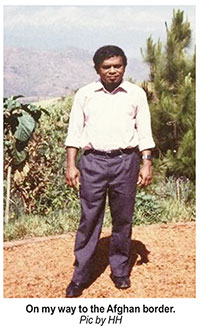
 I had to visit the UNHCR office in Peshawar in 1989 as a World University Service (WUS) representative. WUS Pakistan was assisting refugees independently and apolitically. The visit involved visiting refugee camps in Azakhel and further towards the Pakistan-Afghan border. There was no possibility of crossing the border or visiting Jalalabad in Afghanistan given the heavy fighting.
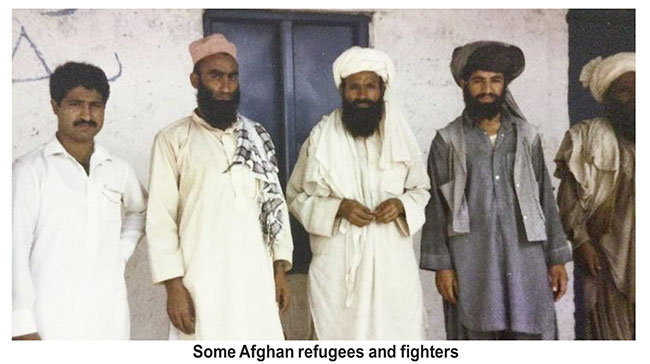
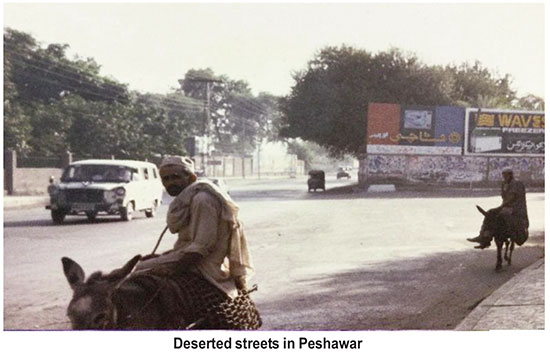
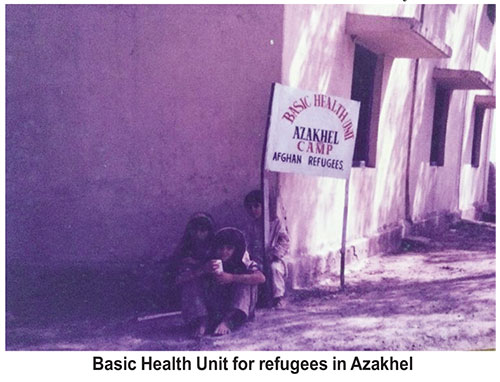
The wounded who were treated at Medicine San Frontier makeshift hospitals were disheartening to look at. In many makeshift camps, young boys carried heavy arms, perhaps guarding their mothers and sisters. These were supposed to be the future Taliban. I was not allowed to take many pictures except of some male refugees/activists (picture 1) and a side view of the Basic Health Unit at Azakhel Camp (picture 2). The streets in Peshawar at that time were largely deserted due to the war (picture 3).
My visit from Geneva was after the Geneva Accords in 1988 between Afghanistan and Pakistan, guaranteed by the US and the Soviet Union. The Soviet Union withdrew and the US promised not to support any faction, true or not. The civil war continued and resulted in a Taliban governed Islamic Emirate in 1997 with many other insurgency (terrorist) groups still operating in the country. The new Emirate was recognised only by a few countries, mainly Saudi Arabia, Pakistan and the UAE. And it fell quite quickly in 2001 when the US invaded.
This bit of history shows how the US, Soviet Union now gone, was involved in the Afghan debacle from the beginning, and the consequences would be extremely difficult to eliminate in the foreseeable future.
What is created?
The speed of the collapse of the US backed Afghan government of Ashraf Ghani shows the futility of what the US and some other Western governments were doing in Afghanistan during the last twenty years in the name of ‘democratic nation building.’
Democracy or human rights could be ensured primarily through internal forces and changes. These cannot be achieved through occupation or colonialism. External examples or diplomatic influence can be useful, if implemented in a friendly manner and not in an arrogant way. Even at present, the way many Western countries reacted to the first press conference of the Taliban was dismissive and arrogant.
It may be true that what they said about the rights of women, female children, the press, and amnesty to those who supported the last government cannot be fully trusted. All might depend on the circumstances. However, those should be welcomed instead of condemned outright for the sake of promoting them in a positive direction. Qualifications must be warranted, instead of sarcasm or condemnation.
What was created by the Western occupiers in Afghanistan appears to be shallow. It is true that some of the middle class sections in urban Kabul and the suburbs embraced Western values, democracy and human rights. That is good. But the great majority of the rural and remote communities were left out. They may have different values or be oblivious of democracy or human rights. Education ought to take precedence over propaganda.
What the occupation largely created were refugees. At present the population in Afghanistan is estimated to be around 40 million. According to the UNHRC, around six million Afghans are living in Iran and Pakistan as refugees. Some of them are reported to be coming back now with some national hope. The UNHCR estimated that Afghan refugees in other, mainly Western, countries amount to nearly three million. They would not come back. Who is unwilling to live in a developed country instead of a poor and a conflict ridden country? The present exodus at the Kabul airport might include not only those who worked for the occupied government but also those who aspire to live in a Western country. Large disparities in living conditions between rich and poor countries is the main reason for such an exodus.
Future challenges
 It would be an extremely difficult task for any future government in Afghanistan to run the economy, day to day administration, while rectifying confusions and conflicts created by the occupiers as well as the Afghans themselves over the past 50 years. Infrastructure development might be a top priority. One hope might be China who would offer to build destroyed or absent infrastructure in the country. There are of course skyscrapers and KFCs built in Kabul. But those are not for the poor or the ordinary.
However, international forces may intervene. China might not be in a position to sort them out at all. China anyway cannot be a panacea. It still does not have much leverage in the UN system or the international community. Therefore, going by the colonial mentality of most of the Western countries, not to speak of the US, there can be future challenges including certain invasions and external influences. There may be a need to look for friends in the West as well. This is what Vietnam did after Saigon.
Of course, there would be major internal challenges as well. Apart from the Taliban, there have been half a dozen other armed groups in Afghanistan. Many have now been integrated into the Taliban, but not all. There can be challenges from ISIS or the remaining Al Qaeda. Whether Afghanistan would again become a haven for international terrorism is also a question. Even about the Taliban itself, we really don’t know much. Therefore, we really have to keep our fingers crossed but not be completely pessimistic, negative or arrogant like the Western pundits.
There is an apparent difference in the Taliban between, for example, 2001 and 2021, that may bring hope for a progressive world. The lessons from Saigon to Kabul are very clear. Diplomacy without interference might be the best for the world in promoting democracy and human rights.
Pics by Laksiri Fernando






by Rajan Philips
Nepal was bracing for Super El Niño. Then it got hit by a two thousand feet wide glacier collapse way up in the Himalayas that sent torrents of water, mud and rocks down valleys and rivers, devastating communities, tourists and physical assets in the mountainous terrains of Nepal and Tibet in China. The disaster struck along the China-Nepal border wreaking havoc on both sides, but a lot more on the side of Nepal than Tibet. More than a thousand people have died, and thousands more are missing in Nepal; about 20 are dead and over 500 missing in Tibet. Hundreds of tourists are also missing on both sides. Many of the missing tourists are South Asian pilgrims from western countries visiting Hindu sacred sites in the Himalayas.
Terrifying videos of the devastation have been going viral. Especially breathtaking is the one showing a monstrous tide of mud sweeping way the Chinese border station building in the Gyirong gorge, a historic crossing point between Nepal and Tibet. Humankind has no defense against the fury of nature whenever and wherever it happens. The force of water in full turbulence is unstoppable. Werner Heisenberg, the great Quantum Physicist, is said to have remarked that on his deathbed he would like to ask God two questions: why relativity? why turbulence? And he suggested that God may have something to say about relativity, implying that there is little we can know about turbulence.
“El Niño Warnings
With global warming water becomes a problem both in its abundance and in its scarcity. Even as Nepal is struggling to recover from its hydro tragedy, the World Meteorological Organization (WOM) is warning that exceptionally warm Pacific waters are aggravating the “El Niño climate troubles and raising the risk of extreme heat, floods and drought around the globe, over the next several months and until February 2027. The South Asian countries have been earmarked for special treatment by El Niño. Already this year, Europe has experienced unusual heat waves and floods, while forest fires from British Columbia in Canada to Indonesia in the far east.
To climate modellers, “El Niño and La Niña are the yin and yang of a phenomenon known as the El Niño-Southern Oscillation, a years-long cycle of warming and cooling of surface waters in the central to eastern tropical Pacific Ocean.” The former is associated with warming waters, and the latter with cooling waters. Either of them can alter weather patterns and surcharge the extreme effects of climate change.
Also, different continents experience the effects of heat and rain differently. Even within countries, there can be floods in some parts while drought and fires affect others. This year’s El Niño is expected to be unusually stronger and the carryover effects next year are expected to be greater. The baseline comparison is to the year 2024 which was the warmest year in the planet’s history. 2027 may break that record.
The UN and the WMO (World Meteorological Organization) are doing their parts, but the leaders of states and governments everywhere have other pre-occupations. Donald Trump is being his usual silly busy renaming Lake Ontario, one of five Great Lakes of North America, Lake America! That is his way of spiting his country’s northern neighbour, Canada. Every country is spending more money to defend itself against other countries. Among western countries, defense spending has become the new economic growth pole. More submarines, more jets and yes, more drones, but very little to deal with climate change – to reduce global warming, to increase weather preparedness and to be ready for disaster mitigation.
A few days before the August 26 glacier collapse in Nepal, I was browsing through Sri Lankan news reports about the level of preparation in Sri Lanka to deal with the anticipated effects of El Niño. Per usual the government was under fire for apparent tardiness in preparing for El Niño. The Department of Agriculture (DOA) was advising farmers to conserve rainwaters from the Maha season to cope with the likely drought for the Yala season next year. I have a problem understanding where and how can farmers, on their own, build water reserves for paddy fields between seasons? I suppose any advice is better than no advice.
And droughts are already occurring in many cultivating areas even as the Castlereagh and Maussakelle reservoirs are reportedly reaching overflow conditions. In some places people had taken to freshwater fish farming, but now they are reportedly walking miles in search of drinking water. Sri Lankan Navy personnel have been photographed feeding water to the wild ponies in Delft. A Peradeniya academic has chimed in about the climate physics of El Niño and the disruptions it is going to cause. What was once limited to climate wonks is now daily bread for everyday commentators.
The Nepal Tragedy
Online El Niño browsing took me to papers in Nepal and some informed popular articles by the country’s climate experts and activists. The articles were about getting prepared for the drought and rains of El Niño. But what hit Nepal and Tibet a few days later on August 26, had nothing to do with El Niño, but had everything to do with global warming, rising temperatures and melting ice in massive quantities and at high altitudes. A week after the disaster a clear assessment of what triggered it is emerging, thanks to satellite images and concurrent analyses by climate experts around the world.
The initial attribution to an earthquake in the area and the later causal correction to a glacier side have now been supplemented by the identification of a bedrock failure underneath the glacier and it is the ensuing avalanche that registered a 5.2 seismic event. As two New York Times reporters (Raj Saha and Jeremy White) have graphically illustrated, the avalanche released “more than seven billion cubic feet of rock and ice,” enough to “fill around 100 football stadiums” in the US. Further, “the debris traveled downstream with a flow rate at least 30 times that of Niagara Falls, … reached a peak speed of over 100 miles per hour … and traveled more than 60 miles, destroying towns and bridges and killing more than 1,000 people.”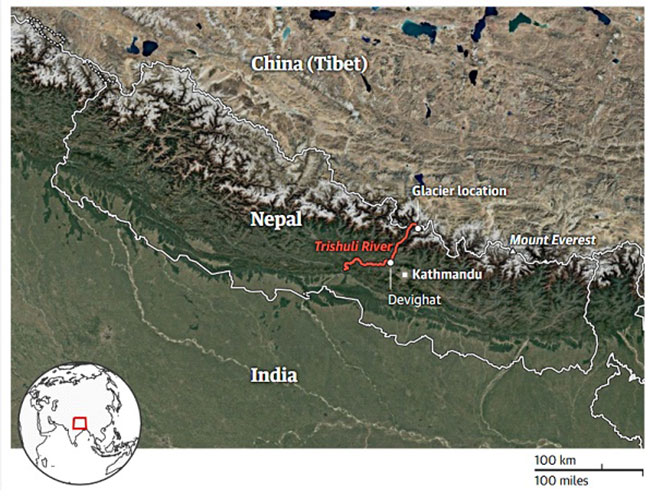
For more context, the Trishuli River (named after Shiva’s trident -trishula), which flows between Gyriong in Tibet and Rasuwagadhi in Nepal, dropping 2,000 metres over a distance of 30 kilometres from its glacier origins to the valley below, became the main conduit of carnage. Overall, 32 concrete bridges were washed away and 12 hydropower projects (accounting for 431 MW) were damaged, with many of their tunnels inundated with over 900 workers stuck in them still unaccounted for.
The disaster is generally attributable to growing glacier instability in the Himalayan area that includes some of the largest glacial systems outside the polar regions. The mountainous area extends over 2,400 km and nearly 600,000 sq. km in five countries (India, Nepal, Bhutan, Tibet (China) and Pakistan), and feeds the hugely populated basins of the Indus, Ganges, and Brahmaputra rivers. Climate change and air pollution have led to the glacier system retreating and melting at alarming rates. A dozen mountainous catastrophes have occurred over the last 20 years, and new satellite images are showing old warning signs that would appear to have been missed.
Astha Guragain, a Nepali climate researcher and activist, has raised the very pertinent question of climate justice in assigning cause for the glacial instability in the Himalayan region within Nepal. His argument is that “Nepal contributes less than 0.01% of global carbon emissions yet is exposed to disproportionate vulnerability from its consequences.” The government of Nepal has estimated the cost of disaster to be $5 billion, a huge amount for a country of 31 million people and $44 billion GDP.
The Nepali government has formally requested funding support from the special UN climate fund. The problem is that the fund has little money because of American indifference and non contribution by others. The current fund balance is a disgraceful $820 million in pledges! Already, there are applications from 119 countries for a total amount of $2.8 billion. The US pledged a paltry $17.5 million under President Biden, but it is nothing under Trump after his decision to pull out of the Paris Accord and the Green Climate Fund, even though the US is the world’s largest emitter of greenhouse gases.
The tragedy poses a huge challenge to Nepal’s new Rastriya Swatantra Party government and its 36 year old Prime Minister Balendra Shah. They were elected only in March this year, winning 182 out of 275 seats. The March elections came after massive youth protests and the ouster of the previous government in September 2025. Shah is a Structural Engineer and rapper artist who forayed into national politics when he was elected as Mayor of Kathmandu in 2022. The still fledgling government is also young of age with 17 its 18 ministers, including the Prime Minister, under the age of 40.
Yet the young Engineer Prime Minister is striking the right notes in asking for international help without diminishing Nepal’s sovereignty. Attributing the current disaster to climate change, Mr. Shah has said that “climate change is a global contribution and its response is also a global responsibility.” While asking for legitimate funds, the government has also turned down instant offers of foreign organizations to undertake search-and-rescue operations.
The refusal is based on the country’s experience after the 2015 earthquake, when the arrival of 76 international teams and over 2,200 personnel overwhelmed Kathmandu’s single-runway airport. And the national memory is that while 53 foreign teams pulled 19 people from the rubble, local forces moved much faster and saved many more lives.
Nepal’s tragedy is also a test to the international community, especially to western governments and leaders, to respond to this Himalayan manifestation of the world’s climate crisis in a formal and substantive way through UN agencies and not use it as another charity moment to be handled by the Red Crosses of the world.
Epoch maker, role model for our readers and especially for our youth
A translator’s view
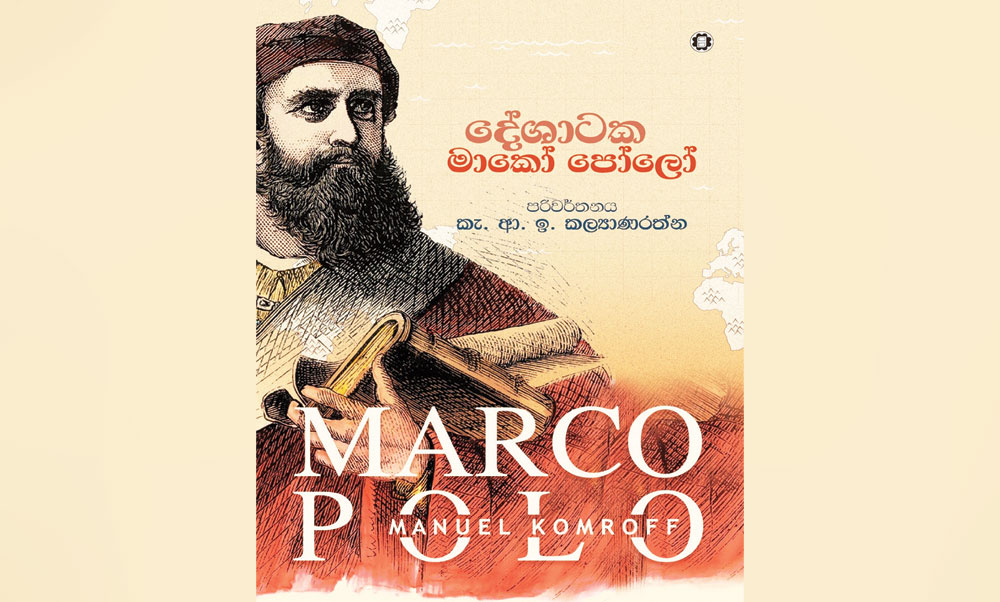
Book: ‘Deshataka Marco Polo’
(A translation of Marco Polo by Manuel Komroff
Translator: K. A. I. Kalyanaratne
Publisher: Sarasavi
By K. A. I.Kalyanaratne
We are currently experiencing a book market characterised by a disproportionate number of publications, particularly in genres such as romantasy, a blend of romance and fantasy.
Hence, the current status, more importantly with regard to reading, would raise the issue as to how far Francis Bacon’s quote, “Reading maketh a full man” continues to be valid in the prevailing circumstances.
Bacon, in fact, emphasised the truth of the transformative power of reading in moulding an individual’s personality through expanding the skill of understanding, empathy as well as emotional intelligence. Reading also helps one to become wise, witty as well as expanding the capability of making precise judgments. In short, Bacon’s perspective on reading as a means of intellectual growth would remain relevant if the reader has the vision and wisdom to pick what to read and shed what to be left .
It is, therefore, amidst these challenges that I decided to launch into this highly risky task of translating Marco Polo into Sinhala. Hence, the tasks of translating a book, the theme of which is quite off the popular track, as well as undertaking such a risky job by the publisher are indeed challenging.
Nevertheless, both the translator and the publisher have won the battle, as the end-product appears to attract the attention of all levels and types of readership and entice especially our youth. Youth should be our target group. The credit for overcoming this tremendous battle should also be given to the author of the original book, Marco Polo, American writer Manuel Komroff, whose style of writing has given life, action and spirit to an otherwise ‘boring / dry subject’, which belongs to a ‘bygone era’. Further, Marco Polo evokes memories of distinctive qualities and events, which continue to bring value that compels us to remember and reflect upon.
Manuel Komroff’s exceptional ability to bring history to life
A normal writer would commence by saying that as Marco Polo had grown and also become strong, he could join his father and uncle on their next expedition. But Manuel Komroff dramatised the event and made the unfolding of the story lively by creating a dialogue between the father (Niccolo Polo) and the son (Marco Polo). This approach enticed and captivated the reader from the very beginning of the narration. It also shows indirectly how fit the son was in undertaking a highly risky and geographically unknown journey, venturing into uncharted waters fraught with storms, shipwrecks, and starvation. These were only a few, out of the numerous hazards they had to overcome. Every step was a step towards uncertainty. This is how the author raises the curtain:
Now, Nicolo Polo, Marco’s father, invited his son to accompany them on their next expedition.
Nicolo looked at his son and smiled.
‘You have grown, you are strong’ he said.
‘Yes, this time you shall go with us to the court of Kublai Khan.’
It had been a wonderful day. Such a wonderful day. But now Marco’s joy knew no bounds.
That night when young Marco closed his eyes, he dreamed of far-off lands and strange races. He dreamed of oriental wonders, marvels and splendors.
He awoke early the following morning. From his bed he could see the rim of the sun mount the eastern horizon across the bay. How far east was Cathay?
Soon, very soon, he could be journeying eastward to that magical land of Cathay. This was the first place of his heart’s desire.
Manuel Komroff’s exceptional descriptive ability to drive life into dry historical facts
Hats off to Manuel Komroff for enabling the Sinhala reader, through this translation, to see how a collection of historical data could be infused into a colourful and dramatic description. Although it is true that words provide the medium for conveying ideas, using them to create the desired liveliness is a different art that needs to be consciously and conscientiously developed. The Sinhala translation provides the opportunity for our readers to experience that vitality in writing.
A further specific instance of Komroff’s exceptional descriptive ability is his narration of the Emperor Kublai Khan’s arrangements in Xanadu (Shangdu) to spend the hot summer months in the cool Manchurian Hills. (Chapter 13). In short, what Manuel Komroff has performed is to bring history to life using the technique of storytelling and making historical events, people and periods engaging and memorable. In fact, this special feature would have been the reason that lured me initially to procure the book, 48 years ago.
Marco Polo – Character study / Character exploration
Anyone and more importantly our youth who need guidance in choosing a ‘Role-Model’ I would unhesitantly recommend studying Marco Polo. A man of character is not measured only by his achievements, prosperity or status, but by the values and principles he constantly upholds. In short one’s character reflects the totality of a person’s disposition, intentions, thoughts and actions, forming a ‘moral-compass’ that directs decisions and behaviour in all instances.
Apart from the tough journey he undertook with his father and uncle, a journey fraught with unpleasant circumstances, to the court of emperor Kublai Khan, winning the emperor’s trust and confidence were not easy tasks. Only a man of deep foresight could move with an emperor whose leadership style demonstrated both the administrative sophistication he had developed, and his ability to coordinate diverse forces towards a unified military objective.
Marco Polo’s deep foresight enabled him to look far ahead of the immediate future, and to adapt to the new environment in which he had to discharge his duties. His acquisition of skills to undertake the long journey, with his father and uncle, and mastering the skills needed to undertake both sea and land expeditions, even before his father gave the consent to accompany them in their second journey to the east, displayed how futuristic Marco Polo’s strategic thinking was.
Once entrusted with honourable and onerous tasks by emperor Kublai Khan, he mastered four languages demanded by the tasks (including Persian, Mongolian, Turkic and Cantonese) and also studied the administrative structures of the empire. It was due to these rare virtues that Kublai Khan once entrusted Marco to undertake a long journey up to Burma, and collect all information needed to plan the country’s economy and restructure taxation within the empire. These tasks, in fact, demanded extraordinary skills as well as extreme integrity and also exceptional leadership.
Marco Polo’s extraordinary foresight
Coupled with the aforesaid virtues / qualities Marco Polo was a visionary who possessed an extraordinary foresight, our youth need to consider developing them. While foresight carries a weight of expectation, people possessing this quality also acquire the ability to look beyond the immediate future, and make near accurate predictions. This ability, in short, involves critical thinking, creativity, strategic planning and fathoming of the forces that shape both the immediate vicinity as well as the rapidly changing outer world / peripheries. These are musts for any person who wishes to lead and reach his / her vision, rather than getting led by the forces and succumbing to them.
What Hendrik Willem says about Marco Polo in The Story of Mankind
“The crusades had been a lesson in the liberal art of travelling. But very few people had ever ventured beyond the well-known beaten track which led from Venice to Jaffa. In the thirteenth century the Polo brothers, merchants of Venice, had wandered across the great Mongolian desert, and after climbing mountains as high as the moon, they had found their way to the court of the great Khan of Cathay, the mighty emperor of China. The son of one of the Polos, by the name of Marco, had written a book about their adventures, which covered a period of more than twenty years. The astonished world had gaped at his descriptions of the gold towers of the strange island of Zipangu, which was his Italian way of spelling Japan. Many people had wanted to go to the east, so that they might find this gold-land and grow rich. But the trip was too far and dangerous, and so they stayed at home.”
Final thoughts: Why Marco Polo still matters
Many readers would cast Marco Polo in the category of explorers like most others who engaged in explorations. This is far from the truth. He wasn’t a mere explorer. He was a bridge-builder, a cultural translator, as well as a visionary who taught that the world was far more integrated than Europeans at the time imagined. Unlike most others his tasks were not confined to just mapping of lands. As some historians expressed, his gritty journeys “rewired global trade” and became a global connector, triggered technological curiosity, and prepared the stage for centuries of more and more explorations, which ultimately resulted in reshaping the earth to its true form. Christopher Columbus, if not inspired by Marco Polo’s ‘Il milione’ (The Travels of Marco Polo), wouldn’t have, for certain, sailed west. Similarly the Portuguese might not have brought the seas and lands under their domination. In short, Europe’s economic growth and expansion might have been delayed by many a century. Marco Polo was thus an epoch maker, who changed history forever.
By Avishka Mario Senewiratne
Editor-in-Chief Ceylon Journal
By now, with the renewed interest and discussions on Martin Wickramasinghe in which you may have taken part before today, let alone the fascinating accounts by my three esteemed colleagues who have spoken would have given you a clear indication that Wickramasinghe was an ‘ideas’ man, who had an opinion and criticism for any subject his eyes or senses laid on. My focus is on a lesser known, hardly discussed perspective, which you will possibly consider as controversial. And that is Martin Wickramasinghe and the Catholic Church.
After Mrs. Sirima Bandaranaike’s SLFP government won the elections of July 1960 there was a period of considerable political and social change. Among its most controversial measures was the state takeover of assisted and denominational schools. The controversy soon went beyond education. It raised larger questions about religion, democracy, and where the authority of the Church should end and that of the State begin.
It was also a lively period in Sri Lanka’s intellectual life. Christianity, democracy and education were debated by formidable minds: Martin Wickremasinghe; Fr. W. L. A. Don Peter, historian and later Rector of St. Joseph’s College; and Bishop Edmund Peiris OMI, the first Sinhalese Catholic bishop and himself a distinguished historian and Sinhala scholar. It is against this background that I approach Martin Wickremasinghe and the Catholic Church.
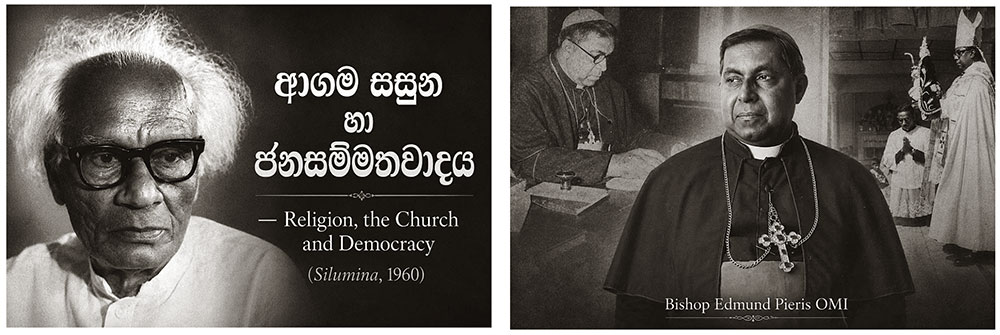
The first part of my discussion are some thoughts on a series of articles Wickremasinghe wrote to the Silumina in 1960. In his first article, “ආගම, සසුන හ ජනසම්මතවාදය”—Religion, the Church and Democracy—he argues that religion should not merely consist of theories and dogmas but must be practiced by its followers. Surprisingly, on this aspect, Britain interested him because it retained a monarchy while political power had become democratic and religion no longer commanded the machinery of government. From here, Wickremasinghe turns his guns on the Catholic Church.
He attacks the Catholic Church’s history of censoring books from the ancient to recent times. To him, an institution which prohibits ideas sits rather uncomfortably beside democracy. There is also some wit in his observation that censorship rarely works as scholars and serious readers will somehow find the forbidden books and probably become even more determined to read them. One might also note his severe criticism of the Catholic Church in his work Evolution and Revolution (1971) for censoring Fr. Teilhard de Chardin’s The Phenomenon of Man (1955). Wickramasinghe was known to be an admirer of Chardin.
However, his deeper quarrel was with the hierarchical structure of the Church. Catholic priests administering schools, he argues, did not necessarily represent ordinary Catholics but an ecclesiastical establishment answering to bishops and ultimately Rome. He questions Church authority over marriage and birth control and objects to religious intervention in science. Papal infallibility particularly troubled him: how can unquestionable authority, he asks in effect, coexist with a society founded upon questioning?
Yet Catholics are not Wickremasinghe’s only targets. Buddhist monks receive their share of the fire. He criticizes the temperance movement, arguing that prohibition would hardly make people sober. The working classes might simply turn to illicit arrack, damaging their health while depriving the government of revenue. To sum up, Wickramasinghe states that public policy should follow social realities rather than religious morality.
In a subsequent article he argues that religious education fares little better. Both Buddhist Dhamma schools and Catholic Sunday schools come under scrutiny. Religion, Wickremasinghe argues, cannot simply be learnt from books; it must be lived. Despite the multiplication of religious schools, he saw no corresponding decline in crime among Buddhist or Christian youth. More religion classes, therefore, did not necessarily produce more virtuous—or better—people.
However, four years earlier, in his book Bana Katha Sahithya, he credited S. Thomas’ distinctive artistic tradition to English clergymen formed by Greek and English literature and inspired by religious ideals. He could therefore admire Christianity’s contribution to culture and education while remaining deeply critical of the authority, censorship and institutional power of the Church itself.
His criticism of Catholicism must also be understood against his view of the colonial missionary legacy. He regarded parts of the Christian establishment as elitist and closely associated with educational and institutional power. Accordingly it must be understood that his criticism against the Church was not for its theology but for its impact on privilege, censorship, authority and bureaucracy.
This is what makes his position more interesting. The larger question Wickramasinghe asks and one that is still relevant was – where should religion end and democracy begin?
Wickremasinghe also observes that elite schools such as S. Thomas’, Royal and Wesley may produce decent and civilised young men, but questions whether their virtue necessarily comes from religious instruction. Good manners and discipline, he warns, should not automatically be mistaken for religious virtue.
But some of his criticisms are problematic. His treatment of papal infallibility appears to make it a broad claim to unquestionable authority, whereas Catholic doctrine confines it to particular circumstances concerning faith and morals. His larger question about authority remains legitimate, but his treatment of the doctrine of papal infallibility is incomplete.
He also accuses the Church of discouraging Catholics from participating in activities initiated by Buddhists and non-Catholics yet provides no evidence from Ceylon for such a sweeping conclusion. Similarly, he suggests that Catholic schools did more than educate children— and that through religious education they exercised control over parents and families. Catholic schools certainly preserved religious identity, but control is a considerably stronger accusation and requires considerably stronger evidence.
The conclusion of the essay is revealing. Writing amid the growing Sinhalaisation of Ceylon, Wickremasinghe argues that a free Buddhist society required two things: a strong socialist government and a strong Sasana.
There is an intriguing tension here. He subjects ecclesiastical authority to severe criticism while placing considerable faith in a powerful socialist State. He even goes on to say that socialism could resolve both social and economic anxieties of society. He could not, of course, have foreseen the later record of Sri Lanka’s socialist experiments.
Wickremasinghe soon received an answer from Bishop Edmund Peiris. Peiris corrected what he regarded as Wickremasinghe’s errors concerning Catholic history, doctrine and the functioning of the Church. This was not a quarrel between strangers. Their association went back at least to 1932. Peiris admired Wickremasinghe’s novels and criticism, while Wickremasinghe respected the Bishop’s scholarship. In replying, Wickremasinghe called Peiris an “old friend,” who wishes “not to quarrel,” and clarified an important distinction: his criticism was principally against the institutional Church and the Vatican, not Christianity as an ethical and social teaching.
To support his argument that the Church historically opposed rationalism, democracy and science, Wickremasinghe relied heavily upon J. B. Bury’s A History of Freedom of Thought (1913). He dismissed Hilaire Belloc’s criticism of Bury as largely corrections of dates, statistics and details rather than a refutation of Bury’s central argument.
Here, Wickremasinghe was perhaps too willing to accept an interpretation congenial to his own rationalism. Bury wrote from a strongly rationalist and anti-clerical standpoint; Belloc was a committed Catholic controversialist. Wickremasinghe failed to note that neither gentleman arrived at the argument without luggage.
Nor could modern Catholicism simply be characterized as an opponent of democracy and social progress: by Wickremasinghe’s lifetime, Catholic social teaching had developed considerably on labour, social justice, human dignity and the responsibilities of the State.
With that exchange coming to a close, I would focus on the second aspect of my argument: Martin Wickramasinghe and Fr. Don Peter.
In June 1960, amid the controversy over the school takeover, Archbishop Thomas Benjamin Cooray publicly defended the democratic right of Catholic schools which had played a pivotal role in the freedom struggle to remain under Church ownership while strongly attacking Marxist statism. Ven. Madihe Pannasiha Thera responded in the Dinamina, accusing Catholic education of undermining the Buddha Sasana and provocatively comparing Catholicism with Marxism.
Defending the stance of the Church, Fr. Don Peter replied to the Dinamina. He dismissed the comparison between Catholicism and Marxism as nonsensical and challenged the foundations of Pannasiha Thera’s argument. It was in this milieu that Martin Wickramsinghe, then aged 70, entered the argument as a response to Fr. Don Peter’s article. This response didn’t end up in one article but a series of four others each by Fr. Don Peter and Martin Wickramsinghe.
Martin Wickramasinghe’s first response titled “Is the Catholic Church Democratic?”, starts his argument by saying “මඩිහේ පඥ්ඥසීහ මහහිමියගේ එක් චෝදනාවක් වත් අසාධාරණ නොවේ යයි හැ(ගේ)” Wickramasinghe argued that the political outlook of the medieval Roman Catholic Church was closely associated with a hierarchical and authoritarian conception of the state. He connects this tradition with the philosophy of Aristotle and St. Thomas Aquinas and contrasts it with modern democracy, which he sees as developing largely from the ideas of English thinkers such as John Locke and David Hume. However, Wickramasinghe does not claim that Catholic doctrine explicitly demands an anti-democratic state; he acknowledges that the evidence from Pope Leo XIII does not necessarily prove such a position.
Nevertheless, he stated that the Church’s historical conduct gives some justification to accusations of authoritarianism. He particularly points to the Catholic Church’s support for Francisco Franco’s dictatorship in Spain and cites Pope Pius XI who called the Fascist Dictator Mussolini, “a man sent by Providence,” after the Vatican Treaty of 1929. Wickramasinghe distinguishes the teachings of Jesus and early Christianity from the political character later acquired by the institutional Church. Drawing upon the Marxist scholar Karl Kautsky’s Foundations of Christianity, he suggests that primitive Christianity possessed egalitarian, even communistic or socialist, characteristics. Although Kautsky was a Marxist, Wickramasinghe argues that his historical criticism cannot simply be dismissed. Overall, he presents Christianity as an evolving historical institution whose later authoritarian tendencies should not automatically be attributed to Jesus’s original teachings.
In his response to Wickramasinghe, Fr. Don Peter’s article is titled “කතෝලික පවුලේ පාලනයට ප්රජාතන්ත්රවාදය උවමනා නැත.” He laments stating that he thought Wickramasinghe was a moderate and not an extremist for the first line in the latter’s response “මඩිහේ පඥ්ඥසීහ මහහිමියගේ එක් චෝදනාවක් වත් අසාධාරණ නොවේ.” Here, his strongest contention to Wickremasinghe rests upon a simple distinction: the Catholic Church is not democratic in its internal government, but this does not make it anti-democratic. He argues that the Church does not claim that every legitimate political system must imitate its own hierarchical structure. Nor, he maintains, should the actions of Catholics in a particular country or period be taken as proof that the Church itself is opposed to democracy.
To explain this, Fr. Don Peter compares the Church to a family. A family is not governed democratically: children do not elect their parents or vote upon every decision. They obey their father because they trust his love, judgement and concern for their welfare. In the same manner, Catholics regard the Pope as a spiritual father and accept his authority as the representative of Christ. This obedience, Fr. Don Peter stresses, concerns principally religious and spiritual matters and applies to Catholics, not to society as a whole.
The distinction is important and exposes a weakness in Wickremasinghe’s argument. A hierarchical institution is not necessarily hostile to a democratic State. Universities, armies and even political parties may contain hierarchies while functioning within democracies.
Yet Fr. Don Peter’s family analogy is not totally convincing. Children possess limited autonomy because they are minors; adult Catholics are morally and intellectually responsible individuals. Comparing ecclesiastical obedience to a child’s obedience to his father risks becoming paternalistic and may actually strengthen Wickremasinghe’s concern about unquestioned authority. Don Peter successfully demonstrates that non-democratic and anti-democratic are not synonymous, but his argument does not entirely answer the larger question Wickremasinghe raises: how should a hierarchical religious authority operate within a society increasingly committed to individual judgement, intellectual freedom and democratic values? Though Wickramasinghe’s criticism is about the Catholic Church’s lack of democracy, he fails to mention how or how not Buddhism or any other main religion functions in a democratic hegemony.
In his next response, titled “ජනසම්මතවාදය හා රෝමානු පල්ලිය,” Wickremasinghe began by apologising to Fr. Don Peter and clarifying that he had actually written, “මඩිහේ පඥ්ඥසීහ හිමියගේ එක් චෝදනාවක් අසාධාරණ නොවේයැයි මට හැගේ,” rather than “එක් චෝදනාවක් වත් අසාධාරණ නොවේ.” The editor of the Dinamina also apologised to readers for the erroneous addition of “වත්,” which had significantly altered the meaning and perhaps contributed to Fr. Don Peter escalating the debate.
From this point, however, the exchange became increasingly polemical. Wickremasinghe revealed some confusion regarding the distinction between the Roman Catholic Church and the local Church in Sri Lanka, an issue Fr. Don Peter readily seized upon. He also invoked an earlier criticism by Panditha Vimalawansha Thero, who had claimed that Wickremasinghe lacked sufficient knowledge of Buddhism and the history of its propagation. Don Peter therefore questioned how someone accused of misunderstanding his own religious tradition could confidently pronounce upon the Catholic Church.
The debate consequently drifted further from its original argument about Catholicism and democracy. The Gnanartha Pradeepaya joined the controversy, attacking Wickremasinghe with the cutting remark, “වික්රමසිංහ මහතා පණ්ඩිතකම කට ගාගත්තෙකැයි.” Thereafter, the exchange gradually petered out without a proper resolution, leaving behind considerable disagreement and evidently some resentment among those involved.
Two years after this exchange, in 1962, Wickremasinghe published Sinhala Sakaskada, a collection of essays on culture, anthropology, democracy and religion, including his articles on the Catholic Church, the school takeover and his responses to Fr. Don Peter. On 14 July 1962, Don Peter wrote to Wickremasinghe questioning why his replies had been omitted, arguing that Catholic readers had thereby been denied the other side of the debate. Wickremasinghe replied that the book was essentially a collection of his own writings but encouraged Fr. Don Peter to publish the entire exchange himself. Fr. Don Peter accepted the suggestion and subsequently published his own Sakaskädé.
In 1964 Fr. Don Peter made a surprising gesture. He invited Wickremasinghe, then nearly 75, to be Chief Speaker at the Sinhala Day of St. Joseph’s College. Wickremasinghe accepted the invitation. Fr. Don Peter later recalled that the two had a long conversation near the College swimming pool and finally resolved the differences arising from their 1960 controversy. Their friendship continued until Wickremasinghe’s death. At St. Joseph’s College, Wickramasinghe who spoke for nearly an hour urged English-educated Sinhalese to value their mother tongue, literature and culture, arguing that without such knowledge they could not understand or live harmoniously with their fellow countrymen. Afterwards, the Literary Association staged Amal Biso, written by Fr. Marcelline Jayakody OMI and produced by Fr. Joe Neththasinghe.
His friendship with Bishop Edmund Peiris likewise endured. More importantly, Wickremasinghe was closely observing the remarkable transformation occurring within Catholicism through the Second Vatican Council of 1962–65. He welcomed its liturgical and ecumenical reforms, greater openness towards other Christian traditions and the growing indigenization of the Church, regarding these as important steps in making Catholicism relevant to the modern world. For the Century Jubilee of the Gnanartha Pradeepaya in 1966, Martin Wickrasinghe wrote the following: “I cannot help but say that I have always had a great fondness for the paper, because of the taste and skill with which it is produced, and because, although its articles are religious in character, they are written in a manner that appeals to anyone. I believe that the editor deserves the highest praise for bringing out a publication of this kind.” (Translated by the writer)
When Edmund Bishop Peiris retired as Bishop of Chilaw in 1972, Wickremasinghe even contributed an article to the Gnanartha Pradeepaya, ironically, the same Catholic newspaper which had attacked him during the earlier controversy, praising Peiris as an important scholar and historian. Bishop Edmund Peiris later wrote perhaps one of the finest assessments of Wickremasinghe’s vast literary output, “The Sage of Koggala,” for his 85th birthday in 1975. More recently, Fr. Ivan Perera recalled to me that, as a seminarian in 1960, he typed Fr. Don Peter’s correspondence with Wickremasinghe for the Dinamina and years later when the controversy mellowed down accompanied Wickremasinghe to the Ampitiya National Seminary, where he addressed the seminarians and even spent the night in Ampitiya. All these are indications of how relations had changed as Wickremasinghe observed the evolution of the Church.
The reconciliation went further. Fr. Tissa Balasuriya, then Rector of Aquinas College, invited Wickremasinghe as Chief Guest at its convocation. Addressing the gathering Wickremasinghe spoke admiringly of Teilhard de Chardin and encouraged the students in their pursuit of learning and embedding an indigenous, original culture and religion.
Thus, the story did not end with the polemics of 1960. Wickremasinghe’s judgement became more nuanced, while the Catholic Church itself was undergoing significant change. Perhaps the lasting value of this episode lies not in deciding who won the argument, but in what followed it. Wickremasinghe and Fr. Don Peter disagreed sharply, yet dialogue eventually gave way to mutual respect and friendship. Their story reminds us that a civil exchange of opposing views need not deepen divisions. At its best, intellectual disagreement can correct misunderstandings, refine convictions and, ultimately, bring both sides towards a better understanding of one another.
Although Wickremasinghe’s relations with the Church improved, many of the questions he raised in the 1960s remain relevant. Less than 20 years after his death, Fr. Tissa Balasuriya’s Mary and Human Liberation came under severe ecclesiastical scrutiny, eventually leading to his temporary excommunication and controversy over the censorship of his work. Once again, Fr. Don Peter firmly defended the position of the Church.
The episode almost brings the story full circle. Questions of censorship, intellectual freedom and ecclesiastical authority, the very issues that had troubled Wickremasinghe decades earlier, had returned in a different generation and circumstance. One can only wonder: had Martin Wickremasinghe lived to witness it, what would he have said?

Shree Charani, Prema Rawat spin Pakistan out for 55 in one-sided contest

Sun directly overhead Bentota, Thiniyawala, Iththakanda, Udawalawe, and Kataragama about 12.08 noon t9day (06)

Showers above 75 mm are likely at some places in the Uva and Eastern provinces.

Tharanga creates history with Diamond League crown in Brussels

UN welcomes Lanka’s anti-graft drive, seeks end to impunity

Dispute which triggered listed company director being detained at BIA resolved

‘Dates have the highest sugar content to fight Coronavirus’

Sunday Island 27 December – Headlines

#SundayIsland 17th December – Headlines

Sunday Island – 28th March

Sunday Island Headlines – 21 March

Sunday Island – 21st February – Headlines
-

 Features7 days ago
When Sri Lankan stories find their own voice
-
 News7 days ago
BASL takes exception to Justice Ganepola being denied a place in SC
-

 News4 days ago
Denied of promotion to SC despite vacancies, justice Gurusinghe retires
-
 Latest News4 days ago
Grade 5 scholarship exam results released
-

 News4 days ago
22A: SC urged to suspend hearing, appoint full bench
-

 Midweek Review5 days ago
The local and global dynamics of Sri Lanka’s 22nd Amendment
-
 News4 days ago
Govt. seeks NATO assistance
-

 Business7 days ago
ADB-funded Thalaiyadi plant serves as blueprint for vulnerable dry zones in Sri Lanka