
Features
The Sandahiru event – celebrating failure

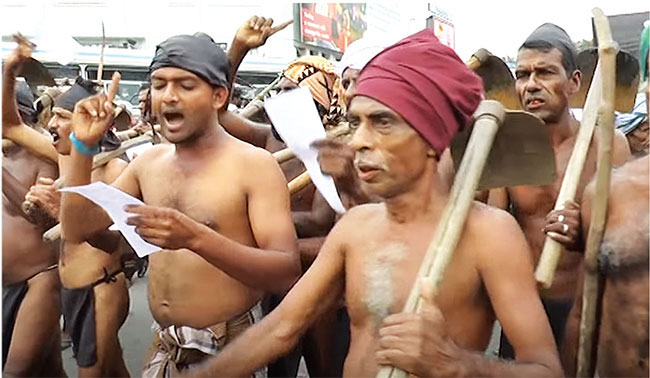
by Anura Gunasekera
A few days ago President Gotabaya Rajapaksa(GR), the first military man and, unarguably, the most ignorant in the ways of governance to occupy the presidential seat, celebrated the completion of two years as the eighth president of the Republic of Sri Lanka. The salutation coincided with the formal vesting with the Sangha, of the “Sandahiru Seya” in Anuradhapura, a project commenced during brother Mahinda’s last term as president. A towering stupa rising above the Jetawana and the Abhayagiri, ostensibly to honour the services rendered by the armed forces and the police in our ethnic conflict but, in reality, a monument to the Rajapaksa delusions of grandeur, aligns the Rajapaksa Family dynasty with the Sinhala Kings. A tribute to the heroic is justified but the supreme incongruity of conflating the quintessential Buddhist symbol, with success in a bloody military campaign, is inconsequential to a hegemonic mindset. The incompatibility was also ignored by the Rajapaksa-adoring Sangha, including the Anunayake Theros of both Asgiriya and Malwatte Chapters, who participated and enthusiastically endorsed its purpose.
Notwithstanding a grandiose commemoration, as Rajapaksa’s second year in the presidency ends and the year 2021 draws to a close, the country stands mired in calamities on every public front.
The Crisis
The economy is in disaster mode. Foreign reserves which were at USD 7.5 Billion in November 2019, when GR took office, had declined to USD 2.8 Billion by August 2021. Despite Central Bank Governor Cabraal’s blithe assurance that the economy can be restructured without IMF assistance, and that wildly reckless money-printing has no impact on inflation, banks are unable to provide importers with forex to import essentials, whilst prices of basic commodities are placing them beyond the reach of ordinary consumers. According to most economists, in the real world, when money printing increases in a background of stagnant or declining national output, all other factors being equal, hyper-inflation is the certain outcome. Recent historical examples are too numerous to quote here. However, Cabraal, who is one of the architects and, also, a highly privileged inhabitant of the Rajapaksa Dystopia, is obviously reading from a different text!
For the last few months, in every village, town and city across the island, for the first time since the Sirimavo Bandaranaike regime 50 years ago, desperate citizens have been waiting in queues to buy the most basic items. There are frequent shortages of sugar, rice, milk powder and cooking fuel; very recently, suppliers ran short of kerosene oil, the only convenient and affordable alternative to cooking gas. Gathering firewood is not an option, especially for the four million urban population of Sri Lanka.
The government has responded to the foreign exchange shortage by imposing drastic regulations to limit dollar usage, declaring over 600 imported items, including mobile phones, clothing, household appliances and a range of foods, as non-essential. Vehicles imports are also included in the restrictions.
Prices of essential foods, vegetables and staples have seen an astronomic escalation during 2021, due to low supply, either because of import restrictions or, in the case of locally grown items, a result of poor harvests due to denial- through unavailability- of basic nutrient inputs, and disruptions in the supply chain from distant growing areas.
The Cause
The pandemic has contributed to the crisis, dismantling livelihoods with some of the monthly paid subjected to wage cuts or layoffs, whilst daily paid workers are denied earnings through inability to access places of work or, because the lockdown has compelled the closure of many small establishments, which rely mainly on casual labour. As in many countries in the developing world, in Sri Lanka, the informal, small and medium scale entrepreneurial sector collectively supports more livelihoods, than either the State or the corporate sector. However, the Covid pandemic is only a contributory factor to an escalating socio-economic disaster. The government, through the implementation of a series of imprudent and ill-conceived policies, has aggravated the situation to a degree beyond retrieval.
Immediately after assuming the presidency, GR ordered sweeping tax concessions, which resulted in the diminution of government revenues by about 30% in 2020. These concessions were beneficial to a minute proportion of the population, which actually needed no such relief. They did not cascade to the ordinary citizen. Soon thereafter, to bridge the cash supply deficit the money printing spree commenced, according to some sources injecting as much as an additional 35% – 40% in to the economy, by mid-2021.
The pandemic Task Force was led by a retired army commander, appointed by a president unable to distinguish between the scientific complexities of fighting a virus, and the tactical requirements of assaulting an enemy garrison. This mindset was also compounded by an inherent insensitivity to the suffering of ordinary people. The mismanagement of the project in its early, critical stages led to an escalation of infections and deaths, especially amongst the elderly who were denied vaccinations at the outset. Successive waves of infection even led to embarrassing State sponsorship of miracle cures- the ridiculous “Dhammika Elixir” and the casting of holy water pots in to flowing water!!
Whilst people were desperately scrabbling around to sustain themselves in a setting of loss of income, essential item scarcities and other privations, overnight, the president decreed a ban on the use of inorganic fertilizer and agro-chemicals. All professional agriculturists in the country (the writer was one for over 50 years) and scientists in related disciplines, have pointed out the certainty of the disastrous outcomes from the implementation of this irrational, unscientific and impractical policy; the adverse consequences are already visible in the case of short term crops, especially rice and vegetables, whilst the impact on the long-term plantation crops, particularly tea, will very soon be evident in the form of crop declines, diminished exports and shrinking foreign exchange earnings.
The Response
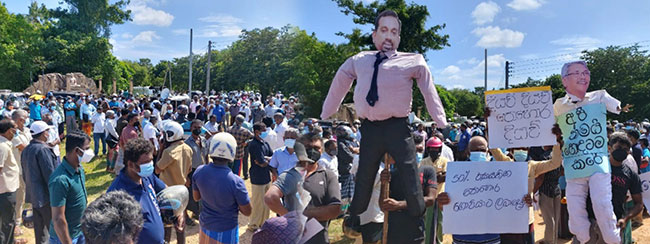
The island-wide uprising of despairing farmers, beating and burning effigies of senior ministers and demanding a reversal of the fertilizer ban, was met with the promise of organic fertilizer as an alternative. The imported organic nutrient, apparently a mixture of sea weed and faeces- a second virus from China after Corona- was found unsuitable, leading to imports from India of “liquid nitrogen”, a product untried on a large scale in that country. One of the President’s responses to the anguish of the farmers was to declare at a public meeting that he could, if he considered it desirable, use the army to seize the farming community by the scruff of its collective neck and compel them to use organic fertilizer!!
The ban on the slaughter of cattle is a similarly ill-considered directive. Alleviating animal suffering is a noble cause but the consequences of the ban will be dire for several hundred thousand people. The cattle rearing industry is multi-faceted and interconnected. Milk production, beef supply and the supply of animal skin to the tanning industry go hand-in-hand. Dairy industry, which is essentially a small farmer collective enterprise, becomes unviable unless unproductive animals are converted to meat. This ban will disempower around 200,000 individual farmers island-wide, many of them Muslims in the Eastern province. The certain consequences will be the decline of local milk production, scarcity of allied dairy products and the unpreventable escalation of illicit cattle slaughter. That proverb of unknown origin, that ” The Road to Hell is Paved With Good Intentions,” is an apt commentary on both the fertilizer and cattle slaughter ban.
Younger brother Basil, hailed by Rajapaksa acolytes as an economic genius of Einsteinian proportions- despite the absence of previous experience and known academic background – has produced a budget reinforced by bloated statistics and unrealizable dreams. His disgracefully incoherent Budget speech, delivered in Sinhala, justifiably lampooned in multiple forums, was not improved by his rambling, garbled contributions in a subsequent English language interview on the same subject, with Ms Indeewari Amuwatte on Ada Derana. The questions were intelligent, precise and designed to elicit clarity. The responses were vague, evasive and inarticulate, by a man struggling to defend the indefensible in a medium clearly unfamiliar to him; at best a cringe-worthy performance.
Consequences
A frustrated electorate propelled GR in to power in justifiable disgust at the dysfunctional governance of the Sirisena- Wickramesinghe regime, only to be confronted, in less than two years, with an ineptitude of colossal proportions. The enormous parliamentary advantage of a two-thirds majority and a presidency with unlimited power, the two moving in parallel rather than in unison, has paved the way for an economic and social disaster. It is an inevitable consequence of the 20th Amendment, which has expanded the powers of the President, whilst encroaching on the authority of the parliament and the judiciary. When the individual so elected believes that he is the sole repository of wisdom in governance – despite a total lack of experience in the field and a wretched absence of ordinary commonsense – chaos ensues. That is what we see everyday, in mass protests against moronic directives.
The only visible success in governance in Sri Lanka today is the inexorable onward march of the Rajapaksa project, which commenced during Mahinda Rajapaksa’s first term and, after a slight hiccup during the abortive Sirisena regime, has gathered a terrifying new momentum since end 2019. It is conservatively estimated that about 64% of the country’s economy is directly controlled by the Rajapaksa family and those connected to it. In a country rapidly sliding in to an abyss where lies the bleak certainty of food and other essential item scarcities – including pharmaceuticals – widespread malnutrition, loss of employment and livelihoods, declining foreign exchange earnings, disruption to education at all levels and the disintegration of the society, the only glow in a leaden sky comes from the Rajapaksa comet. The State will surely fail but the First Family will surely prosper.
Unless a disoriented and vacillatory opposition quickly gathers its wits, firstly jettisoning the toxic Ranil Wickremesinghe and then rallying round Premadasa – not necessarily the best of men but the only possible alternative – the Rajapaksa dynastic succession, from elder brother to younger brother and from uncle to nephew, and thereafter to another sibling or relative, is a certainty.
Gotabaya Rajapaksa was elected President by the convergence of normally divergent political forces. But, once elected, by-passing the legislature and other democratic institutions, he has chosen to govern through the armed forces and a collection of “Task Forces”, staffed or led by ex-military men, and other disciples and profiteers, answerable to only him. A spineless, collusive and essentially corrupt legislature has become a rubber stamp to his will. A reading of the two year performance report establishes beyond doubt that the “Viyathmaga” is the road to certain ruin, and that the “Eliyamaga” will condemn this country to economic darkness before the Gotabaya presidency ends.
Very recently, parliamentarian Kumara Welgama delivered a speech at the Diyawanna assembly, amusing, but brutally frank, in its exposure of the venality of recent regimes and the familial considerations which overrode national interests in decision making at the highest levels of governance, whilst highlighting the aberrant mentality that pervades the current dispensation. It was also prophetic in the warnings sounded to the ruling regime. Not one of his statements were contested. It must now be clear to all that when madmen are allowed to run the asylum, lunacy becomes institutionalized and insanity infiltrates governance.


 The current outbreak of anti-immigrant protests in Durban, South Africa is bound to have taken many a subscriber to value-based politics or political idealism quite by surprise. After all, this is evidence that despite the historic accomplishments of nation-builders of the stature of the late President Nelson Mandela it cannot be taken for granted that identity politics, including racism in its worst forms, is no more in South Africa.
At the time of this writing details are scarce on the substantive root causes of the protests but it could very well be that economic grievances, particularly on the part of the majority community in South Africa, are contributing considerably to the disaffection. Shrinking employment and material prospects are likely to figure majorly among the factors igniting the unrest.
Fortunately, the local authorities in Durban are losing no time in calling for peaceful co-existence among the relevant communities and are pointing to the vital importance of stepping-up national integration processes. Apparently, immigrants in sizable numbers from neighbouring countries are present in Durban. However, international TV footage of the protests quoted some local authorities as saying that the majority of the immigrants in some centres that housed them were not illegal migrants and had the documents that entitle them to be in Durban.
In the Durban protests the world has fresh proof of the socially divisive consequences of the gathering globe-wide economic disaffection, touched off particularly by the continuing crisis in West Asia. Going ahead, the world would need to brace for increasing identity-based unrest of the kind it is just witnessing in South Africa.
Considering that the material lot of ordinary people everywhere could only aggravate progressively, with the US and Iran showing no signs of negotiating an end to their confrontation any time soon, it will be left to the more democratic and progressive sections of the world community to initiate positive measures collectively to bring a measure of relief to the discontented.
The swiftness with which such relief will be provided would depend crucially on the importance those sections taking up these undertakings attach to value-based politics as opposed to Realpolitik of power politics.
Going by these yardsticks, Italy could be considered to be moving in the right direction. Recently Italy came to the fore in initiating the collective named, ‘Rome Coalition for Food Security and Access to Fertilizer’, which has as one of its aims the swift provision of fertilizer to economically weak African countries.
In a recent statement Italian Minister of Foreign Affairs and International Cooperation, Antonio Tajani, said that a principal aim of the project was to ensure that the farmers of Africa gained easy access to fertilizer, considering that food security is a growing concern among some of Africa’s economically vulnerable countries.
The statement went on to mention that some 30 countries hailing from the Mediterranean region, the Middle East, the Balkans as well as the FAO had been invited to join the coalition. The venture is far-seeing in that food security is main among the reasons for social discontent which in turn could degenerate into endemic political turmoil and bloodshed. Separatist violence and geographical fragmentation of countries wouldn’t be too far behind these developments, as Africa itself has often proved.
It is hoped that more G7 countries would take the cue from Italy and do what they could to ease the hardships of economically distressed countries, particularly of the global South. In these efforts they would need to break rank with the US, which is today brutally indifferent to the consequences of its policy of making ‘America First’, come what may.
Going by current developments, the Trump administration seems to be blithely oblivious to the wider, deleterious effects of its policy course in West Asia. Besides rendering Iran militarily and otherwise impotent nothing else seems to matter to Washington, as regards West Asia. This is policy short-sightedness of an extreme kind. After all, right now West Asia could be said to be sitting on the proverbial powder keg.
On the other hand, Iran is not giving the world the impression that it is doing anything constructive to get out of the policy straitjacket that it wove for itself decades ago. Rather than enter into a policy of ‘live and let live’ in relation to Israel in particular and initiate a process of reconciliation with the latter, it has chosen to operate within policy parameters that continue to damn Israel. This has put Israel always on the ‘defensive’ so to speak and prevented the opening up of space for meaningful dialogue.
That said, Israel is obliged to explore the possibilities of entering into a negotiatory process with the Arab-Islamic world that could lead to a de-escalation of tensions and bloodshed. It cannot continue to look at its neighbours through lenses that distort them as archetypal enemies who should be ‘wiped off completely from the face of the earth.’
In other words, the need is urgent for Realpolitik to give way to value-based politicks. Italy is beginning to prove that the latter approach could be pursued with some success. May be the EU and the UK could throw their weight behind these initiatives as well and establish that international politics could be refashioned on the basis of humane, civilized norms. The UN would need to be fully supportive of these moves and prove an organizational nucleus of the operations that follow.
In fact the time is ripe for people of conscience to collectively stand up on the side of peace and say ‘No’ to war and violence. Organizations such as the ICRC, the WHO and Medicines Sans Frontiers have already taken up this call. Referring to the widespread destruction of health facilities and their dehumanizing results these organizations have said, among other things, that ‘This is not a failure of the law. It is a failure of political will.’
True, ‘failure of political will’ among those powers that matter accounts for the runaway, uncontrollable nature of war and destruction in contemporary times, but more fundamentally it is a failure of the human conscience. It could very well be that the phenomenal levels to which violence and war have been unleashed today have had the effect of deadening consciences. This is a matter for urgent study and wide discussion.

 I would describe Indunil Kaushalya Dissanayaka as innovative and creative, and she operates under the name of Cuteefly.
Indunil always comes up with something novel to celebrate special occasions, and she does it with candles … and that’s her profession.
She was in the spotlight when she created a happening scene, with candles, for Christmas, Sinhala and Tamil New Year, and Valentine’s Day.
As lanterns light up Sri Lanka for Vesak, the Colombo-based candle maker is quietly turning wax and wick into little pieces of the festival.

Candles reflecting Vesak themes
Her candles reflect Vesak themes – light, peace, remembrance, giving, etc., to enable you to fill your Vesak celebration with devotion and beauty.
Among her Vesak creations is a lotus-shaped soy candle, scented with sandalwood, lavender, etc., meant to burn during this Vesak Poya Day.

Indunil Kaushalya Dissanayaka: Customers
praise her for her creativity
These handcrafted Vesak candles are perfect for offering at the temple, she says.
What makes her creations so novel is that they come in different shapes, scents, themes, and all are handmade.
What’s more, her customers have heaped praise on her for her creativity.
According to Indunil, her creations are perfect as a thoughtful gift … to bring beauty, unity, and light into every moment.
Says Indunil: “Our beautifully handcrafted Unity candles are designed with premium detail and love, making them perfect for celebrations, gifts, and meaningful occasions.”
Cuteefly, says Indunil, is available online.
Readers could contact Indunil on 0778506066 for more details.
He Facebook Page is: Cuteefly.

Handmade with love

 Yes, dark spots do crop up on the skin, especially with sun exposure and, of course, as the skin ages.
However, these tips should be of immense benefit to those who are faced with dark spots.
* Lemon and Honey Glow Mask:
You will need 01 teaspoon lemon juice and 01 teaspoon honey.
Mix the lemon juice and honey well and then apply this mixture, only on the dark spots.
Leave for 10–15 minutes and then rinse with cool water.
Benefits:
Lemon helps brighten pigmentation.
Honey moisturises and heals skin.
Gives a natural glow.
* Aloe Vera Gel Treatment:
All you need is fresh aloe vera gel.
Apply the gel apply on dark spots, before going to bed.
Leave overnight and wash in the morning.
Benefits:
Reduces acne marks and pigmentation.
Soothes irritated skin.
Helps skin repair naturally.
* Turmeric and Yoghurt Paste:
You will need 01 teaspoon yoghurt and a pinch of turmeric
Mix the yoghurt and turmeric into a smooth paste and apply on affected areas.
Leave for 15 minutes and then wash gently with lukewarm water.
Benefits:
Turmeric brightens skin naturally.
Yoghurt removes dead skin cells.
Helps fade dark spots gradually.
Use these packs 02-03 times a week as results are generally seen over time.
You can also try this out: Mix a ripe papaya into a smooth paste and apply to the face, or directly on to the dark spots. Leave for 15-20 minutes and then wash with lukewarm water.

Let us all build a society valued with peace and harmony, guided by unity and solidarity beyond all differences – PM

Showers will occur at times in the Western, Sabaragamuwa and North-western provinces and in Galle, Matara, Kandy and Nuwara-Eliya districts

Rajitha calls for combined lists, denounces those unwilling to join as traitors

20 lawmakers, four officials visiting China

More Japanese funds for demining operations in the north

Clingendael Institute delegation visits Pathfinder Foundation

‘Dates have the highest sugar content to fight Coronavirus’

Sunday Island 27 December – Headlines

#SundayIsland 17th December – Headlines

Sunday Island – 28th March

Sunday Island Headlines – 21 March

Sunday Island – 21st February – Headlines
-

 Business6 days ago
Historic launch of CCWE Fashion Week & International Summit 2026
-

 News4 days ago
All-New GRAVITE launches at LKR 6.99 Mn
-

 Features4 days ago
The NPP’s pivot to the past
-
 News3 days ago
Police probe underway to ascertain links between criminals deported from UAE and local politicians
-
 News2 days ago
Easter Sunday carnage: Court told Maulana’s statement cannot be accepted without cross-examination
-

 Opinion6 days ago
The need to reform Buddhist ecclesiastical order
-
 Features4 days ago
End of Peacekeeping
-
 News3 days ago
Dickoya double murder suspect arrested