
Business
ComBank Q+ Payment App adds Airtel and Hutch for mobile bill settlement


Airtel and Hutch have become the latest additions to the ComBank Q+ Payment App ‘In-App Bill Payments’ feature which already facilitates Dialog and Mobitel pre-paid and post-paid bill settlements.
With Airtel and Hutch joining the ComBank Q+ Payment App, which was the first QR-based App to be launched under LANKAQR, the national Quick Response (QR) Code platform, users of the platform can pay the bills of, or reload their phones connected to all mobile service providers operating in the country, the Bank said.
To begin paying via their phones through the app, Commercial Bank customers simply have to download the ComBank Q+ Payment App from the App Store or Google Play Store, sign up by filling in the required details (User ID and e-mail) and create an Q+ account. In order to enable financial payments, customers have to add a ComBank credit, debit or prepaid card. The user will then be able to sign on to the device and perform transactions.
Currently, the Payment App enables users to make payments in eight categories such as data reloads, pre-paid and post-paid mobiles, fixed telephone lines, utilities, water and electricity (CEB and LECO), pay TV bills, Credit Card outstanding and Pre-paid Cards top-up. The facility will be further enhanced with the inclusion of more beneficiary companies such as educational institutes and insurance companies, the Bank said.
To pay through the ComBank Q+ Payment App, users click on the ‘Bill Payment’ menu on the App, select the preferred billing category and then the billing company and insert the requested details.


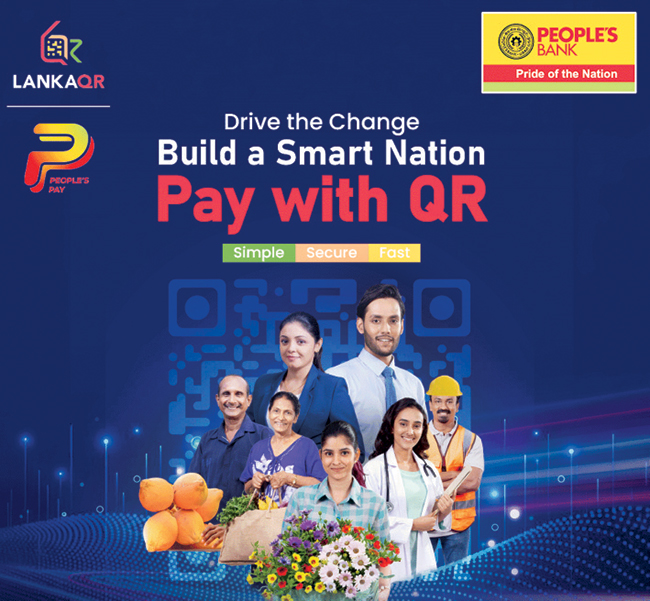
Marking a significant milestone in Sri Lanka’s digital transformation journey, the National QR Payment Adoption Programme was recently launched with the objective of accelerating the country’s transition towards a cash-lite economy. The initiative aims to reduce reliance on physical currency by promoting the widespread use of QR-based digital payments, enabling individuals and businesses to conduct fast, secure and convenient transactions via mobile devices, said a release from the People’s Bank.
It said: As a leader in digital banking, People’s Bank proudly aligns with this landmark national initiative, reinforcing its commitment to building a digitally empowered economy. The Bank supports the programme through its flagship digital wallet “People’s Pay”, which offers a seamless platform for QR-based transactions and a range of everyday financial services.
In line with the programme’s objectives, customers can perform QR transactions without incurring additional charges, while merchants benefit from zero fees on transactions up to Rs. 5,000. To further encourage adoption, valuable gifts will be awarded to selected winners among LANKAQR users, enhancing engagement and promoting digital payment usage across the country.
People’s Bank’s participation reflects its ongoing digital transformation strategy, which has evolved beyond traditional online banking to deliver an integrated, lifestyle-oriented financial ecosystem. The Bank continues to set industry benchmarks by offering secure, efficient and user-friendly digital platforms, ensuring customers have uninterrupted access to banking services anytime, anywhere.
At the heart of this initiative is People’s Pay, a sophisticated digital wallet designed to streamline everyday financial transactions while catering to the evolving needs of the modern consumer. The application features a seamless self-registration process, comprehensive tri-language support, and secure storage of payment details, ensuring both convenience and security for users.
In addition, the People’s Pay app enables customers to make real-time bill payments and QR-based transactions with exceptional ease and efficiency. The facility to link multiple bank accounts further enhances flexibility and convenience, while the transaction limit provides users with greater financial control and improved security.
In a strategic move to bolster the national QR adoption program, the People’s Pay app now facilitates Peer-to-Peer (P2P) QR transfers. This functionality allows users to generate both static and dynamic QR codes, enabling efficient transactions without the need to disclose sensitive account information.
The National QR Payment Adoption Programme represents a critical step in advancing Sri Lanka’s digital payments landscape. By fostering fast, secure and transparent transaction methods, the initiative aims to ensure inclusive participation in the digital economy, empowering citizens across all regions and communities.

ANC Campus has announced the launch of a formal articulation partnership with Adelaide University at Cinnamon Lakeside, Colombo, creating a clear progression pathway for Sri Lankan students seeking an Australian university degree.
Through this pathway, students can begin their university-level studies at ANC Campus in Sri Lanka before progressing to Adelaide University in Australia, subject to the relevant academic, English language, and entry requirements. By completing the first year through ANC’s Australian Diploma pathway in Sri Lanka, students can significantly reduce the overall cost of their Australian education journey, with estimated first-year savings of up to LKR 13 million when tuition and living expenses are considered.
The launch was attended by representatives of ANC Campus, Adelaide University, and the Australian Trade and Investment Commission (Austrade), alongside members of the media, students, parents, and invited guests. Austrade’s presence highlighted the continued importance of Australia-Sri Lanka education links.
Speaking at the launch, Dayan D. L. Fernando, Chief Executive Officer of ANC Campus, said the partnership gives Sri Lankan students a credible and well-supported route into Australian higher education.
“For over two decades, ANC has worked with international university partners to help Sri Lankan students begin their global education journey with the right academic preparation and guidance. This partnership with Adelaide University gives students a clearer route to an Australian degree and gives parents greater confidence in the pathway their children are choosing,” he said.
Fernando added that international education is one of the most important decisions a family makes, and proper guidance is essential.
“At ANC, our responsibility is to guide students correctly. We must help them understand the pathway, the requirements, the destination, and the opportunities ahead. ANC prepares students for the highest likelihood of success.

Union Assurance PLC, Sri Lanka’s longest-standing private Life Insurer, recently hosted the SLIM Certified Financial Adviser Graduation Ceremony at its Head Office premises, recognising 38 professionals who successfully completed the programme, a milestone that reflects the company’s focus on building a highly capable and accredited sales force.
The Certified Financial Adviser programme, delivered in partnership with the Sri Lanka Institute of Marketing (SLIM), the National Body of Marketing in Sri Lanka, which was designed to elevate the expertise of the company’s high performing adviser force. Spanning 11 comprehensive modules covering areas such as Advanced Consultative Selling Skills, Negotiation Mastery, Digital Prospecting Techniques, and Emotional Resilience in Sales, participants underwent a rigorous learning journey that concluded with a formal assignment, bringing the full cohort to completion.
The programme reflects Union Assurance’s commitment to ensuring its advisers are positioned to serve customers with confidence, credibility, and genuine understanding of their needs; values that are central to the company’s purpose of protecting what matters most. The SLIM qualification also opens a structured educational pathway for graduates, with opportunities to advance through further nationally recognised certifications.
Speaking at the ceremony, Chief Agency Officer at Union Assurance, Imtiyaz Aniff stated: “We are pleased to recognise the dedication of our people who committed to this programme alongside their core responsibilities. The SLIM certification equips our advisers with the skills and credentials to serve our customers at a higher standard, and that directly supports the quality of advice we deliver. We look forward to seeing this cohort carry forward what they have learned and continue to grow in their careers.”
Union Assurance is a subsidiary of John Keells Holdings PLC (JKH), the largest conglomerate listed on the Colombo Stock Exchange, operating with over 80 companies in 7 diverse industry sectors. The Company has completed nearly four decades of success with a Market Capitalisation of Rs. 45.6 Bn and a Life Fund of Rs. 92.8 Bn as of end December 2025. Set to protect lives and enrich the well-being of all Sri Lankans, Union Assurance offers Life Insurance solutions that cover the health, investment, protection, retirement and education needs of Sri Lankans. With an island-wide branch network and a workforce that is over 3000-strong, Union Assurance continues to invest in people, products and processes with a customer-centric focus to be responsive to emerging changes in the Life Insurance industry.

Spain starts evacuating virus-hit cruise ship in Tenerife

“Sri Lanka must shape the future of AI through policy, ethics, and inclusive governance, not simply adapt to it.” – Prime Minister

Bangladesh announce Women’s T20 World Cup squad, pick only two pacers

Landslide Early Warnings issued to the districts of Badulla and Monaragala

Successful Digital Education depends on strong infrastructure, quality content, and Teacher Training — PM

Navy renders assistance to bring ashore injured fisherman for urgent medical attention

‘Dates have the highest sugar content to fight Coronavirus’

Sunday Island 27 December – Headlines

#SundayIsland 17th December – Headlines

Sunday Island – 28th March

Sunday Island Headlines – 21 March

Sunday Island – 21st February – Headlines
-

 News4 days ago
MIT expert warns of catastrophic consequences of USD 2.5 mn Treasury heist
-

 News6 days ago
CJ urged to inquire into AKD’s remarks on May 25 court verdict
-

 News7 days ago
USD 3.7 bn H’tota refinery: China won’t launch project without bigger local market share
-

 Editorial4 days ago
Clean Sri Lanka and dirty politics
-

 Editorial7 days ago
Deliver or perish
-
 Opinion6 days ago
Security, perception, and trust: Sri Lanka’s delicate balancing act
-

 News2 days ago
SLPP expresses concern over death of former SriLankan CEO
-

 News20 hours ago
Lanka Port City officials to meet investors in Dubai