
Latest News
No Kings protests draw huge crowds as anti-Trump rallies sweep across US


Huge crowds have gathered to protest against President Donald Trump’s policies in cities across the US – among them New York, Washington DC, Chicago, Miami and Los Angeles.
The rally in New York City’s iconic Times Square drew thousands of people not long after it began on Saturday morning.
The streets and subway entrances were densely packed with people holding up signs with slogans like, “Democracy not Monarchy” and “The Constitution is not optional”.
Ahead of the demonstrations, Trump allies accused the protesters of being linked with the far-left Antifa movement, and condemned what they called “the hate America rally”.
Organisers and protesters out on Saturday said the events were peaceful.
Non-violence is a core principle of No Kings events, the group states on its website, which urges all participants to de-escalate potential altercations.
In New York, sections of the crowd regularly erupted into chants of “this is what democracy looks like” as a near-constant drumbeat boomed in the background alongside cowbells and noisemakers.
Helicopters and drones could be seen flying overhead, and police stood on the sidelines.
One organiser with a loudspeaker announced that 100,000 had shown up, though it’s not clear if he meant in the Times Square vicinity or across the city’s five boroughs where smaller rallies and events were also being held.
A police officer standing by estimated that over 20,000 were marching down 7th Avenue.
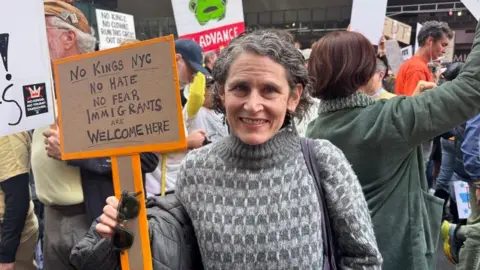
Beth Zasloff, a freelance writer and editor, said she had joined the New York protest because she feels outraged and distressed at what she called a “move toward fascism and an authoritarian government” happening in the Trump administration.
“I care a lot about New York City,” Ms Zasloff said. “It gives me hope to be out here with many, many other people.”
Since returning to the White House, Trump has embraced an expansive view of presidential power, using executive orders to block funding approved by Congress and dismantle parts of the federal government, to introduce sweeping tariffs on other countries, and to deploy national guard troops to cities despite objections by state governors.
The president says his actions are necessary to rebuild a country in crisis and he has dismissed claims he’s a dictator or fascist as hysterical. But critics warn some of the moves by the administration are unconstitutional and a threat to American democracy.
Massimo Mascoli, a 68-year-old retired electronic engineer and resident of New Jersey who grew up in Italy, said he was protesting because he can’t watch the US descend into fascism as his home country did in the last century.
“I am the nephew of an Italian hero that deserted the Mussolini army and joined the resistance,” Mascoli said. “He was tortured and killed by the fascists, and after 80 years, I didn’t expect to find fascism again in the United States.”
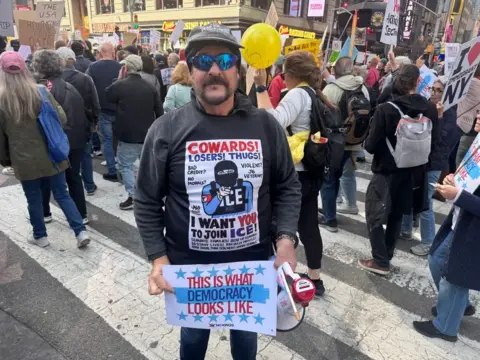
Mascoli is particularly concerned about the Trump administration’s immigration crackdown, implementation of widespread tariffs, deployment of National Guard troops into US cities, and cuts to healthcare for millions of Americans.
“We cannot count on the Supreme Court, we cannot count on the government,” Mr Mascoli said. “We cannot count on the Congress. We have all the legislative, the executive and judiciary that are all against the American people right now. So we are fighting.”
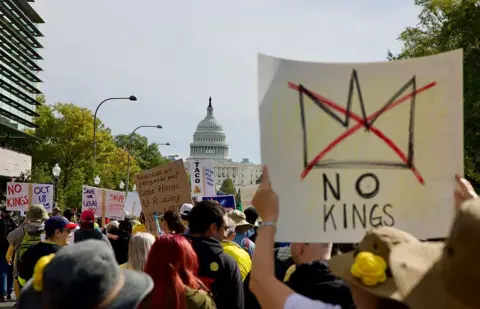
Protests are expected to continue across the country throughout the day. In Washington DC, Vermont Senator Bernie Sanders delivered a keynote speech.
“We’re not here because we hate America, we’re here because we love America,” he said to a crowd of thousands.
At the DC march, the BBC saw one man wearing a hat emblazoned with Trump’s “Make American Great Again” slogan, who said he was in town to visit and decided to check out the protest. He declined to give his name, but said while he didn’t really “get it”, people had been civil. Shortly after, a woman shouted a derogatory comment at him.
Throughout Europe, protesters took to the streets in Berlin, Madrid and Rome earlier on Saturday to show solidarity with their American counterparts. A couple of hundred protesters also gathered outside the US embassy in London.
In Toronto, demonstrators near the US consulate general waved signs including “Hands off Canada”.
US protest organisers said the gatherings would challenge Trump’s “authoritarianism”.
In an interview with Fox News, set to air on Sunday but teased on Saturday, Trump appeared to address the upcoming rallies.
“A king! This is not an act,” Trump said in a preview clip of the interview. “You know – they’re referring to me as a king. I’m not a king.”
“We’ll have to get the National Guard out,” Kansas Senator Roger Marshall said ahead of the rallies, according to CNN.
“Hopefully it’ll be peaceful. I doubt it.”
Republican governors in several US states have placed National Guard troops on standby, but it is unclear how visible the military presence there will be.
Texas Governor Greg Abbott on Thursday activated the state’s National Guard ahead of a protest scheduled in Austin, the state’s capital.
He said the troops would be needed due to the “planned antifa-linked demonstration”.
Democrats denounced the move, including the state’s top Democrat Gene Wu, who argued: “Sending armed soldiers to suppress peaceful protests is what kings and dictators do – and Greg Abbott just proved he’s one of them.”
Virginia’s Republican Governor Glenn Youngkin also ordered the state National Guard to be activated, though local reports said troops were not present during the protest.
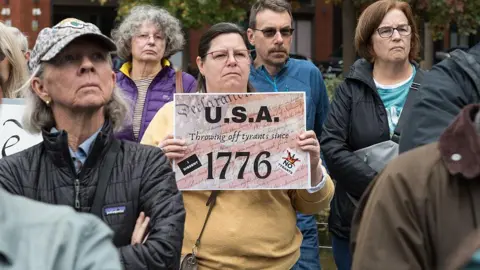
One protester at the rally in the capital held up a sign that read “I am antifa”.
Chuck Epes, 76, said it was a “loaded” term, and just meant he supported “peace, daycare, liveable wage, healthcare”, as well as immigrants and people of colour.
“He’s gaslighting everybody – or trying to, and it ain’t working,” he said.

It is common for presidents to become more unpopular as their term wears on. Joe Biden had a 55% approval rating, according to Reuters/Ipsos, in January 2021. By October of that year, his approval had declined to 46%.


The Asian Youth Games gold medallist who has run sub four minutes previously returned a time of 3:55.97 seconds to become the first athlete in his age category at these championships to run the distance under four minutes.
Achintha who has a personal best of 3:53.05 from last year was representing Prince College Ratnapura today.
In another impressive 1,500 m feat Tharushi Abhisheka of Lyceum International School, Wattala established a new meet record in the Under-20 Girls’ 1,500m as she returned a time of 4:34.59 seconds to win.
By the end of the second day of the meet seven new meet records had been established.
D. V. C. de Soysa (of Galewela Central College) Under-16 Boys’ Discus Throw – 55.83m.
D. G. Lahiru Achintha (of Ratnapura Kumara Vidyalaya) Under-18 Boys’ 1,500m – 3:55.97 secs.
W. P. Nethula Induwara (Rahula College, Matara) Under-14 Boys’ 100m – 11.70 seconds
K. V. R. Gayesha (Ira Handa Kotuwa Wewa Maha Vidyalaya, Polonnaruwa) Under-16 Girls’ High Jump – 1.70m
H. M. D. S. Herath (Maris Stella College, Thimbirigaskatuwa) Under-20 Boys’ Long Jump – 7.65m
P. M. Amaya Semindi (Vijitha Central College, Dikwella) Under-14 Girls’ High Jump – 1.58m
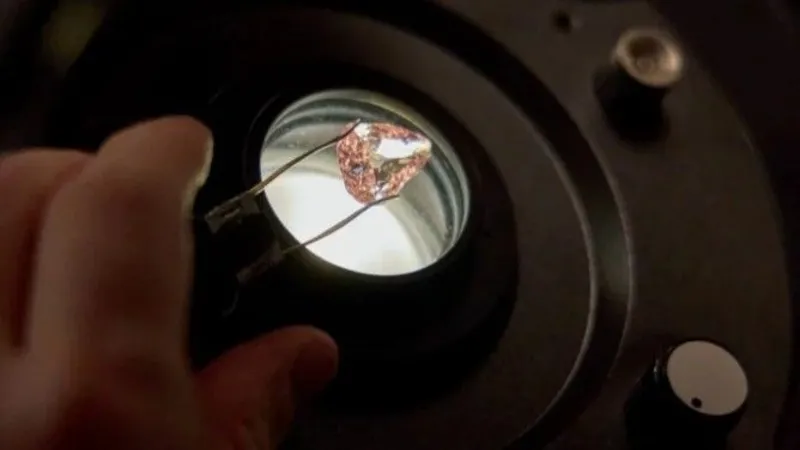
A rare pink diamond is going on display in France for the first time since it was stolen almost 100 years ago to the day – the last time it was shown to the public.
The nine-carat, pear-shaped gemstone known as the “Grand Condé” was pilfered in an overnight raid on the Château de Chantilly in October 1926 and concealed in a hollowed-out apple.
The diamond – one of few royal jewels to survive the French Revolution – was recovered a few weeks later when a hungry maid at the hotel in which the thieves were staying took a bite of the apple.
It will once again be on display in the Condé Museum at the Château de Chantilly until 3 January.
The museum’s director Mathieu Deldicque said that while the apple story may sounds far-fetched, it was widely covered by newspapers at the time.
Deldicque has faced questions about whether the exhibition may be tempting fate, especially given the string of heists on European cultural institutions in the past 12 months, including the daring daylight robbery of jewellery from the Louvre museum in Paris.
While he declined to reveal to CNN how much the diamond was insured for, he noted that extensive academic study into the properties of the diamond had taken place to make it uniquely identifiable.
The results of this analysis, as well as previously unseen archive material about the gem’s history and theft, form part of the exhibition, according to the museum.
Naturally occurring pink diamonds are exceptionally rare and often sell for tens of millions of dollars. The highest price ever fetched for one at auction was $71.2m (£53.6m) in 2017, according to Sotheby’s.
The exact origins of the Grand Condé remain a mystery.
It was first mentioned in 1740 in an inventory of Louis Henri de Bourbon, Prince of Condé, drawn up following his death, the Château de Chantilly said.
It then became part of the collection of Queen Marie-Amélie of Bourbon-Sicily, the wife of French King Louis Philippe I, and then her son, Prince Henri of Orléans, the Duke of Aumale.
He bequeathed it to the Institut de France, which now owns the Château de Chantilly, 50km (31 miles) north of Paris, along with thousands of artworks and manuscripts which became the Musée Condé collection.
(BBC)
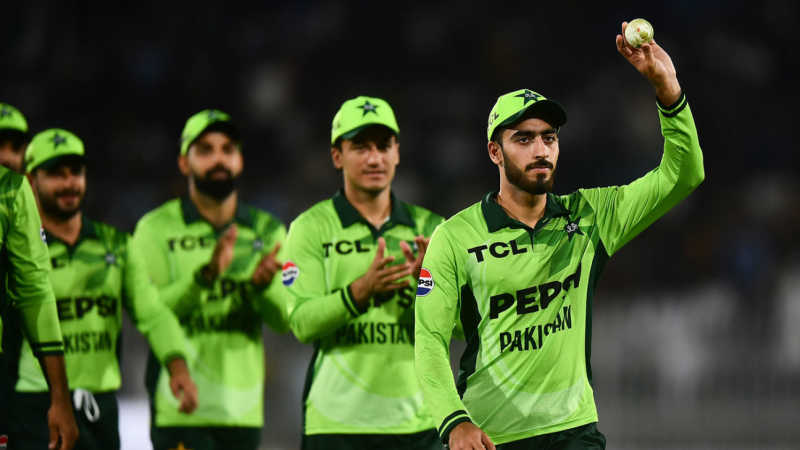
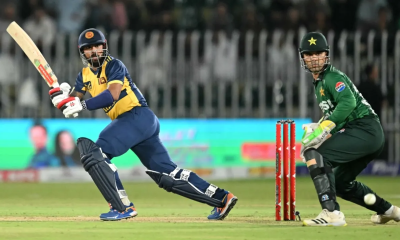
Sri Lanka’s men begin this match having won an international in the past week. This is more significant than it sounds. Their 2026 has been abysmal, with the team losing 22 matches to the 10 they have won. New captain Kusal Mendis had carried his team to that victory with his 87 not out off 48 balls, after Sri Lanka’s seamers had also had an encouraging outing.
But the game was only a dead rubber, Pakistan having sewn up the T20I series already. Pakistan have hardly been lighting up 2026 either, but they have had substantially more success than Sri Lanka. They had won their most recent ODI series, against Australia, 2-1. In that series, Pakistan may even have discovered a bright young all-round talent, left-arm spinner and lower-order batter Arafat Minhas, who claimed the Player of the Series award for his seven wickets at an average of 12.28. He has been in penetrative form in the past 10 days as well, having claimed five wickets across the three T20Is against Sri Lanka. Against Australia, Pakistan had also had excellent performances from Shaheen Afridi and legspinner Abrar Ahmed. It had, in fact, been Pakistan’s bowlers who dominated in a low-scoring series.
The tri-series is important for all three sides because there is now officially less than 12 months before the World Cup, which is set to begin on October 2 next year. Sri Lanka still have plenty to figure out – their white-ball squads having been in serious flux this year, as a new set of selectors searches (often fruitlessly) for a winning combination. Pakistan have players and stratetgies to trial as well.
In the series against Australia, Babar Azam had top-scored for Pakistan, hitting 40, 16, and 69 to average 41.66 across the matches. No one will call it a return to his heyday, but it was an encouraging sign following a modest run in 2025, in which he averaged 34 across 17 innings. Sri Lanka has been one of his favoured opponents over the years, Babar having struck four of his 20 centuries against them, averaging 58.33. The tracks in Rawalpindi at least are expected to be good for batting. Can he build up some form in the one format he now plays?
Lahiru Udara has reason to feel miffed at the selectors, many think. Having hit 188 against West Indies three Tests ago, he was left out of the squad entirely for the forthcoming Test series. But with Pathum Nissanka having been ruled out of the ODIs through an ongoing hamstring problem, Udara has surged into ODI contention on the back of a good T20I innings last week. At age 32, he knows his chances at this level are numbered. With the World Cup on the horizon, there is perhaps no better format to impress in right now than ODIs.
With neither Sahibzada Farhan nor Maaz Sadaqat in the ODI squad, Saim Ayub and Fakhar Zaman may open.
Pakistan (possible): Saim Ayub, Fakhar Zaman, Hasan Nawaz, Babar Azam, Salman Ali Agha, Shadab Khan, Ghazi Ghouri (wk), Minhas Arafat, Shaheen Afridi (capt.), Haris Rauf, Naseem Shah
Sri Lanka may bring Avishka Fernando straight into the XI, with Kamil Mishara having had a run of modest scores. Sri Lanka also have some decisions to make on the spin-bowling front, although they are likely to favour Maheesh Theekshana over legspinner Sachindu Colombage.
Sri Lanka (possible): Lahiru Udara, Avishka Fernando, Kusal Mendis (capt, wk), Kamindu Mendis, Sahan Arachchige/Pavan Rathnayake, Janith Liyanage, Dasun Shanaka, Dunith Wellalage, Dushmantha Chameera, Eshan Malinga, Maheesh Theekshana, Asitha Fernando
(Cricinfo)

Showers or thundershowers will occur in most parts of the island after 1.00 p.m.

Buddhist hierarchy demands prison perks for monk convicts

Debate on NCM against Speaker postponed indefinitely

Karannagoda pushed for £24,536 for Yoshitha’s UK training, Court told

Flu cases surge across Lanka

Lankan rubies among treasures of London’s Cheapside Hoard

‘Dates have the highest sugar content to fight Coronavirus’

Sunday Island 27 December – Headlines

#SundayIsland 17th December – Headlines

Sunday Island – 28th March

Sunday Island Headlines – 21 March

Sunday Island – 21st February – Headlines
-

 Latest News5 days ago
Nissanka’s return headlines Sri Lanka’s Test squad against Pakistan
-

 Latest News6 days ago
Farhan and Sadaqat help Pakistan seal series in style
-

 Features6 days ago
Intake 16: 45 years of duty and honour
-
 News6 days ago
Malwathu Chapter issues statement on talks with President over Gnanasara Thera’s robes
-
 News6 days ago
CP alleges NPP has taken the blame for illegal US sanctions on Iranian vessels
-

 News4 days ago
Sri Lanka, India caught in US-Iran ship crisis
-

 Opinion6 days ago
How long can Sri Lanka remain silent on its demographic crisis?
-
 Latest News4 days ago
Kusal Mendis’ unbeaten 87 hands Sri Lanka consolation win