
Latest News
Reeling from Trump’s tariffs, India and China seek a business reboot


India’s Prime Minister Narendra Modi landed in China on Sunday with the sting of Donald Trump’s US tariffs still top of his mind.
Since Wednesday, tariffs on Indian goods bound for the US, like diamonds and prawns, now stand at 50% – which the US president says is punishment for Delhi’s continued purchase of Russian oil.
Experts say the levies threaten to leave lasting bruises on India’s vibrant export sector, and its ambitious growth targets.
China’s Xi Jinping, too, is trying to revive a sluggish Chinese economy at a time when sky-high US tariffs threaten to derail his plans.
Against this backdrop, the leaders of the world’s two most populous countries may both be looking for a reset in their relationship, which has previously been marked by mistrust, a large part of it driven by border disputes.
“Put simply, what happens in this relationship matters to the rest of the world,” Chietigj Bajpaee and Yu Jie of Chatham House wrote in a recent editorial.
“India was never going to be the bulwark against China that the West (and the United States in particular) thought it was… Modi’s China visit marks a potential turning point.”
India and China are economic powerhouses – the world’s fifth and second largest, respectively.
But with India’s growth expected to remain above 6%, a $4tn (£3tn) economy, and $5tn stock market, it is on the way to moving up to third place by 2028, according to the International Monetary Fund (IMF).
“While the world has traditionally focused on the single most important bilateral relationship in the world, US and China, it is time we shift more focus on how the second and would-be third largest economies, China and India, can work together,” says Qian Liu, founder and chief executive of Wusawa Advisory, based in Beijing.
But the relationship is deeply challenging.
The two sides have an unresolved and long-standing territorial dispute – that signifies a much broader and deeper rivalry.
Violence erupted across Ladakh’s Galwan Valley in June 2020 – the worst period of hostility between the two countries in more than four decades.
The fallout was largely economic – a return of direct flights was taken off the table, visas and Chinese investments were put on hold leading to slower infrastructure projects, and India banned more than 200 Chinese apps, including TikTok.
“Dialogue will be needed to help better manage the expectations of other powers who look to India-China as a key factor of Asia’s wider stability,” Antoine Levesques, senior fellow for South and Central Asian defence, strategy and diplomacy at IISS, says.
There are other fault lines too, including Tibet, the Dalai Lama, and water disputes over China’s plans to build the world’s largest hydroelectric power project across a river shared by both nations, as well as tensions with Pakistan after the Pahalgam attack.
India also does not currently enjoy good relations with most of its neighbours in South Asia, whereas China is a key trading partner for Pakistan, Bangladesh, Sri Lanka and Afghanistan.
“I would be surprised if a BYD factory is coming to India, but there may be some soft wins,” Priyanka Kishore, founder and principal economist at research company Asia Decoded, says.
It’s already been announced that direct flights will resume, there may be more relaxations on visas, and other economic deals.
However, the relationship between Delhi and Beijing is “an uncomfortable alliance to be sure”, notes Ms Kishore.
“Remember at one point, the US and India were coming together to balance China,” she adds.
But India is completely perplexed with the US and its position: “So it’s a smart move – and feeds into the multipolar narrative that both India and China believe in.”
Modi is travelling to China for the Shanghai Cooperation Organisation (SCO) – a regional body aimed at projecting an alternative worldview to that of the West. Members include China, India, Iran, Pakistan and Russia.
In the past, India has downplayed the organisation’s significance. And critics say it hasn’t delivered on substantial outcomes over the years.
The June SCO defence ministers’ meeting failed to agree on a joint statement. India raised objections over the omission of any reference to the deadly 22 April attack on Hindu tourists in Indian-administered Kashmir, which led to the worst fighting in decades between India and Pakistan.
But experts say the downturn in Delhi’s relations with Washington has prompted India to rediscover the utility of the SCO.
China, meanwhile, will value the optics of Global South solidarity amid Trump’s tariff chaos.
The Brics grouping – of which China, India, Russia, Brazil and South Africa are the founding members – has drawn the ire of Trump, who has threatened to slap additional tariffs on group members on top of their negotiated rates.
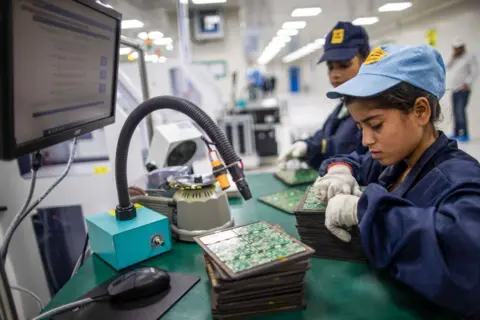
Modi last met Xi and Russia’s Vladimir Putin at the Brics summit in Russia in October 2024. Last week, Russian embassy officials said Moscow hopes trilateral talks with China and India will take place soon.
“Leveraging each of their advantages – China’s manufacturing prowess, India’s service sector strengths, and Russia’s natural resource endowment – they can work to reduce their dependence on the United States to diversify their export markets and ultimately reshape global trade flows,” Bajpaee and Yu said in their editorial.
Delhi is also leveraging other regional alliances, with Modi stopping in Japan on the way to China.
“Asean and Japan would welcome closer co-operation between China and India. It really helps in terms of supply chains and the idea of Make in Asia for Asia,” Ms Kishore says, referring to the political grouping comprising 10 Southeast Asian economies.
India continues to be reliant on China for its manufacturing, because it sources raw materials and components from there. It will likely be looking for lower import duties on goods.
India’s strict industrial policies have so far held it back from benefiting from the supply chain shift from China to South East Asian countries, according to experts.
There is a case for partnership, a strong one, says Ms Kishore, where India pitches to manufacture more electronics.
She points out that Apple makes airpods and wearables in Vietnam, and iPhones in India, and so there would be no overlap.
“Faster visa approvals would be an easy win for China as well. It wants market access in India either directly or through investments. It’s dealing with a shrinking US market, it’s already flooded Asean markets, and a lot of Chinese apps like Shein and TikTok are banned in India,” says Ms Kishore.
“Beijing would welcome the opportunity to sell to 1.45 billion people.”
Given the complexity of the relationship, one meeting is unlikely to change much. There is a long way to go on improving China-India ties.
But Modi’s visit to China could repair some animosity and send a very clear signal to Washington that India has options.
[BBC]


Maia Bouchier’s century led England to their highest successful ODI run-chase to defeat Ireland by six wickets in the opening match of their three-game series in Leicester.
Bouchier initially played a supporting role to Sophia Dunkley’s 61-ball 73. But, after the duo had shared a 143-run opening stand off just 118 balls to set the foundations for England, Bouchier finished with an emphatic 104 off 95.
It was England’s older hands who saved the hosts after Ireland had posted an impressive 281 for 5 on a good batting track, with fifties to captain Gaby Lewis, Amy Hunter and Rebecca Stokell. But while Bouchier, Dunkley and Alice Capsey share more than 100 ODIs between them, in the context of the hosts’ developmental approach to this series, Bouchier’s performance was most on point.
On the eve of this first match, stand-in skipper Charlie Dean had emphasised the opportunities for players to establish themselves as top selection choices with five key players missing from the squad. Bouchier, who since the 2025 Ashes has only played a bit-part for her country, got the message and sent one right back.
With Tammy Beaumont and Heather Knight retired and Amy Jones rested for this series, England entered this match with a new top order, Dunkley promoted to open alongside Bouchier and Jodi Grewcock at No. 3, playing just her third international.
The new opening pair made light work of their task early on as Ireland’s bowlers struggled to make any impact, as England’s attack had earlier.
Bouchier crashed four fours in a row off Jane Maguire and, after 10 overs, they were 72 without loss, compared to Ireland’s 51 for 1.
Dunkley reached fifty first, off 40 balls with 10 fours, including the one that brought up the mark, crashed through the covers off Kia McCartney. Bouchier reached her half-century off 63.
Dunkley survived a stumping attempt while trying to drive legpsinner Cara Murray but she fell next ball, smashing one back for a sharp return catch.
Murray was finding appreciable turn and she bowled left-hander Grewcock through the gate with one that pitched on middle and hit the top of leg stump.
Bouchier raised her ton off 91 balls, driving McCartney through the covers for her 11th four. But she fell moments later, picking out Orla Prendergast at long-on off the bowling of Arlene Kelly.
That left Capsey to combine with another first-choice England player in Freya Kemp to take their side to the brink of victory with a 54-run partnership for the fourth wicket. With one shot needed for victort, Kemp holed out for a typically quickfire 36 off 22 balls, including four consecutive boundaries off Arlene Kelly, before Capsey struck the winning four to remain unbeaten on 41.
Earlier, the hosts had battled to crack a century stand for the second wicket between Hunter and Lewis, before Stokell fired off a 43-ball fifty.
Stand-in wicketkeeper Capsey, taking the gloves for Jones, took an excellent catch dive-rolling to her right to remove Alice Tector off an edge from Issy Wong to put Ireland at 13 for 1 in the fifth over.
But then Hunter and Lewis settled into their stubborn stand worth 136 runs off 152 balls, negating the hosts’ three-pronged spin attack with ease and showing little mercy to the seamers either.
The duo reached half-centuries within a few strokes of one another, Hunter first off 67 balls with a swept four over midwicket followed by a leg-side single off Mady Villiers, the off-spinner playing her first white-ball international in two years. Lewis raised her fifty off 66 balls by pulling a short ball from Lauren Filer for four.
Wong returned to the attack in the 30th over and struck with her third ball back, a fuller one which jagged in through the gate and clattered into Lewis’s stumps to break their union.
Tilly Corteen-Coleman was expensive in her fifth match for England, coming after she had warmed the bench in the shadow of fellow left-arm spinners Sophie Ecclestone and Linsey Smith during the T20 World Cup.
With Corteen-Coleman having conceded 53 runs off seven wicketless overs, England skipper Dean deployed her offspin to prise out Hunter, luring her down the pitch with one that slid past the inside edge and turned onto leg stump.
Stokell had raced to 46 off 37 balls when and was still on the cusp of her half-century when she overturned an lbw dismissal to Dean, with replays showing the ball pitched outside leg stump. Having already celebrated her fifty for a four that replays showed had actually come off her helmet, she brought up the milestone with a single back over the bowler’s head off Dean. who then bowled Leah Paul next ball to claim her second wicket.
Scores:
England Women 283 for 4 in 38.1 overs (Maia Bouchier 104, Sophia Dunkley 73, Alice Capsey 41*; Cara Murray 3-58) beat Ireland Women 281 for 5 in 50 overs (Gaby Lewis 69, Amy Hunter 62, Rebecca Stokell 54*; Issy Wong 2-57, Charlie Dean 2-44) by six wickets
[Cricinfo]
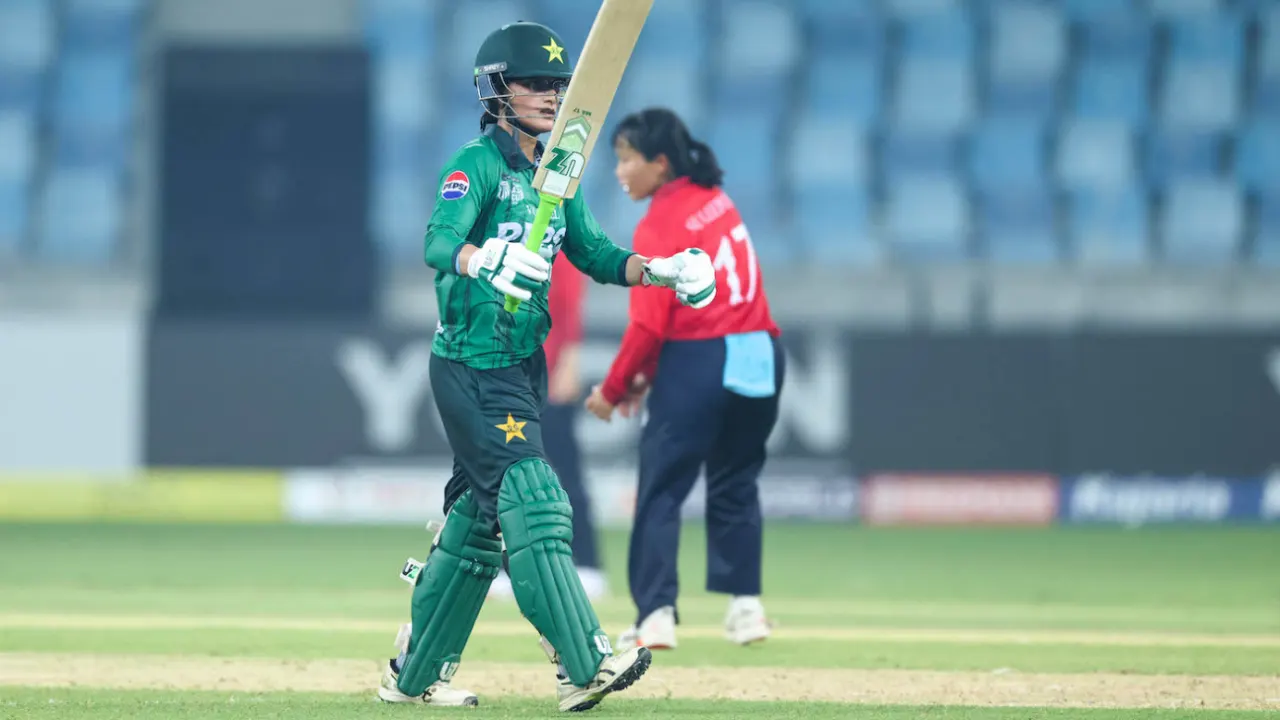
Muneeba Ali braved the oppressive heat of Dubai before Pakistan’s spinners put on a disciplined show to begin their T20 Asia Cup campaign with a commanding win over Thailand. The result knocked Thailand out of the competition as they suffered their second defeat in three matches.
On a pitch which stayed low, Fatima Sana backed her spinners to do the job by opting to bat at the toss, a decision which raised eyebrows at the time. She stood vindicated in the end as Pakistan completed a comfortable 35-run win.
But, it also brought to light Pakistan’s perennial batting woes as they managed only 119 for 9 in 20 overs despite Sana harbouring hopes of her side going beyond 150. Thailand never stood a chance of chasing the target against Pakistan’s quality spin attack and finished with 84-8 in 20 overs.
There was anticipation in the lead up to this contest as to whether the Thai left-arm orthodox bowler would surpass India’s Deepti Sharma as the highest wicket taker in the format. Thipatcha Putthawong did not make the spectators wait as she achieved the feat with a double-wicket maiden in the second over of the game.
Putthawong sent back Shawaal Zulfiqar on the second ball with the one that gripped off a length. It had Zulfiqar punch the ball right into the midriff of Suleeporn Laomi at point. Four balls later, she got her landmark wicket when Gull Feroza, back into the Pakistan side after missing the Sri Lanka T20Is, was caught at fine leg while playing the paddle.
That over tightened the screws on the Pakistan batters as they struggled to get going throughout the powerplay, which they finished with 32 for 3. Putthawong and Phannita Maya shared the six overs between themselves but it was the former’s figures of 3-0-21-1 that stood out.
Ayesha Zafar was the third batter to fall inside the powerplay, courtesy an outstanding catch by Natthakan Chantham at midwicket off Maya’s bowling.
Putthawong added another wicket to her tally in the last over of the innings. She now has 173 wickets in the format at a staggering average of 9.17 and economy of 4.11.
As has often been the case, the onus of doing the repair work fell on Muneeba, who opened the innings with Zulfiqar. She saw partners fall before putting together a solid partnership of 54 runs with Shamas.
Shamas picked up boundaries through point and wide of slip in her first four balls to kick the innings into gear. It helped Muneeba, who was struggling for breath because of the harsh Dubai weather, settle down. Muneeba often fell on her haunches to gather her breath and, at one point, had to be tended to by the team physio.
Conditions were tough for batting with the pitch playing slow and low, and the outfield being heavier than usual for a T20 game. Muneeba, nonetheless, continued to fight until the death overs and registered her fourth half-century. She finished with 54 off 52 with four boundaries and was stumped off Laomi’s bowling in the 17th over.
Shamas, who found herself in the main squad because of an injury to Najiha Alvi, made a crucial run-a-ball 20 to stop the floodgates. But her wicket, also to Laomi, re-opened the floodgates.
Laomi takes two in an over
Pakistan fans must have taken solace in the fact that Shamas was replaced by their captain, who had been at the top of her game in the T20 World Cup this year. But Sana had a brief stay at the crease. She was caught and bowled, second ball, as Laomi took a stunning catch diving forward. Both wickets fell in the 13th over of the innings. It was the second time in the innings that Pakistan lost two in an over.
Laomi varied her lengths and pace with great deception to finish as the best bowler for her side with 3-14 from four overs.
The average first-innings score at this venue in the women’s T20Is is 118, and that Pakistan managed one more was because of Tuba’s 12* off only four balls. She announced her arrival at the crease, amidst a flurry of wickets, with a gigantic six over square leg. She then hit a boundary through the covers in the last over.
Thailand might have harboured hopes of repeating the heroics from the 2022 edition of the T20 Asia Cup when they beat Pakistan. But they were eviscerated in Sadia Iqbal’s first over, the second of the run chase, as she sent back Maya and Nannapat Koncharoenkai.
Coincidentally, this over, like the second over of the first innings, ended up as a double-wicket maiden, and the two wickets in both these overs came on the second and last ball of the over across the innings.
Thailand needed one of their batters to emulate Muneeba, but they were starved of runs by Pakistan’s disciplined bowling and attacking field sets. They stood no chance at chasing the total down with the required run rate climbing every over.
The introduction of Nashra Sandhu after the powerplay further aggravated Thailand’s woes as the left-arm spinner allowed only six runs from her four overs, she picked up Chantham as well. Iqbal returned for the last over of the innings and picked up a wicket on the last ball to finish with 3 for 11 from four overs.
That Pakistan were able to secure a win despite a subpar batting performance was partly because they played a weaker opposition. But, their next opponents, India, are not likely to provide them much of a leeway.
Scores:
Pakistan Women 119 for 9 in 20 overs (Muneeba Ali 54, Sadaf Shamas 20, Umm e Hani 17, Tuba Hassan 12*; Phannita Maya 2-34, ; Thipatcha Putthawong 3-18, Sunida Chaturongrattana 1-23, Suleeporn Laomi 3-14) beat Thailand Women 84/8 in 20 overs (Naththakan Chantham 14, Naruemol Chaiwai 17, Aphisara Suwanchonrathi 13, Chanida Sutthiruang 25; Fatima Sana 1-22, Sadia Iqbal 3-11, Nashra Sandhu 1-06, Tuba Hasan 2-17) by 35 runs
[Cricinfo]
Latest News
Sun directly overhead Anamaduwa, Moragollagama, Dambulla, Manampitiya and Valaichchenai, at about 12.10 noon today (02)

The sun is going to be directly over the latitudes of Sri Lanka from 28th of August to 07th of September due to its apparent southward relative motion.
The nearest places of Sri Lanka over which the sun is overhead today (02) are Anamaduwa, Moragollagama, Dambulla, Manampitiya and Valaichchenai, at about 12.10 noon.

Prime Minister participates in Global Conscious Food Systems Summit in Bhutan

Bouchier century sets England up for record 282-run chase against Ireland

Muneeba, Pakistan’s spinners knock Thailand out of Asia Cup

Showers will occur in the Western and Sabaragamuwa provinces and in Galle, Matara, Kandy and Nuwara-Eliya districts

Sun directly overhead Anamaduwa, Moragollagama, Dambulla, Manampitiya and Valaichchenai, at about 12.10 noon today (02)

SC rejects petitioners’ request for full bench

‘Dates have the highest sugar content to fight Coronavirus’

Sunday Island 27 December – Headlines

#SundayIsland 17th December – Headlines

Sunday Island – 28th March

Sunday Island Headlines – 21 March

Sunday Island – 21st February – Headlines
-

 News5 days ago
Eight politicians in drug kingpin probe
-

 Features3 days ago
“Wrap Me Up in My Blazer”— A Gentlemanly Bradby Reminiscence
-

 Business5 days ago
Sri Lanka opens up: A new season of direct connectivity
-

 Features5 days ago
Redefining ageing in Sri Lanka
-
 Latest News6 days ago
Nepal-Tibet floods: What happened, what caused them and who is missing?
-

 Editorial6 days ago
Unfolding El Niño and burning issues
-
 Foreign News7 days ago
At least eight killed, hundreds missing after Nepal flash flood
-

 Features2 days ago
When Sri Lankan stories find their own voice