
Latest News
Cabinet nod to implement National Cyber Protection Strategy 2025-2029


The first Information and Cyber Protection Strategy of Sri Lanka, introduced in 2018, was implemented from 2019 to 2023. The Computer Emergency Readiness Team (Sri Lanka CERT) has prepared the National Cyber Protection Strategy for Sri Lanka – 2025-2029 on cybersecurity based on the first Cyber Protection Strategy with the assistance of the World Bank. The aforementioned strategy has been drafted based on the theme fields, upgrading the legal regulatory framework, increasing knowledge, enhancing the readiness of cybersecurity, strengthening response capabilities, and increasing cooperation in a way that covers only the civilian sectors of cybersecurity in Sri Lanka.
Accordingly, the Cabinet of Ministers has approved the proposal presented by the President, in his capacity as the Minister of Digital Economy to implement the ’National Cyber Protection Strategy 2025-2029´.

Latest News
Landslide Early Warnings issued to the districts of Colombo, Gampaha, Kalutara, Kegalle, Nuwara Eliya and Ratnapura

The National Building Research Organisation [NBRO] has issued landslide early warnings to the Districts of Colombo, Gampaha, Kalutara, Kegalle, Nuwara Eliya and Ratnapura valid from 09:00 hrs on 23.05.2026 to 09:00 hrs on 24.05.2026
Accordingly,
LEVEL III [RED] landslide early warnings have been issued to the Divisional Secretaries Divisions and surrounding areas of Deraniyagala, Ruwanwella and Dehiowita in the Kegalle district and Ratnapura, Ayagama, Kuruwita and Eheliyagoda in the Ratnapura district.
LEVEL II [AMBER] landslide early warnings have been issued to the Divisional Secretaries Divisions and surrounding areas of Seethawaka and Padukka in the Colombo district, Attanagalla in the Gampaha district, Palindanuwara, Ingiriya, Bulathsinhala and Horana in the Kalutara district, Yatiyanthota in the Kegalle district and Pelmadulla, Kiriella, Kalawana, Nivithigala and Elapatha in the Ratnapura district.
LEVEL I [YELLOW] landslide early warnings have been issued to the Divisional Secretaries Divisions and surrounding areas of Divulapitiya and Mirigama in the Gampaha district, Mathugama and Agalawatta in the Kalutara district, Bulathkohupitiya in the Kegalle district, and Ambagamuwa in the Nuwara Eliya district.
,
.

The US has announced a new policy that means most immigrants seeking a green card will have to leave the country and apply at an embassy or consulate abroad.
The US Citizenship and Immigration Services (USCIS) said on Friday that people seeking a change in status must do so through consular processing outside of the country “except in extraordinary circumstances”.
The move – a part of the Trump administration’s effort to curtail illegal immigration – closes a loophole that had allowed visa holders and visitors to apply for a green card while still in the US.
Critics of the policy say the longstanding system allowed families to stay together during the lengthy application process.
The new method could also make it difficult or impossible for some immigrants who leave the country in hopes of gaining a green card to return.
The USCIS policy memo states that people such as students, temporary workers or people on tourist visas need to go through the Department of State from outside of the US.
“When aliens apply from their home country, it reduces the need to find and remove those who decide to slip into the shadows and remain in the US illegally after being denied residency,” USCIS said, making the system “fairer and more efficient”.
On X, the Department of Homeland Security, which oversees USCIS, said: “The era of abusing our nation’s immigration system is over.”
“We’re returning to the original intent of the law to ensure aliens navigate our nation’s immigration system properly,” USCIS Spokesman Zach Kahler said.
“From now on, an alien who is in the US temporarily and wants a green card must return to their home country to apply, except in extraordinary circumstances,” he continued.
Kahler said the policy allows the immigration system “to function as the law intended instead of incentivising loopholes” and that visits “should not function as the first step in the green gard process”.
It is unclear whether pending green card applications will be affected.
A spokesperson for the USCIS told the BBC that as the policy is rolled out, “people who present applications that provide an economic benefit or otherwise are in the national interest will likely be able to continue on their current path”.
“Others may be asked to apply abroad depending on individualised circumstances,” it said.
Being a green card holder, or lawful permanent resident, allows a person to live and work permanently in the US. Obtaining one is a multi-step process that can take months to several years.
There are currently more than a million legal immigrants waiting for approval on their adjustment of status green card applications, according to the Cato Institute’s director of immigration studies.
Kahler argued that following the law allows the majority of cases to be handled by the US State Department at consular offices abroad and frees up USCIS resources to focus on processing other cases that fall under its purview – such as visas for victims of violent crime and human trafficking, naturalisation applications, and other priorities.
The move is consistent with longstanding immigration law and immigration court decisions, the agency said. Immigration officers are being directed to “consider all relevant factors and information on a case-by-case basis when determining whether an alien warrants this extraordinary form of relief”.
Michael Valverde, who was a senior official at USCIS under both Republican and Democratic administrations until his departure last year, said to the BBC’s US media partner CBS that Friday’s announcement would “disrupt the plans of hundreds of thousands of families and employers annually”.
“This is a largely unprecedented move that will limit lawful immigration to the US greatly,” Valverde said. “People who followed the rules faithfully now face tremendous uncertainty.”
The Trump administration has instated bans or restrictions on citizens from nearly 40 countries.
Another policy from the administration this year has paused all visa issuances to immigrant visa applicants from 75 countries.
Overstaying a US visa can lead to deportation, ineligibility for future visas and re-entry bans lasting up to 10 years, according to the US State Department.
[BBC]

Tulsi Gabbard will resign from her position as the US director of national intelligence in the Trump administration, citing her husband’s recent bone cancer diagnosis.
“His strength and love have sustained me through every challenge,” she wrote in her resignation letter on Friday. “I cannot in good conscience ask him to face this fight alone while I continue in this demanding and time-consuming position.”
President Donald Trump said in a social media post that Gabbard “has done an incredible job, and we will miss her”.
Her resignation is effective 30 June. Aaron Lukas, the principal deputy director, will step in as acting director, Trump said.
Gabbard, a loyal supporter of Trump during his 2024 presidential campaign, was confirmed as one of the most powerful figures in US intelligence-gathering weeks after he returned to the White House in 2025. But this year, she has largely been out of public view even as the US took military action against Iran, put pressure on Cuba, and notably removed Venezuela’s president.
Gabbard is the fourth Cabinet member to depart the Trump administration after Lori Chavez-DeRemer left her position as labor secretary in April. Homeland Security Secretary Kristi Noem and Attorney General Pam Bondi both left the administration earlier this year.
In her resignation letter, Gabbard said her husband, Abraham, “faces major challenges in the coming weeks and months.”
Trump posted on social media that Gabbard “rightfully, wants to be with him, bringing him back to good health as they currently fight a tough battle together. I have no doubt he will soon be better than ever.”
During her political career, she had positioned herself as an anti-interventionalist in foreign wars, creating tension after Trump decided to attack Iran. Following US-Israel strikes, she avoided endorsing the decision, carefully evading questions during a congressional hearing in March about whether the administration knew of the conflict’s potential fallout.
She also faced scrutiny during questioning over what Democrats perceived as discrepancies between White House and intelligence community claims about Iran’s nuclear enrichment capabilities.
Last year, Trump appeared to dismiss Gabbard’s declaration before Congress that Iran was not seeking to build a nuclear weapon.
“I don’t care what she said,” Trump told reporters at the time. “I think they were very close to having a weapon.” He has repeatedly cited Iran’s nuclear capability as a reason for the US war with Iran.
Gabbard’s departure comes two months after her top aide, former National Counterterrorism Center Director Joe Kent, left the the administration over the war in Iran, urging the president to “reverse course”.
Following Kent’s resignation, Gabbard publicly backed Trump’s decision in Iran, saying that as commander-in-chief, the president was responsible for determining what is and is not an imminent threat.
A military veteran who served with a medical unit in Iraq, Gabbard has had a few political firsts in her career.
She was first elected to the Hawaii Legislature aged 21 in 2002, the youngest person ever elected in the state. She left after one term when her National Guard unit was deployed to Iraq.
Gabbard went on to represent Hawaii in Congress as a Democrat from 2013 until 2021 – becoming the first Hindu to serve in the House.
She ran an unsuccessful bid for president in 2020, positioning herself on an anti-interventionalist foreign policy platform.
In 2022, she left the Democratic Party and initially registered as an independent – accusing her former party of being an “elitist cabal of warmongers” driven by “cowardly wokeness”.
As a contributor on Fox News, she was vocal on topics such as gender and freedom of speech, and became an outspoken supporter of Donald Trump before joining the Republican party.
She endorsed Trump in 2024, campaigned with him and served as a member of his transition team after the election.
Trump nominated her to be director of national intelligence shortly after he won the election. As head of the intelligence community, Gabbard coordinates among multiple intelligence agencies and advises the president.
Under her leadership, the size of the intelligence community has shrunk. When announcing plans to cut the agency’s staff by almost 50% last year, she said the agency had become “bloated and inefficient” over the last two decades.
[BBC]

Kohli refuses Head handshake after heated Hyderabad-Bengaluru clash in IPL

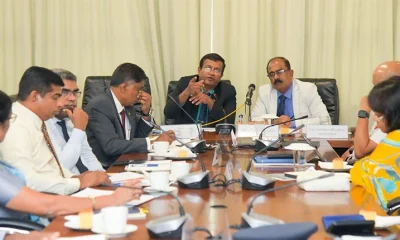
Ampara District special Coordination Committee meeting chaired by the President

Landslide Early Warnings issued to the districts of Colombo, Gampaha, Kalutara, Kegalle, Nuwara Eliya and Ratnapura

Most people seeking green cards must now apply from outside US

Tulsi Gabbard to resign as US director of national intelligence

SpaceX launches massive Starship V3 rocket on test flight

‘Dates have the highest sugar content to fight Coronavirus’

Sunday Island 27 December – Headlines

#SundayIsland 17th December – Headlines

Sunday Island – 28th March

Sunday Island Headlines – 21 March

Sunday Island – 21st February – Headlines
-

 Features7 days ago
Sri Lankan Airlines Airbus Scandal and the Death of Kapila Chandrasena and my Brother Rajeewa
-

 News7 days ago
Kapila Chandrasena case: GN phone records under court scrutiny
-

 Features4 days ago
Octopus, Leech, and Snake: How Sri Lanka’s banks feast while the nation starves
-

 News7 days ago
Rupee slide rekindles 2022 crisis fears as inflation risks mount
-

 Business7 days ago
Expansion of PayPal services in Sri Lanka officially announced
-
 News3 days ago
Steps underway to safeguard Sri Lanka’s maritime heritage
-

 News7 days ago
Court orders further arrests in alleged USD 42 Mn NDB fraud case
-

 Opinion3 days ago
Murder of Ehelepola family, Bogambara Wewa and Sightings of Wangediya