
Features
Influence of St. Aloysius’ and Its Teachers

So my life from rags to riches, from elementary education to self-acquired knowledge, from shattering adversity to rewarding accomplishment, is an epitome of the determination, the tenacity, the purposefulness, and, above all, the cultural values, inculcated in me, as a Buddhist, by the teaching and the example of the Christian Fathers and Teachers who moulded my up-bringing in the impressionable age of my youth. I then learnt never to take no for an answer!
(N.U. Jayawardena, The Aloysian 1915-1990 Diamond Souvenir, p.256)
(Chapter IV continued)
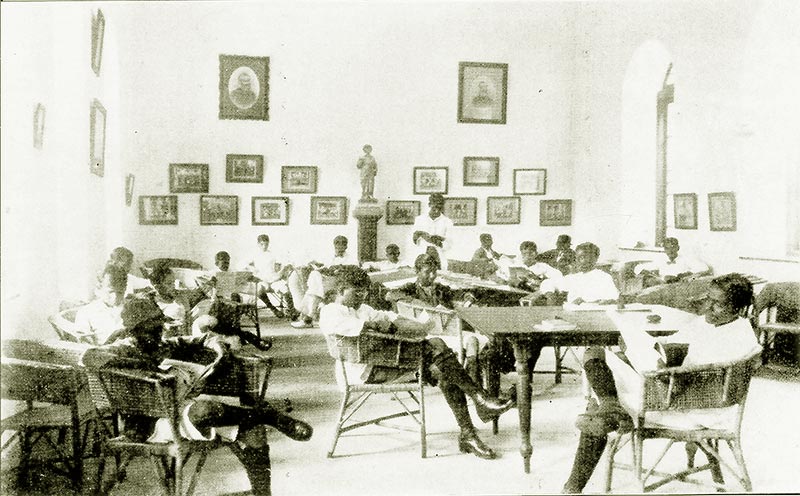
Compared to the other schools NU had attended, St. Aloysius’ with its numerous facilities was a lively and stimulating place for a young boy. It opened up a new world, where studies, sports, cadeting, field trips, debates, theatrical performances (including Shakespeare and Molière), as well as an excellent school magazine, were features of school life. Other advantages were the science laboratory, library and reading room, and a dedicated teaching staff, which included scholars such as Father S.G. Perera, the historian, and several Belgian, British and Irish priests who were specialists in various fields. There were also excellent local teachers, Sinhala, Tamil and Burgher.
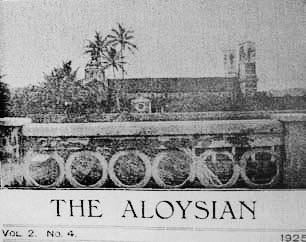
Cover of The Aloysian
The staff of St. Aloysius’, composed as it was of teachers from diverse communities, including foreigners, broadened the vision of the boys, who generally came from monolingual, mono-ethnic backgrounds. The school magazine The Aloysian, published annually, kept up a high standard, and included articles, poems and sketches by studentsand articles by staff members. The school motto was “Certa Viriliter” (Fight Manfully), and the school crest included the letters “I.H.S.,” the first three letters of the Greek word for Jesus, which was an old Jesuit emblem. The original crest (designed by Father Soden) had two elephants and two lions. When the crest was modified in 1933 and fashioned as a shield, these were replaced by four symbols: an elephant for Sri Lanka; three lilies for purity of conscience, associated with St. Aloysius; the flaming torch (of learning); and the rooster, the Dutch emblem of Galle (The Aloysian 1915-1990, pp.57-58).
NU’s Teachers
Dedicated teachers often leave an indelible impression on their students, by igniting their imagination, and stimulating their intellect by opening doors to knowledge and self-potential. Such teachers are never forgotten. NU was fortunate to have teachers who opened out new vistas for him. He was at St. Aloysius’ between the ages of 12 and 16, which are formative and impressionable years of a young person’s life. In later life, NU always made special mention of these teachers and referred frequently to Father S.G. Perera (1882-1950), who encouraged him, took a keen interest in his studies and gave him special tuition in Latin, enabling NU to get a distinction in that subject in his Cambridge Senior Examination.
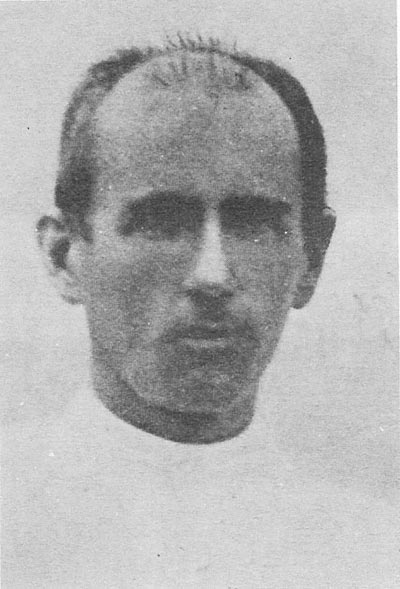
Father Michael Soden
Born in Kalutara, Simon Gregory (S.G.) Perera was in government service before joining (in 1905) the Belgian Province of Jesuits, who were in charge of Catholics of the Southern Province diocese. He was trained in philosophy and humanities at the Sacred Heart College in Shambaganur, southern India, and subsequently taught at St. Aloysius’ College, Galle. He completed his ecclesiastical studies in India between 1911 and 1915, and was ordained in 1919, becoming the first Sri Lankan Jesuit. Father Perera spent his life at St. Aloysius’ – somewhat reclusively – and while teaching senior classes he also engaged in serious
historical studies, visiting Portugal from 1932 to 1933 for research.
According to A.C. Alles, Father Perera “devoted himself without interruption to his research work,” in an austere room with “a desk heaped with manuscripts, documents, books and letters” and overlooking “the Indian Ocean in the distance over the palm trees.” He had “a small coterie of students and teachers who helped him in work connected with the editing of his writings.” Alles adds that, it was from Father Perera that he (and no doubt NU) learnt “the art of writing, the elements of sound reasoning and logical sequence and above all precision in detail” (The Aloysian 1915-1990, pp.118-19).
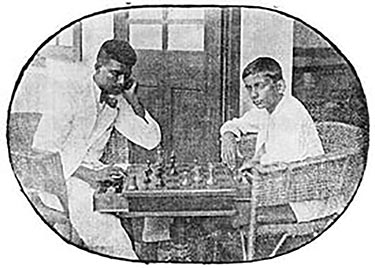
Playing chess in the Reading Room
Father Perera’s best-known works were his History of Ceylon, which was a popular textbook in schools, and his translation from Portuguese of Queyroz’s The Spiritual and Temporal Conquest of Ceylon. He also contributed articles regularly on historical themes to learned journals, and wrote often for the St. Aloysius’ school magazine. Another Jesuit priest, Father Michael Soden (1883-1933), helped NU with Chemistry. Father Soden, who was from Britain, had joined the Jesuit Order in 1901, and after further studies in Europe was sent to St. Aloysius’ College. NU made reference to Fathers Perera and Soden coaching him in Latin and Chemistry, respectively, “out of an abundance of kindness” (The Aloysian 1915-1990, p.254).
NU also referred to one of his first teachers, affectionately called ‘Bundy’ Silva, a stern disciplinarian, and praised other teachers who prepared him for the Cambridge Senior Examination. Several of them, including Keegal, J.E. Ludowyk and Michael Croos, were from the Burgher community, known for its modernizing influence and academic achievements, often setting the pace for other communities. NU vividly recalled Keegal, “who taught History fascinatingly,” enabling NU to gain a distinction in History at the Cambridge Senior. He also remembered Michael Croos, who taught him in Form III, as “that remarkable teacher” (The Aloysian 1915-1990, pp.254-55).
Julien Edema Ludowyk of Galle was “the respected and exacting teacher” of Mathematics, taking great pains with the students. He had started his teaching career in 1890 at All Saints’ School, Galle, and then alternated between Mahinda College and St. Aloysius’ up to his retirement in 1927. “The verandah of his home in Kaluwella (Galle) became in the evenings a veritable workshop where poor boys were punctiliously coached for public and professional examinations by a teacher much poorer than the pupils themselves” (ibid, p.173). NU received extra help from Ludowyk, since he needed to pass in Mathematics at the Cambridge Senior to gain exemption from the London Matriculation. In 1926 he sat the latter examination as a private student and passed in the First Division, becoming one of only two ‘overseas’ students to achieve this distinction. Among Julien Ludowyk’s many pupils was his cousin’s son E.F.C. (Lyn) Ludowyk, later an eminent Professor of English at Peradeniya
University, who studied at Richmond College, Galle, in the early 1920s. EFC’s father, who was a teacher at Richmond, was ambitious for his children to move beyond their middle-class lifestyle in the Galle Fort and “attain the mortal blessedness of a cadetship in the Ceylon Civil Service” (Ludowyk, 1989, p.60). As EFC, who was weak in Mathematics, recalled: “I did learn sufficient in the way of Arithmetic, Geometry and Algebra from Uncle Julie to take me later through the Cambridge Junior and Senior local examinations.” Ludowyk added:
All teachers… insisted on the discipline of completing the task set; with them there were no easy options; you had to know, and to know thoroughly, whatever was set as the appointed lesson. It was unthinkable that it should, or could be otherwise.
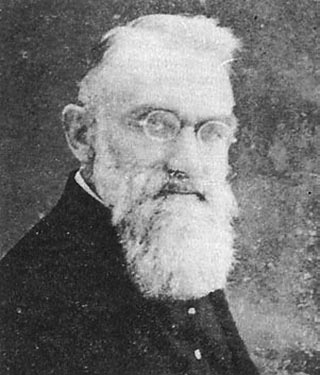
Father Olivier Feron
Such methods of teaching at the time would have influenced NU. According to E.F.C. Ludowyk, the teachers were strict and there was only “momentary resentment at the punishments they so conscientiously awarded.” He also claimed that, “there were strong bonds of respect most certainly and, in many cases, genuine affection between them and their pupils” (Ludowyk, 1989, p.61). Dr. Michael Roberts, a student at St. Aloysius’ in later years (1946-57), had this to say about the teaching staff:
Few schools today could boast of such a cohort of skilled teachers – persons dedicated, skilled, knowledgeable and in varying degrees, patient. We boys were never angels of course. There was always a limit to patience and some teachers matched their learning with verbal ferocity which few of us dared to test… But threading their teaching too was a commitment to humanity as much as to learning. (One Hundred Years of Love and Service, 1895-1995, p.69)
NU was fortunate to have committed and interesting teachers, some whom had many outside interests. Julien Ludowyk, for example, was famous for his agitation on behalf of teachers – a group who were proverbially poor. He founded the Southern Province Teachers’ Association, and “fought on till he brought the whole subject of teachers’ salaries to the forefront of public affairs” and made the government acknowledge “the scandalous inadequacy of teachers’ salaries” (Ludowyk, 1989). The result of such agitation was a revision of the salary scales and the Teachers’ Pension Ordinance of 1928. Ludowyk was unusual for the time; he was a pioneer of the Galle Labour Movement and a member of the Galle Maha Jana Sabha.
He was said to have taken “a leading part in politics in the South, and… (had) seriously contemplated contesting the Hambantota seat in the Legislative Council” (The Aloysian 1915-1990, p.173). Others who influenced NU were the Rector of St. Aloysius’, Father Feron, whom NU called “a master of French and Latin,” and Father Denis Murphy, “a master of English.” They were both, according to NU, “erudite, kind but stern” (ibid, p.254). Father Olivier Feron (1862-1939) was a French-speaking Belgian who had joined the Jesuits. He went to Britain for further studies in philosophy, along with other Belgian Jesuits, Fathers Cooreman and d’Herde, who both also later worked in Sri Lanka.
Father Feron was sent to teach at St. Aloysius’ in 1908, becoming its Rector in 1913 (ibid, p.112). During his period, the school made great progress: by 1915 a science room and laboratory were added; followed by a commercial department in 1917, and a manual training workshop in 1919. What was known as the “Cambridge Block” was completed in 1922, with a reading room/library, a “Masters room,” a science lecture room and laboratory (The Aloysian 1915-1990, p.111). NU was no doubt influenced by the energy, style and discipline of Father Feron, a dominant figure in the school, who placed great “confidence and trust in his inferiors,” and was to them “a father much more than a superior.” As stated in the school magazine:
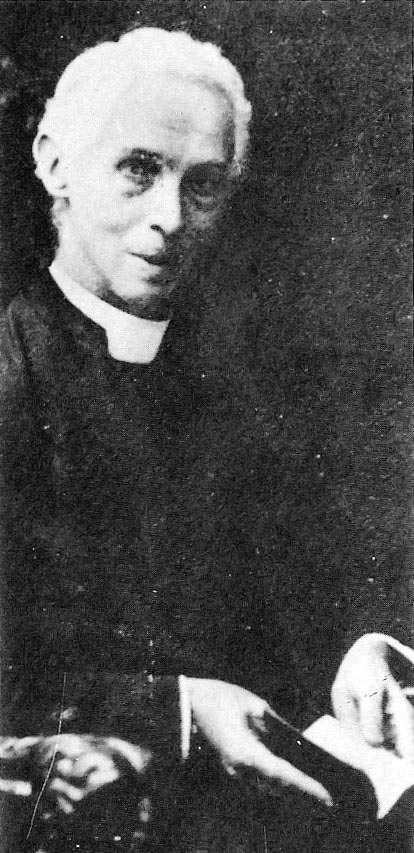
Father Denis Murphy
He expected his subordinates to work hard. He was exacting and demanded much of them; but his gentle ways obtained even more. No wonder his inferiors were ready to toil and sweat and spend themselves for their dear Rector. (The Aloysian 1915-1990, p.114)
The Library and Reading Room
The Aloysian magazine commented that the library and reading room attracted the studious boys, and were a place where they could spend time reading, playing chess and spelling games; there was also access to newspapers, the choice being wide, including not only the local papers – Observer, Times, Daily News, Herald, Leader and Catholic Messenger – but also foreign magazines, including Punch and Asiatic Review. The Reading Room, with clusters of chairs and tables, was described in the school magazine as “palatial… reserved for members
of the upper school,” who paid one rupee a term. NU would have benefited immensely from the Reading Room, since already as a young student he was ‘addicted’ to reading. Professor E.F.C. Ludowyk recalled that, to boys like himself with limited money, the libraries of Galle were treasure troves. In the schools there were libraries, which “opened up new vistas,” and in town were public libraries, including the Galle Library in the Fort, which Ludowyk, a self-professed “avid reader,” used. He also dipped into the library of St. Aloysius’, from which his cousin Randolph Ludowyk (NU’s batch-mate) borrowed books, thereby providing EFC with “another supply.” He claims that, the “chief difference between the libraries was that St. Aloysius’ had the books from Catholic missions [and] the novels of Father O’Flynn on the boys of Chicago” – a popular series among Catholic youth (Ludowyk, 1989, pp.81-82).
Cricket
Father Denis Murphy (1862-1943), mentioned above, was born in Ireland and joined the Jesuits in 1882; he arrived in Sri Lanka in 1901. Father Murphy built up St. Aloysius’ in its early years, and took a keen interest in promoting a better knowledge of English, as well as organizing sports activities (The Aloysian 1915-1990, pp.115-16). Cricket provided much excitement for the boys of St. Aloysius’, whose main rivals in Galle were Richmond College and Mahinda College. E.F.C. Ludowyk remarked that, “the fanatical competition” in cricket generated by school matches “took a strong hold” on him. Recalling that “the partisanship went to extremes,” Ludowyk says it was “seriously rumoured” that:
Father Murphy, the Prefect of Games at St. Aloysius’, secretly blessed the cricket ball with which his team played. He was a likely candidate for a sorcerer – he was bearded and constantly muttered over the book he wascarrying. (Ludowyk, 1989, p.80)
One of EFC’s classmates, however, countered “such machinations,” with “charmed water sprinkled on the pitch the first thing in the morning,” to give “our slow left-arm bowler the edge over our opponents” (ibid, p.80). NU watched the school cricket matches and enjoyed the excitement of the competitive matches, for as he said in later life, “when I was young I was very fond of cricket but after that I had no opportunity to do sports” (interview by Kalpana Isaac, 1991).
NU’s Success
NU has described his rapid progress in school:
In Galle I soon got on with my studies and as a result got a promotion to the second form and thereafter I got double promotions. I then sat for the Cambridge Junior and passed the examinations. However, I was underage to sit for the sixth form examinations, so I studied for two years in the same class waiting till I was old enough to sit for the exam. (interview by Manel Abhayaratne) He also recorded some problems he faced: During this time my father was not so well off financially and I was keen to leave school and help him. My brother too had entered school, and due to these financial liabilities I thought that it would be better to find a job rather than spend my time studying. However, when the results came I had passed with honours, and that made me feel that I should continue studying; in fact, my parents were keen that I studied rather than leave school and work. (ibid)
The Aloysian records in more detail that N.U. Jayawardena passed the Cambridge Junior in 1922, and the Cambridge Senior in 1924 with honours, and with distinctions in History, Latin and Physiology. This was the largest number of distinctions by any pupil of the school that year, but in spite of this, NU had already left school to seek employment. Instead of going on to the University College, Colombo, as did two of his batch-mates at St. Aloysius’ – namely, Randolph Ludowyk and Somasunderam Chetty –NU joined the staff of St. Servatius’, Matara, in 1925 (The Aloysian, 1925, pp.233 & 237). The fact, that students who had done less well than himself went on to the University College, would have disappointed NU, but this would have also made him even more determined to eventuallyfurther his studies, which he did a few years later.
It was his rigorous training and wide experience in St. Aloysius’, together with the dedication of his teachers, that gave NU the ability and determination to face the future. Writing in 1989, he paid tribute to St. Aloysius’, where he had studied from 1920 to 1925:
I still retain vivid memories of my years at College, of the lay teachers and the ‘priest-teachers’ who took an abiding interest in me personally as a student, of the value of discipline, attention to studies and respect for elders which the teachers and Reverend Fathers inculcated in me and above all, of the character formation and the cultural values they bestowed on me which contributed in no small measure, despite the many vicissitudes which befell me, to my development and progress in life from humble beginnings to what little I have been able to achieve over the years. (The Aloysian 1915-1990, p.254)
(Excerpted from N.U. JAYAWARDENA The first five decades)
By Kumari Jayawardena and Jennifer Moragoda ✍️


The Preamble to Sri Lanka’s Constitution states: “The PEOPLE of SRI LANKA having by their Mandate … entrusted and empowered their Representatives … to draft, adopt and operate a new Republican Constitution in order to achieve the goals of a DEMOCRATIC SOCIALIST REPUBLIC, whilst ratifying the immutable republican principles of REPRESENTATIVE DEMOCRATIC”.
The intent of this exercise is to ascertain whether the practices as adopted by successive Governments to elect the People’s representatives are in keeping with the “immutable principles of Representative Democracy”.
According to Article 3 of the Constitution: “Sovereignty includes the powers of government, fundamental rights and the franchisee”. Furthermore, Article 3 is an entrenched article – Article 83. According to Chapter XIV, titled “The Franchise And Elections”, Article 88 states: “Every person shall, unless disqualified….be qualified to be an elector at the election of the President and of the Members of Parliament or to vote at a Referendum”. Therefore, it is the electors in the Electoral Districts, as determined by the Delimitation Commission (DC), that elect the President and Members of Parliament.
EXISTING INCONSISTENCIIES
= The first relates to Article 96 (1). This states: “The (DC) shall divide into not less than twenty and not more than twenty-four electoral districts…”. The reason for the upper limit for Electoral Districts is perhaps because Sri Lanka was originally divided into twenty-for Administrative Districts (now 25), and 96 (3) establishes a relationship between Electoral Districts and Administrative Districts when it states: “Where a Province is divided into a number of electoral districts the Delimitation Commission shall have regard to the existing administrative districts so as to ensure as far as practicable that each electoral district shall be an administrative district or a combination of two or more administrative districts or more electoral districts together constitute an administrative district”
Despite the fact that the Constitutional direction to the DC was that the Electoral District was to “have regard to the existing Administrative District”, the number of Electoral Districts established by the DC is twenty-two (22) while the number of Administrative Districts are now twenty-five (25). Although the provision to combine Administrative Districts into one Electoral District exists, the reason for the difference is reportedly because the DC decided to factor in issues, such as land which is extraneous to franchise thus compromising the sanctity of franchise and the sovereignty of the electors. On the other hand, if the Electoral District is coterminous with the Administrative District, not only would it protect the elector’s Franchise but also enable the elected members to address the administrative interests of the electors. Would such an opportunity not give substance to the “immutable republican principle of Representative Democracy”?
= The second inconsistency relates to Article 96 (4). This states: “The electoral districts of each Province shall together be entitled to return four members, (independently of the numbers which they are entitled to return by reference to the number of electors whose names appear in the registers of electors of such electoral districts), and the Delimitation Commission shall apportion such entitlement equitably among such electoral districts”.
Consequently, the four members to be returned from each of the nine Provinces amounts to thirty-six additional members, shall be apportioned equitably by the DC among the twenty-two (22) Electoral Districts together with the one hundred and sixty members from the electoral registers, thus making a total of one hundred and ninety-six members being elected through the franchise of the electors. The balance twenty-nine through the National List nominated by Political Parties is also elected by the electors, thus making a total of two hundred and twenty-five (225) Members of Parliament elected through Electoral Districts.
The irony however, is that although Members of Parliament are elected through Electoral Districts, all Executive Powers of the Line Ministries of the Central Government are implemented by the District Secretaries in the twenty-five Administrative Districts. The present convoluted process of appointing a Parliament through Electoral Districts and administering its functions through Administrative Districts cannot be justified. What would be more meaningful is to make Administrative Districts also perform Electoral functions such as appointing the Members of Parliament.
= The third inconsistency relates to the election of Members for Provincial Councils. According to the Provincials Councils Act: “Every administrative district in a Province shall for the purposes of elections to the Provincial Council established for that province, constitute an electoral area”
This is a departure from the practice adopted to elect Members to Parliament since they are based on outcomes from twenty-two (22) Electoral Districts. Therefore, it is worth exploring why Members to Parliament and Provincial Councils cannot be elected using the existing 25 Administrative Districts.
RECOMMENDATIONS
The intention is for an arrangement where Administrative Districts are also assigned electoral functions, so that both Members to Parliament and Provincial Councils could be elected by a single unit. The advantage would be that Administrative Districts could carry out Central Government functions under a District Secretary as at present, a parallel unit within the Administrative District could be set up to implement devolved powers in each of the Administrative Districts, while retaining the existing structural arrangements of Provincial Councils. This would facilitate the coordination of devolved powers with Central Government activities, thus improving productivity of each.
CONCLUSION
The current practice is that while representative of the Government of Sri Lanka is elected by Electoral Districts as stated above, Provincial Councils in the periphery with less powers than the Government are elected by electors in Administrative Districts of each Province. If elections to Parliament and to Provincial Councils are elected by electors in each of the twenty-five Administrative Districts, perhaps one election could elect Members to both bodies.
In view of the significant cost savings involved, it is imperative that serious consideration is given to equip Administrative Districts to serve as Electoral Districts for Parliamentary Elections as well as for Provincial Council Elections, since such an arrangement would further fortify the “immutable republican principle of Representative Democracy”. Furthermore, since such an arrangement would be closer to the People, services to them would be better served.
By Neville Ladduwahetty
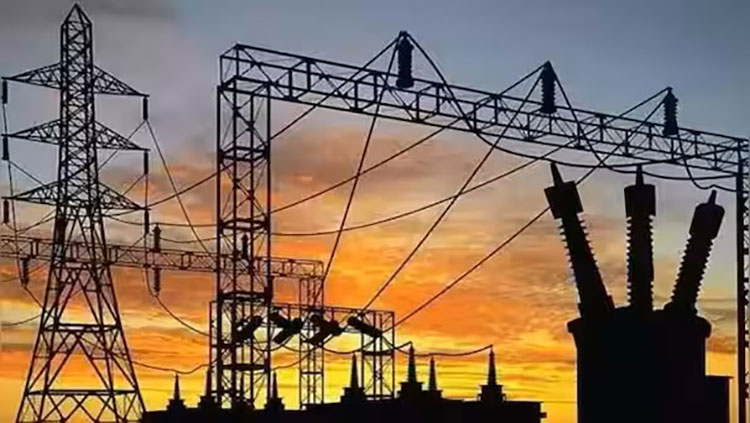
The much-dreaded power cuts are already here though not declared as such. The tragedy is that the power cuts are not due to inadequate electricity supply, but the inability of the power and energy authorities to use the abundant solar and wind power installed without any financial or economic burden on the state. They ought to admit their lack of wisdom to be mindful of the rapid changes in the sector and the need to be equipped.
Fuel Prices have been increased again up to the 2022 levels. Therefore another Electricity tariff hike is inevitable. Perhaps, the government may hold it back until September, when the next tariff revision is due. An appeal has been made to “prosumers” to switch off their solar PV system in the fear of grid stability being affected. While there is excess solar power, which they are unable to manage, even when the demand is below the installed capacity and high contribution of hydro, solar and wind. May 31 (Sunday) energy mix indicated substantial use of oil in CEB-owned power plants and those belonging to the Independent Power Producers (IPPs) . What is the rationale? One would believe that even the hydro reservoir water can be saved for use during the night, without curtailing solar and wind power. It will be said that the system is very complex and beyond the understanding of mere mortals like ordinary “prosumers”, who have added over 2300 MW to the grid, entirely at their expense and at rates well below the average cost of generation. (See Image 1)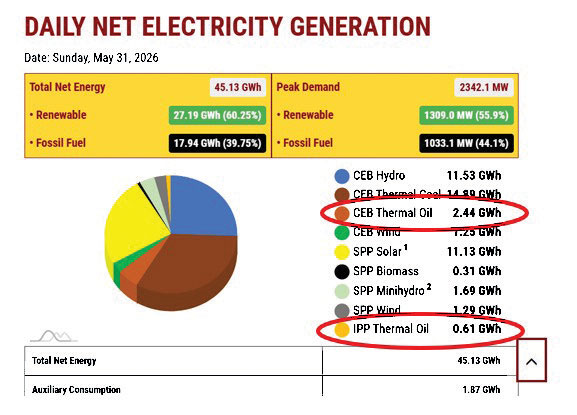
Storage Batteries and Renewable Transition
The fact that the growing need for storage batteries to optimise the utilisation of variable renewable energy (VRE) has been felt for the last decade or more, and nothing was done about it, is never mentioned in their laments.
However, there is a glimmer of hope due to the initiatives taken by the Public Utilities Commission of Sri Lanka (PUCSL). An increase in the demand due to a general GDP growth will have to be met using renewable resources. It has been clearly noted that such alternatives must be developed while curtailing the use of oil and ensuring the uninterrupted power to the consumers.
Recognising this need and the fact that fastest intervention is possible by promoting BESS (Battery Energy Storage Systems) to be added to all existing renewable energy sources, the PUCSL has initiated stakeholder consultation to determine the feed-in tariff payable for each type of BESS. A detailed methodology for determining the FIT has been circulated. The identified types of BESS discussed were as follows”
1. Power Plants
a. Mini -Hydro
b. Mini – Hydro-Local: mini hydro plants that at least use locally manufactured turbines
c. Wind
d. Wind – Local: Wind plants that at least use locally manufactured turbine blades
e. Biomass – Dendro – Biomass plants that use sustainably grown fuel wood
f. Biomass – Agricultural/Industrial Waste; Biomass fired plants use byproducts, like paddy husk, sawdust, sugar cane bagasse, etc.
g. Municipal Solid Waste
h. Waste Heat Recovery
i. Ground Mounted Solar PV
j. Floating Solar PV
2. Prosumers
a. Roof Top Solar PV
b. Rooftop Solar PV with Battery Energy Storage System (BESS)
c. Prosumers with behind the meter Battery Energy Storage System (BESS)
3. Power Plants with BESS
We mentioned in an earlier article that the PUCSL proposed a scheme whereby we can get rid of use of oil for power generation in stages, commencing with elimination of the diesel use by 2027 and all imported oils by 2030.
Stakeholder Meeting & Feed In Tariff( FIT)
The PUCSL has been empowered by the new Electricity Act No 36 (as amended), which came into full force on 09 March, 2026, with responsibility for calculating and announcing all FIT schemes, both for purchase and sale of electricity to consumers.
A well-represented stakeholder meeting was held recently, when the proposed methodology for determining the FIT of each type of BESS was given to them to provide further specific inputs. It is, therefore, realistic to expect such a FIT to be declared by the end of June, 2026.
While this is a welcome and progressive step unlike the ad hoc process adopted hitherto. But the fact remains that the responsibility for the effective use of FIT to attract investors to add the BESS at different scales, lies with the one or more of the newly appointed companies to take over the functions of the former Ceylon Electricity Board (CEB).
Government Recognition of Fossil Fuel Risks
The current government has reportedly recognised the danger of overdependence on imported fossil fuels, which we have absolutely no control over. This is something we have been stressing for a long time. However, better late than never. As a matter of interest, we show the degree of fossil fuel dependence and its adverse impact on the economy. (See Graph 1)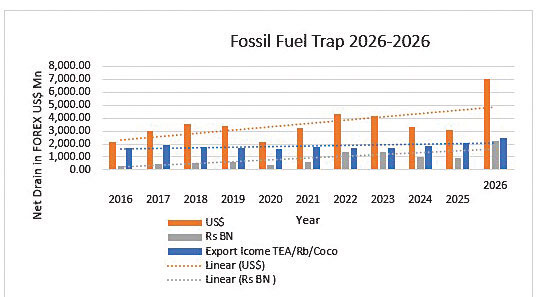
It is to be noted that earnings from our traditional exports of tea, rubber and coconuts fail to meet the ever-increasing cost of importing fossil fuels. Time was when earnings from these exports barely helped meet the cost of import of fuels which was back in 2010. The rupee cost of imports is shown in Billions to keep the data columns within the bounds of the chart. This is the factor which affects you and me directly.
However, we earnestly urge the government to direct the electricity companies to take immediate action to prepare the grid which costs only a fraction of the values predicted by the CEB to institute their schemes which are not in line with the ground reality to accept the BESS system once the FIT is announced. Reasonable BESS and FIT will help attract investors with the assurance of short-term and long-term improvement, at no cost to the state.
Solar PV & BESS Proposal
We proposed some time back of the opportunity for those “prosumers” using 300 units per month, for installing solar PV with adequately sized batteries, which is more economical than drawing power from the grid, and to gain the happy situation, to be insulated from the danger of power cuts and further increases in consumer tariff.
The PUCSL intervention to declare a BESS tariff will add a great impetus to those who are willing to adopt the above proposal. They will be encouraged to increase the capacity of their installations as well as the battery capacity so that the excess can be exported to the grid during peak hours, when firm economic power is most needed. Such additional features would enhance their financial returns and would enable rapid elimination of the use of diesel during peak hours. In recent months with the depreciation of the rupee, coupled with the increase of costs of solar panels, inverters and batteries, our original analysis of financial viability of this interevention was facing some uncertainties. As such, we welcome this move by the PUCSL, whereby the consumers would have a steady revenue in addition to the savings on their monthly electricity bills. It is likely that the level of FIT and the permitted number of exports will be adequate to work with the increased costs, as shown. (See Table 1)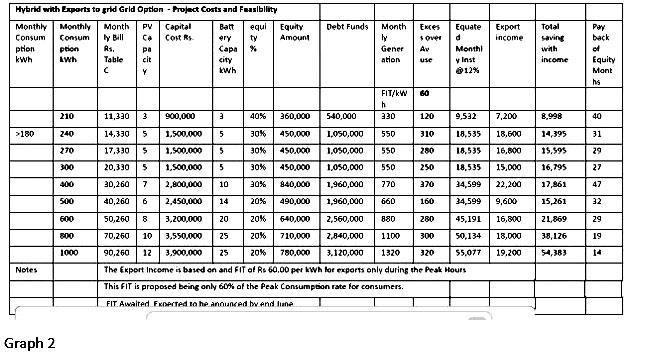
It must be noted that the cost values are highly volatile ,and some variations are to be expected. FIT for export on energy is stated as 60% of the current peak time energy charge of Rs 106/kWh.
This revolution is well within the means of the over 200,000 potential “Prosumers” who consume over 250 units per month. While they would fulfil their own goal of being immune to any power cuts as well as being insulated from future tariff increases, they would be serving the country by progressively eliminating the need for any fossil fuels for power generation. For example, if 50,000 of them add 10 kWh of battery capacity, the peak power demand can be reduced by 500 MW, thereby obviating the need for using the most expensive diesel during the peak period. Very special advantages can be derived by those also purchasing EVs instead of petrol and diesel vehicles. It will be possible to save on LPG, which costs Rs 4,700.00 per cylinder at present. Thus, the excuse for demanding ever increasing consumer tariff in the future will not be available. As such this move would help all consumers down to the lowest level of consumers.
It is hoped that the energy authorities recognise this reality and support the PUCSL proposals by approving the BESS FIT system and directing all Utility companies to adopt the same and urgently initiate action to install the simple infrastructure additions to accept the BESS energy, as proposed. If they care to review this proposal having discarded biases and any other agendas, they, too, will benefit.
Conclusion
The inescapable conclusion one can derive from the above is that the solution to the crisis is available from the consumers themselves in a manner that is attractive and profitabe to them. It would also be of major assistance for the Utility to manage the sector effectively and efficiently. In addition, all consumers will benefit by gradually weaning themselves away from the grid an use of oil for power generation. This would obviate any more demands for consumer tariff increases by the National System Operator. The PUCSL has taken an essential first step with its intention to declare a BESS FIT. It is up to the government to ensure that the Ministry and the Utility companies adopt the correct stance and make a commitment to ensure the success of this scheme as soon as possible.
by Eng Parakrama Jayasinghe
Past President and Council Member
Bio Energy Association of Sri Lanka
The JVP General Secretary Tilvin Silva’s recent remarks at a news conference in Jaffna where he ruled out the possibility of holding provincial council elections this year has been widely reported and widely criticized. About the same time there was another media event in Jaffna that went largely unnoticed and unreported outside Jaffna. What was said at the second media event may carry far more political implications than Tilvin Silva’s election timing talk. A veteran Tamil political participant made the startling yet not implausible statement that the prospect of having political devolution under the JVP-NPP government is becoming “a daydream”. The statement was made by Dr. K. Vigneswaran, who served as Provincial Secretary to the only North-East Provincial Council Government that was elected under the auspices of the Thirteenth Amendment.
Dr. Vigneswaran is a Professional Civil Engineer who studied at Royal College, graduated with First Class Honours in Engineering in 1964, and went on to complete a pioneering PhD at the university of Waterloo, Canada, applying the finite element method (FEM) in the field of Geotechnical Engineering. His engineering career has always been at the Irrigation Department where he rose to a Deputy Director. That was when the department was in its golden years, and Vigneswaran was known for his technical mentorship, meticulous administrative skills, and for knowing the fine print of everything. While at the Irrigation Department, Vigneswaran married Ramya de Silva, a fellow irrigation Engineer. After 1983, Vigneswaran became a fulltime political activist and a powerful resource in Tamil politics, but with unwavering commitment to nonviolence, democracy and federalism. The family moved first to India and then Canada, and Vigneswaran has been shuttling between Canada and Sri Lanka.
Devolution: Tortuous Trajectory
Since 1987, the Indo-Sri Lanka Agreement, and the 13th Amendment, Vigneswaran has been a permanent fixture in all the politics and institutional dynamic of implementing 13A and establishing provincial councils. He served as Secretary to the only elected Provincial Government for the Northern and Eastern Provinces. After 1994 and the election of Chandrika Kumaratunga as President, Vigneswaran became a key participant in all the civil society efforts and government initiatives to restore the PCs and implement 13A, both during the Kumaratunga presidency and the succeeding administrations of Mahinda Rajapaksa and the Sirisena-Wickremesinghe duo.
Devolution efforts stalled after the election of Gotabaya Rajapaksa, who in so many words declared that he had no time for 13A or PCs in his presidential agenda, whatever it was. Only that his whole agenda turned out to be a wholesale disaster for the country. Already by then, all the nine Provincial Councils had fallen into abeyance with the cancellation of the 1988 PC elections by the Sirisena-Wickremesinghe duo, with the TNA standing by. The abeyance continues under the JVP-NPP government with no apparent end in sight after Tilvin de Silva’s statement in Jaffna.
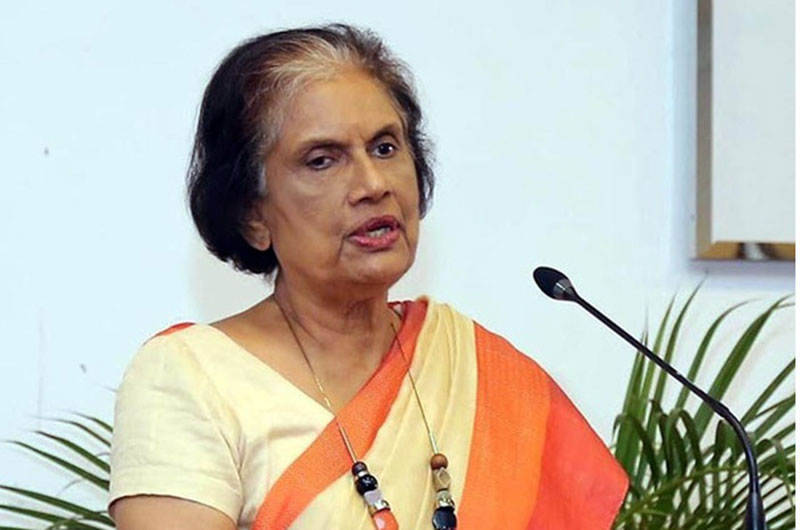
I say all this to provide the proper context for Vigneswaran’s statement in Jaffna that the prospects for power devolution under the JVP-NPP government are becoming a political daydream. He said something else as well: that of all the government leaders he has encountered over the years, the only leader who has been genuinely sincere about power devolution is former President Chandrika Kumaratunga, and no one else. I am constrained to add that the insincere category would include Ranil Wickremesinghe, who for all his handsome promises, never matched any of them with experiential sincerity. The present JVP-NPP government still has time to show that they are not an insincere lot.
It is not my purpose to agree with or question Dr. Vigneswaran’s assertions, but to use them as cue and context to comment on the widening mismatch between the JVP-NPP government’s promises and its practices on the matter of power devolution and the restoration of the PC system. With a stalling economy, rising prices and external shocks, it is obvious that the government has all the economic matters to worry about, but that does not mean that it can ignore all the other government responsibilities. No government is put in power to solve a single problem or address a single issue. It is in the nature of governments to deal with multiple problems with varying priorities. Otherwise you could have a single cabinet minister to deal with one problem at a time. That is never going to be the case.
The economy is of course the top of mind priority for the government even as it is a top of mind concern for the people. Even on the economic front, the government is holding steady but is showing little progress. And there are other government initiatives where political accountability will call for answers: to wit, the catchall Clean Sri Lanka programme, ambitious educational reforms, contentious energy sector reforms and, yes, power devolution as well as the overpromised constitutional reforms. Not to mention the sprawling unforced errors over substandard coal imports, foreign exchange fraud, and the chronic neglect of developing the renewable energy sector. Correcting these fields of errors may require a separate ministry for each.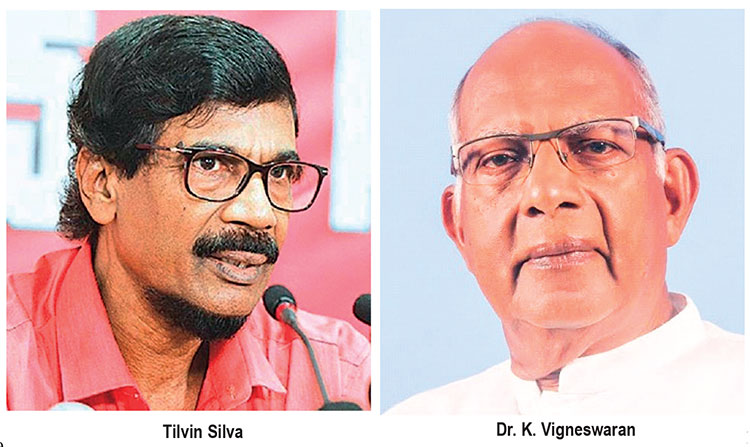
Devolution: Daydream or Deliverable
On the PC system and constitutional reform, there has been scant progress in spite of handsome promises. On both, the government is inadvertently deepening the holes that it had dug itself into through indifference, inaction or procrastination, or all of them and more. In the matter of devolution and provincial councils, the government can simply defuse the situation by directing the Election Commission to conduct elections at the earliest opportunity that is logistically possible. Making his statement in Jaffna, Mr. Tilvin Silva alluded to funding shortfall and legal complications as reasons for the necessity to postpone PC elections until next year. Neither reason holds water.
The funding question would seem to have been put to rest by the statement of Health Minister and Cabinet Spokesman Nalinda Jayatissa, presumably reflecting cabinet consensus, that there are no funding issues and if needed additional funds could be arranged through supplementary allocations. It is also disingenuous to cite legal complications as a reason. The so called legal complications arose because of the collective stupidity of the Sirisena-Wickremesinghe parliament that included the then miniscule NPP and the politically-lost TNA. The JVP-NPP has now ballooned from a handful MPs to a two-thirds majority and it can expedite any legislation that it wants to enable the PC elections to be held without delays.
Alternatively, the elections can be held under the old arrangement of proportional representation with assurance by political parties to honour their commitment to fielding more female candidates. Already at a gathering of all political parties, including the NPP (but not the JVP), and civil society groups, convened by People’s Action For Free & Fair Elections (PAFFREL), the political parties jointly committed to a 25% quota for women and youth under the old electoral system. The ongoing parliamentary committee exercise studying the legal matter, headed by the overstretched Foreign Minister Vijitha Herath, is also an unnecessary red herring. The Election Commission is ready to go under whatever law or electoral system that is before it. So, there is no reason to hide behind legal complications to further delay the PC elections.
Somewhat amusingly, Public and Parliamentary Affairs Minister Ananda Wijepala has trotted out the argument that the NPP government has already conducted two nationwide elections during the one and a half years it has been in office, and that unlike the Ranil Wickremesinghe government the JVP-NPP is not in the business “to delay elections for our personal benefit” – whatever that means. Unfortunately, the good minister is missing the point. The question is not how many elections can the JVP-NPP hold in how many years, but how many years do people in the provinces have to wait before they vote in another provincial election? How many more years? That really is the question.
We know the current situation in the provinces. There are provincial governments but no elected provincial councils. The government administration in every province is being run by the President of the Republic through his handpicked governors and unelected government officials. This is a travesty of democracy and the euthanizing of the PC system. Already under 13A, the office of the provincial governors has been constitutionally and legally compared to the office of the Governors of old Ceylon who represented the monarch in what was then a crown colony. The irony is that a JVP-NPP President may have inadvertently positioned himself as the monarch of all he provincially surveys, courtesy of the Thirteenth Amendment!
The JVP was in the forefront of the litigation that caused the demerger of the Northern and Eastern Provinces. If Dr. Vigneswaran’s assertion were to prove correct, a potential dissolution of the provincial system under the JVP-NPP government would be the consummation of the JVP’s original opposition to the introduction of the provincial council system itself. The whole system may not be eradicated, but it could be devoured of its democratic essence while preserving the administrative shell as the medium for the country’s president to overreach into the provinces. That would be worse than a daydream, a real nightmare.
by Rajan Philips ✍️

Showers in the Western, Sabaragamuwa and North-western provinces and in Galle, Matara, Kandy and Nuwara-Eliya districts

Diesel replacement costs up to Rs. 4.5 bn in April

Sallay on hunger strike: Counsel warns CID

Opp. questions why Rs 10 bn meant for Ditwah victims held in Treasury account

‘Samurdhi Bank operates without dedicated audit framework’

Constitutional inconsistencies relating to franchise

‘Dates have the highest sugar content to fight Coronavirus’

Sunday Island 27 December – Headlines

#SundayIsland 17th December – Headlines

Sunday Island – 28th March

Sunday Island Headlines – 21 March

Sunday Island – 21st February – Headlines
-

 News6 days ago
Lankan duo emerge winners in Latin dance championship held in Blackpool, UK
-
 Latest News4 days ago
Kusal Mendis, Pathum Nissanka, bowlers put Sri Lanka 1-0 up
-
 News4 days ago
New US tariffs proposed on 60 countries, including Sri Lanka
-
 Features3 days ago
Power crept into the Sangha and is now tearing it apart
-

 News6 days ago
Sri Lankan teen killed in Chennai clash; three arrested
-
 Features3 days ago
Kondachchi wind farm and battery storage project to boost energy security, says Power Ministry Secretary
-
 Features3 days ago
Saudi Arabia sets new benchmark in Hajj management as 1.7 million pilgrims complete sacred journey
-

 News2 days ago
Asst. Manager, security officer arrested over Rs 30 mn snatch at Horana PB branch