
Foreign News
South Korea’s new president has a Trump-shaped crisis to avert


South Korea’s new president, Lee Jae-myung, has secured a storming victory, but his honeymoon will barely last the day.
The former opposition leader is not getting to enjoy the two-month transition period usually afforded to new leaders, so they can build their team and nail down their vision for the country.
Instead he is entering office immediately, to fill the hole left by the impeachment of the former president, Yoon Suk Yeol, who last December tried and failed to bring the country under martial law.
In electing Lee, with almost 50% of the vote , South Koreans have vehemently rejected the military dictatorship that was almost forced upon them. Lee campaigned on the promise that he would strengthen South Korea’s democracy and unite the country, after a divisive and tumultuous six months.
But that will have to wait. First, he has a Donald Trump shaped crisis to avert.
In the coming months, Trump has the power to destabilise South Korea’s economy, its security, and its volatile relationship with North Korea.
South Koreans were dismayed when Trump slapped 25% tariffs on all Korean imports in April, after already hitting the country with aggressive tariffs on its core industries – steel and cars. They had assumed that being longstanding military allies from the days of the Korean War, and having a free-trade agreement with the US, would spare them.
If these tariffs take effect “they could trigger an economic crisis”, a seasoned advisor to Lee’s Democratic Party, Moon Chung-in, said.
Before Trump’s announcements, South Korea’s economy was already slowing down. The martial law chaos constricted it further. Then, in the first quarter of this year, it contracted. Fixing this has been voters’ number one demand, even above fixing their beleaguered democracy.
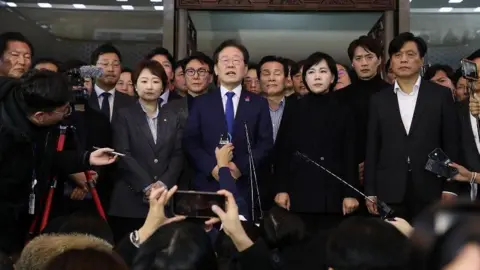
But without a president, talks with Trump have been on hold. They cannot be put off any longer.
And there is much more than South Korea’s economy at stake in these negotiations.
The US currently guarantees South Korea’s security, by promising to come to its defence with both conventional and nuclear weapons, were it to be attacked by its nuclear-armed neighbour, North Korea. As part of this deal there are 28,500 US troops stationed in the country.
Yet Trump has made clear he does not plan to differentiate between trade and security when negotiating with South Korea, signalling that Seoul is not pulling its weight in either area.
In a post on his Truth Social platform in April, Trump said that during initial tariff talks with South Korea he had “discussed payment for the big time military protection we provide”, calling it “beautiful and efficient one-stop shopping”.
This approach makes Seoul uniquely vulnerable.
Evans Revere, a former senior US diplomat based in Seoul, fears a crisis is coming. “For the first time in our lifetime we have a US president who does not feel a moral and strategic obligation towards Korea”.
In his first term as president, Trump questioned the value of having US forces stationed in Korea and threatened to withdraw them unless Seoul paid more to have them. It seems likely he will demand more money this time around.
Seoul may not want to pay more, but it can afford to. A bigger problem is that Trump’s calculations, and that of his defence department, seem to have changed. This is no longer just about the money. Washington’s top priority now in Asia is not just stopping North Korea attacking the South, it is also to contain China’s military ambitions in the region and against Taiwan.
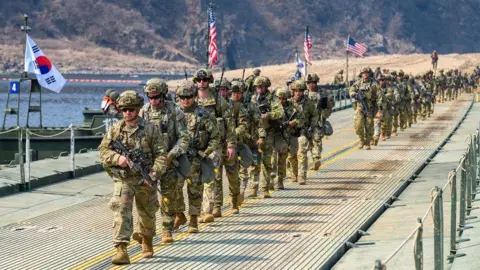
Last year, a now senior US defence official, Elbridge Colby, said that South Korea was going to have to take “overwhelming responsibility for its own self-defence against North Korea”, so the US could be ready to fight China.
One option is that the troops stationed here would switch their focus to constraining China. Another, touted by acouple of US defence officials last month, is that thousands of soldiers would be removed from the peninsula altogether and redeployed, and that Seoul’s military would also have to play a role in deterring Beijing.
Not only could this put South Korea in a dangerous military predicament, but it would also create a diplomatically difficult one.
President Lee, who historically has been sceptical of Korea’s alliance with the US, wants to use his presidency to improve relations with China, South Korea’s powerful neighbour and trading partner. He has stated several times that South Korea should stay out of a conflict between China and Taiwan.
“We must keep our distance from a China-Taiwan contingency. We can get along with both”, he said during a televised debate last month.
The political advisor Mr Moon, who once served as national security advisor, reiterated Lee’s concerns. “We are worried about America abandoning us, but at the same time we are worried about being entrapped in American strategy to contain and encircle China”, he said. “If the US threatens us, we can let [the forces] go”, he said.
For Mr Revere, the former US diplomat, this combination of Lee, Trump and China threatens to create “the perfect storm”. “The two leaders may find themselves on very different pages and that could be a recipe for a problematic relationship. If this plays out, it would undermine peace and stability in North East Asia”.
In Pyongyang, Kim Jong Un will no doubt be watching closely, keen to exploit the shifting ground. His nuclear weapons programme is more dangerous than ever, and nothing or no-one has been able to convince him to wind it down – including Donald Trump who, during his first term, was the first US president to ever meet a North Korean leader.
Since returning to office Trump has indicated he would like to resume talks with Kim, which ended without agreement in 2019. In Seoul, there is real concern that this time the pair could strike a deal that is very bad for South Korea.
The fear is that Trump would take an “America first” approach, and ask Kim to stop producing his intercontinental ballistic missiles that threaten the US mainland, without addressing the multiple short-range nuclear weapons pointed at Seoul. And in return, Kim could demand a high price.
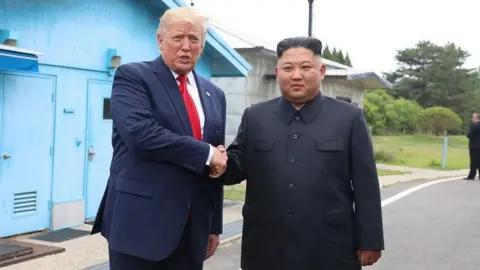
Kim has far more leverage than he did in 2019. He has more nuclear warheads, his weapons are more advanced, and the sanctions that were supposed to put pressure on his regime have all but collapsed, thanks largely to Vladimir Putin. The Russian leader is providing Kim with economic and military support in return for North Korea’s help fighting the war in Ukraine.
This therefore gives Kim the cover to make more audacious requests of the US. He could ask Trump to accept North Korea as a nuclear weapons state, and agree to a deal that would reduce Pyongyang’s weapons count rather than get rid of them altogether. Another of his requests could likely be for the US to remove some the security it provides South Korea, including the troops.
“North Korea is in the driver’s seat now. The only curve-ball is how much risk President Trump will take”, said Sydney Seiler, who was involved in the 2019 negotiations on the US side. “The idea there might be some sort of troop withdrawal [included in a deal] is really not that far-fetched”.
Mr Seiler stressed that the US would “not leave South Korea in the dust,” but advised South Korea’s new president to “establish a relationship with Trump early on”, and be clear they expect to be part of any process, if talks materialize.
The new president must move quickly on all fronts, added Mr Revere, arguing that Lee’s first homework assignment should be to come up with a list of 10 reasons why South Korea is an indispensable partner and why American dollars are being well spent; reasons that can convince a skeptical and transactional Trump.
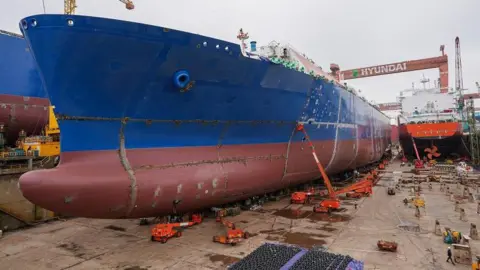
One Ace card South Korea is hoping to play is its shipbuilding prowess. It builds more vessels than any other country bar China, which is now the world’s dominant ship builder and home to the largest naval fleet. This is a frightening prospect for the US whose own industry and navy are in decline.
Last month I visited South Korea’s flagship shipyard in Ulsan on the south coast – the largest in the world – where Hyundai Heavy Industries builds 40-50 new ships a year, including naval destroyers. Sturdy cranes slotted together sheets of metal, creating vessels the size of small villages.
Seoul is hoping it can use this expertise to build, repair and maintain warships for the US, and in the process convince Washington it is a valuable partner.
“US shipbuilding difficulties are affecting their national security”, said Jeong Woo Maan, head of strategy for Hyundai’s naval and ship unit. “This is one of the strongest cards we have to negotiate with”.
In his campaign for president, Lee Jae-myung declared he did not want to rush into any agreements with Trump. Now in office, he could quickly find himself without this luxury.
[BBC]

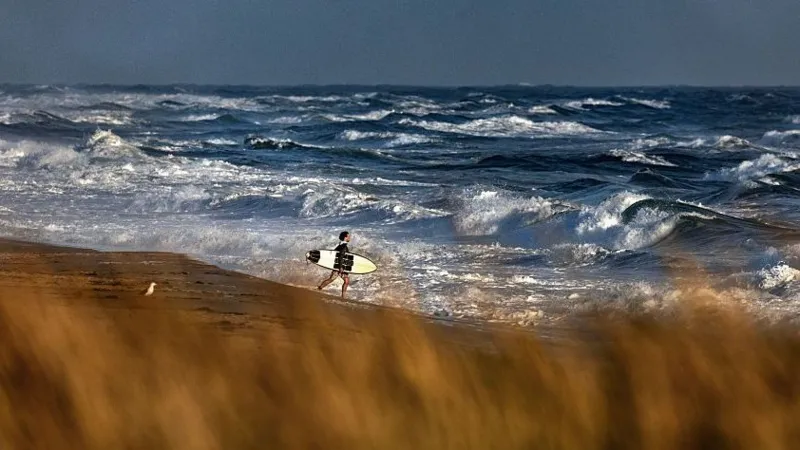
US authorities have found debris from a medical transport aircraft that went missing with six people on board.
The Federal Aviation Administration told the BBC it had lost contact with the Gulfstream G-100 plane just after 01:00 local time (05:00 GMT) on Saturday, while it was travelling from Bermuda to Boston, Massachusetts.
The search for survivors continues off the coast of Nantucket, a Massachusetts island, the US Coast Guard said.
Authorities have notified the next of kin of those on the flight, four Canadian nationals and two Bermudian nationals.
“Search crews located a debris field confirmed to be from the aircraft off the coast of Nantucket,” the US Coast Guard said in an update on Saturday night. It added that ships, helicopters and planes were involved in searches that would through continue the night.
The plane departed from Bermuda’s L.F. Wade International Airport at 23:40 local time, according to flight data from FlightAware, and was due to land at Boston’s Logan International at 01:30 EDT (05:30 GMT).
According to the tail number released by the Coast Guard, the plane belonged to Latitude Air Ambulances, a company that provides international medical flights for patients returning home.
Among those on board were two pilots and two medical staff, both Canadian, Clarence Togeretz, director of flight operations at Latitude, told CBC News.
The crew flew to Bermuda to collect a patient and their relative, who are not Canadian, Togeretz said.
FlightAware’s tracker shows the aircraft significantly dropped in altitude before its communications went dark, plummeting from around 7,300m (24,000ft) to 3,300m (11,000ft).
Radio transmissions shows trouble with communications between the air traffic controller and the pilot, the Boston Globe reported based on transmissions provided by LiveATC.net.
“You’re coming in blind? Is that what you said?,” the air traffic controller asked. “Are you declaring an emergency, or no?”
The pilot’s response was inaudible.
“You’re coming in a little weak so I didn’t hear what your response was, if you were declaring an emergency or not,” the air traffic controller said, according to the Globe.
The air traffic controller later confirmed the pilot had declared an emergency.
An area fire dispatcher asked emergency crews just after 01:00 EDT to prepare to meet a plane with an “electrical issue”.
The dispatcher later said “the aircraft has lost radio and radar”.
The Coast Guard said it would provide an update on Sunday morning local time.
[BBC]

A car has crashed into a crowd of rugby league supporters in the eastern Australian city of Newcastle, injuring 10 people, including three children.
New South Wales police said on Saturday that two of the injured – a five-year-old girl and a 67-year-old man – were in a critical condition and the other eight were in stable condition in hospital.
Police said they had arrested the 18-year-old man driving the vehicle and were investigating what happened. They said the crash was not believed to be related to “terrorism”.
The crowd had gathered to farewell the local rugby league side, the Newcastle Knights, ahead of their grand final against the Sydney Roosters on Sunday.
Newcastle Lord Mayor Gavin Morris said the driver, a rugby league fan, had lost control of his vehicle and had been taken into custody.
“He was revving the car, he was excited, he was a supporter, he was there for the joy of the moment,” Morris told the national broadcaster ABC.
“Somehow he lost control of the car … and he’s gone into the crowd,” he added.
Prime Minister Anthony Albanese said: “My thoughts are with everyone injured or involved in the horrible incident this morning in Newcastle.”
“Rugby league brings people together, and this should have been a weekend of excitement and pride for Newcastle fans,” he wrote in a social media post.
[Aljazeera]
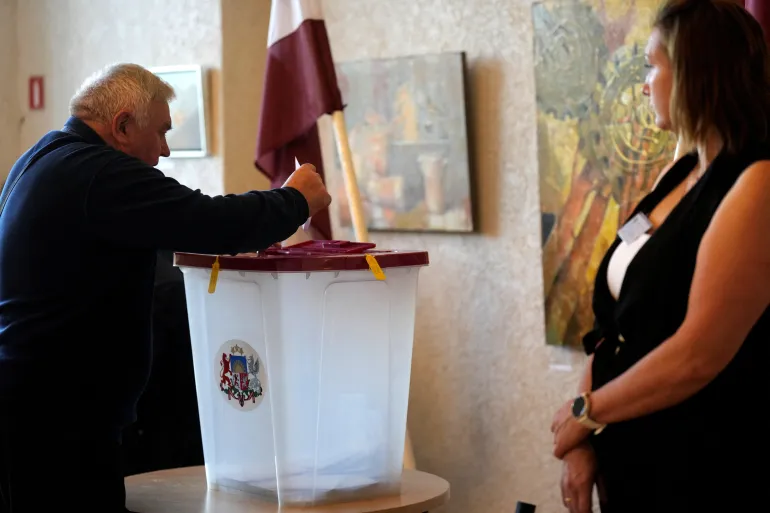
Polls have opened in Latvia for an election taking place against the backdrop of perceived security threats from Russia and a nationwide cost-of-living squeeze.
Saturday’s vote is the first electoral test for Prime Minister Andris Kulbergs after coming to power in May this year when his predecessor resigned due to a backlash from stray drone incursions from Ukraine.
Kulbergs, whose right-wing United List party is currently polling at about 20 percent, is expected to hold onto his position, but the decline of two allies in his current coalition means he is set for a complicated negotiation over the makeup of any future government.
Polls opened at 05:00 GMT and will close at 17:00 GMT. The results are not expected to change Latvia’s pro-European and pro-Ukrainian course.

About 1.5 million people are eligible to vote in the country’s 11th parliamentary election since independence from the Soviet Union in 1991.
Latvian politics are highly fragmented, with parties rarely seeing above 20 percent vote share and coalitions being the norm.
This year, 14 electoral lists are contesting the election, but polls indicate only seven are likely to enter parliament, with the rest expected to fail to meet the minimum 5 percent vote threshold.
Rising living costs, low wages, strains on the healthcare system and long-term population decline have all featured prominently in campaign debates.
Most parties in Latvia are pro-Ukraine; however, the populist Sovereign Power party – which says it wants Ukraine to win but argues money spent supporting Kyiv would be better spent at home – looks likely to become the country’s second-biggest party, with more than 9 percent of the vote. Most other parties have ruled out forming a coalition with Sovereign Power.
Latvia First, a pro-Ukraine and populist nationalist party currently polling at about 9 percent, could be a potential coalition partner for PM Kulbergs.
The Progressives, a pro-European social democratic party, are polling at 6 percent.
Ethnic Russians make up roughly one in four Latvian citizens, but their vote, which has traditionally been cast along identity-based lines, looks set to be made according to economic and social issues.
Latvia is the poorest of the Baltic states, and it has sharply increased its defence spending since Russia invaded Ukraine, now allocating nearly 5 percent of its gross domestic product (GDP) to defence.
[Aljazeera]

Establishment of an Institutional Framework to Inagurate Upper Hydro Catchment Areas Management Authority
Introduction of Flora and Fauna (Regulation of actions of the Indigenous Community within the nominated areas) Regulations
M. M. D. J. Senarathne, appointed Director General of the Department of National Botanical Gardens

Harmanpreet Kaur steps down as India captain

Turkiye, Pakistan agree Saudi Arabia military deployment under Mecca pact

Rumesh Tharanga among nominees announced for World Athlete of the Year 2026

‘Dates have the highest sugar content to fight Coronavirus’

Sunday Island 27 December – Headlines

#SundayIsland 17th December – Headlines

Sunday Island – 28th March

Sunday Island Headlines – 21 March

Sunday Island – 21st February – Headlines
-

 Latest News7 days ago
Gold winner Tharanga gets brand-new Honda Vezel from SLAAJ
-

 News6 days ago
US-assisted ‘Ice’ detection: NPC to examine IGP’s move to transfer drug-busting team
-

 Features7 days ago
Why Sri Lanka needs an Inclusive Civic Nationalism – urgently
-

 Editorial5 days ago
Colombo Port drug bust: The plot thickens
-

 News7 days ago
Civil society activist accuses govt. of favouring Ven. Gnanasara
-
 Midweek Review7 days ago
Dappula’s Easter Sunday ‘grand conspiracy’ claim demolished
-

 Editorial7 days ago
When crime bosses rise above law and shrines
-
Editorial6 days ago
Drug busting, transfers and trust deficit