
Opinion
81st Birth Anniversary of Dr. (Mrs.) Dulcie de Silva – A tribute


“In the end, it is not the years in your life that count. It is the life in your years.” — a quote from Abraham Lincoln that offers me a unique perspective to reflect on the life and work of Dr Mrs. Dulcie de Silva, whose 81st birthday falls on May 12, 2025. She is fondly addressed as Dulcie. Her life so far has been full of loving relationships, intellectual curiosity, a strong commitment to helping others, and an interesting career in public health with a focus on training primary healthcare workers. These qualities have made her one of Sri Lanka’s most memorable public health figures in recent times.
Dr de Silva’s move to the Institute of Hygiene Kalutara (now the National Institute of Health Sciences – NIHS) in 1976 as a Medical Officer was a defining moment in her life. That was when she truly embraced public health as her lifelong path. Later, she became part of the faculty, training primary healthcare workers, and stood out as one of its pioneers. She had the good fortune to be mentored by the late Dr Godwin Fernando, who took on the role of Chief Medical Officer of Health Kalutara in 1972. She also worked alongside a passionate group of co-workers from various health fields.
In the early 1970s, public health started going through a major transformation, especially in how front-line health workers were trained. This shift really kicked off when Dr Godwin Fernando became Chief Medical Officer of Health.
The transformation was not easy. It was a tough journey driven by Dr Fernando’s strategies, in partnership with his team — with Dr de Silva playing a key role. There was careful planning and structured roll-outs aimed at addressing the country’s health training needs more effectively. Getting approval from the ministry and cabinet was a major hurdle. Dr Fernando and his team had to navigate uncertainty and challenges to get NIHS recognized as a decentralized unit of the Ministry of Health. He had the willpower and skills to face whatever came his way. “Si vis pacem, para bellum” (If you want peace, prepare for war). Dr Fernando had a rare ability to anticipate the future. He was incredibly resilient — able to adapt, recover, and continue. With these strengths, he led an effort to persuade, negotiate, defend, and compromise in the interest of what became a nationally recognized achievement.
This entire journey gave Dr de Silva the experience to equip herself with future-ready skills and long-term success. She believed that “a vision is not enough; it must be combined with venture. It is not enough to stare up the steps; one must also step upstairs.” She believed bringing new life to your life requires focus, dedication, and emotional energy. She was driven by purpose and eventually became the fifth Director of NIHS in 1997 serving until her retirement in 2004.
The golden years of NIHS began with its full autonomy as a decentralized body under the Ministry of Health. This stage involved major developments in human resources, infrastructure and curriculum redesign, to mention but a few.
From the early 1980s, NIHS took new steps in its training programs. A notable example was the community development project in Adikarigoda, a small village near Kalutara, which became a “community school” offering direct training and research opportunities. Dr Halfdan T. Mahler, then Director-General of the World Health Organization, visited both NIHS and this village in the mid-1980s. He was deeply moved by the sense of unity and spirit there. In appreciation, Dr Mahler made a personal donation to restart a preschool project that had stalled for years. Dr Mahler is known for launching the “Health for All by the Year 2000” strategy.
Dr de Silva had a talent for managing problems. She was a moral compass who made steady, thoughtful decisions. Her leadership style was marked by calm strength, confidence, and consistency. She was known for doing ordinary things in extraordinary ways and following the principle: “Never impose on others what you would not choose for yourself.”
She was an erudite person with immense potential and experience in teaching and learning — providing a dynamic environment that nurtured intellectual curiosity, critical thinking, and ethical leadership. She believed in lifelong learning. “Ancora imparo” (Still, I am learning) — the Italian quote fits her perfectly.
Dr de Silva’s family and social life were filled with joyful moments and admirable qualities. She was always kind-hearted, cheerful, and modest — someone who lived with grace and grit. I remember the birthday parties of our sons and daughters back in the 1970s when we lived in the NIHS quarters. Today, you have your elder sons, daughter, grandchildren, and Mr. Andrew de Silva — once Secretary of Education close to you in your senior years.
You now lead a virtuous family life deeply rooted in religious and spiritual pursuits. “A virtuous wife was one who led the good life. A good laywoman endowed with religious devotion, moral virtues, and openness as well as wisdom and learning and gifting to charity makes success of her life in this very existence.” (Samyutta Nikaya)
Dr de Silva returned to public life though in a limited way after ten years of retirement, as a co-founder of the NIHS Pensioners’ Association, formed in December 2014. She served as its president for nine consecutive years. The association’s mission is to support the health, social, and spiritual needs of its members, while also showing continued loyalty to NIHS. One of its major achievements was naming the NIHS Auditorium as “Dr Godwin Fernando Memorial Auditorium” — a lasting tribute to a public health pioneer. The association celebrated its 10th anniversary in December 2024, marking a significant milestone.
On aging, Dr de Silva believes that with the right attitude and healthy spirit, aging can bring joy and new rewards. She feels positive aging is about being confident, staying active, and living fully.
She has answered some of life’s deepest questions: How should I live my life? For what should I aim? What values should I live by? These are what some call “Socrates questions.”
Dr de Silva has lived a psychologically rich life — never boring, always full of new experiences. She is a rare blend of qualities in one person. She lived authentically and gracefully and is undoubtedly a true legend of our time. Her contributions to public health are clear and lasting.
As she continues her retirement journey, I wish her good health and much joy in the years ahead.
The wonderful memories we share are priceless.
A.K. Seneviratne
A Former Senior Tutor, Public Health
NIHS Kalutara



To say that the developing new world order is history in the making may not be an exaggeration, because the economic, military and hegemonic landscape of the world may be undergoing radical realignment in these troubled times. Multipolarity and the emergence of the Global South’s economic and political clout may be the defining features of the new world order. There may be several evidential happenings around the world that give credence to the above observation. For instance, at the 61st Munich Security Conference, held in 2025, multipolarity was accepted as a historical inevitability and a reality. The Munich Security Report 2025, themed “Multi-polarization,” explicitly states that the world already lives in a multipolar order. The Munich Security Council, traditionally dominated by Europe and the US, saw 30 percent of its speakers, this time, representing the Global South, a testament to the world’s multipolar trajectory
The Munich Security Report 2025 highlights that BRICS nations contribute to approximately 40 percent of global trade, as well as crude oil production and exports. Further, according to the International Monetary Fund, the GDP of emerging markets and developing economies accounted for 58.9 percent of the global economy in 2023.
Countries in the Global South are asserting greater independence in global affairs. They have actively promoted greater democracy in international relations through platforms such as BRICS and the Shanghai Cooperation Organisation, injecting vital momentum into the world multi polarisation process.
Another clear indicator of this reality is the way the US failed to impose its will in the affairs of the Middle East. Significantly, it could not achieve its objectives in the war against Iran and, furthermore, its European allies refused to join, saying that it was not their war. The fact that the war, which the US and Israel expected to be a quick “strike and take over,” has ended up in a stalemate, with Iran holding all the cards, according to Prof Jeffrey Sachs, points to the changing balance of power in the world. Obviously, Iran was able to enhance its military capability due to the significant development of the multiple military power blocs.
In this regard it is interesting to see that most of the countries in Asia, Africa and Latin America, which have suffered due to western hegemony and economic exploitation, tariffs and sanctions and dollar weaponisation, are beginning to make moves towards realigning their relationship with world powers. Several African nations, Egypt, Ethiopia, Algeria, Kenya, Tanzania, are actively realigning toward the Global South, shifting away from Western-aligned partnerships to pursue multipolarity, resource sovereignty, and new economic ties with powers like China, Russia, and India.
In Asia, too, the trend is apparent; Malaysia has adopted an explicit Global South policy, focusing on outreach to the Middle East, Africa, and Latin America, as well as deepening ASEAN institutional ties. Indonesia focuses on inclusive multilateralism and critical balancing in global governance, ensuring the developing world’s economic needs are prioritised. Iran, Saudi Arabia, and the United Arab Emirates joined BRICS in 2023, reflecting a strategic shift to diversify their diplomatic and economic alliances away from purely Western orbits. There are several other countries that are emerging as economically independent and diplomatically articulative states, like Nigeria, Turkiye, and Mexico.
What is the position of Sri Lanka in this rapidly changing world order? Are we going to be left behind? Why aren’t there any signs that Sri Lanka is projecting itself as a willing partner of this journey in the South? Why isn’t it attempting to break away from the neo-liberal grip that keeps it in poverty and turn to the South? Are there any tangible economic, political or geopolitically strategic projections, reaching out to the Global South, that Sri Lanka has launched, at present, like so many other countries are doing? Even when opportunities knock on its door, Sri Lanka doesn’t seem to be interested. A case in point is the BRICS meeting in 2024, held in Russia. Though Sri Lanka was invited, none of its state leaders attended the meeting, resulting in the loss of an opportunity to establish vital economic, political and cultural links and bonds with Global South countries.
What is restraining Sri Lanka? Is it its present economic vulnerabilities and dependence on the West? It is the Global North that controls the Sri Lankan economy at present. We are tied to the IMF and controlled by their conditions and the IMF is under the thumb of the West. Further 60 percent of our exports go to the Global North. It seems likely that our export oriented, debt-burdened economy cannot afford to turn towards the Global South because of our utter dependence on the West. We saw that there was no hesitation to slap tariffs on us though we show the least tendency to disobey. One could imagine what could happen if we turn southwards, even a little bit. This is the reason why Sri Lanka would dare not change direction the slightest.
Countries that turn southwards do so to escape from the hegemony, exploitation and coercive power of the West. Isn’t there a way out for Sri Lanka to get out of this vicious global economic system and become economically independent? We were bankrupt in 2022 and people rose up against the system and wanted a change. The present government rode that tide and came to power promising a change. But there was no change and not even an attempt to change. What needed a change was the economy in the main, which would be meaningless unless a break from the fetters of neo-liberalism was the aim. What did not change was exactly that, though there were attempts to change other less vital areas, such as going after the corrupt in the Opposition.
It must be said that the government had an excellent opportunity to correct decades long mistakes. The people were asking for a change which means they were prepared to participate and support the government if it wanted to go for that change. An attempt should have been made to gradually change the export-import-debt based economy and lessen the dependence on the Global North and its economic system. A turn towards the Global South would have facilitated the desired change. The government was left-oriented, or so they said. But it appeared to be helpless to break away from the neo-liberal shackles, leave alone negotiating a better deal with the IMF.
True, we are not strong enough to go for such radical change but we could have made ourselves strong by achieving self-sufficiency, the only way to become economically independent. Such a move, no doubt, would initially result in hardship for the people, but eventually the country would come out of its poverty. Now they are condemned to eternal privation.
The government’s plan, if it wanted to go for the change, they promised, should have been to first launch a comprehensive programme to achieve self-sufficiency in our essential needs like food, cloth, medicine and green energy. The other critical move that Sri Lanka should have made was to join the Global South in its march towards a new world order. Such a strategy would have helped us to achieve a stronger and independent economy.
An important outcome of adopting such a policy would be that our economy would not be vulnerable to external shocks such as tariffs, drop in tourism, turmoil in the Middle East that disrupts fuel supply and migrant-remittances, and external trade vagaries. Further, when we are not dependent on our essentials, nobody would be able to dictate to us or interfere in our internal affairs.
Another important factor in Sri Lanka’s favour is its strategic position in the Indian Ocean and the fact that due to this everybody needs it. India would like to have a firm grip on it, so does the US. China has invested heavily in it due to this reason. However, Sri Lanka, at present, is not strong enough to leverage this geographical strategic situation to its advantage because of its highly dependent and vulnerable status. As a consequence of this strategic situation could be exploited by powerful countries as is now happening.
What Sri Lanka could do in this regard is to develop its airports and harbours as a transit trade hub by leveraging its strategic geographical position in the Indian Ocean to serve as a central stopping point where cargo, vehicles, and raw materials are consolidated, temporarily stored, or re-exported, primarily connecting East Asia, the Middle East, Africa and the Indian subcontinent. This would facilitate trade among the Global South countries and enhance Sri Lanka’s role and image in the new world order. At present Sri Lanka’s true potential in this business has not been realised due to its vulnerabilities, but if it chooses to take the path outlined above it could succeed. For this to happen Global South assistance is vital. There is no choice for Sri Lanka but to grab this moment of history and join the journey towards the new world order before we are left behind.
by N. A. de S. Amaratunga
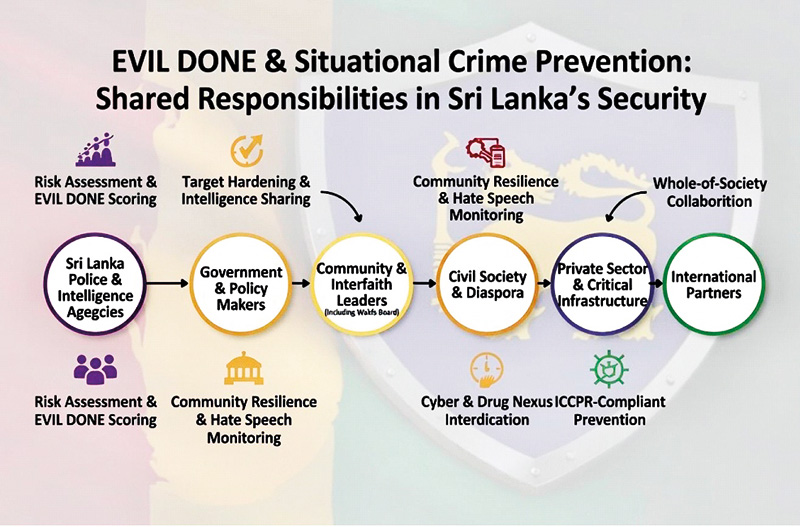
Adapting Opportunity-Reduction Strategies:
In the annals of Sri Lanka’s turbulent security history, from the brutal LTTE insurgency that claimed tens of thousands of lives to the devastating 2019 Easter Sunday attacks, one pattern persists with frustrating regularity: successive governments wield draconian tools like the Prevention of Terrorism Act (PTA), ICCPR provisions, and Emergency Regulations with zeal while in power, only to decry them as authoritarian when in opposition. This selective amnesia reflects not strategic depth but political expediency. Amid evolving hybrid threats from lingering Tamil diaspora networks and ethnic hate speech to drug trafficking and cyber vulnerabilities, Sri Lanka urgently needs principled, proactive tools that transcend partisan cycles.
The EVIL DONE framework, developed by criminologists Ronald V. Clarke and Graeme R. Newman in their seminal 2006 work Outsmarting the Terrorists, offers precisely such an instrument. Rooted in Situational Crime Prevention (SCP) and Rational Choice Theory (RCT), it shifts the focus from reactive force to intelligent opportunity reduction. Adapting it could fortify our national resilience while upholding human rights and interfaith harmony.
At its core, EVIL DONE is a pragmatic diagnostic tool for assessing why terrorists select specific targets. It posits that attackers, like other rational actors, weigh costs, benefits, risks, and rewards. The acronym evaluates target attractiveness across eight criteria, typically scored from 0 to 5 (higher scores signalling greater vulnerability): Exposed (highly visible or accessible sites), Vital (critical infrastructure like power plants or ports), Iconic (symbolically potent locations such as religious shrines or monuments), Legitimate (targets framed as ideologically justified), Destructible (easily damaged with available means), Occupied (crowded venues maximising casualties and media impact), Near (proximate to attacker networks), and Easy (lacking robust guardianship or surveillance).
This framework draws directly from the broader principles of Situational Crime Prevention (SCP), pioneered by Ronald V. Clarke, which manipulates immediate environmental factors to make crimes harder to commit, riskier, less rewarding, less provocative, or less excusable. SCP organises 25 practical techniques into five categories: increasing effort (e.g., target hardening and access controls), increasing risks (e.g., enhanced surveillance and guardianship), reducing rewards (e.g., concealing targets and denying benefits), reducing provocations (e.g., managing frustrations and neutralising peer pressure), and removing excuses (e.g., setting clear rules and alerting conscience). In the context of terrorism prevention, these techniques operationalise EVIL DONE by informing risk registers, layered defences, and multi-agency strategies. As featured in programmes like the Institute of Strategic Risk Management’s (ISRM) Level 5 Award in Terrorism Prevention and Management, SCP fosters integrated, whole-of-society approaches that complement Sri Lanka’s intelligence-led policing and major event security expertise proving far more sustainable than episodic reliance on emergency powers.
Sri Lanka’s past provides compelling case studies. During the LTTE era, attackers masterfully exploited Iconic, Legitimate, and Vital targets, the Dalada Maligawa bombing, political assassinations, and economic infrastructure strikes. The group’s calculated campaigns demonstrated bounded rationality: timing assaults for maximum propaganda value while minimising immediate risks. Post-2009, the 2019 Easter Sunday carnage starkly illustrated Easy + Occupied + Iconic vulnerabilities. Coordinated suicide bombings on churches and luxury hotels during peak hours exploited soft targets, intelligence gaps, and communal tensions, resulting in over 270 deaths. Major international events, such as CHOGM 2013 and cricket World Cups, where robust coordination proved effective, further underscore the value of layered defences informed by opportunity reduction.
Yet today’s threats extend far beyond conventional terrorism, demanding an expanded application of EVIL DONE. The Tamil diaspora, particularly segments in Canada, the UK, Europe, and Australia, presents a complex transnational dimension. While much diaspora activity centres on legitimate advocacy for accountability and reconciliation, residual networks have historically facilitated financing, propaganda, and logistics.
In EVIL DONE terms, these amplify Near, Easy, and Iconic risks through digital coordination and grievance narratives. Proactive strategies balanced intelligence sharing, diaspora outreach, and counter-narratives could reduce opportunities without alienating communities. Models from the Sri Lanka Wakfs Board’s interfaith initiatives offer a blueprint for inclusive engagement.
Ethnic and racial tensions, exacerbated by hate speech, further elevate vulnerabilities. In our multi-ethnic society, online and offline incitement targeting Tamils, Muslims, or other groups turns religious sites and cultural events into high-scoring Iconic + Legitimate + Occupied targets. Sri Lanka’s ICCPR Act No. 56 of 2007, incorporating Article 20(2) prohibitions on incitement to hatred, provides a legal foundation, yet selective enforcement erodes credibility and fuels cycles of distrust.
Applying EVIL DONE here means integrating hate speech monitoring into risk registers, bolstering digital guardianship, and promoting community policing to deny attackers the social fissures they exploit. Consistent application across governments is essential, not the “crying foul” hypocrisy that characterises much of our politics.
The narcotics-terror nexus demands unrelenting vigilance. Sri Lanka’s strategic position as an Indian Ocean transit hub has long exposed us to heroin, synthetic drugs, and organised crime networks. Battling the drug mafia is not a peripheral law enforcement issue but a core national security imperative. These syndicates corrupt institutions, erode community cohesion through widespread addiction, generate illicit funds that potentially finance extremism, and create vulnerable recruitment pools for radical ideologies. In EVIL DONE analysis, trafficking operations exploit Vital + Destructible + Easy nodes, ports, border controls, financial systems, and urban distribution networks, while turning addiction-plagued neighbourhoods into Occupied soft targets ripe for exploitation.
Continuing this battle requires sustained intelligence-led operations, inter-agency coordination, maritime domain awareness, and community rehabilitation programmes. Only by dismantling these mafia networks can we sever symbiotic links between drug profits and terrorism, preventing the social decay that undermines hard-won peace.
Cyber threats compound these risks in our digital age. Ransomware attacks, phishing campaigns, and data breaches on government and private systems expose Exposed + Vital + Easy infrastructure. Breaches not only erode public trust but enable disinformation that inflames ethnic divisions or facilitates hybrid operations. Adapting EVIL DONE to the cyber domain, scoring digital assets for visibility, criticality, and guardianship, alongside enhancements to Sri Lanka CERT and public-private partnerships, is imperative. The emphasis on capability development through training and exercises provides a ready pathway.
Globally, the framework’s strengths lie in its actionability and flexibility. It enables cost-effective prioritisation, adapts to static and dynamic targets (including major events and urban resilience), and integrates seamlessly with intelligence-led policing. Empirical applications in the UK, Istanbul, and beyond demonstrate its predictive value, particularly the “DONE” elements for modern lone-actor and low-tech threats. Supplements like the TRACK (The TRACK – Tolerant- Relevant- Accessible-Known – framework is a contemporary extension of the EVIL DONE model, developed by researchers Zoe Marchment and Paul Gill (around 2020). It focuses specifically on the spatial and operational dynamics of how terrorists choose targets in modern contexts) framework can address spatial dynamics. Limitations must be acknowledged honestly.
EVIL DONE assumes bounded rationality, potentially undervaluing deeply ideological or suicidal actors. Over-reliance risks creating a “fortress society” or unintended threat displacement without tackling grievances. In Sri Lanka, empirical validation through local case studies is needed, alongside safeguards to ensure ICCPR compliance and avoid over-hardening that stifles freedoms.
The path forward is clear.
First , pilot EVIL DONE scoring in national risk registers, incorporating hybrid scenarios involving diaspora links, hate speech, drugs, and cyber vectors.
Second , embed it in professional development at the Police Academy, military institutions, and other stakeholders such as the immigration and emigration, customs, drug control board and coast guards etc.
Third , develop Sri Lanka-specific analyses for training, policy, and publications, including contributions to the national security discourse. Fourth, institutionalise consistent, oversight-driven application to transcend political cycles.
Finally , foster regional SAARC collaboration and leverage interfaith platforms for community resilience.
Sri Lanka’s hard-won peace after defeating LTTE terrorism and navigating post-Easter reforms positions us as a global thought leader in counter-terrorism. Embracing tools like EVIL DONE honours the sacrifices of the past while securing the future. It demands statesmanship over short-termism, principled consistency in law application, intelligence-driven prevention, and whole-of-society unity. As we confront hybrid threats in an interconnected world, opportunity reduction offers not just defence, but a pathway to enduring harmony and resilience. Our policymakers must choose brains over power, strategy over expediency. The alternative is perpetual vulnerability.
Mahil Dole, SSP (Retired), is the former Head of the Counter-Terrorism Division of the State Intelligence Service of Sri Lanka, and has served as Head of the Sri Lankan Delegation at three BIMSTEC Security Conferences. With over 40 years of experience in policing and intelligence, he writes on regional security, interfaith relations, and geopolitical strategy.
By Mahil Dole ssp rtd.
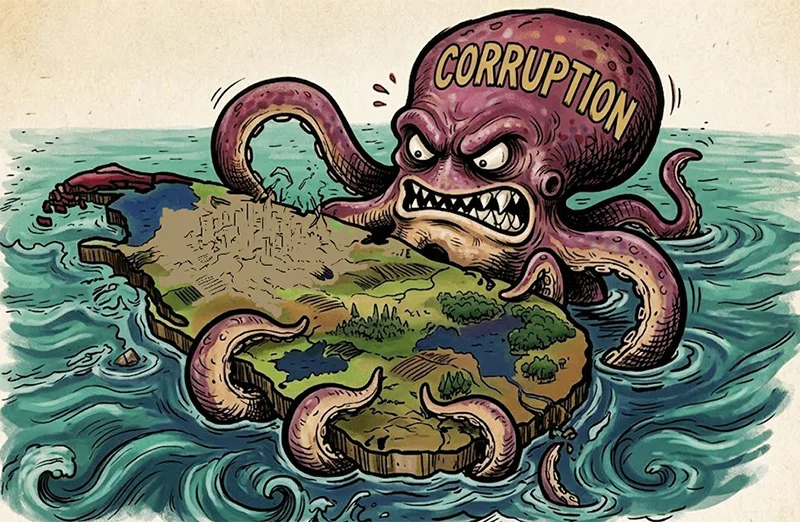
Many of us know that post-independence Sri Lanka is nearly eight decades old, yet the country has not achieved the level of growth and development necessary to ensure a high quality of life for its citizens. Most people point fingers at the politicians who governed the country and criticize their economic policies. One of the most recent accusations against political leaders is corruption. This concern becomes evident when analysing measures such as the Corruption Perceptions Index and examining recent incidents such as the Central Bank bond scam. Ultimately, the country had to face severe economic downturns and a declining standard of living. Consequently, Sri Lanka was compelled to reform its legal framework by introducing new laws for the implementation of monetary policy and the control of corruption, while also seeking assistance from international organisations. It is true that the effective enforcement of the law can reduce corruption. However, achieving meaningful results requires a broader understanding of corruption, along with improvements in legal mechanisms and more effective methods of enforcement. This short write-up aims to familiarise citizens with a broader definition of corruption, its various forms, and several measures that can be adopted to combat corruption effectively and efficiently.
Corruption undermines democracy
As stated by the United Nations, corruption undermines democracy and the rule of law, leads to violations of human rights, distorts markets, erodes the quality of life, and allows organised crime, terrorism, and other threats to human security to flourish. It is also a key factor contributing to economic underperformance and a major obstacle to poverty alleviation and sustainable development. Furthermore, corruption represents a failure of governance, as it distorts the allocation of resources and weakens government performance. The World Bank defines corruption as “the misuse of public office for private gain.” In this context, public power is abused by elected politicians or appointed public officials for personal benefit. In the modern global economy, no country can be considered completely free from corruption; therefore, corruption remains a global issue.
Academic literature provides numerous definitions of corruption, and many researchers have proposed various theories to explain it. The relationships between corruption and other socio-economic variables have been widely analysed, while both its causes and effects have been extensively discussed. The United Nations Convention Against Corruption, introduced in 2004, proposed several measures to combat corruption. Nevertheless, corruption continues to remain high in many developing countries and is also evident, to some extent, in developed economies. Sri Lanka is no exception. Authorities responsible for controlling corruption in Sri Lanka have acknowledged that investigations and prosecutions alone are insufficient to effectively combat corruption. Therefore, expanding the frontiers of knowledge on corruption, particularly in the Sri Lankan context, is of timely and national importance.
Although the literature provides and explains many definitions of corruption, there is no single universally accepted definition. In efforts to combat corruption effectively, definitions must encompass a broader range of ideas, and people should properly understand the various forms and dimensions of corruption.
Certain improper activities carried out by public sector officials are difficult to categorise strictly as the “abuse of public property for private gain.” For example, in the public sector, failure to properly perform assigned duties, leaving official work unfinished despite being entrusted with responsibilities, taking unnecessarily long periods to complete official tasks, using excessive public resources, and deliberately delaying public services can all be considered forms of corruption or administrative misconduct. Furthermore, in some instances, officials and institutional heads intentionally remain silent about the corrupt activities of others, assist corrupt individuals in concealing evidence, or show reluctance, lethargy, or unwillingness to take legal action against corrupt public officers. Although Sri Lanka’s Anti-Corruption Act No. 9 of 2023 defines corruption, it does not explicitly incorporate all of these dimensions.
Moreover, legalised corruption is another issue that deserves attention. This relates to weaknesses or manipulations in the process of framing laws and regulations. Certain actions may not directly fall under the definition of the “use of public property for private gain,” yet they may still represent indirect or extended forms of corruption. Therefore, for the successful control and prevention of corruption, broader and more comprehensive definitions are required.
Forms of Corruption
Corruption may appear in various forms. If the economy is broadly divided into the public and private sectors, corruption can be analysed under two major categories: public sector–specific corruption and public–private sector corruption. The first category refers to corruption that occurs solely within the public sector, while the second involves the abuse of public resources in transactions or interactions between the public and private sectors.
Within the first category, corruption may occur not only at the individual level but also collectively. Individual corruption takes place when a single public officer abuses public resources or authority for personal gain. However, collective corruption involves coordinated behavior among groups of public officials. This collective behavior may occur within a particular institutional hierarchy or among several related institutions and hierarchies. For example, within a single hierarchy, when a citizen visits a public office to obtain a service, a particular officer may be responsible for handling the relevant task. If the officer is corrupt, he or she may deliberately avoid performing the required duty by raising irrelevant objections or refusing to provide the service efficiently. In some cases, the officer may intentionally insert doubtful or questionable remarks into official documents and forward them to a superior officer in order to obstruct the successful completion of the request.
At times, superior officers themselves may instruct subordinate officers on the type of comments or procedural objections that can be used to justify rejecting a request when no personal benefit or reward is received. Conversely, when a material reward or bribe is offered, all officials involved may cooperate and share the benefit among themselves. This represents a collective form of corruption confined within a particular hierarchy in the public sector, without any direct involvement from the private sector.
Collective corruption may also occur across two or more institutions or hierarchies that are required to work together. Such situations are often observed in the process of taking legal action against criminal offences. If the relevant institutions fail to perform their duties honestly and effectively, the legal process may collapse. Where officials within these institutions act corruptly or engage in favoritism, they may collectively benefit from rewards or unlawful advantages received in exchange for their cooperation or inaction. This is another form of collective corruption that exists entirely within the public sector.
In such circumstances, the rule of law becomes ineffective. Therefore, there is a strong need to recognise and incorporate these collective patterns of corrupt behavior into broader definitions and theories of corruption. This may also provide a foundation for the development of new theoretical approaches to understanding corruption in the public sector.
For the second category, namely public–private sector corruption, many examples can be identified. Tender procedures and procurement activities conducted by state institutions are common practices in every country. When private sector actors attempt to influence public officials through rewards, bribes, or other benefits in order to secure favorable decisions, such actions fall within this category of corruption.
In some instances, private individuals who work in association with public institutions may collaborate to generate undue benefits for themselves. For example, within the court system, lawyers are paid by plaintiffs and defendants for legal representation. Certain lawyers may intentionally delay court proceedings for personal financial gain. In some cases, lawyers representing opposing parties — such as plaintiffs and defendants or co-owners in partition cases — may unofficially cooperate to prolong legal procedures, including the delayed submission of documents or repeated postponements of hearings. By extending the duration of cases, they may maximize the payments received for their court appearances and related services. Such practices can also be regarded as a form of corruption linked to the interaction between public institutions and private actors.
Moreover, within public institutions, when one official engages in corrupt activities, superior officers or fellow officials may intentionally remain silent without reporting the misconduct or taking disciplinary action against the corrupt individual. In Sri Lanka, different political parties have governed the country from time to time; however, corruption has remained widespread under many administrations. Prior to elections, political leaders frequently promise to eliminate corruption and publicly declare that legal action will be taken against corrupt individuals once they are elected. Nevertheless, after assuming power, many fail to fulfill these promises and often avoid taking legal action against corrupt individuals connected either to previous governments or to their own administrations.
Even when certain public officials initiate legal action against corrupt individuals, procedural loopholes or omissions may intentionally be allowed to weaken the effectiveness of such actions. If a superior officer or relevant authority deliberately ignores corruption or fails to take proper legal measures, such behavior may itself be regarded as a secondary form of corruption, which can be described as “corruption on corruption.” Therefore, officials who knowingly tolerate, conceal, or fail to act against corruption should also be considered corrupt.
Preventive Measures
Law serves as the strongest safeguard and a key preventive measure against corruption. However, when the legal framework governing corruption is expanded, the size of government may also increase, and as a result, tax burdens may rise. On the other hand, an excessively enlarged government may itself create additional opportunities for corruption. Therefore, policymakers must exercise caution when designing preventive measures.
It is true that law enforcement institutions take action and punish corrupt individuals with the aim of combating corruption. However, even when legal provisions are adequately established, enforcement is often weak or inconsistent in some countries. In certain cases, legal actions are not taken at all, or they are not implemented effectively against corrupt individuals. At times, officials may deliberately allow omissions or procedural weaknesses within legal processes. In other situations, the legal framework itself may be inadequate, containing loopholes that hinder effective enforcement. In such circumstances, the law must be reformed and made more efficient. Policymakers therefore need to explore new approaches to strengthening anti-corruption legislation. For instance, if legislation clearly states that every employee within a public institution is accountable for corrupt activities occurring within that institution, it may enhance collective responsibility and help prevent collective forms of corruption. Furthermore, when corruption occurs within an institution, heads of institutions or relevant legal authorities may sometimes remain silent. Such silence can enable the continuation and spread of corruption, a situation that may be described as “corruption on corruption.” To address this, legal provisions could be extended to define the deliberate silence or inaction of institutional leaders in the face of known corruption as a punishable offence. Thus, continuous efforts are needed to explore and strengthen legal mechanisms in order to make anti-corruption laws more effective and comprehensive.
Conclusion
Corruption may appear in various forms, and everyone needs to remain vigilant about it. Those who engage in corruption, as well as those who remain silent and fail to take adequate measures to control it, are equally responsible for the persistence of corruption. If the law can be effectively enforced without unnecessarily expanding the size of government, it would be more beneficial for social welfare. Therefore, a broader and more inclusive definition of corruption is required for its successful control. Certain activities may not strictly fall within the internationally recognized definition of corruption as the “use of public property for private gain.” Although Sri Lanka’s Anti-Corruption Act No. 9 of 2023 provides a relatively broader definition, it still does not fully capture all such practices. Moreover, legalised corruption is another important issue that requires further discussion, particularly in relation to the processes of law-making and law enforcement. This includes situations where legal frameworks themselves may be designed or applied in ways that indirectly enable corrupt practices.
by Dr. Tikiri Nimal Herath
Emeritus Professor
tikiriherath@gmail.com

Canada introduces bill to ban social media for children under 16

Lutkenhaus, 17, upsets Olympic champion Wanyonyi in Oslo

An Everest guide’s miraculous survival raises questions for tourism industry

Whale graveyard dating back five million years discovered

Trump says US will hit Iran ‘hard’ again today

Showers will occur at times in the Western, Sabaragamuwa and North-western provinces and in Galle, Matara, Kandy and Nuwara-Eliya districts

‘Dates have the highest sugar content to fight Coronavirus’

Sunday Island 27 December – Headlines

#SundayIsland 17th December – Headlines

Sunday Island – 28th March

Sunday Island Headlines – 21 March

Sunday Island – 21st February – Headlines
-
 Features6 days ago
Power crept into the Sangha and is now tearing it apart
-

 Features6 days ago
Kondachchi wind farm and battery storage project to boost energy security, says Power Ministry Secretary
-

 News4 days ago
Women’s T20 World Cup 2026 warm-up: Chamari Athapaththu’s 94 helps Sri Lanka beat Pakistan
-
 Features6 days ago
Saudi Arabia sets new benchmark in Hajj management as 1.7 million pilgrims complete sacred journey
-

 News5 days ago
Asst. Manager, security officer arrested over Rs 30 mn snatch at Horana PB branch
-

 Editorial3 days ago
Probe Sallay’s complaint
-

 News4 days ago
Lankan-Canadian inducted to Toronto Sports Hall of Fame
-
 News1 day ago
Local firms move millions of dollars overseas for phantom imports: Govt.