
Business
Apparel Giant Omega Line celebrates 25 years of excellence

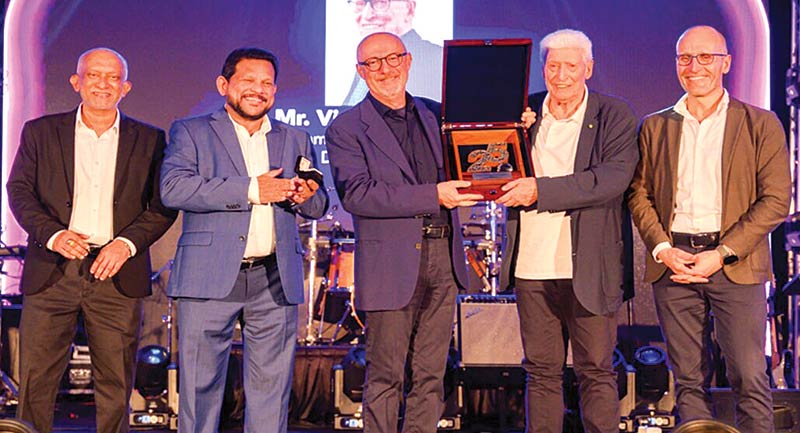
Omega Line Ltd, Sri Lanka’s largest exporter of clothing items to the European market which produces and exports more than 90 million clothing items consisting of fashion garments such as bras, briefs, and beachwear, recently celebrated 25 years of excellence in contributing to the growth of the Sri Lankan economy. Founded in 1999 with its first and flagship apparel manufacturing facility in the North-Western province of Sri Lanka, Omega Line has grown to over 4,500 employees at Sandalankawa, and its Vavuniya factory, which is the largest investment in the Northern province, has 2,900 employees. Omega Line is a wholly owned investment of Oniverse (formerly Calzedonia), based in Verona, Italy, and the brainchild of Group President Dott. Sandro Veronezi. In addition, Omega Line and its’ sister companies employ over 15,000 employees across several factories and collaborate with several subcontractors to produce pyjamas, night-dresses, and T-shirts. Omega Line’s portfolio of brands comprises renowned names including Calzedonia, Intimissimi, Tezenis, and Falconeri, which speaks volumes about the outstanding success of Omega Line in contributing to the Sri Lankan economy since its inception. The group has invested over US$400 Million in Sri Lanka and exported a combined total of over 200 million garments last year.
“We are delighted to celebrate our 25th anniversary with notable milestones. Since our inception in 1999 as a single manufacturing facility with 30 employees, we have expanded to seven factories employing over 15,000 across affiliated factories and various production lines. This growth exemplifies our production capabilities and our dedication to expansion, diversification, and geographic reach,” stated Dott. Sandro Veronesi, President of Oniverse Holdings, Italy. “We came to invest in Sri Lanka at the height of the terrorist war, but we were able to come this far due to the hard work of Mr. Vincenzo Joppolo, immediate past Chairman and Managing Director, Felix Fernando, Kapila Wanniarchchi, Ms. Bruna Carelle, and the Sri Lankan team. We are also expanding Benji Ltd. this year by adding another factory” he added.
“We attribute much of our success to our unwavering belief and commitment to employee engagement and happiness which in turn enables us to realize our primary goal of delivering the highest quality products, on time and at the lowest cost. In 1999, Oniverse (formerly Calzedonia) had only around 300 retail outlets operating in very few European countries. However, due to the expansion of its supply chain, Oniverse now sells in over 55 countries with over 5,700 retail outlets. Sri Lanka produces over 75% of the garments Oniverse sells currently and is a testament to the trust Oniverse has placed in Sri Lankan operations,” stated Felix A. Fernando, CEO & Managing Director of Omega Line Ltd, who is also the company’s first employee.
Sustainability is one of Omega Line’s key drivers in all its manufacturing operations. While aligning with global initiatives such as the Paris Agreement to reduce greenhouse gases and limit global warming with its commitment to achieving renewable energy targets set by its parent company, Oniverse, Omega Line is targeting 2030 to fully transition to renewable energy sources for which significant steps have already been taken by incorporating solar power into their operations. Furthermore, initiatives such as investing in low-power consumption machinery, transitioning to LED lighting, and recycling wastewater for gardening and toilets are prime examples of how Omega Line cares for the environment.
Omega Line was bestowed the Best Corporate Citizen Award in 2023/24 by the Ceylon Chamber of Commerce recently for its outstanding contributions to economic development, empowering rural economies, providing employment opportunities, supporting small businesses, and engaging in charitable work. Moreover, Omega Line has been recognized as a Great Place to Work ranking amongst the top 15 in the production and manufacturing sector. Over 90% of employees at Omega Line are females which is a testament to Omega Line’s commitment to women empowerment.


Lankan businesses are facing increasing pressure to strengthen climate governance, compliance, and risk management frameworks as climate-related disclosure requirements, investor expectations, and regulatory standards continue to evolve.
Against this backdrop, Genesis – the Dilmah Centre for a Sustainable Future will host a specialised post-summit technical workshop titled “Climate Action: A Strategic Executive Workshop on Climate Resilience and Business Continuity” on June 12, in Colombo.
The programme is designed as a continuation of discussions initiated at the Sri Lanka Climate Summit 2026 and will bring together sustainability managers, compliance officers, ESG professionals, risk specialists, and corporate decision-makers. It aims to translate climate commitments into practical business strategies.
The workshop will focus on implementation rather than advocacy, examining emerging disclosure frameworks, financing mechanisms, and regulatory pathways shaping corporate climate action in Sri Lanka.
Keynote speaker Dr. Lalanath de Silva, an internationally recognised environmental lawyer and governance expert, will address the evolving legal and compliance landscape influencing climate-related business decisions.
Technical sessions will cover IFRS S2 climate-related disclosures, climate risk governance, green finance opportunities, internal carbon pricing, and access to climate financing. Speakers will include climate risk specialist Rohan Cooray, Shiranee Yasaratne of Biodiversity Sri Lanka, and Suganthi Samarasinghe of UNDP Sri Lanka.
Organisers said climate readiness is increasingly becoming a business necessity rather than a sustainability option, with growing scrutiny from global markets and regulators.
Participation is free of charge, but prior registration is required due to limited seating for professionals in sustainability, governance, compliance, and risk management roles.
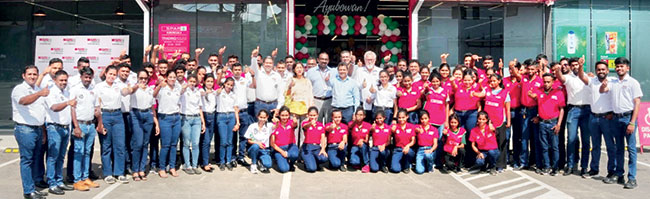
SPAR Sri Lanka has expanded its retail network with the opening of a new outlet in Kurunegala, marking another milestone in the supermarket chain’s growth across the country.
The new store, strategically located to serve the growing population of the North Western Province, offers a wide range of products, including fresh fruits and vegetables, premium meat products, bakery items, household essentials and both local and international brands.
The outlet also features several specialty sections, including a Coconut Corner, Wellness Corner and a dedicated area catering to pet care products.
Speaking at the opening, SPAR Sri Lanka Chief Executive Officer Kumar de Silva said the new outlet reflects the company’s commitment to delivering a “glocal” shopping experience by combining international retail standards with local customer preferences.
“Our Kurunegala outlet reflects our dedication to providing customers with the best range, superior quality and exceptional service under one roof,” he said.
The store also offers SPAR’s signature fresh food concepts, including in-store bakery products, ready-to-eat meals and freshly prepared juices aimed at meeting the needs of busy consumers.
The company said customers will benefit from a range of promotional offers, loyalty rewards, weekend deals and seasonal discounts.
SPAR Sri Lanka said the expansion would also contribute to local economic development through employment generation and support for local suppliers, further strengthening the country’s retail sector.
Pic and Text by SK Samaranayake
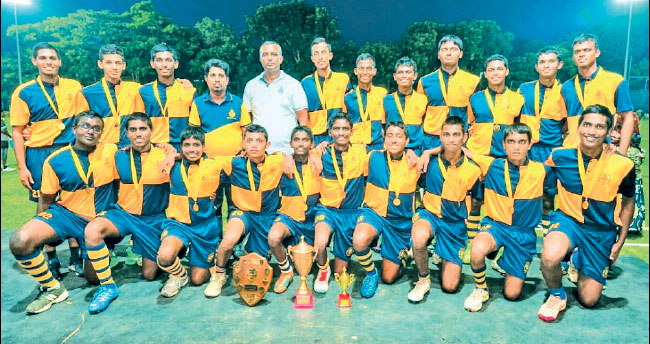
Royal College, Colombo, emerged unbeaten champions of the All-Island Under-20 Hockey Tournament after defeating defending champions St. Thomas’ College, Matale, in a nail-biting sudden-death penalty shootout at the Rajarata University Grounds in Mihintale last week.
The final ended in a 1-1 draw after Royal equalised five minutes from time to cancel out the Matale side’s earlier lead.
With the penalty shootout also ending in a 4-4 deadlock, the match proceeded to sudden death. The Reid Avenue outfit eventually prevailed in the second round of sudden-death penalties to clinch the title.
A brilliant save by goalkeeper Stefan Anthonipillai, who stretched to his right to deny a crucial attempt, and the decisive conversion by Rumal Jayasinghe helped Royal secure the Under-20 championship for the first time since the tournament’s inception in 2014.
Royal’s centre-forward Savain Karunasiri was one of the team’s standout performers throughout the tournament, scoring crucial goals, including strikes in both the semi-final and the final. Anthonipillai was equally impressive, guarding the goal superbly throughout the seven-match campaign.
Royal finished runners-up when the tournament was held in Matale last year.
The Colombo school produced a series of consistent performances despite having to play on an uneven grass surface that was not ideally suited to the fast-paced modern game.
Royal began their campaign with a 2-0 victory over Christ Church College, Matale, before defeating arch-rivals St. Thomas’ College, Mount Lavinia, 1-0. They then beat Kingswood College, Kandy, 2-0 and Maris Stella College, Negombo, 2-1 to top their group.
In the quarter-final, coach Damith Panditharatne’s side overcame fancied Dharmadutha College, Badulla, by 2-0.
Royal then edged out St. Joseph Vaz College, Wennappuwa, 1-0 in the semi-final, adopting a disciplined defensive approach against the aggressively attacking Puttalam outfit.
In the other semi-final, St. Thomas’ College, Matale defeated Trinity College, Kandy, 3-1. St. Joseph Vaz later beat Trinity 1-0 in the third-place playoff.
Panditharatne’s five-year development programme, with a strong emphasis on fitness, stamina and technical skills, played a key role in Royal’s success. The title marked Royal’s first national Under-20 tournament triumph since winning the National Schools Games in 2017.
A former national player, Air Force striker and Sri Lanka Police coach, Panditharatne has focused on addressing the weaknesses of individual players while building a cohesive unit. The former Christ Church College, Matale player has been coaching Royal since 2022 with the support of the Royal College Hockey Club (RCHC), comprising former Royal hockey players.
For his outstanding performances, Anthonipillai was adjudged the Best Goalkeeper of the Tournament. Royal College was also named the Most Disciplined Team of the Tournament.

Women’s T20 World Cup 2026 warm-up: Kapp, Wolvaardt take SA past Ireland

Women’s T20 World Cup 2026 warm-up: Chamari Athapaththu’s 94 helps Sri Lanka beat Pakistan

Rahul, Gill hit centuries as India dominate Afghanistan on opening day

Persistent rain in Kingston washes out second ODI between West Indies and Sri Lanka

Heavy showers about 100 mm are likely at some places in the Western and Sabaragamuwa provinces and in Galle, Matara, Kandy and Nuwara-Eliya districts

Open hearing on coal procurement inquiry set for July first week

‘Dates have the highest sugar content to fight Coronavirus’

Sunday Island 27 December – Headlines

#SundayIsland 17th December – Headlines

Sunday Island – 28th March

Sunday Island Headlines – 21 March

Sunday Island – 21st February – Headlines
-

 News5 days ago
Lankan duo emerge winners in Latin dance championship held in Blackpool, UK
-

 Business6 days ago
IMF’s unstated rate:Sri Lanka’s $695m loan costs about 5.33% per annum
-
 Latest News3 days ago
Kusal Mendis, Pathum Nissanka, bowlers put Sri Lanka 1-0 up
-

 News3 days ago
New US tariffs proposed on 60 countries, including Sri Lanka
-

 Business6 days ago
Sri Lankan scientist-innovator Milinda Edirisinghe introduces AI-integrated gem testing system to gemological world
-

 Features2 days ago
Power crept into the Sangha and is now tearing it apart
-

 News6 days ago
UNP challenges NPP move to amend Vihara – Devalagam Act
-

 News5 days ago
Sri Lankan teen killed in Chennai clash; three arrested