
News
Weerasekera warns of plot against SL military in Geneva

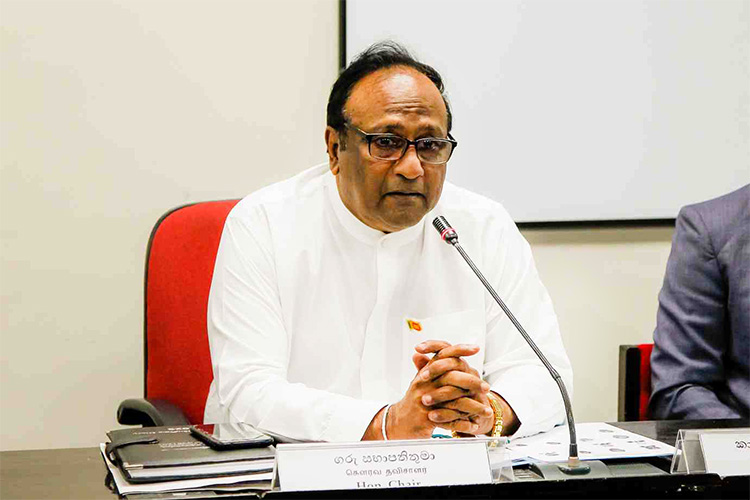
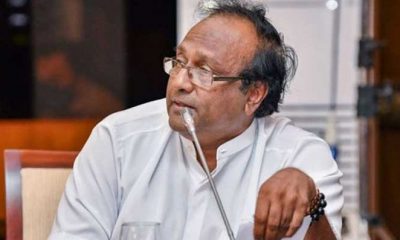
Chair of the Sectoral Oversight Committee on National Security retired Vice Admiral Sarath Weerasekera has said an external mechanism is in place to prepare the ground for a war crimes probe against the Sri Lankan military and those who provided political leadership for the country’s war on terror.
Addressing the last SOC held in the Parliamentary complex, Weerasekera said that a recent report by the external mechanism established in Geneva to collect evidence against military personnel and political leaders falsely accused of war crimes in Sri Lanka stating that there was a significant amount of evidence against them.
Weerasekara has stated that an external mechanism has been established in Geneva to collect evidence related to war crimes against those heroes and political leaders who brought about the most unlikely victory against the LTTE terrorists.
In a report recently published by the said mechanism, it has been stated that they have a significant amount of evidence against the military leaders of this country, he said.
It was further emphasized that several countries are currently working together to file cases in their jurisdictions and international courts under the universal jurisdiction against the military leaders of Sri Lanka who have been found to have committed war crimes. Although this external mechanism has been rejected by the Ministry of Foreign Affairs of Sri Lanka, they are continuously collecting evidence against the military leaders of Sri Lanka and the dangerous situation here is that the military officers of Sri Lanka can be arrested in any country of the world and prosecuted in the International Court of Justice, Weerasekera pointed out.
It was also discussed that this external mechanism has the ability to describe the war in this country as a war against the Tamils and not against the LTTE. It was emphasized that this activity is a threat to the self-esteem of the Sri Lankan war heroes, as well as the national security, and the Ministry of Foreign Affairs should immediately take measures to stop the accusations of war crimes by other countries of the world against the Sri Lankan military personnel and the prosecution of cases in the International Military Tribunals. Here, the Committee asked the Ministry of Foreign Affairs about the strategies they have to reject the external mechanism brought by the Geneva Human Rights Organizations and their readiness to take action against them if they are prosecuted in the International Military Tribunal.
Commenting on this, the Ministry of Foreign Affairs said that the Ministry has taken steps to inform the countries that are acting impartially in this regard by expressing a strong protest against the reports of the Geneva Human Rights Commission.
Attorney-at-Law Darshana Weerasekera, who was called before the Committee to express further comments in this regard, stated that Sri Lanka should have a strong domestic mechanism that can break the external mechanism with evidence. He also said that for this purpose, a strong local data file should be prepared by incorporating the facts of the LLRC report and the Paranagama report.
Chair of the Committee Weerasekera stated that the proposed Commission for Truth, Unity and Reconciliation will further support the external forces that are against this country.
The Anti-Terrorism Bill was also considered in the Committee and the Committee approved all the amendments made by the Attorney General’s Department, as indicated by the Supreme Court.
In addition, it was discussed in the Committee that the term ‘terrorism’ has not been defined to suit this country, and since the terrorist is born as a result of much training, there is no method to catch the terrorist during training, Parliament sources said.






Latest News
Sun directly overhead Neriyakulam, Punewa, Kebithigollewa, Pankulam and Sinhapura at about 12.10 noon today (31)


The sun is going to be directly over the latitudes of Sri Lanka from 28th of August to 07th of September due to its apparent southward relative motion.
The nearest places of Sri Lanka over which the sun is overhead today (31) are Neriyakulam, Punewa, Kebithigollewa, Pankulam and Sinhapura about 12.10 noon.

… highlights injustice caused to Justice R. Gurusinghe
The Bar Association of Sri Lanka (BASL) has alleged that due to the failure on the part of President Anura Kumara Dissanayake to fill the existing vacancies in the Supreme Court, a Senior Justice of the Court of Appeal, Justice Dhammika Ganepola, retired at the age of 63 without being considered for, or granted, a promotion to the Supreme Court, to which he was well entitled. The BASL pointed out at the time of Ganepola’s retirement there were four vacancies in the Supreme Court.
In a letter dated 17 August, 2026, addressed to President Dissanayake, the BASL declared that the failure to promote and recognise Ganepola’s distinguished judicial service, resulting in his retirement at the age of 63, is indeed a loss to the Judiciary.
A top BASL spokesman told The Island yesterday (30) that the Bar Council, over the weekend, had decided to release the hitherto confidential letter.
The official said that they also wanted to remind the President of his assurance given to BASL, on 12 August, 2026, that vacancies in the Supreme Court and Court of Appeal would be filled as soon as possible, within a month.
The following is the text of the BASL letter, signed by Rajeev Amarasuriya, President, BASL, and its Secretary Nalin De Silva: “We write further to our letters dated 29th December 2025 and 30th June 2026 in relation to the above, to which we have not received any response.
We also refer to our meeting with Your Excellency on 12th August. As discussed during the meeting, there have been vacancies in the Supreme Court since May 2025, and the number of vacancies has now increased to four (04). There are also four (04) vacancies in the Court of Appeal. These are all matters we have already written to Your Excellency about.
Your Excellency informed the BASL Delegation when we met that you would be taking steps to make recommendations to fill these vacancies as soon as possible, within a month.
We write to reiterate the importance of giving due consideration to the criteria set out in our aforesaid letter dated 29th December 2025. We also wish to emphasise that, in making judicial appointments and promotions, seniority should be given due priority, in keeping with longstanding practice, until such time there are objective and defensible guidelines governing the assessment of merit.
The only justifiable departure to this criterion would be where there exists a specific and recognized demerit in respect of the particular Judge concerned or such other known compelling circumstances that are objectively identifiable such as where a Judge has previously been overlooked for promotion unfairly or conversely, where a Judge has been unfairly previously granted promotions above others.
This approach will safeguard both the integrity of the Judiciary and the trust reposed in it by the public.
Further, while there has been considerable discussion and representation by the Government regarding the importance of retaining experienced judges, as reminded to Your Excellency at our said meeting that, only a few months ago on 8th May 2026, a Senior Justice of the Court of Appeal, Justice Dhammika Ganepola, retired at the age of 63 without being considered for, or granted, a promotion to the Supreme Court, to which he was well entitled, and in which there were four vacancies at the time.
The failure to promote and recognise his distinguished judicial service, resulting in his retirement at the age of 63, is indeed a loss to the Judiciary.
We also drew Your Excellency’s attention at the said meeting to the fact that the Senior-most Justice of the Court of Appeal, Justice R. Gurusinghe, who joined the Judicial Service in 1996, who also Acted in the Office of President of the Court of Appeal (appointed by Your Excellency) on 11th May 2026, is due to retire at the end of this month. In fact, we learnt through the Media that Her Ladyship then Chief Justice Justice Murdu Fernando, PC, had previously in July 2025 recommended to Your Excellency the promotion of Justice R. Gurusinghe to the Supreme Court, but the same is pending from that time.
He too is well deserving of promotion to the Supreme Court and has already been recommended by the former Chief Justice, and his case must also receive due and urgent consideration before his impending retirement.
We hope that Your Excellency will take due note of and give due regard to the concerns of the Bar, as well as to the established principles, practices and conventions governing judicial appointments, when taking steps to fill these vacancies.
On this, Your Excellency is already open to the accusation that these vacancies have been kept open, to fill with favourites of the Government which is yet another serious indictment on the independence of the judiciary which accusation would be confirmed if recommendations are made outside established practice.
Moreover, the BASL expresses grave concern that withholding promotions of Judicial Officers for extended periods of time places undue pressure on Judicial Officers in the discharge of their duties and constitutes both directly and indirectly, interference with the independence of the Judiciary, in addition to the strain obviously caused to the dispensation of justice in other Courts and the stifling and delay of career progression of Judges legitimately entitled to promotions.
We do hope that Your Excellency would take due note and cognizance of the foregoing when effecting these judicial promotions which have been long overdue and which have already adversely impacted the efficiency and effectiveness of the administration of justice.”
The BASL has copied the letter to Prime Minister Dr. Harini Amarasuriya, Speaker Dr. Jagath Wickremaratne, Opposition Leader Sajith Premadasa and all members of the Constitutional Council.

Opposition Leader Sajith Premadasa on Saturday (29) challenged the government to hold the long-delayed Provincial Council elections, saying the polls would provide an opportunity to gauge the level of public support enjoyed by the administration.
Addressing a farmers’ meeting in Tissamaharama, Hambantota, Premadasa also criticised the latest Rs. 17 per kilogram increase in wheat flour prices, warning that it would push up the prices of bread, bakery products and other flour-based food items and place further pressure on households already struggling with the rising cost of living.
He said Sri Lanka ranked 120th among 130 countries in an international comparison of minimum wages, arguing that wages remained inadequate to meet the escalating cost of living.
Premadasa also questioned official assessments of living standards, asking whether a person could survive for an entire month on Rs. 17,315, a figure he attributed to the Department of Census and Statistics.
He claimed that between 30 and 40 percent of the population was living in poverty and called for a clear programme to help affected families improve their economic conditions.
Turning to the proposed 22nd Amendment to the Constitution, which seeks to increase the retirement age of superior court judges, the Opposition Leader accused the government of attempting to undermine judicial independence and interfere with democratic institutions.
He also criticised the government’s handling of poverty, employment, agriculture, healthcare and investment, saying more effective measures were needed to provide relief to people facing economic hardships.Premadasa called for stronger policies to attract foreign direct investment and urged the government to formulate a national strategy for developing the tourism industry.

Iran attacks US bases in Jordan after US strikes Larak Island

Showers will occur in the Western, North-western and Sabaragamuwa provinces and in Galle, Matara, Kandy and Nuwara-Eliya districts.

Sun directly overhead Neriyakulam, Punewa, Kebithigollewa, Pankulam and Sinhapura at about 12.10 noon today (31)

BASL takes exception to Justice Ganepola being denied a place in SC

Sajith challenges govt. to hold PC polls

Mahendran denies name change allegation

‘Dates have the highest sugar content to fight Coronavirus’

Sunday Island 27 December – Headlines

#SundayIsland 17th December – Headlines

Sunday Island – 28th March

Sunday Island Headlines – 21 March

Sunday Island – 21st February – Headlines
-

 News6 days ago
Missing doctor’s body found in Mahiyanganaya
-
 News6 days ago
Australia declines to release Finance Secy Suriyapperuma’s citizenship details
-
 News6 days ago
22A: BASL suggests CJ recuse himself from hearing petitions
-

 News3 days ago
Eight politicians in drug kingpin probe
-

 Features1 day ago
“Wrap Me Up in My Blazer”— A Gentlemanly Bradby Reminiscence
-

 Business3 days ago
Sri Lanka opens up: A new season of direct connectivity
-

 Features3 days ago
Redefining ageing in Sri Lanka
-
 Features5 days ago
Insights from Chieftains of Uva: Genealogy of two Kandyan Families – Part II