
News
WNPS files Supreme Court challenge against wind power project in Mannar Island


In a significant move aimed at protecting the unique ecosystem of Mannar Island, environmental protection organization, Wildlife and Nature Protection Society (WNPS), has filed a fundamental rights application in the Supreme Court. This legal action challenges the recent cabinet decision to award a wind power project in Mannar Island to Adani Green Energy Limited of India.
The Petitioner WNPS is represented by President’s Counsel Sanjeeva Jayawardana with Prashanthi Mahindarathe, Revan Weerasinghe and Rukshan Senadheera, instructed by S.W.A Amila Kumara.
WNPS, known for its staunch advocacy for environmental conservation, argues that the project poses a severe threat to the island’s unique biodiversity and pristine landscapes especially in the Mannar Island. The island itself is home to several protected areas such as the Adam’s Bridge National Park, the Viduthalaithivu National Park and the Vankalai Sanctuary.
The former two were declared RAMSAR wetlands only a few months ago by Minister Pavithra Wanniarachchi. In addition, Mannar is the southernmost point of the Central Asian Flyway used by innumerable migratory species, while also being home to several indigenous water bird and bat species.
WNPS contends that the decision to approve the project was made without any appreciation of Mannar’s singular positioning as a biodiversity hub, violating both national environmental protection laws as well as international Conventions. The island’s diverse ecosystems, including mangroves, coral reefs, and wetlands, play a crucial role in maintaining the region’s environmental balance. The organization states that a severe threat exists that the construction and operation of the wind power project could lead to irreversible damage to these ecosystems.
The Petitioner contends that the manner and form of these actions by various authorities grossly abuse the doctrine of public trust reposed in authorities like the Forest Department and Department of Wildlife that have blithely ignored the irreparable ramifications of this project in a protected area replete with vulnerable species and war affected population struggling to survive.
The proposed Adani project will potentially raise the number of turbines on Mannar Island to 82, supplementing the 30 turbines existing as part of the Thambapawani project which has already caused staggering numbers of bird deaths, more than anticipated by the ornithologists consulted on the project. If allowed to continue unabated the extension to the Adani project – titled Phase III – will pockmark Mannar island with 103 turbines across nearly 66% of Mannar’s land mass which has been declared Energy Development Areas.
As one of the oldest conservation organizations in the world, the WNPS challenges the credibility of the Environmental Impact Assessment carried out by the Sustainable Energy Authority of Sri Lanka [SEASL] on behalf of Adani Green Energy. In fact, at page xxi of the Environmental Impact Assessment, it has categorically been admitted that “in the case of Thambapawani Wind Power Project, higher bird collision risks than predicted have occurred, as there are reported bird collision in the transmission lines”.
WNPS argues that this alone should act as a deterrent to proceed with this Project in Mannar, which contradicts the principles of sustainable development. While recognizing the need for renewable energy sources, the organization insists that such projects must be planned and executed in a manner that safeguards environmental integrity. This is particularly so when the EIA itself has identified alternative locations that are more suitable to set up a wind power farm and provides no rationale for how Mannar – the most vulnerable site – was chosen.
The Petitioner highlights a conflict of interest between SLSEA’s role as regulator and their purported role as agent for the Adani group. Given that SLSEA also functions as a regulator, this dual role is inappropriate and raises concerns about the integrity of SLSEA’s actions. The Petitioner deems it shocking that a regulatory body is acting as a project proponent, suggesting that SLSEA’s actions are motivated by extraneous considerations and self-interest.
Under Section 16 of the Sri Lanka Sustainable Energy Act No. 35 of 2007, no entity can undertake an on-grid renewable energy project without a permit from SLSEA. Section 17 grants SLSEA’s project approving committee the authority to issue provisional approvals, and Section 18 mandates this committee to approve or reject final project applications. Thus, SLSEA is the primary licensing authority, making its role as an agent for Adani Green Energy in seeking an EIA particularly inappropriate and illegal.
The Petitioner is also concerned with the SEASL’s line Minister tabling power purchase prices in Parliament far in excess of those assessed in the EIA and entirely disproportionate with regional prices by the same supplier. The Petitioner is concerned that the Minister of Power and Energy Energy intends to approve the project despite lacking the statutory authority to act as the Project Approving Authority, which should be SLSEA.
The EIA estimates the cost of power generation at USD 0.046 per kWh, while the Minister stated it would be USD 0.0885 per kWh. The Petitioner finds the discrepancy alarming, as the contract negotiations are based on a price nearly double the EIA estimate. Despite a later revision to USD 0.0826 per kWh, no valid reasons were provided for this increase. The Petitioner asserts that the project cannot be approved with such escalated costs without overhauling the EIA to reflect the actual cost of power generation.
Finally, the Technical Evaluation Committee recommended a tariff of USD 0.075 per kWh, yet the Cabinet approved a higher cost without explanation, violating procurement procedures. The Petitioner requests the court to call for the recommendations or reports made by the Technical Evaluation Committee and the Cabinet Appointed Negotiation Committee under Article 126 of the Constitution.
The Petitioner notes the project has been portrayed to the public as a Government-to-Government initiative with India, yet no details of contributions, grants, or loans from the Indian government have been disclosed.
Additionally, the project lacks a competitive bidding process, and the Swiss Challenge method has not been followed, violating procurement guidelines. Given the project’s proximity to protected areas, it required assessments and approvals from the Department of Wildlife Conservation (DWC) and the Coast Conservation Department (CCD), which were omitted, rendering the EIA void and unlawful.
WNPS’s legal challenge seeks to ensure that the government adheres to the principles of environmental justice and accountability while supporting the Governments push towards renewable energy. The organization calls for a thorough review of the decision-making process, emphasizing the need for transparency, scientific rigour, and public participation.
As the nation awaits the Supreme Court’s response, the outcome of this case will be closely watched by environmentalists, policymakers, and the general public on whom the tariff burden will eventually rest. The decision will not only impact the future of Mannar Island but also shape the broader landscape of environmental governance in Sri Lanka.








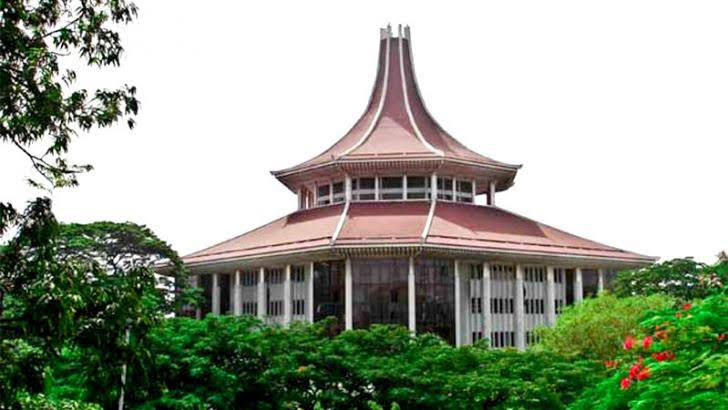
Attorney-at-Law Sugandhika Fernando, on behalf of the Vinivida Foundation, petitioned the Supreme Court yesterday (02), seeking a full bench, excluding Chief Justice Preethi Padman Surasena, to hear the petitions challenging the 22nd Amendment Bill. She also requested that the hearing be suspended immediately until the matter was fully heard and determined.
Among the respondents are Chief Justice Surasena, the first respondent, and Attorney General Parinda Ranasinghe. Justices Yasantha Kodagoda, Shiran Gooneratne, Achala Wengappuli and Priyantha Fernando have also been named as respondents.
The petitioner has sought to have quashed the decision of the first respondent to appoint a five-member bench, which she alleged was made in violation of the norms of public law. She also sought a bench comprising all Supreme Court judges, excluding those cited as respondents, to hear the special determination applications on the 22nd Amendment.
The petitioner further contended that Chief Justice Surasena, who is due to retire on December 1, 2026, would be the main beneficiary of the 22nd Amendment.
The hearing of the petitions continued for a second day yesterday (02) before a five-member Supreme Court bench comprising Chief Justice Preethi Padman Surasena and Justices Achala Wengappuli, Arjuna Obeyesekere, Sampath Abeykoon and Gihan Kulatunga.
The hearing, which commenced on Tuesday morning, continued for nearly 12 hours, until 10:30 p.m.
Solicitor General Viraj Dayaratne, appearing for the Attorney General, submitted yesterday that the Government had presented the 22nd Amendment Bill to the Constitution and the Judicature (Amendment) Bill with the objective of expanding and streamlining the country’s judicial system.
After the Solicitor General’s submissions concluded, counsel representing the petitioners requested an opportunity to respond to the Solicitor General and the intervening petitioners. However, the Chief Justice declined to allow the petitioners’ counsel to make further oral submissions, concluded the determination hearing and directed them to file written submissions instead.
Sri Lanka has formally requested assistance from the North Atlantic Treaty Organisation (NATO).
According to a press release issued by the Defence Ministry, Defence Secretary Air Vice Marshal (retd) Sampath Thuyakontha has discussed defence cooperation with NATO, with discussions focusing on military modernisation, advanced technology, cyber capabilities and disaster response.
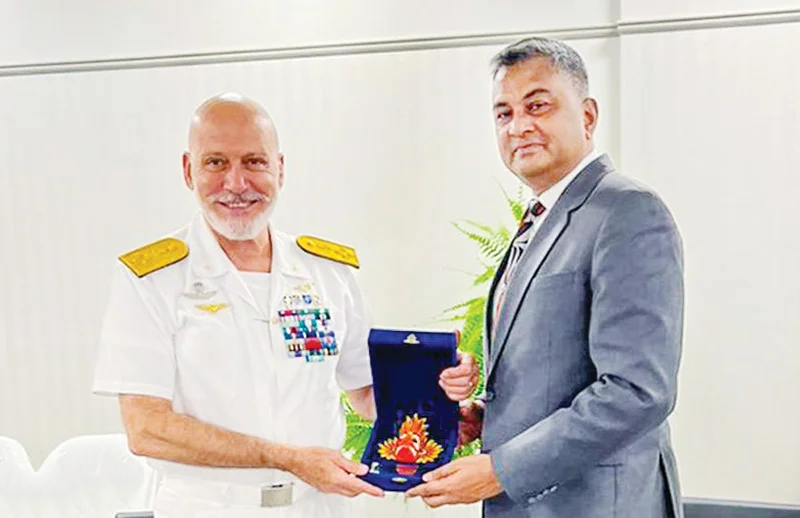
This was during talks between AVM Thuyakontha and NATO Military Committee Chairman Admiral Giuseppe Cavo Dragone on the sidelines of the Chiefs of Defence Conference in Victoria, Canada.
During the meeting, Secretary Thuyacontha outlined Sri Lanka’s defence requirements and areas of interest, including the modernisation of military hardware, acquisition of advanced technologies, and strengthening cyber capabilities and surveillance platforms, the Ministry of Defence said in a statement.
The two sides also discussed opportunities for greater technical cooperation, including the exchange of military personnel, expanded education and training programmes, and increased sharing of expertise and information.
Humanitarian Assistance and Disaster Relief (HADR) was also identified as an area for potential cooperation. The discussions included the exchange of expertise and the effective use of unmanned aerial vehicles (UAVs) in disaster response and related operations.
Defence Secretary Thuyacontha invited NATO to further strengthen its engagement with Sri Lanka, emphasising sustained dialogue, information sharing and practical cooperation in areas of mutual interest.
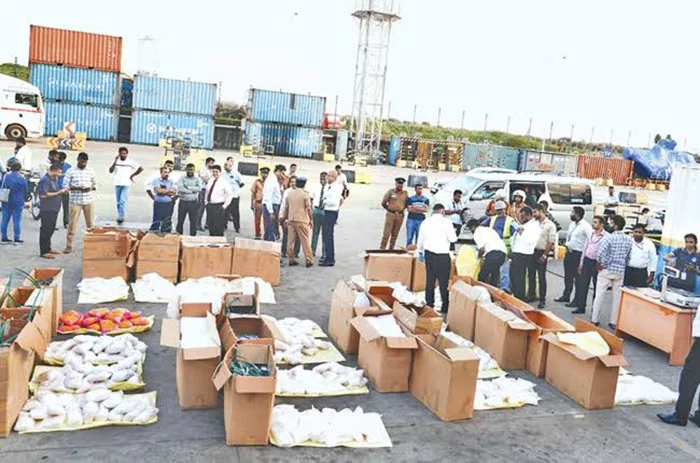
The US Embassy in Colombo yesterday (02) said the recent detection of 463 kg of Crystal Methamphetamine at the Colombo Port had been made possible by intelligence provided by the US. It noted that the detected narcotics were to be moved to international markets, via Colombo.
The text of the US Embassy statement: “The U.S. Drug Enforcement Administration’s (DEA) New Delhi Country Office and Sri Lanka’s Police Narcotics Bureau (PNB) conducted a successful joint operation disrupting a Pakistan-based narcotrafficking network attempting to smuggle crystal methamphetamine through Sri Lanka to international markets.
Acting on intelligence developed by DEA’s Foreign Counterparts Unit Pakistan Anti-Narcotics Force Special Investigations Cell between August 14–29 on suspicious maritime containers moving from Pakistan to Colombo, PNB seized approximately 463 kg of crystal methamphetamine—valued at $21 million—concealed in bath towels, and arrested several suspects, including Pakistani nationals. This operation underscores the strength of the U.S.-Sri Lanka partnership in dismantling transnational criminal organizations that fund terrorism and threaten communities in both our countries.
This cooperation builds on longstanding training and technical assistance provided through the U.S. Department of State’s Bureau of International Narcotics and Law Enforcement Affairs (INL) to the Sri Lanka Police and Customs. The United States remains committed to working with Sri Lanka and regional partners to aggressively pursue transnational criminal organizations, deny them the revenue from illicit drug trafficking, and protect our citizens from the dangers of narcotrafficking.”

22A: SC urged to suspend hearing, appoint full bench

Govt. seeks NATO assistance

Recent ‘Ice’ detection at the Colombo Port made on US intelligence – Embassy

Sri Lanka launches National Food Safety Policy with support from FAO and EU

Mendis, Nissanka return for England white ball series

Janashakthi Life delivers 36% revenue growth, ‘outperforming the industry’

‘Dates have the highest sugar content to fight Coronavirus’

Sunday Island 27 December – Headlines

#SundayIsland 17th December – Headlines

Sunday Island – 28th March

Sunday Island Headlines – 21 March

Sunday Island – 21st February – Headlines
-

 News6 days ago
Eight politicians in drug kingpin probe
-

 Features4 days ago
“Wrap Me Up in My Blazer”— A Gentlemanly Bradby Reminiscence
-

 Business6 days ago
Sri Lanka opens up: A new season of direct connectivity
-

 Features3 days ago
When Sri Lankan stories find their own voice
-
 Latest News7 days ago
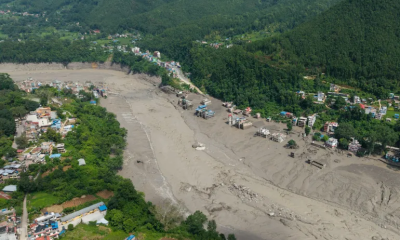
Nepal-Tibet floods: What happened, what caused them and who is missing?
-

 Features6 days ago
Redefining ageing in Sri Lanka
-

 Editorial6 days ago
The toxic legacy of two lakes
-
 Business6 days ago
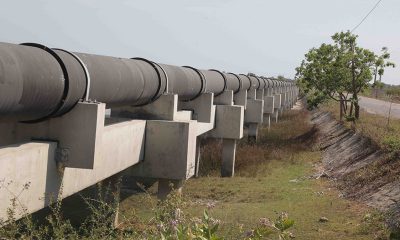
Jaffna Teaching Hospital secures lifeline water supply via ADB-funded Thalaiyadi sea water desalination plant